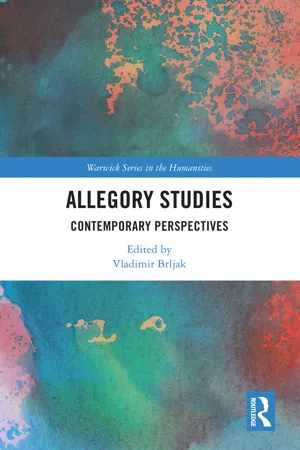
Allegory Studies: Contemporary Perspectives collects some of the most compelling current work in allegory studies, by an international team of researchers in a range of disciplines and specializations in the humanities and cognitive sciences. The volume tracks the subject across disciplinary, cultural, and period-based divides, from its shadowy origins to its uncertain future, and from the rich variety of its cultural and artistic manifestations to its deep cognitive roots. Allegory is everything we already know it to be: a mode of literary and artistic composition, and a religious as well as secular interpretive practice. As this volume attests, however, it is much more than that—much more than a sum of its parts. Collectively, the phenomena we now subsume under this term comprise a dynamic cultural force which has left a deep imprint on our history, whose full impact we are only beginning to comprehend, and which therefore demands precisely such dedicated cross-disciplinary examination as this book seeks to provide.
- 320 pages
- English
- ePUB (mobile friendly)
- Available on iOS & Android
eBook - ePub
About this book
Information
1 Invoking the Other
Allegory in Theory, from Demetrius to de Man
Michael Silk
What is it about allegory that so attracts the theoretical gaze, in recent times in particular? The history of the word “allegory” and its cognates in other languages shows that allegory has been debated and contested in all periods, from Greco-Roman antiquity onwards. The history of the word is fraught with complications, the specifics of which illuminate a welter of confusing or confused commentary on texts and contexts old and new: witness the case of personification-allegory. Any attempt to come to terms with, or critique, contemporary theoretical usages calls for an informed understanding of this history.
What is allegory? These days, the word is conventionally associated with texts like Orwell’s Animal Farm and Bunyan’s Pilgrim’s Progress, with Renaissance emblems and paintings like Tintoretto’s Origin of the Milky Way—where Jupiter holds the baby Hercules to the breasts of the sleeping Juno, from which milk spurts upwards to form the Milky Way and downwards in the form of lilies. Across a range of recent theory, however, allegory is understood more open-endedly, in close relation to a range of recent theoretical preoccupations.1 Conventional understanding also distinguishes allegory (as in a text) and allegoresis (as applied by reader or interpreter to a text). Much recent theory challenges that distinction, among much else.
1 Preliminary versions of this chapter were delivered as papers at the Warburg Institute’s Rethinking Allegory colloquium, the Comparative Literature Research Seminar at King’s College London, the Redefining Allegory conference at Queen Mary University of London and the Classical Reception Research Seminar in Cambridge. My thanks to participants at all these events for helpful comments, as also to Patrick Boyde for advice on some of the Italian material and to Nicolette Zeeman for productive conversation about personification-allegory. [Editorial note. The author’s procedure in this chapter is to provide his own translations of passages from non-English works and, wherever possible, to cite original sources without reference to particular editions. For the reader’s convenience, and by agreement with the author, suggested editions or translations are listed in square brackets in the notes and/or added in the bibliography, excluding titles easily consulted in the Loeb Classical Library. Here and throughout this chapter, items in square brackets are editorial additions.] With many of the conventionally identified instances liable to attract the dismissive phrase “naive allegory”; the first to use the phrase seems to have been Frye, Anatomy of Criticism (Princeton, 1957), 90.
In this chapter, my concern is not specifically with allegory in practice or allegoresis in practice, but with understandings of allegory: allegory in theory. And one question particularly exercises me: what is it about allegory that so attracts the theoretical gaze, in recent times in particular? In confronting this question, I shall focus on the uses of the word allegory, its cognates in other Western languages and their history, all the way back to the Greek, and then Latin, allegoria, which is their common source. I am not concerned to argue that a universal definition of allegory is possible. Nietzsche said, “Only that which has no history can be defined”2—and the word allegory certainly has a history.
2 Zur Genealogie der Moral (1887), 2.13.
Not so long ago, allegory was routinely despised. This is from an early essay by the poet Yeats:
the other day … I sat for my portrait to a German symbolist, whose talk was all of his love for symbolism and his hatred for allegory … . The German insisted that symbolism said things which could not be said so perfectly in any other way, and needed but a right instinct for its understanding, while allegory said things which could be said as well, or better, in another way, and needed a right knowledge for its understanding.
Yeats, commending the argument, goes on to contrast Michelangelo’s Moses, as a specimen of symbolic art, with Tintoretto’s Origin of the Milky Way, which (in Yeats’s words) is “allegory without any symbolism” and “apart from its fine painting” is “but a moment’s amusement for our fancy.”3
3 “Symbolism in Painting” (1898). The “German symbolist,” seemingly, was Oscar Wilde’s friend, Paul Hermann. [“Symbolism in Painting,” in Essays and Introductions (London, 1961), 146–8.]
What Yeats is offering here is a version of the Romantic take on allegory. Contrast this, from our contemporary, the performance and theatre scholar Lynette Hunter:
Allegory … is uniquely suited to engage with the locations of partial knowledge that have resulted from concepts of différance in aesthetics coming together with the new political realities of an enfranchised population. The contradictions of allegory generate and carry the enigmatic experience of partial knowledge, in which we honestly recognize that others are radically different from our selves … . 4
4 “Allegory Happens,” in The Cambridge Companion to Allegory, ed. Copeland and Struck (Cambridge, 2010), 273.
The word has been reclaimed (with seeming implications for our assumptions about “knowledge”). But why is it this word that is thus reclaimed, and how has it acquired these new dimensions? In rehearsing the history of the word, I shall scrutinise some much-discussed, and some less-discussed, moments in the history of ideas, but I shall also linger on loose ends (as well as misleading claims), which rarely get the attention they deserve.5
5 Misleading alternations between the word allegory and one or other version of “the idea” of allegory are particularly common in modern essays on the allegorical in past periods.
The word allegoria is a coinage in ancient Greek (allēgoría), and a reasonably transparent coinage: “saying something other” (állo agoreúōn) or “saying” it “otherwise” (állōs). We have no means of knowing when precisely the word was coined or by whom, though we can point to the likely context. Commentators often tell us that Plutarch (late first century AD) calls it “a new term,”6 displacing hupónoia (“hint” or “hidden meaning”). But all Plutarch actually says is that “what are now called allēgoríai [plural] used to be called hupónoiai [plural],”7 which tells us nothing about the time-span in question or about the degree of synonymity. It might be like saying, “what’s now called tuberculosis used to be called consumption” (which it was, a century and a half ago), or even like saying, “what are now called genes used to be called blood” (“blood will out,” “it’s in the blood,” “bad blood”). I suggest that Plutarch’s is a loose equation, not unlike the equation of genes and blood—because blood carries none of the technical implications of genes, and carries other implications instead. The Greek allēgoría is a technical term in rhetorical theory and, specifically, carries associations with the rhetoricians’ favourite trope, metaphor: the Greek hupónoia (which often means “guess” or “suspicion”) is and has neither.
6 So e.g., Cambridge Companion, ed. Copeland and Struck, 2, following Struck, Birth of the Symbol (Princeton, 2004), 145.
7 Moralia, 19e (“How a Young Man should Study Poetry”): taîs pálai mèn huponoíais, allēgoríais dè nûn legoménais.
The earliest attestations of the word allēgoría are in the rhetorical theorising of the Hellenistic period, in Demetrius’ essay On Style (probably second century BC), where (indeed like hupónoia) it means “hidden meaning,” as in a riddle (aínigma), but not so obscure as in a riddle:
Allēgoría [in oratorical practice] makes an impression, especially in threats … . Anything with a hidden meaning [tò huponooúmenon] is more disconcerting [than something “clear and plain”]: different people interpret it in different ways … . This is why the mysteries use allegorical expressions, to inspire shock and awe, as in darkness and night. And allēgoría does indeed resemble darkness and night. But … one does have to avoid a sequence of allegories, or else our words turn into a riddle.8
8On Style (Perì Hermēneías), 99–102 (cf. ibid., 151, 282). The adverb “allegorically” (allēgorikôs) crops up in a fragment of the philosopher Cleanthes (third century BC), but hardly in a verbatim quotation: Stoicorum veterum fragmenta, ed. von Arnim (Leipzig, 1903–24), fr. 526.
Modern scholarship refers collectively to “the allegorists” in antiquity, meaning not rhetoricians like Demetrius, but mostly mystical or philosophical interpreters of myth, especially those of later centuries like the Neoplatonist Proclus (fifth century AD): interpreters who famously identify hidden meanings in Homer, as in the battles of the gods in the Iliad.9 However, the word allēgoría is not associated with most of these sources. If they attach a label to the hidden meanings, the usual label is súmbolon (“symbol”) or indeed hupónoia, as already in Plato (Homeric stories, like the battles of the gods, “we must not admit into the city, whether composed with hupónoiai [plural] or without”).10 The first notable uses of allēgoría in this connection are by the scholar Heraclitus (second century AD?) in his essay on “Problems in Homer.” This Heraclitus reads Homer’s Athena as “perfect wisdom” and Homer’s Odysseus as “a sort of instrument of every virtue,” while “in the battle of the gods, [Apollo] takes a stand against Poseidon, because between fire and water there is always irreconcilable enmity.”11 And Heraclitus draws attention to the key word: “the name allēgoría … is self-explanatory: the trope [trópos: deviant word-usage] that says one thing but signifies something other than what it says is called allēgoría on this basis.”12
9 Iliad, 20–...
Table of contents
- Cover
- Half-Title
- Series
- Title
- Copyright
- Contents
- List of contributors
- Acknowledgments
- Introduction: Allegory Past and Present
- 1 Invoking the Other: Allegory in Theory, from Demetrius to de Man
- 2 The Failures of Allegory and the Allegory of Failure: Dislocation, Time and Subjectivity, c. 1230–1600
- 3 Painted Allegory’s Fortunes in Seventeenth-Century Antwerp
- 4 Stoics, Origen, Bacon: On the Interconnections of Physics and Allegory
- 5 Allegory, Ambiguity, Accommodation
- 6 “[C]onsigned to a Florida for tropes”: Theorizing Enlightenment Allegory
- 7 Late Modernist Allegory and the Psychedelic Experience
- 8 Allegory and the Work of Aboriginal Dreaming/Law/Lore
- 9 Allegory and Bodily Imagination
- Afterword: The Future of Allegory
- Bibliography
- Index
Trusted by 375,005 students
Access to over 1.5 million titles for a fair monthly price.
Study more efficiently using our study tools.
Frequently asked questions
Yes, you can cancel anytime from the Subscription tab in your account settings on the Perlego website. Your subscription will stay active until the end of your current billing period. Learn how to cancel your subscription
No, books cannot be downloaded as external files, such as PDFs, for use outside of Perlego. However, you can download books within the Perlego app for offline reading on mobile or tablet. Learn how to download books offline
Perlego offers two plans: Essential and Complete
- Essential is ideal for learners and professionals who enjoy exploring a wide range of subjects. Access the Essential Library with 800,000+ trusted titles and best-sellers across business, personal growth, and the humanities. Includes unlimited reading time and Standard Read Aloud voice.
- Complete: Perfect for advanced learners and researchers needing full, unrestricted access. Unlock 1.5M+ books across hundreds of subjects, including academic and specialized titles. The Complete Plan also includes advanced features like Premium Read Aloud and Research Assistant.
We are an online textbook subscription service, where you can get access to an entire online library for less than the price of a single book per month. With over 1.5 million books across 990+ topics, we’ve got you covered! Learn about our mission
Look out for the read-aloud symbol on your next book to see if you can listen to it. The read-aloud tool reads text aloud for you, highlighting the text as it is being read. You can pause it, speed it up and slow it down. Learn more about Read Aloud
Yes! You can use the Perlego app on both iOS and Android devices to read anytime, anywhere — even offline. Perfect for commutes or when you’re on the go.
Please note we cannot support devices running on iOS 13 and Android 7 or earlier. Learn more about using the app
Please note we cannot support devices running on iOS 13 and Android 7 or earlier. Learn more about using the app
Yes, you can access Allegory Studies by Vladimir Brljak in PDF and/or ePUB format, as well as other popular books in Literature & Literary Criticism. We have over 1.5 million books available in our catalogue for you to explore.