eBook - ePub
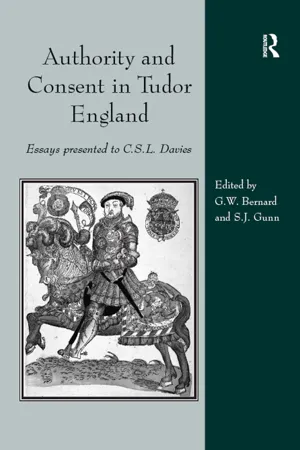
Authority and Consent in Tudor England
Essays Presented to C.S.L. Davies
- 320 pages
- English
- ePUB (mobile friendly)
- Available on iOS & Android
eBook - ePub
About this book
Brought together as a tribute to the distinguished Tudor historian C.S.L. Davies, the essays in this collection address key themes in the current historiography of the Tudor period. These include the nature, causes and consequences of change in English government, society and religion, the relationship of centre, localities and peripheral areas in the Tudor state, the regulation of belief and conduct, and the dynamics of England's relations with her neighbours. The contributors, colleagues and students of Cliff Davies, are all leading scholars who have provided fresh and interesting essays reflecting the wide ranging inquisitiveness characteristic of his own work. They seek to cross as he has done the traditional boundaries between the medieval and early modern periods and between social, political and religious history. A coherent collection in their own right, these essays, by showing the many new directions open to those studying the Tudor period, provide a fitting tribute to such an influential scholar.
Chapter 1
Cliff Davies at Wadham
Jane Garnett and Pat Thompson
Mixed fortunes for distinguished early modern historian Cliff Davies of Wadham College, Oxford. After seeing his daughter Liz on the receiving end of a vicious press campaign following her selection earlier this month as prospective Labour candidate for the marginal seat of Leeds North East he had happier news last week when one of the competing versions of the Norrington table revealed that finalists from his college had the best history results in Oxford.
A clip from the Times Higher Education Supplement for 21 July 1995 is proudly pinned up on the board outside Cliff’s college room – until recently accompanied by a later profile of Liz: ‘Why this is the face that frightens Blair’. Alongside is a jokey newspaper cutting on tutorials (how to put the wind up your tutors), a fading cartoon of Nick and Dot, Wadham’s founders, drawn in the early 1990s for the irreverent end-of-term rag Wadwords by a History student, Shaun Pye, and a photograph of the Hammersmith Socialist League in 1885. They present a revealing juxtaposition, expressing Cliff’s very distinctive combination of qualities: absolute devotion to his family, unfailing pride in and loyalty to his students and to the college, passionate radicalism and a refusal to take himself too seriously. Since Cliff is not a man to wear his heart on his sleeve, such sideways approaches to what he cares about are important. For someone visiting his room for the first time, they are the first indicators of a personality. Once inside his room, other images elaborate the picture: the panoramic view over the college which he commands; the endearingly uncomfortable 1960s furniture; bookshelves lined with all the major historical journals, the latest numbers of others always lying on his table to be consulted before they go to the library; tucked between the spines of books or propped up against them, cards mostly from former students; a drawing of Maurice Bowra hanging under the Earl of Rochester; next to a teetering pile of Cliff’s students’ doctoral theses, former Wadham History fellow Reggie Lennard framed by Erasmus and the Tudor ship Henry Grâce à Dieu.
Cliff grew up in Hammersmith, in a family which was part of the Welsh diaspora in the twentieth century. He went to St Paul’s School, and was strongly recommended for admission to Wadham by a renowned and formidable schoolmaster, Philip Whitting. He was duly elected the senior History scholar in his year. In 1956, after doing his national service with the East Surreys (and learning German in the process), he came up to Wadham. Cliff’s undergraduate years coincided with a diversely talented, dramatically extrovert and somewhat raffish generation in college. His own style was quiet and scholarly, and most of his friends were serious-minded intellectuals; but he also enjoyed the company of some of his more exotic contemporaries. His tutors, Lawrence Stone and Pat Thompson, anticipated that with growing confidence Cliff too would acquire a touch of flamboyance. They were right: Cliff’s charisma comes both from seriousness and strength of principle, often explosively expressed and defended, and from his attraction towards people who are in many ways unlike himself. He has always had a sympathy with theatrical undergraduates and with any student who pursues a genuine enthusiasm with panache. Soon after taking an excellent First in Schools, Cliff spent a happy year as a lecturer at Pembroke before moving on to Glasgow, where he taught modern economic and social history. He has always retained a breadth of historical outlook and interest well beyond the late medieval and early modern period in which he has specialized. This he has shared with Kathleen, herself an accomplished historian and committed teacher; they have always read and debated, walked and travelled widely together. Cliff and Kathleen met as second-year undergraduates in 1958, and married in 1962. In 1963 Lawrence Stone left for Princeton and Cliff was elected as his successor at Wadham. Meanwhile he had completed his D.Phil. thesis, on the problems of supply to the Tudor army and navy, which he characteristically proceeded to ignore, regarding it as a mere rite of passage, not to be drawn attention to.
It cannot have been easy for Cliff to return to the college where he had been an undergraduate, to become the colleague of his former tutor. But he immediately threw himself into the job, taking enormous trouble over his teaching, as he was always to do, challenging his pupils and caring for them as individuals. Cliff has always liked people who stand up for themselves, who answer back – ‘cheeky chaps’ as he used to call them. But he has always also had a great deal of time for those less self-assured, for those who are shy and nervous as he was himself when he first arrived as an undergraduate. He cares passionately about teaching in a tutorial system, and has retained a drive to explain to students what it is about, and to help them to benefit from it. He sets before students the ideal of critical reading, of keeping up a running dialogue with themselves as they read; of organizing their time so that they can act or play rugby to a high level as well as committing themselves to History; of learning to look at problems from unexpected angles and to ask awkward questions; of constantly confronting their tutors – of being ‘bloody-minded’. It is rare that a tutor keeps up such a level of enthusiastic engagement with teaching over a whole career; yet this is what Cliff has done, repeatedly trying to think of new ways of stirring people up. Most fundamentally, he has always treated students as fellow-participants in the process of historical research, sharing with them his own projects and ideas, his scruples about evidence and his questions about interpretations. At a student-organized college conference on ethics, Cliff spoke movingly about the historian’s responsibility to the past.
Cliff’s radicalism has been a constant, whilst it has taken different forms. He revelled in the atmosphere of the 1970s and early 1980s when a desire for change was making itself felt around the university. In particular, he was a staunch supporter of the advent of women to Wadham, and was later to give the warmest of welcomes to a female colleague. Living in a family of strong women, he has always had high expectations of his women students, and has indeed sometimes (more than they have often realized) wanted them to be more combative than they have been inclined to be themselves. He has been unusually sensitive to the subtle ways in which men can patronize women, and was sufficiently enraged to walk out in protest from a college dinner at which an important old member was giving a tasteless after-dinner speech. In the 1980s Cliff developed a political sympathy with Mrs Thatcher, a position which surprised some of his colleagues and made for lively debates in college classes. In some respects it represented for Cliff, the son of a shopkeeper, a social affinity; he deplored the snobbery which he felt lay behind many attitudes to her. Cliff has absolutely no time for bien pensant middle-class left/liberal intellectuals, and likes New Labour as little as his daughter does. Whilst not sharing her politics, it is entirely consistent of him to wish that the Labour Party still had a place for people like her. There has been a real integrity and honesty about his political thinking which has mirrored his approach to history, and his challenge to his students to have the courage of their convictions and never simply to go along with modish trends.
Cliff’s commitment to the college has been total. He has held the major college offices of Senior Tutor and Sub-Warden, as well as being a long-standing Keeper of the Archives (a post which he will retain in retirement). On committees he is always sane, and takes up positions of principle without banging predictable drums: his voice is thereby the more effective. The job which he has perhaps enjoyed most, and has done twice, is that of Tutor for Graduates. He has campaigned tirelessly for a better deal for graduate students (both in the college and in the History Faculty, where he also acted as Director of Graduate Studies). He has been imaginative in thinking of ways in which their facilities could be improved, and, most of all, has been concerned to ensure that college supervision works as well as it can. He has worked hard to get to know each graduate student personally. Almost every Friday evening in term, he has taken graduate students in to dinner as his guests, and has hugely enjoyed talking to them about their research projects and encouraging them to feel part of a wider academic community.
Cliff has been the most supportive and loyal of colleagues. Often working behind the scenes, nearly always preferring to communicate anything really serious by a note on paper rather than in conversation, he has always been touchingly concerned. He has been the ideal person with whom to have the occasional difference of opinion: he is always straight, considers the alternative view carefully, and accepts or rejects points without fuss. Almost never does he later remember which position he took, so there are no lingering resentments. A great deflator of pomposity, Cliff has worn his own authority lightly, and has never stood on ceremony. As Keeper of the Archives, and reformer of the college Gazette, he has encouraged current students and old members to contribute ephemeral material which conveys something of the variety of everyday student life or to write about their personal experiences. Thanks to his energies, future historians of the college will be less reliant on bursary records and endless photographs of the 1st Eight. The official story of Cliff’s commitment to the life of the college may be told through committee minutes. More evocative will be a photograph of him a couple of years ago dancing round the mulberry tree hand in hand with Jane’s daughter and a group of first-year students, before going off to join the graduates’ summer party.
Chapter 2
Cliff Davies the Tutor
Philip Waller, John Robertson and Martin Conway
Going up to Wadham in 1964, I was among Cliff’s first intake, though I was then unaware of this. A little scene-setting will explain. It was a transient trainee teacher who had recommended Wadham (and put Balliol eighth of your eight choices, he added, suspecting there was a Hill too high). The school’s regular teachers could not distinguish Oxford’s colleges; even the trainee ventured no more than that Wadham was good for History and inclined to recruit from outside the public schools. He did not identify its tutors as Pat Thompson and Cliff Davies and, had he done so, it would have signified nothing. In those days, the entrance examination was in two stages, the first papers taken in one’s own school. That passed, candidates were invited to Oxford to sit further papers. Latin and another language were still compulsory, and it was considered smart to suggest learning beyond the A-level syllabus, which in my case was the nineteenth century. Hence I went to the public library to introduce myself to Charles I. I met instead C.V. Wedgwood and an amount of romantic rubbish, which impressed me no end and equipped me with a fourth question. The General Paper was another matter, altogether alarming because the northern way was to stick to the concrete and shun dialectics (a word unknown in Pennine parts). I remember attempting a question on education and in a mad moment banging on about Emile. I had not read it, of course, but I had a dim recollection of its being mentioned once in a scripture class. As for Rousseau himself, he might as well have been Demis Roussos, the fat man in a caftan the size of a marquee who sang like a eunuch. My essay was pure fiction. There followed the interview. This took place in Pat Thompson’s room; Cliff was there, as also was Warden Bowra who released stentorian snorts occasionally, otherwise brooded impassively like Buddha. Cliff conspicuously writhed. It was he who addressed the inescapable question about my fantastic Jean Jacques. The memory still causes burning sensations but also gratitude for Cliff’s manner: a demonstration of how to administer a scholarly check with personal charity. He left me with the conviction that I knew nothing about history (which was true), yet one day might learn something (which may be true).
Between acceptance and matriculation passed half a year in which acquaintance must be established with Bede, Gibbon and Macaulay, and Tocqueville, totempoles of the one-term Prelim, to be examined in December. Wadham confronted its freshmen with a Collection on these texts in noughth week. Again, therefore, Cliff was drenched in his pupil’s nonsense; but this time he could retaliate with marginalia, pithy questions inscribed in that idiosyncratic script whose near-illegibility resembles a medical prescription. The tutorials that ensued over the next three years constituted an induction into scholarly techniques and values which carry lasting impression, though it was well understood that the pre-modern age was not for me. Cliff covered a tremendous range. As well as for Gibbon and Macaulay, I attended on him for English History I (beginnings to 1330) and II (1330–1685), for some portion of Political Thought and for the Further Subject, Tudor and Stuart Economic Documents (Bland, Power and Tawney). His room was then above the King’s Arms, approached by a linoleum-lined maze of staircases and corridors, and its interior decoration seemed colourless, the equipment spartan. There was no frugality about the tutorial fare, which was rich in intellectual and individual curiosity. It is difficult now to recall the poverty of much historical literature that then did service on so many topics of medieval and early modern history, but Cliff, with his critical vigilance, schooled pupils in dissent and tended any emerging shoots of independence. This was the abiding lesson, not to accept anything on trust, not to be a follower. And withal there was a pleasing contrast, to find such invention and incisiveness issuing from so shy and shuffling a figure. His chair might or might not have been uncomfortable, but Cliff was forever fidgeting. As the undergraduate’s essay wore on with its declarations, Cliff would be seen declining deeper into the seat and almost sliding off it, such that, with legs far outstretched, he formed a human plank from floor to chair edge. The shirt lap would ruffle up and loose coins tip from his trouser pockets, but Cliff’s solution was essentially sound: to collect these on his navel, building a tower until, alas, the provocation of some imbecility emitted from the intoned essay induced a lurch, whereupon Pisa’s angle proved too steep and the edifice of pennies and shillings cascaded to the carpet.
There is still something of this restlessness about the senior Cliff, yet now the wider academic world appreciates what his first undergraduates glimpsed, that this is the outward sign of a perpetually inquiring mind. I salute his great gifts, expressed not just in his publications but, above all, by his personification of intellectual excitement and imagination, his dedication to republican virtue, his indifference to rank and title, his rejection of the vain and shoddy, his winning warmth, sense of fun and limitless generosity.
Philip Waller
By 1969, when I went up, Cliff’s tutorial style was in full flow. The mannerisms – the contortions, the gradual elongation out of the chair – were just as Philip Waller has inimitably described them. But once adjusted to them, one realized that they were the prelude to the expression of definite intellectual convictions, which took the tutorial far beyond the salutary deflation of undergraduate pretension. Since I was in the main an early modernist, and had many tutorials with Cliff, it may be worth adding a few words about the intellectual content of Cliff’s teaching, especially in English History.
As Philip Waller emphasizes, Cliff then taught both medieval and early modern English history, beginning the former just before the Norman Conquest. He did not attempt the impossible: by the late 1960s the old Oxford ideal of the continuous study of English History had fallen before the increasing range of economic and social as well as political subject-matter which undergraduates might explore. But he understood and conveyed the rationale of those compulsory papers: the study of long-run continuities – and changes – in society and polity. Henry II’s ‘new men’ taught an abiding lesson in the attitude of the English monarchy to its nobility, and in its flexible approach to counsel, which would in due course put the ‘Tudor Revolution in Government’ firmly in perspective.
But the most fertile theme, the subject of Cliff’s most animated insights, was the social order, and the scope and nature of resistance to it. There was a creative tension to Cliff’s thinking in these years, when Marxist, or at least social-structural, forms of explanation set the agenda for scholars and undergraduates (including myself). Cliff clearly resisted such explanations, whose weaknesses he was then exploring in a series of ground-clearing articles on peasant and other popular revolts. But he was no Mousnier, flatly denying the reality of class resentment. His judgement that ‘Rebellion provided an opportunity of asserting self-respect and working off the hostility and frustration of men whose humility was too often taken for granted’1 has an edge which cuts clean through any assumption that hierarchy was passively accepted. What Cliff objected to was the simple-mindedness of the belief that class provided an exclusive, mechanical explanation for revolt. At the same time, he emphasized the abiding confidence of the English landed classes in ‘their’ social order. A typical example (of such confidence, but also of Cliff’s eye for evidence) was the counties’ response to a Privy Council circular of 1569, inviting them to consider the dangers of establishing local arms depots for a force to supplement the militia. A majority of counties refused to credit their peasants with any intention to misuse the weapons; one which did foresee a problem thought that the Council must be referring to poaching. Though the episode would be discussed in print,2 it had first surfaced in a revision class, when it set Cliff off on a memorably incisive analysis of English social relations.
Cliff’s distrust of structural explanations also found expression in counter-factual speculation. It was a matter of contingency that the crisis of Henry VIII’s relations with Rome had not ended in a ‘Gallican’ solution. More arrestingly, Cliff pointed out that had Elizabeth died in 1571, when she fell seriously ill, there could easily have been a War of Religion in England. Leicester had the arms, hoarded in Kenilworth, the connections, having long cultivated the radical preachers, and the motive to resist the legitimate but Catholic heir, Mary queen of Scots, in favour of either James VI or Arabella Stuart, to whom he hoped to marry his son. As one who has never been truly persuaded that Elizabeth’s reign was interesting, I wish that Cliff had made the suggestion the subject of a short book, or even an article; its potential ramifications have still not been properly explored. But Cliff made the point to check facile determinism; he was not, in my experience, a champion of contingency for its own sake. When contingency was enshrined as the new orthodoxy by Conrad Russell in the 1980s, I suspect that Cliff rebelled again, and reminded his students that economic pressures generated some fundamental tensions within early modern English society.
Certainly Cliff was never a mere empiricist. It was he who taught the then compulsory Political Thought paper; and while he did so with a sceptical eye, he did not display the world-weary cynicism towards ideas which so debilitated much anti-Marxist history at the time. To one with a growing interest in intellectual history, Cliff’s willingness to see the point of studying ideas, even when they were obviously not his own first interest, was vital encouragement.
Above all, Cliff conveyed the discipline of history. The most me...
Table of contents
- Cover
- Half Title
- Title Page
- Copyright Page
- Table of Contents
- List of Contributors
- List of Abbreviations
- 1 Cliff Davies at Wadham
- 2 Cliff Davies the Tutor
- 3 Cliff Davies the Historian
- 4 Was There a Renaissance Style of Politics in Fifteenth-Century England?
- 5 The Policie in Christen Remes: Bishop Russell’s Parliamentary Sermons of 1483–84
- 6 Thorns in the Flesh: English Kings and Uncooperative Scottish Rulers, 1460–1549
- 7 Regulating Sex in Pre-Reformation London
- 8 The English Reformation: Report from a Stationary Train
- 9 The Tyranny of Henry VIII
- 10 War, Dynasty and Public Opinion in Early Tudor England
- 11 The Vernacular Litany of 1544 During the Reign of Henry VIII
- 12 O Lorde save the kyng: Tudor Royal Propaganda and the Power of Prayer
- 13 The English King’s French Islands: Jersey and Guernsey in English Politics and Administration, 1485–1642
- 14 The Witch’s Familiar in Elizabethan England
- 15 Improvement, Policy and Tudor Towns
- 16 The Real, Attempted ‘Tudor Revolution in Government’: Salisbury’s 1610 Great Contract
- 17 A Bibliography of C.S.L. Davies, 1962–2001
- Index
Trusted by 375,005 students
Access to over 1.5 million titles for a fair monthly price.
Study more efficiently using our study tools.
Frequently asked questions
Yes, you can cancel anytime from the Subscription tab in your account settings on the Perlego website. Your subscription will stay active until the end of your current billing period. Learn how to cancel your subscription
No, books cannot be downloaded as external files, such as PDFs, for use outside of Perlego. However, you can download books within the Perlego app for offline reading on mobile or tablet. Learn how to download books offline
Perlego offers two plans: Essential and Complete
- Essential is ideal for learners and professionals who enjoy exploring a wide range of subjects. Access the Essential Library with 800,000+ trusted titles and best-sellers across business, personal growth, and the humanities. Includes unlimited reading time and Standard Read Aloud voice.
- Complete: Perfect for advanced learners and researchers needing full, unrestricted access. Unlock 1.5M+ books across hundreds of subjects, including academic and specialized titles. The Complete Plan also includes advanced features like Premium Read Aloud and Research Assistant.
We are an online textbook subscription service, where you can get access to an entire online library for less than the price of a single book per month. With over 1.5 million books across 990+ topics, we’ve got you covered! Learn about our mission
Look out for the read-aloud symbol on your next book to see if you can listen to it. The read-aloud tool reads text aloud for you, highlighting the text as it is being read. You can pause it, speed it up and slow it down. Learn more about Read Aloud
Yes! You can use the Perlego app on both iOS and Android devices to read anytime, anywhere — even offline. Perfect for commutes or when you’re on the go.
Please note we cannot support devices running on iOS 13 and Android 7 or earlier. Learn more about using the app
Please note we cannot support devices running on iOS 13 and Android 7 or earlier. Learn more about using the app
Yes, you can access Authority and Consent in Tudor England by George Bernard,Steven Gunn in PDF and/or ePUB format, as well as other popular books in History & World History. We have over 1.5 million books available in our catalogue for you to explore.