Temperature Measurement covers nearly every type of temperature measurement device, in particular, bimetallic thermometers, filled bulb and glass stem thermometers, thermistors, thermocouples, and thermowells. Includes suppliers and prices.
Béla G. Lipták speaks on Post-Oil Energy Technology on the AT&T Tech Channel.
Temperature is an expression denoting a physical condition of matter, just as are mass, dimensions, and time. Yet, the idea of temperature is a relative one, arrived at by a number of conflicting theories. The classic theory depicts heat as a form of energy associated with the activity of the molecules of a substance. These minute particles of all matter are assumed to be in continuous motion which is sensed as heat. Temperature is a measure of this heat.
To standardize on the temperature of objects under varying conditions, several scales have been devised. The Fahrenheit scale arbitrarily assigns the number 32 to the freezing point of water and the number 212 to the boiling point of water and divides the interval into 180 equal parts. The Centigrade or Celsius scale calls the freezing point of water 0 and its boiling point 100.
In line with the classic theory, some relation to the point where molecular motion is at a minimum had to be established, and the Kelvin scale, using Centigrade divisions, was drawn. Zero Kelvin was determined to be −273.19°C. The Rankine scale places its zero at −459.61°F using Fahrenheit divisions in the same arbitrary way in which Lord Kelvin used the Celsius scale.
THE INTERNATIONAL PRACTICAL TEMPERATURE SCALE (IPTS)
The International Practical Temperature Scale is the basis most present-day temperature measurements. The scale established by an international commission in 1948 with text revision in 1960.1 A revision2 of the scale was adopted in 1990 and is reproduced in Tables 1a and 3a. scale is defined by reproducible temperature points established by physical constants of readily available 1832°F (1000°C) and by platinum-platinum and 10% rhodium thermocouples when it is more. The National
TABLE 1aPrimary Temperature Points Defined by the International Practical Temperature Scale (IPTS-90)
Equilibrium Point
°K
°C
Triple Point of Hydrogen
13.81
−259.34
Liquid/Vapor Phase of Hydrogen at 25/76 Std. Atmosphere
17.042
−256.108
Boiling Point of Hydrogen
20.28
−252.87
Boiling Point of Neon
27.102
−246.048
Triple Point of Oxygen
54.361
−218.789
Boiling Point of Oxygen
90.188
−182.962
Triple Point of Water
273.16
.01
Boiling Point of Water
373.15
100
Freezing Point of Zinc
692.73
419.58
Freezing Point of Silver
1235.08
961.93
Freezing Point of Gold
1337.58
1064.43
ORIENTATION TABLE
The range in temperature within the universe varies from the near zero of black space to the billions of degrees in the nuclear fusion process deep within the stars. But the practical range on earth can be considered as extending from 1°R upward about five decades to around 20,000°R. This is still a tremendous range, and no single sensor could possibly cover it. Therefore, one of the restrictions on the temperature sensor concerns the temperature range over which it can stay reasonably accurate. Table A (at the front of this volume) has been prepared to show the approximate temperature ranges of each of the sensor types. The many types of sensors are listed on the left, while some of their characteristics are shown horizontally across the top. If it is not known what general type of sensor will do a specific job, the table can help point the way to the right selection.
Once the class of sensors has been found, the data in the table will give a rough idea of the applicability of that design.
When the possible choices of selection have been narrowed down to a few instrument types, the reader should turn to the corresponding sections of this volume. In the front of each section there is a summary of basic features, such as accuracy, cost, and range. Inspecting these briefly, one can determine if the instrument generally meets the requirements or not. If it does, one should read the section which describes the design and its available variations in detail. If some of the features are unacceptable, one should proceed to the next choice noted in the orientation table.
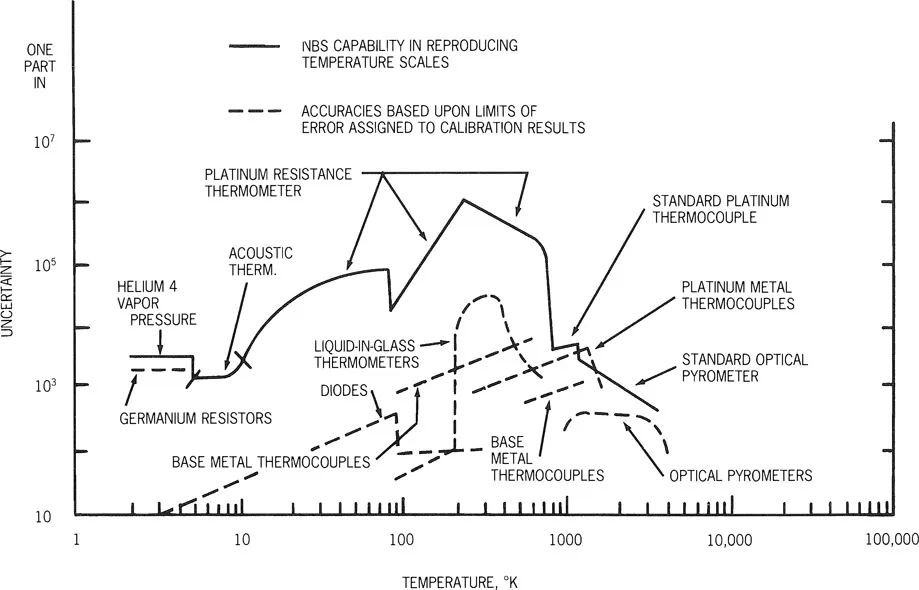
FIG. 1bUncertainties in calibrating different temperature sensors at various temperatures. (From NBS Technical Note No. 262)
Temperature sensors should be selected to meet the requirements of specific applications. Table 1c can assist the reader in this task.3 If the application engineer determines the required temperature level, the nature of the information required (point or average temperature), and the nature of the process environment, this table can be used to determine the suitability of various sensors to that application. The most difficult temperature measurement applications are those where high temperatures are to be detected within a hostile environment, such as that which exists within a fluid-bed coal gasifier.
TABLE 1cTemperature Sensor Selection Table
Measured Temperature
Under 500°C
Above 500°C
Reading 1
Point
Average
Point
Average
Hostile Environment 2
No
Yes
No
Yes
No
Yes
No
Yes
Interference 3
No Yes
No Yes
No Yes
No Yes
No Yes
No Yes
No Yes
No Yes
Sensors 4 Color Indicators
G(L) G(L)
G(L) G(L)
G(L) G(L)
G(L) G(L)
Bimetallic Units
G F
G(P) F(P)
Filled Elements
G F
G(P) F(P)
G(L) F
F(P) F(P)
Resistance Bulbs
E F
E(P) F(P)
E F
E(P) F(P)
E F
G(P) F(P)
G(L) F
G(P,L) F(P,L)
Thermistors
E(L) F
G(P) F(P)
E(L) F
G(P) F(P)
Thermocouples
G F
G(P) F(P)
F(L) F(L)
F(L) F(L)
E F
E(P) F(P)
F(L) F(L)
F(L,P) F(L,P)
Quartz Crystals
E(L) F
Radiation Pyrometers
E(L) G(L)
E(L) G(L)
E(A,L) G(A,L)
E(A,L) G(A,L)
Infrared Pyrometers
E(L) E(L)
E(L) G(L)
E(L) E(L)
E(L) E(L)
Spectroscopic (Fraunhofer) Sensors
A A
Thermopile
G(A) F(A)
G(A) F(A)
Acoustic Time Domain Reflectometry (TDR)
D D
D D
D D
D D
CODE LETTERS:
D-in development
L-limited
F-fair
G-good
E-excellent
P-protective well reduces speed of response
A-detects the average temperature of an area
EXAMPLE: G(D)—This combination of code letters refers to a device which is a good selection for the particular service, but is not yet commercially available.
1 This device either detects a point or the average temperature of some section of the process or of the refractory.
2 The term “hostile environment” here is used to mean processes such as fluid beds, where the sensor is likely to experience the mechanical impact of high velocity solid particles.
3 “Interference” refers to need to overcome temperature interferences due to hot refractories or to temperature differences between the carrier gas and the solid particles in it.
4 For considerations of measurement error, span, cost stability, response time, linearity, materials of construction, etc., refer to the text.
THE MANY WAYS OF MEASURING TEMPERATURE
It is believed that Galileo invented the liquid-in-glass thermometer around 1592. The principle behind the thermocouple—the existence of the thermoelectric current—was discovered in 1821 by Thomas Seebeck. The same year Sir Humphry Davy noted the temperature dependence of metals, but the first resistance temperature detector (RTD) was not constructed until 1932, by C. H. Meyers. The development of temperature sensors was a slow process until the middle of the twentieth century. Today there are nearly 20 differ...
Table of contents
Cover
Half Title
Title
Dedication
Contents
Contributors
1 Application and Selection
2 Bimetallic Thermometers
3 Calibrators and Simulators
4 Color Indicators, Crayons, Pellets
5 Fiber-Optic Thermometers
6 Filled-Bulb and Glass-Stem Thermometers
7 Integrated Circuitry (IC) Transistors and Diodes
8 Miscellaneous Temperature Sensors
9 Pneumatic and Suction Pyrometers
10 Pyrometric Cones
11 Radiation and Infrared Pyrometers
12 Quartz Crystal Thermometry
13 Resistance Temperature Detectors (RTDS)
14 Temperature Switches and Thermostats
15 Thermistors
16 Thermocouples
17 Thermowells
18 Ultrasonic Thermometers
Index
Trusted by 375,005 students
Access to over 1.5 million titles for a fair monthly price.
Study more efficiently using our study tools.
Frequently asked questions
Yes, you can cancel anytime from the Subscription tab in your account settings on the Perlego website. Your subscription will stay active until the end of your current billing period. Learn how to cancel your subscription
No, books cannot be downloaded as external files, such as PDFs, for use outside of Perlego. However, you can download books within the Perlego app for offline reading on mobile or tablet. Learn how to download books offline
Perlego offers two plans: Essential and Complete
Essential is ideal for learners and professionals who enjoy exploring a wide range of subjects. Access the Essential Library with 800,000+ trusted titles and best-sellers across business, personal growth, and the humanities. Includes unlimited reading time and Standard Read Aloud voice.
Complete: Perfect for advanced learners and researchers needing full, unrestricted access. Unlock 1.5M+ books across hundreds of subjects, including academic and specialized titles. The Complete Plan also includes advanced features like Premium Read Aloud and Research Assistant.
Both plans are available with monthly, semester, or annual billing cycles.
We are an online textbook subscription service, where you can get access to an entire online library for less than the price of a single book per month. With over 1.5 million books across 990+ topics, we’ve got you covered! Learn about our mission
Look out for the read-aloud symbol on your next book to see if you can listen to it. The read-aloud tool reads text aloud for you, highlighting the text as it is being read. You can pause it, speed it up and slow it down. Learn more about Read Aloud
Yes! You can use the Perlego app on both iOS and Android devices to read anytime, anywhere — even offline. Perfect for commutes or when you’re on the go. Please note we cannot support devices running on iOS 13 and Android 7 or earlier. Learn more about using the app
Yes, you can access Temperature Measurement by Bela G. Liptak in PDF and/or ePUB format, as well as other popular books in Technology & Engineering & Electrical Engineering & Telecommunications. We have over 1.5 million books available in our catalogue for you to explore.