eBook - ePub
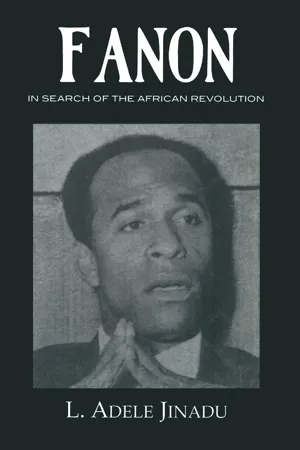
Fanon
About this book
First published in 1986. Fanon: In Search of the African Revolution is different from other books on Fanon in that it approaches him as both a political philosopher and political sociologist of the African experience. It suggests that Fanon's political writings be viewed in terms of his concern with how relations are structured in colonial and post-colonial Africa and the implications of those structural arrangements for political conflict in Africa. Fanon's attempt to explain the pathologies and contradictions of African politics in terms of class and the historical processes that influence and constrain class political behavior is provocative and insightful. But the moral dimension that informs Fanon's theoretical perspectives is no less important, if only because it attests to his strong advocacy of the need for revolutionary change as a condition for the restructuring of African political systems.
Trusted by 375,005 students
Access to over 1.5 million titles for a fair monthly price.
Study more efficiently using our study tools.
Information
Subtopic
AnthropologyIndex
Social SciencesI
PROLOGUE
Chapter 1
INTRODUCTION
Frantz Fanon’s Critical Spirit
This book is concerned with answering the question: How does Fanon aid our understanding of the nature of political processes in colonial and postcolonial Africa? In other words, the purpose is to offer a critical examination of the ideas about man and society in colonial and postcolonial Africa set forth in the political writings of Frantz Fanon.1
This is necessarily a two-fold task: first, there is the task of exposition, by means of which one aims at a better understanding of the man and his ideas, of the connection between his thought and the milieu or environment within which he wrote. Pertinent questions to ask, in this respect, include the following: What did Fanon mean? How did his ideas on colonialism and postcolonial African politics relate to one another? How did those ideas develop — what were the social, historical, biographical and intellectual contexts which determined and shaped their development? Second, there is the task of criticism and evaluation. To do this is to inquire about how valuable, valid, insightful and convincing those ideas are; it is to assess their explanatory power, to see if they will stand up to close scrutiny and withstand the weight of evidence that may be adduced against them. It is also to evaluate the cogency and force of criticisms made of those ideas by other critics of Fanon.
Both tasks are indeed closely related, if only because it is by a critical assessment that one will come to have a sympathetic understanding and admiration for the thought of Fanon. Indeed, throughout much of this study critical remarks and evaluations are juxtaposed with the exposition of Fanon’s ideas on man and society.
The portrait of Fanon that should emerge is that of a moralist and humanist. He had a passionate concern for, and commitment to humanity and the human condition; he felt uneasy in a hypocritical world where lip service was paid to the ideals of social justice, equality and freedom. He brought moral concerns and perspectives to bear on social and political questions.
Organization of the Book
In Part II, I offer a critical exposition of Fanon’s views on man and society in a colonial milieu and examine Fanon’s moral justification of violence and his theory of revolution. Part III is concerned with Fanon’s analysis of politics and political change in postcolonial Africa and the policy implications that can be inferred from that analysis.
My argument is that there is a direct link between these parts of the dissertation. An analysis of colonial society and its heritage leads to an analysis of the conditions under which change can be effected. It is after all Fanon’s contention that problems of modernization and nation-building in postcolonial Africa are directly tied to colonial rule and its heritage.
Fanon on Man and Society in a Colonial Milieu
Part II of this book is, then, concerned with the views of Frantz Fanon on man and society in a colonial milieu. The concern here is to raise and answer a number of questions:
What conception of human nature does Fanon entertain? How does this conception affect both his critique of colonial society and his conception of the ideal society? What criticisms of colonialism and colonial rule does he offer and how are the criticisms related to his conception of human nature and the ideal society? What is the connection, if any, between his thesis that violence is cleansing and purifying and his critique of colonial society, on the one hand, and his conception of human nature on the other hand?
In attempting to answer these questions I shall relate Fanon’s political writings to a wider context of western and nonwestern social and political thought. The purpose of so relating Fanon’s thought is neither to establish the “influence” of any particular social theorist or school of social theory on Fanon, nor to stake a claim for the “influence” of Fanon on some other social theorists. Skinner has brilliantly illuminated some of the methodological and conceptual problems involved in establishing “influence” in the history of political ideas.2
But to say that it is difficult or impossible to establish one social theorist’s influence on another social theorist is not to deny that there is what Greenleaf has called an “affinity” between the speculations of two or more social theorists on a particular concept or social issue. In situations where this “affinity” of thought is present, so Greenleaf rightly observes, “no question of influence need arise: it is simply that there are certain similarities in manner of thought which appear to the mind of the observer."3 For example, in the case of Fanon one wants to examine the “similarities in manner of thought,” which might be said to exist between his conception of “violence” and that of Marx or Sorel or Sartre; or between his critique of colonialism and that of Césaire; or between his speculations on revolution and those of Marx or Lenin or Mao; or between his conception of freedom and that of Rousseau or Marx or Sartre.
Part II is divided into four chapters. In Chapter 2, I state and assess Fanon’s critique of colonialism and colonial rule. Chapter 3 is about the concept of alienation in Fanon’s political writings: in this respect, focus will be placed on his discussion of what he considers to be the inherent violent nature of the colonial situation, and his thesis about the role of language as a form of cultural imposition. In Chapters 4 and 5, I examine the concepts of violence, liberation and revolution in Fanon.
The African Context of Fanon’s Political Writings
In Part III, I place Fanon’s political writings in a postcolonial African setting. I assess his contribution to the historiography of African politics in the period since 1957, the year of Ghana’s independence. Having done that, I then discuss his analysis of social class behavior and political conflict in postcolonial Africa. Hopefully, the following questions should be answered: What moral considerations inform his assessment of political processes in colonial and postcolonial Africa: What model of political conflict in postcolonial Africa does Fanon offer us? What does the model tell us about the direction of social and political change in Africa? What policy recommendations can be reasonably drawn from the model?
A consideration of Fanon’s analysis of postcolonial African politics raises two questions. First, is it meaningful to talk about African politics as such? Second, how credible is Fanon as an analyst of postcolonial African politics?
The first question is a pertinent one to ask insofar as Africa is not composed of uniform social, economic, and political units. My position, however, is that when one talks about African politics and of a model of African politics, one is talking about underlying currents of politics on the continent, about political institutions and political “styles” which, while having local variations, are fundamentally the same from one country to another or one region to another. Such a focus is at least a starting point for an understanding of politics in postcolonial Africa. To say, therefore, that there is a pattern to African politics is neither to deny the heterogeneity of Africa nor to overlook limitations inherent in any model of African politics.
The second question is about the extent and reliability of Fanon’s knowledge of postcolonial African politics. It would seem that Fanon was greatly handicapped in this connection. His “field” experiences in Africa were limited to North Africa and West Africa. He had no first-hand knowledge of East, Central and Southern Africa, and it is open to question how much he knew or could have known of those West African countries in which he lived or visited. My approach, however, is to look upon him as an analyst who brings a primarily normative or ethical perspective to bear on his concerns about the problems of nation-building in Africa. He relied on his impressions and intuitions. It is argued later on that it is a measure of the greatness of the man that, limited as his “field experiences” were, he offered us penetrating insights into the social dynamics of political conflict in postcolonial Africa.
Part III is divided into three chapters. Chapter 6 offers an assessment of Fanon’s notion of commitment and how this affects his views on the role of the African intellectual as an agent of social change. Chapter 7 assesses Fanon’s theory of African politics and underdevelopment. Chapter 8 discusses the policy implications of Fanon’s political writings.
Some Methodological Questions
The task of interpreting and assigning meanings to political texts, or any literary texts for that matter, is not an easy one.
The problem is essentially one of providing a set of appropriate criteria of evidence one should follow in uncovering and assigning meaning to the text in question. If poetic, literary or philosophical interpretation is not to became a capricious affair the question posed by Skinner must be faced, namely, “What are the appropriate procedures to adopt in the attempt to arrive at an understanding of the work?"4 Does one rely exclusively on either the text itself or the social milieu or context within which the writer is or was operating? Are these textual and contextual procedures for interpreting the work mutually exclusive? What constitutes “understanding” in the circumstances?
I have, however, employed two broad strategies, suggested by Cioffi,5 in interpreting Fanon and assigning meaning to his political writings. First, I have relied on autobiographical and biographical facts about him. Second, I have also had to rely on empathy, on my intuitions and judgment.
The selection of autobiographical considerations to bring to bear on the interpretation of literary texts is a vexing one; for, as Cioffi points out, “it is difficult to know where the line should be drawn” between those considerations that are strictly relevant and those that are mere irrelevant “intrusions."6
In the case of Fanon, we know, as a relevant autobiographical fact about him, that he was concerned with colonialism, racism, and political development in Africa; we know also that this was one reason why he wrote Black Skin, White Masks, A Dying Colonialism, Wretched of the Earth, and Toward the African Revolution. His political writings, his explicitly stated concerns and interests, as borne out particularly in the last three of these four books, were chiefly about Africa.
These four books also define the context within which he wished to be interpreted and understood. We know that he was concerned about political leadership roles in Africa; we also know that he was concerned about, and interested in problems of nation-building, particularly those connected with the creation of political order and social justice, in Africa; we know he subscribed to the idea of Pan-Africa. These observations are no doubt truer of the Fanon of the late 1950’s and early 1960’s than of the Fanon of the early 1950’s when Black Skin, White Masks was published.
To place Fanon in an explicitly African setting is not, however, to say that his concerns and interests, or that the “relevance” of his writings and message, were exclusively limited to Africa. One implication of this autobiographical approach is the denial of the textual-contextual dichotomy; instead it points to the interconnections between the text and the context in interpreting a piece of literature.
Reliance on one’s own judgment of the intention of a writer is an important aspect of literary interpretation. This may involve one’s making a leap of faith. No doubt some judgments are better than others; yet it is part of the problem one must face that it is never clear how one is to formulate the criteria of good judgment. As Cioffi admits, “though there are those whose judgment is better in such matters; and rules for determining this, these do not form a system and only experienced people can apply them. There are consequences which distinguish correct from incorrect judgment, but these are of a diffuse kind and like the rules incapable of general formulation.”7
The connection between one’s own intuitions and some autobiographical facts about a writer lies in the fact that “a conviction that a poet stands in a certain relation to his words conditions our response to them."8
The Significance of Fanon
This book is different from others on Fanon in that it approaches Fanon as both a political philosopher and political sociologist of the African experience. It suggests that Fanon’s political writings be viewed in the context of his concern with how power relations are structured in colonial and postcolonial Africa and the implications of those structural arrangements for political conflict in Africa.
It is perhaps to be expected that discussion of the work of such a polemical and didactic political philosopher as Fanon will usually be colored by political or ideological bias. As a result of this, interpretations of his ideas, particularly by hostile reviewers, have tended to be based on a careless or impressionistic reading of his writings. Those writings have not been viewed by most of these reviewers in their totality. Rather, this or that passage from The Wretched of the Earth, his most famous work, is taken as representative of his ideas generally. The result, not surprisingly, is a distortion of his meaning and message. What is offered here is therefore a measured, but sympathetic interpretation of various aspects of Fanon’s life and work in the context of Africa.
But in what does Fanon’s importance as well as his relevance lie? Fanon rode the crest of the wave of radicalism in North America — a radicalism that grew out of the civil rights movement and opposition to the war in Vietnam — in the late 1960s and early 1970s. However, to most on the right and to many liberal intellectuals in Western Europe and North America he was a villain, a perpetrator of a heinous myth, someone who glorified violence. Yet such denunciations invariably conveniently refused to place Fanon’s discussion in the wider perspectives of his valid characterization of colonial and postcolonia...
Table of contents
- Cover
- Title Page
- Copyright Page
- Dedication
- Table of Contents
- Acknowledgements
- Part I: Prologue
- Part II: The Political Sociology of Colonial Society
- Part III: The Political Sociology of Postcolonial Africa
- Part IV: Epilogue
- Bibliography
- Index
Frequently asked questions
Yes, you can cancel anytime from the Subscription tab in your account settings on the Perlego website. Your subscription will stay active until the end of your current billing period. Learn how to cancel your subscription
No, books cannot be downloaded as external files, such as PDFs, for use outside of Perlego. However, you can download books within the Perlego app for offline reading on mobile or tablet. Learn how to download books offline
Perlego offers two plans: Essential and Complete
- Essential is ideal for learners and professionals who enjoy exploring a wide range of subjects. Access the Essential Library with 800,000+ trusted titles and best-sellers across business, personal growth, and the humanities. Includes unlimited reading time and Standard Read Aloud voice.
- Complete: Perfect for advanced learners and researchers needing full, unrestricted access. Unlock 1.5M+ books across hundreds of subjects, including academic and specialized titles. The Complete Plan also includes advanced features like Premium Read Aloud and Research Assistant.
We are an online textbook subscription service, where you can get access to an entire online library for less than the price of a single book per month. With over 1.5 million books across 990+ topics, we’ve got you covered! Learn about our mission
Look out for the read-aloud symbol on your next book to see if you can listen to it. The read-aloud tool reads text aloud for you, highlighting the text as it is being read. You can pause it, speed it up and slow it down. Learn more about Read Aloud
Yes! You can use the Perlego app on both iOS and Android devices to read anytime, anywhere — even offline. Perfect for commutes or when you’re on the go.
Please note we cannot support devices running on iOS 13 and Android 7 or earlier. Learn more about using the app
Please note we cannot support devices running on iOS 13 and Android 7 or earlier. Learn more about using the app
Yes, you can access Fanon by Jinadu in PDF and/or ePUB format, as well as other popular books in Social Sciences & Anthropology. We have over 1.5 million books available in our catalogue for you to explore.