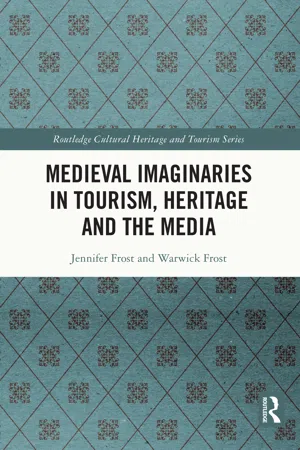
This book examines the pervading influence of medieval culture, through an exploration of the intersections between tourism, heritage, and imaginaries of the medieval in the media.
Drawing on examples from tourist destinations, heritage sites, fictional literature, television and cinema, the book illustrates how the medieval period has consistently captured the imagination of audiences and has been reinvented for contemporary tastes. Chapters present a range of international examples, from nineteenth century Victorian notions of chivalry, knights in shining armour exemplified by King Arthur, and damsels in distress, to the imagining of the Japanese samurai as medieval knights. Other topics explored include the changing representations of medieval women, the Crusades and the Vikings, and the challenges faced by medieval cathedrals to survive economically and socially.
This book offers multidisciplinary perspectives and will appeal to scholars and students across a variety of disciplines such as cultural studies, history, tourism, heritage studies, historical geography and sociology.
For many of us, Dubrovnik conjures up vivid images of the siege in 1991, when the breakup of Yugoslavia saw the medieval walled city hit by sustained bombing by the Serbian army for three months. It had been designated a World Heritage site by UNESCO just 12 years earlier and was a popular destination for tourists. Sandwiched between Split and Kotor on the Dalmatian Coast, Dubrovnik was the most well-known of the three medieval masterpieces. The majority of the visitors had fled, and international television news broadcasts were filled with searing images of crumbling buildings, sniper attacks and the death of civilians, in what was described by the International War Crimes Tribunal in The Hague as, ‘wanton destruction’ with, ‘devastation not justified by military necessity’ (Wood, 2001). It had survived an earthquake in 1667, but this level of damage was crippling. The Old Town was placed on UNESCO’s list of endangered sites and removed only in 1998. Its medieval heritage was subsequently restored, and today, it is difficult to find remnants of the war. The restoration work has been sensitively carried out; avoiding a Disney version of the city that looks like it has been newly built, while at the same time not aiming for fake antiquity. The wounds to the physical fabric essentially look like the result of the passage of time and add to the ambience of what is again a premier drawcard for tourists.
Nowadays, visitors pour off cruise boats and head to the walls and streets of the Old Town, whose shops, bars and restaurants largely depend on the constant foot traffic (Figure 1.1). The large number of cruise boats that dock in Dubrovnik’s harbour has been criticised for leading to over-tourism, ‘the excessive growth of visitors leading to overcrowding in areas where residents suffer the consequences of temporary and seasonal tourism peaks, which have caused permanent changes to their lifestyles, denied access to amenities and damaged their general well-being’ (Milano, Novelli and Cheer, 2019: 354). Dubrovnik is often cited as one of the worst examples of this along with other medieval cities such as Venice, Granada, Barcelona and Malta (Milano et al., 2019). The appeal of these hotspots is partly an attractive medieval core such as the winding streets of Barcelona’s Old Town (Ciutat Vella) and Gothic District (Barri Gòtic), and partly iconic medieval architecture like St Mark’s Basilica in Venice and Granada’s Alhambra Royal Palace. The high level of visitation of these destinations reflects a widespread fascination with the heritage of the medieval period.
Figure 1.1Tourists in the Old Town of Dubrovnik.
Source: Jennifer Frost.
Dubrovnik, however, has one further string to its bow. It has been used as the setting for a number of film and television productions in recent years, including Star Wars: The Last Jedi (2017) and Robin Hood (2018), but is best known as the location for King’s Landing, the capital of the imaginary medieval kingdom of Westeros in Game of Thrones (2011–2019). Based on the book series A Song of Ice and Fire (1996–2011) by George R. R. Martin and set in the fictional world of Westeros and Essos, Game of Thrones is not only a fantasy where knights fight with swords and joust in tournaments and dragons really exist, but additionally, Martin has adapted many historical incidents and themes from medieval history (Larrington, 2016). For a television series, Game of Thrones was distinguished by very high production values, spearheading the modern trend for television productions to aim for a look and feel comparable to cinematic blockbusters. This was in part achieved by the exceptional use of attractive locations in Croatia, Iceland, Northern Ireland and Iceland, all places that have consequently attracted increased tourism flows as a result (Waysdorf and Reijnders, 2017). In the first season, the scenes of King’s Landing were shot in Malta, but after that, production was shifted to Dubrovnik to take advantage of better financial and logistical inducements. In tourism terms, Dubrovnik benefited from a 38% increase in tourist arrivals between 2011 and 2015, a period in which a financial recession meant that most competing destinations were experiencing a decline in visitation (Tkalec, Zilic and Recher, 2017). For fans, the appeal of Dubrovnik as King’s Landing was that:
Most of the characters are linked to this city, and because it is the capital, it is a place of political plots, intrigues and secrets. The medieval-like context of the series highlights Dubrovnik’s most attractive tourist assets such as the rich and preserved historic town center.
(Tkalec et al.,...
Table of contents
Cover
Half Title
Series Title
Title Page
Copyright Page
Table of Contents
List of Figures
List of Tables
Acknowledgements
Chapter 1: The continuing fascination for the medieval
Chapter 2: Gazing at the Gothic: Medievalism and tourism in the nineteenth and early twentieth centuries
Chapter 3: Medieval kingship: Hollow crown or tower of strength?
Chapter 4: The princess in the tower?: Changing representations of medieval women
Chapter 5: Medieval knights and chivalry
Chapter 6: Medieval castles and walled cities
Chapter 7: Positioning medieval cathedrals in the modern era
Chapter 8: Robin Hood: Reinterpreting the medieval outlaw
Chapter 9: The hammer of the gods?: Contested and changing imaginaries of the Vikings
Chapter 10: Encounters with the ‘Other’: Crusaders and Muslims in medieval narratives
Chapter 11: Japan and medievalism: The samurai, cinema and cultural appropriation
Chapter 12: Fictional media and heritage from the medieval perspective: Trends, issues and setting a research agenda
Filmography
Index
Trusted by 375,005 students
Access to over 1.5 million titles for a fair monthly price.
Study more efficiently using our study tools.
Frequently asked questions
Yes, you can cancel anytime from the Subscription tab in your account settings on the Perlego website. Your subscription will stay active until the end of your current billing period. Learn how to cancel your subscription
No, books cannot be downloaded as external files, such as PDFs, for use outside of Perlego. However, you can download books within the Perlego app for offline reading on mobile or tablet. Learn how to download books offline
Perlego offers two plans: Essential and Complete
Essential is ideal for learners and professionals who enjoy exploring a wide range of subjects. Access the Essential Library with 800,000+ trusted titles and best-sellers across business, personal growth, and the humanities. Includes unlimited reading time and Standard Read Aloud voice.
Complete: Perfect for advanced learners and researchers needing full, unrestricted access. Unlock 1.5M+ books across hundreds of subjects, including academic and specialized titles. The Complete Plan also includes advanced features like Premium Read Aloud and Research Assistant.
Both plans are available with monthly, semester, or annual billing cycles.
We are an online textbook subscription service, where you can get access to an entire online library for less than the price of a single book per month. With over 1.5 million books across 990+ topics, we’ve got you covered! Learn about our mission
Look out for the read-aloud symbol on your next book to see if you can listen to it. The read-aloud tool reads text aloud for you, highlighting the text as it is being read. You can pause it, speed it up and slow it down. Learn more about Read Aloud
Yes! You can use the Perlego app on both iOS and Android devices to read anytime, anywhere — even offline. Perfect for commutes or when you’re on the go. Please note we cannot support devices running on iOS 13 and Android 7 or earlier. Learn more about using the app
Yes, you can access Medieval Imaginaries in Tourism, Heritage and the Media by Jennifer Frost,Warwick Frost in PDF and/or ePUB format, as well as other popular books in Business & Hospitality, Travel & Tourism Industry. We have over 1.5 million books available in our catalogue for you to explore.