This innovative study of racial upheaval and urban transformation in Baltimore, Maryland investigates the impact of "blockbusting"—a practice in which real estate agents would sell a house on an all-white block to an African American family with the aim of igniting a panic among the other residents. These homeowners would often sell at a loss to move away, and the real estate agents would promote the properties at a drastic markup to African American buyers.
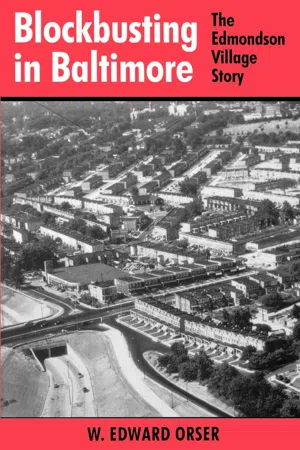
In this groundbreaking book, W. Edward Orser examines Edmondson Village, a west Baltimore rowhouse community where an especially acute instance of blockbusting triggered white flight and racial change on a dramatic scale. Between 1955 and 1965, nearly twenty thousand white residents, who saw their secure world changing drastically, were replaced by blacks in search of the American dream. By buying low and selling high, playing on the fears of whites and the needs of African Americans, blockbusters set off a series of events that Orser calls "a collective trauma whose significance for recent American social and cultural history is still insufficiently appreciated and understood."
Blockbusting in Baltimore describes a widely experienced but little analyzed phenomenon of recent social history. Orser makes an important contribution to community and urban studies, race relations, and records of the African American experience.
- 256 pages
- English
- ePUB (mobile friendly)
- Available on iOS & Android
eBook - ePub
About this book
Information
Publisher
The University Press of KentuckyYear
2021Print ISBN
9780813109350
9780813118703
eBook ISBN
9780813184050
1
The Trauma of Racial Change
The Trauma of Racial Change
The recent reflections of two women illustrate the poignancy and complexity of their experience in the west Baltimore neighborhood of Edmondson Village when racial change began to occur on a massive scale in the late 1950s, early 1960s. In an interview I conducted with a white former resident, Marilyn Simkins sought an explanation for the response of whites who panicked and fled the neighborhood: “They saw a very secure world changing very drastically,” she said, “and they couldn’t accept it. This was distasteful, and in some respects it was forced down their throats, and they felt they had no other choice, I guess.”1 In a separate interview session, Margaret Johnson, a pioneer from the era of initial African American settlement in the same neighborhood, described her own feeling about the flight of her white neighbors: “They were friendly, but. they were prejudiced. They didn’t want to live where colored people did. . . . They don’t have to say it. . . . They didn’t tell you [why they moved]; they just moved!”2 Embedded in both statements—though not necessarily voiced in the careful choice of words and in the sense of dignity that each displayed—are shadings that range from anger and pain to wistfulness and bewilderment. Both testify eloquently to the trauma of rapid racial change on two different sides of the neighborhood succession experience, a trauma whose legacy continues to be felt in their lives and in the lives of countless other former and present residents of outer urban neighborhoods such as Edmondson Village. In fact, it is a collective trauma whose significance for recent American social and cultural history is still insufficiently appreciated and understood.3
The Role of Blockbusting
Edmondson Village, an extensive rowhouse neighborhood on Baltimore’s west side, had been developed from the 1920s onward as a suburban enclave for Baltimore’s burgeoning white middle class. During the single decade from approximately 1955 to 1965, however, virtually its entire population of twenty thousand was replaced in rapid fashion by a new population of equal size. Few explanations—whether natural, social, or economic—would be adequate to account for such massive displacement and resettlement. Yet, in the urban equation of mid-twentieth-century America a single factor represented sufficient causation: race. (See maps 1 and 2.)

Map 1. Racial composition and population for Baltimore City, 1930-1970. Edmondson Village neighborhood boundaries are in bold outline on the city’s west side. (Compiled by the author from U.S. Census tract data; map by UMBC Cartographic Services)

Map 2. Racial composition of the Edmondson Village neighborhood, 1940-1970. (Compiled by the author from U.S. Census tract data by block; map by UMBC Cartographic Services)
That the experience of racial change is common enough in recent history for this statement to seem unremarkable is telling in itself. But in the Edmondson Village case, rapid racial change was triggered by a particularly intensive and systematic application of blockbusting. As contemporaries came to define it, blockbusting was the intentional action of a real estate operative to settle an African American household in an all-white neighborhood for the purpose of provoking white flight in order to make excessive profits by buying low from those who fled and selling high to those who sought access to new housing opportunities.
Blockbusters lit the match, but, as the definition implies, they were only one ingredient in a complex set of circumstances. Indeed, blockbusting exploited the crevices of an otherwise pervasive and systematic system that governed race and residence. In mid-twentieth-century urban America, a silent conspiracy sought to assure and preserve the segregated dual housing market. At the institutional level, the refusal of the real estate, financial, and governmental establishment to underwrite housing choices that challenged dominant patterns of residential segregation represented one pillar of a remarkably durable conspiracy. However, the dual housing market constituted an unwritten agreement in the restraint of trade, as legal historian Garrett Power has argued in his work on Baltimore, and the problem of enforcement was the temptation to “cheat,” especially if there was an advantage to be gained by doing so. In these terms, blockbusters functioned as cheaters, operating outside the pale of mainstream institutions. While these operatives risked censure in withdrawing from the general conspiracy, their activities also permitted establishment institutions to maintain the illusion of upholding the racial status quo. In the early stages of post-World War II blockbusting, such agents were active on the margins of ghetto areas, engaging in transactions shunned by conventional real estate and lending institutions; in the later stages, they sometimes took advantage of more open mortgage policies that channeled funds into particular sections of cities deemed to be “changing.” The financial pay-off for such activities often was immense.4
At the individual level, the refusal of white residents to consider the possibility of residential integration made their own racism the second pillar upholding the edifice of the dual housing market. Social and racial homogeneity frequently were the unwritten promises of residential community, especially in suburbanizing outer city neighborhoods, whether the provinces of the white elite or of whites with more modest income levels. It often was assumed that economic constraints made racial integration unlikely, though the assumption was much more credible for exclusive enclaves than for ordinary neighborhoods. But such reasoning betokened an unquestioned faith in the mechanisms of residental segregation, which led most white residents to take for granted the preservation of the racial status quo in housing. Ironically, this absolute position—which categorically ruled out heterogeneity and made their social world seem so secure—also heightened their vulnerability to the tactics of blockbusters, who could play on their presumptions of racial exclusivity to trigger their fears. Therefore, in particular historic moments when circumstances converged to threaten the conspiracy controlling the dual housing market, as in the instances of blockbusting in the post-World War II period, resistance or flight were the characteristic responses. When whites cried foul, blockbusters and their defenders could point out that they had only themselves to blame if they lost out in the process.
Finally, of course, the set of requisite circumstances depended upon pent-up demand for housing opportunity by African Americans, long restricted in terms of residential options but eager, even desperate, for improved housing and neighborhood amenities. Since they were denied entry to the real estate market beyond the perimeters of residential segregation, finding mainstream real estate and financing doors closed to them, their only access to home purchases came through the offices of blockbusters or speculators. Given these constraints, many African Americans nevertheless were ready to seize the opportunity for new housing on such terms, even if the costs were exploitative and the financial arrangements shaky. Indeed, when blockbusters were challenged on the ethics of their operations, they defended their practices as providing a necessary service others refused and therefore requiring greater risks, which justified higher profits.
The tactics used by blockbusters to manipulate the system to their advantage were not entirely new in the 1950s and 1960s. Gilbert Osofsky found that similar practices were employed at the turn of the century in Harlem, when New York’s African American population swelled as a result of migration from the South, and speculators, dubbed “white blackmailers,” channeled African American tenants into the temporarily depressed tenement market uptown.5 From time to time in twentieth-century American cities, areas of African American concentration expanded in similar fashion in response to population pressures and changes in housing stock at the neighborhood and metropolitan level, especially as inner city housing aged and new housing became available on the suburban periphery. Typically, this kind of enlargement was incremental, occurring on the margins of the African American ghetto, and often it represented acquisition of residence in neighborhoods where physical deterioration or depressed housing prices had begun to occur. Sherry Olson has noted that some expansion of this type occurred in Baltimore immediately following World War I, when African American population increases combined with a suburban boom in whites-only housing to produce an episode where some of the tactics that came to be associated with blockbusting were employed.6
What made the episodes of blockbusting and the resultant racial change in American cities during the 1950s and 1960s so significant, however, was their extent and scale. Rather than marginal ghetto expansion, entire neighborhoods and broad sections of cities were transformed from predominantly all-white to predominantly all-African American in a relatively short period of time. In Baltimore, charges of blockbusting were voiced in the midst of massive episodes of white flight and rapid racial succession, primarily in the northwestern and western sections of the city (the Reisterstown Road, Liberty Heights Avenue, and Edmondson Avenue corridors) and to a lesser extent on the near northeast (along lower Harford Road and The Alameda, and in sections around Lake Montebello). In Chicago, a comparable process occurred with particular intensity on the south and west sides, where inhabitants referred to the work of “panic peddlers” in triggering white flight and producing large-scale racial change in such neighborhoods as Lawndale and Austin. The same term was applied to operatives in Washington, D.C., in the midst of racial change which occurred there in dramatic proportions. And the process apparently was much the same in the New York borough of Brooklyn, where the pre-World War II concentration of African Americans and Puerto Ricans in a section of Bedford-Stuyvesant expanded substantially during the postwar decades.7
In a number of cities—Boston, New York, Chicago, Philadelphia, Baltimore, and others—blockbusting sometimes targeted Jewish neighborhoods, prompting extensive Jewish to African American succession. Jews and African Americans, both excluded from equal access to the housing market, whether by such legal mechanisms as restrictive covenants or by discrimination entrenched in custom, often lived in close proximity yet with clear lines of social separation. While Jewish communities often exhibited rare degrees of tolerance, they also were disproportionately singled out by speculators and frequently proved vulnerable to such manipulation. Hillel Levine and Lawrence Harmon have made a convincing case that older Jewish neighborhoods in Boston were victimized through the collusion of the city’s financial, real estate, and political leadership, for example.8 However acute such episodes, the phenomenon of blockbusting as a trigger for white flight transcended religious and ethnic identification. Baltimore’s Edmondson Village area, for instance, consisted of a rather even mix of Protestants and Roman Catholics, and numerous other cases similarly illustrate the broad susceptibility of communities to blockbusting tactics.
Sometimes the residential turnover accompanying blockbusting occurred in older, inner city neighborhoods, when speculators carved up large housing units into multifamily tenements and profited from charging excessive rents to new African American tenants. This process characterized the experience in Cleveland’s Hough section during the 1950s, for example.9 But in other instances, blockbusting and rapid racial change extended into areas that in the process became the “secondhand suburbs,” where the housing stock was only several decades old, single-family dwellings predominated, and resident home ownership was the prevailing pattern, as was the case in Edmondson Village. In these circumstances, speculative profits resulted when housing, typically bought low from fleeing whites, was sold to African Americans at higher than market value and on terms arranged to benefit the speculator, not the buyer.
In retrospect, the 1950s and 1960s represented the zenith of blockbusting and the kind of rapid racial change it generated. During these decades the cracks in the edifice of the segregated housing market became more visible. The World War II period produced unprecedented population growth in urban centers, but little expansion in the available housing stock. At war’s end, suburban development opened up a new housing frontier for white Americans, but the walls of de facto segregation continued to hem in an African American population feeling severely cramped by inadequate and rigidly limited housing. Pressure upon housing alone might have forced change. But expectations were rising as well. In part these resulted from improved economic opportunities available to some African Americans in the wartime and postwar economy. In part they were spurred by the formative stages of the civil rights movement, which gained ideological steam from a war fought against racism to produce a more vocal challenge to the racial status quo. One prop of the dual housing market was struck down in 1948 when the Supreme Court ruled that states could not enforce residential restrictive covenants. Rising expectations and a sense of changing times led some African Americans to consider active choices to improve their housing opportunities and neighborhood amenities.
In spite of these mounting pressures—perhaps because of them—mainstream private and governmental institutions sought to hold a firm line, resisting the voices of change and making very few concessions to accommodate the new circumstances. Much the same must be said for white public opinion. Nowhere was reluctance to confront change more evident than on the domestic front, the province of home. In older inner city neighborhoods white residents frequently had to accept degrees of social diversity regarding class and ethnicity, but race was another matter. Faced with the prospect of African American settlement, residents of such neighborhoods sometimes resisted racial change forcefully, even violently, especially in instances where ethnic ties and social class combined to reinforce internal cohesion and to repel outsiders. In other cases, they viewed African American entry as another sign of neighborhood powerlessness, and flight ensued.
Outer city neighborhoods had been developed on the implicit promise of social homogeneity inherent in the suburban ideal in its various late nineteenth- and twentieth-century versions. In these suburban havens, whether older or newer, whites constructed what they considered to be a safe and secure social world, depending upon covert mechanisms to assure racial restriction rather than upon traditions of overt resistance. Therefore, white residents of most outer city neighborhoods typically refused to consider the possibility of racial integration. During the decades in question many communities remained immune to change, whether due to geographical or social, political, and economic factors. Overt resistance occurred occasionally, as was the case in the Brooklyn section of Canarsie, where Italians and Jews, once displaced from older sections of the city, dug in their heels to defend their neighborhood’s identity, attempting to maintain the community as a “fortress, a fenced land.” 10 In some instances, residents tried valiantly to make integration work. Chicago’s Oak Park community, for example, developed a national reputation for its systematic efforts to stem the tide of white flight and to promote racial balance.11 But in many communities, when residents were confronted directly by the challenge of African American settlement, they succumbed to racial fears and moved on. When the process was abetted by blockbusting, as in Edmondson Village, flight often assumed dramatic proportions.
Flight on such a scale traumatized whole communities, leaving its mark on those who left as well as upon those who took their place. While fleeing whites may have contributed to their own victimization through their collective behavior, they nevertheless faced the many difficulties associated with hasty relocation: the loss of community ties, the uncertain prospects of new settings, and—for many—the substantial financial penalty that blockbusting extorted. The social and economic toll for African American newcomers was often even greater. They gained housing options they had been illegitimately denied but at exploitative prices that strained their economic resources—necessitating new and sometimes onerous family strategies to meet the financial demands—and on terms that left them extremely vulnerable and insecure. Sometimes the instability of rapid racial change continued unabated in unstable patterns of residential turnover. Incoming residents often complained that commercial and governmental services declined in the wake of white flight and racial change. Given the exploitative mechanisms involved in blockbusting and the instab...
Table of contents
- Cover
- Half title
- Title
- Contents
- List of Maps and Figures
- Preface
- 1 The Trauma of Racial Change
- 2 The Making of a Rowhouse Neighborhood
- 3 Continuity and Undercurrents of Change
- 4 A White Community Responds to Change
- 5 African American Pioneers
- 6 The Legacy of Blockbusting
- Appendix A: Suggested Reading
- Appendix B: Home Ownership on Selected Blocks, 1955-1973
- Notes
- Bibliography
- Index
Trusted by 375,005 students
Access to over 1.5 million titles for a fair monthly price.
Study more efficiently using our study tools.
Frequently asked questions
Yes, you can cancel anytime from the Subscription tab in your account settings on the Perlego website. Your subscription will stay active until the end of your current billing period. Learn how to cancel your subscription
No, books cannot be downloaded as external files, such as PDFs, for use outside of Perlego. However, you can download books within the Perlego app for offline reading on mobile or tablet. Learn how to download books offline
Perlego offers two plans: Essential and Complete
- Essential is ideal for learners and professionals who enjoy exploring a wide range of subjects. Access the Essential Library with 800,000+ trusted titles and best-sellers across business, personal growth, and the humanities. Includes unlimited reading time and Standard Read Aloud voice.
- Complete: Perfect for advanced learners and researchers needing full, unrestricted access. Unlock 1.5M+ books across hundreds of subjects, including academic and specialized titles. The Complete Plan also includes advanced features like Premium Read Aloud and Research Assistant.
We are an online textbook subscription service, where you can get access to an entire online library for less than the price of a single book per month. With over 1.5 million books across 990+ topics, we’ve got you covered! Learn about our mission
Look out for the read-aloud symbol on your next book to see if you can listen to it. The read-aloud tool reads text aloud for you, highlighting the text as it is being read. You can pause it, speed it up and slow it down. Learn more about Read Aloud
Yes! You can use the Perlego app on both iOS and Android devices to read anytime, anywhere — even offline. Perfect for commutes or when you’re on the go.
Please note we cannot support devices running on iOS 13 and Android 7 or earlier. Learn more about using the app
Please note we cannot support devices running on iOS 13 and Android 7 or earlier. Learn more about using the app
Yes, you can access Blockbusting in Baltimore by W. Edward Orser in PDF and/or ePUB format, as well as other popular books in Social Sciences & North American History. We have over 1.5 million books available in our catalogue for you to explore.