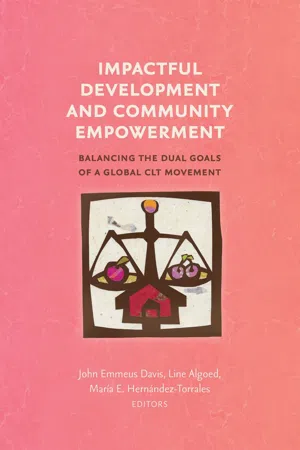
eBook - ePub
Impactful Development and Community Empowerment
Balancing the Dual Goals of a Global CLT Movement
- English
- ePUB (mobile friendly)
- Available on iOS & Android
eBook - ePub
Impactful Development and Community Empowerment
Balancing the Dual Goals of a Global CLT Movement
Information
1.
Community Land Trusts
Combining Scale and Community Control to Advance Mixed-Income Neighborhoods

Emily Thaden and Tony Pickett
Community land trusts (CLTs) continue to gain ground as an innovative model for achieving permanently affordable housing through community control of the land placed in trust. Large-scale implementation of the CLT model can buffer the adverse effects of systemic racism and involuntary displacement through gentrification, by ensuring that a lasting stock of high-quality, affordable housing remains in place to intentionally benefit communities of color, even when new investments create a market-driven increase in real estate values. When CLTs control a sufficient percentage of housing in areas that are high-cost or where housing costs are rising, the neighborhood can achieve mixed-income status. This has potential to enrich residents’ lives across all income levels through diverse interconnectedness and opportunities for betterment.1
However, research continues to reveal just how challenging it is for mixed-income communities to produce benefits for lower-income people of color. Too often, communities of color that experience new investments, accompanied by an influx of more affluent and often predominately white households, report that the changes work to the benefit of the higher-income white households and the detriment of lower-income households of color. Residents of color are experiencing racism, including social and cultural alienation and a loss of political influence, which are often expressed in sentiments such as, “This is no longer my neighborhood.” The CLT model, when focused with a racial equity lens, attempts to address both the perception and the reality of these shifts in power and culture by placing the residents of homes on the CLT’s land in key leadership and decision-making positions and by putting the needs of low-income Black and Brown residents at the center of the CLT’s mission.
A major debate among CLT practitioners and advocates involves the tradeoffs and tensions between “going to scale” with the housing portfolio and enacting “community control.” People on one side of this debate make the case that increasing the number of homes held in trust is necessary, both for CLTs’ financial sustainability and for the production and preservation of mixed-income, racially inclusive communities. The other side argues that ever-increasing scale may inevitably erode the community’s and local residents’ control in decision making—a vital part of the CLT governance model. As a recent publication on transformative land strategies argues, the evolution of CLTs has reached an “inflection point” and “scale is not an adequate end-goal if the commitment to the practice of democratic governance, and the organizing and political education to support it, are left by the wayside.”2
In this essay, we suggest that pitting the straw men of scale and community control against one another does the field more harm than good. Instead, we support a theory of change that reconciles and balances the two goals in order to create more comprehensive CLT-based approaches that advance racial justice and inclusive community development. The non-violent protests in Albany, GA during the 1960s—which were an instrumental part of the Black-led Civil Rights movement—gave birth to the CLT model. And today, the global protests of the Black Lives Matter movement set forth demands for racial justice and radical solutions to address systemic social, political, and economic exclusion of Black and Brown people and their communities. These demands call out CLTs as a vehicle to transform land use and housing through community control of both. This is, indeed, an inflection point for CLTs. We must center ourselves in our Civil Rights history and fight harder than ever to realize our transformational racial justice work through CLTs. But to begin, we must first explain the CLT model and its challenges.
AFFORDABLE HOUSING IN MIXED-INCOME COMMUNITIES DONE DIFFERENTLY: THE CLT MODEL
Unfortunately, the majority of new affordable housing developed in urban areas follows an ill-fated pattern:3 Public funds are invested to improve disinvested communities, address poor housing conditions, and create high-quality affordable housing options. Improvements to the affordable housing stock often spur additional private real estate investments within the same area. The neighborhood is considered to be “revitalizing”—an unmanaged process that may slowly or quickly turn into gentrification. Higher property values drive up rents and property taxes, which attracts higher-income households and more private investment. This begins to push out lower-income households. Additional displacement pressure often occurs as the affordability periods for the affordable housing stock start to expire and properties revert to market-rate.4 When that happens, residents of the affordable housing also get displaced.
Within this pattern there is a brief period—somewhere between revitalization and gentrification—when the community is mixed-income and, typically, more racially diverse. However, this period quickly wanes in the absence of stopgaps to prevent the pressure of displacement. Ultimately, the neighborhood may end up more segregated than it was before public investment hit the streets. CLTs provide a solution to this unanticipated consequence of development. Community land trusts are nonprofit corporations that steward community assets and provide permanently affordable housing for families and communities. CLTs acquire and secure land with a renewable ground lease (typically with a 99-year agreement) and ensure that all affordable housing on that land remains affordable in perpetuity. If CLTs can create a significant stock of affordable housing in neighborhoods, they act as bulwarks against gentrification and low-income resident displacement.
CLTs and “Community Control”
In his framework of displacement, Dan Immergluck defines political displacement as occurring when new residents belonging to racial and economic groups that have traditionally held more power move into a neighborhood and stifle the voice of long-time residents, which perpetuates economic and racial supremacy.5 CLTs mitigate this type of displacement by placing current and future lower-income residents at the center of “community control” and decision making about neighborhood needs. Unlike most other nonprofits or community development corporations, the traditional CLT governance model operationalizes community control by being structured as a nonprofit, corporate-community membership organization whose members include all residents of CLT homes and other residents in the CLT service area. The members pay nominal annual dues and support the CLT’s mission. Members have decision-making authority over major decisions.
Fast Facts About CLTs

One-third of a traditional CLT’s board of directors is elected by and composed of residents living on the CLT’s land, and an equal portion is elected by and composed of members who reside within the CLT’s targeted “community” but do not live on the CLT’s land. This structure balances the interests of residents of different incomes, races, cultures, and backgrounds to ensure that the uses of CLT-owned land prioritizes the needs of all members.
Through their commitment to community control, CLTs foster engagement and interconnectedness among economically and racially diverse residents to enact the CLT’s mission and decide on the prioritized uses of land owned in perpetuity by the CLT. Many CLTs also actively engage the communities where they hold land in trust through community events, educational programming, and opportunities for civic engagement.
CLTs and Homeownership
Depending on what the community needs, CLTs can develop rural and urban agriculture projects, commercial spaces to serve local communities, affordable rental and cooperative housing projects, or conserve land or urban green spaces. To date, however, most CLTs have focused mainly on creating homes that remain permanently affordable and thus provide successful homeownership opportunities for generations of lower-income families and families of color. The importance of this focus cannot be understated. Redlining, predatory lending, and other barriers have made homeownership through the private housing market incredibly difficult for lower- income families and households of color to attain and sustain. One study found that the probability of sustaining homeownership for longer than five years by first-time homebuyers who were low-income or people of color was equal to a fifty-fifty coin toss—and that was before the foreclosure crisis.6
By contrast, the approach used by CLTs, shared equity homeownership, invests public resources to reduce the home’s initial price and then keeps the price affordable to all future homebuyers through resale restrictions. This gives the CLT a vested interest in the property and in the homeowner’s success. Homes are not treated as risky and speculative investments; rather, homes are stabilizing and transformational forces. In return, the homeowners agree to sell their homes at a resale-restricted and affordable price to another lower-income homebuyer in the future. This arrangement enables the resident to own a home and build some wealth, and also enables the CLT to preserve the public’s investment in making homes permanently affordable for family after family.
Evidence of CLT Effectiveness
CLTs have demonstrated effectiveness in increasing racial diversity and affordability; stabilizing the average household income in their neighborhoods; and maintaining middle-class ratios, education levels, and owner-occupied housing rates. Researchers have found, for instance, that:
Table of contents
- Cover
- Title Page
- Copyright Page
- Contents
- Figures
- Introduction: A Dual-Goal Model of Community Development John Emmeus Davis, Line Algoed, and María E. Hernández-Torrales
- 1. Combining Scale and Community Control to Advance Mixed-Income Neighborhoods
- 2. The Best Things in Life Are Perpetually Affordable: Profile of the Champlain Housing Trust, Burlington, Vermont
- 3. Stewardship of Urban Real Estate for Long-Term Community Benefit: Profile of the Urban Land Conservancy in Denver, Colorado
- 4. Origins and Evolution of Urban Community Land Trusts in Canada
- 5. Seeding the CLT in Latin America and the Caribbean: Origins, Achievements, and the Proof-of-Concept Example of the Caño Martin Peña CLT
- 6. Community Control of Land: Thinking Beyond the Generic Community Land Trust
- 7. Better Together: The Challenging, Transformative Complexity of Community, Land, and Trust
- About the Contributors
Trusted by 375,005 students
Access to over 1.5 million titles for a fair monthly price.
Study more efficiently using our study tools.
Frequently asked questions
Yes, you can cancel anytime from the Subscription tab in your account settings on the Perlego website. Your subscription will stay active until the end of your current billing period. Learn how to cancel your subscription
No, books cannot be downloaded as external files, such as PDFs, for use outside of Perlego. However, you can download books within the Perlego app for offline reading on mobile or tablet. Learn how to download books offline
Perlego offers two plans: Essential and Complete
- Essential is ideal for learners and professionals who enjoy exploring a wide range of subjects. Access the Essential Library with 800,000+ trusted titles and best-sellers across business, personal growth, and the humanities. Includes unlimited reading time and Standard Read Aloud voice.
- Complete: Perfect for advanced learners and researchers needing full, unrestricted access. Unlock 1.5M+ books across hundreds of subjects, including academic and specialized titles. The Complete Plan also includes advanced features like Premium Read Aloud and Research Assistant.
We are an online textbook subscription service, where you can get access to an entire online library for less than the price of a single book per month. With over 1.5 million books across 990+ topics, we’ve got you covered! Learn about our mission
Look out for the read-aloud symbol on your next book to see if you can listen to it. The read-aloud tool reads text aloud for you, highlighting the text as it is being read. You can pause it, speed it up and slow it down. Learn more about Read Aloud
Yes! You can use the Perlego app on both iOS and Android devices to read anytime, anywhere — even offline. Perfect for commutes or when you’re on the go.
Please note we cannot support devices running on iOS 13 and Android 7 or earlier. Learn more about using the app
Please note we cannot support devices running on iOS 13 and Android 7 or earlier. Learn more about using the app
Yes, you can access Impactful Development and Community Empowerment by John Emmeus Davis,Line Algoed,María E. Hernández -Torrales, John Emmeus Davis, Line Algoed, María E. Hernández -Torrales in PDF and/or ePUB format, as well as other popular books in Politics & International Relations & City Planning & Urban Development. We have over 1.5 million books available in our catalogue for you to explore.