This remarkable collection uses genre as a fresh way to analyze the issues of gender representation in film theory, film production, spectatorship, and the contexts of reception. With a uniquely global perspective, these essays examine the intersection of gender and genre in not only Hollywood films but also in independent, European, Indian, and Hong Kong cinemas. Working in the area of postcolonial cinema, contributors raise issues dealing with indigenous and global cinemas and argue that contemporary genres have shifted considerably as both notions of gender and forms of genre have changed. The volume addresses topics such as the history of feminist approaches to the study of genre in film, issues of female agency in postmodernity, changes taking place in supposedly male-dominated genres, concepts of genre and its use of gender in global cinema, and the relationship between gender and sexuality in film.
- English
- ePUB (mobile friendly)
- Available on iOS & Android
eBook - ePub
Gender Meets Genre in Postwar Cinemas
About this book
Contributors are Ira Bhaskar, Steven Cohan, Luke Collins, Pam Cook, Lucy Fischer, Jane Gaines, Christine Gledhill, Derek Kane-Meddock, E. Ann Kaplan, Samiha Matin, Katie Model, E. Deidre Pribram, Vicente Rodriguez Ortega, Adam Segal, Chris Straayer, Yvonne Tasker, Deborah Thomas, and Xiangyang Chen.
Information
Publisher
University of Illinois PressYear
2012Print ISBN
9780252078316
9780252036613
eBook ISBN
9780252093661
Subtopic
Film History & CriticismPART ONE
REFIGURING GENRE AND GENDER
CHAPTER 1
THE GENIUS OF GENRE AND THE INGENUITY OF WOMEN
Every reference to the cinema director as author carries the weight of several centuries of literary and art historical criticism. This very weight makes it difficult to argue against authorship in motion-picture industry history. Nevertheless, it is my contention that authorship has been taken up too uncritically. One cannot hope to completely discredit the authorial approach, but the critical ascendance of the author has been successfully challenged in a number of ways, for example, for its eclipse of the audience’s contributions to meaning. In this essay, however, I begin by picking up a thread from my earlier argument about the work of silent cinema director-producer, Alice Guy Blaché, namely that auteur criticism gives short shrift not only to the audience but to other texts as sources of meaning. Here “other texts” references genre, the repetition with difference of popular forms. The author, I maintained, blocked the most important insights of the critically convulsive 1970s, most significantly, the poststructuralist assertion that we are constituted through language (Gaines 2002, 98). As Stephen Heath put it, “the author is constituted at the expense of language” (1973, 88; my emphasis).
Approaches to cinema-as-language and to genre converged and later diverged in the 1970s. Film genre theory was one of the first critical heirs of the more systematic approach to culture promised by semiotics and structuralism. Initially, the rule-governed operation of the linguistic sign system was analogized with the iconic sign system and refined into genre theory’s understanding of rules or conventions in the relatively stable western and gangster genres. Cinema-as-language shared with genre criticism an understanding of cultural conventionality: culture as a readable system. However, with the stress on “representation” as ideological symptom, cinema-as-language became ascendant and genre was subsumed. Here Heath’s reference to the tension between “author” and “language” recalls Raymond Williams’s three-tiered understanding of consciousness:
To be a writer in English is to be already socially specified … at one level to an emphasis on socially inherited forms, in the generic sense; at another level to an emphasis on socially inherited and still active notions and conventions; at a final level to an emphasis on a continuing process in which not only the forms but the contents of consciousness are socially produced. (Williams 1977, 193)
Here Williams challenges the individual creator as himself the source of cultural forms produced by his singular consciousness. Thus individual autonomy, so esteemed in notions of “the author,” is negated.
It is this co-implication of authorship and genre that I want to revisit. Hence my title, which questions the location of genius, wants to force an earlier issue for feminists into the foreground. To be specific, when a woman director is said to “author” a melodrama, does she “transcend” the form in the way that the male auteur was said to have “transcended” industrially produced genre? One might assume that feminist film theory, new in the 1970s, would have taken up this question. Although feminist film theory was immediately interested in director Dorothy Arzner, her work was not considered in exactly auteurist terms, for feminist interest in film theory barely overlapped with early 1970s auteurism, anticipating, rather, later poststructuralist approaches. It is, then, a poststructuralist auteurism we find in Claire Johnston’s well known analysis of the ending of Arzner’s Dance, Girl, Dance (1940): “Towards the end of the film Arzner brings about her tour de force, cracking open the entire fabric of the film and exposing the workings of ideology in the construction of the stereotype of woman” (1973, 29). In 1973, this move was an exciting possibility for a nascent feminist film criticism. However, it was not a totally new approach but rather a variation on post-1968 French theoretical developments, echoing Jean-Louis Comolli and Jean Narbonis’ 1971 theorization of the “category E” film, that exemplary popular work that was able to turn itself inside out so that it critiqued its own ideological scheme (see Klinger 1986). In retrospect, one wonders if the methodology of ideological critique, originally developed for popular genre films, was not in this moment gradually and imperceptibly moved into auteur criticism, where it remains today. We will return to the easy analogy between the author and the text that made such a move possible.
We find another indication of the proximity of authorship to genre in the way the discovery of Arzner was formulated. If Johnston attributes critique to Arzner, its object is the construction of “stereotype,” a conceptualization straight from 1970s genre criticism. Furthermore, auteurism’s consideration of an entire oeuvre is paralleled by genre’s grouping of films, both the legacy of structuralism. Thus the approach to Arzner is both poststructuralist (uncovering ideological operations) and structuralist (uncovering authorial patterns).1 Finally, it is important to recall that the new British feminist film theory did not then develop the auteur approach one might have expected following Johnston’s attention to Arzner, but rather, pursuing richer developments in the broader field, concentrated on the function of women in film noir. Here, genre questions raised through ideological analysis of the femme fatale in the dark 1940s gangster film would meet an emerging feminist concern with women and representation. In E. Ann Kaplan’s foundational 1978 collection two different directions for feminist film theory were rehearsed, together raising the question of sexual representation as a function of genre. However, what became the burning issue for feminist film theory—women, body, ideology, or representation-as-language—would soon eclipse the consideration of film genre-as-language.2
To my knowledge, no feminist lamented the emphasis on representation at the expense of genre, perhaps because representation engulfed the parameters of genre theory at the time: conventions of narrative, iconography, and stereotypage. However, feminist literary criticism was quick to notice that film theory’s challenge to authorship coincided with the discovery of female writers, a move that effectively withdrew the possibility of individual critical acclaim before it could be conferred (Felski 2003, 58). This was less of a problem for feminist film theory since no large-scale claim had been staked for female auteur directors, although this is not to say that Dorothy Arzner, along with others such as Ida Lupino (Kuhn 1995) and Germaine Dulac (Flitterman-Lewis 1996) were not important theoretical points of departure.3
As I have argued before, however, every nomination of an auteur risks slipping back into prestructuralist discourse of the individual artist (Gaines 2002, 89). In this discourse, the elevation of the auteur director above the popular genre he uses invites the attribution of “genius.” However, there was no established filmic discourse of either director or genius artist in the first decades of the new motion picture industry. Historically, the concerted move to treat mainstream motion picture directors as artists began with Cahiers du Cinéma in the 1950s, when unlikely studio director Howard Hawks was noticed by the French (Rivette 1953). Perhaps recent exposure of the relative arbitrariness of Hawks’s elevation to the status of “genius” justifies a healthy skepticism about auteurism (Wollen 2002, 12). One objects to the elitism that attributes “genius” to one cultural worker to the exclusion of another. However, we would not abandon feminism’s commitment to championing women innovators as a vehicle of historical restitution. While checking any tendency to look for “great women” on the analogy with “great men” in history, we do want to proclaim the genius of women found in unlikely places. Here, then, I officially proclaim the genius of women in general, exemplified by the particular genius of Alice Guy Blaché, whose achievements in silent-era motion picture production are unparalleled.4
Still, if we claim Alice Guy Blaché as auteur, we should acknowledge its antithesis—the conventional form she used as the locus of genius. Rather than commending the genius of the artist, we praise the ingenuity of the narrative and iconographic structure, a structure itself incorporating the director and her audience. So the alignment of “women” with “genius” in my title takes the term away from the Romantic notion of the individual by reaffirming the interchangeability of the critical categories “women” and “genre.” And yes, this means reasserting “women” as generic, which, after all, has been one of the great achievements of second-wave feminist theory. This allows us to pose the codification of emotional knowledge in genre as both receptacle for and testimony to a remarkable facility—no natural gift but rather a highly developed social expertise in the ways and means of feeling. Recent critical developments have established “emotional knowledge” as anything but a contradiction in terms, as seen, for instance, in Deidre Pribram’s study of Crash (2004) in this volume. From this historical vantage we look back to the genre theory of the 1970s with its important emphasis on formula but not yet accommodating the special problems of either emotion or visceral response. Now, most importantly, we are on the other side of foundational work on what have been termed the basic “body genres”: horror, pornography, and melodrama (Dyer 2007, 178–80; L. Williams 1991). And yet, the study of these bodily genres appears to have gone around rather than through genre theory.
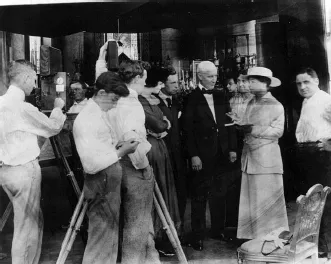
Fig. 1.1 Alice Guy Blaché directing My Madonna (1915). Courtesy: Ft. Lee Library, Ft. Lee, New Jersey.
The question of what I am calling emotional expertise is, of course, automatically gendered and simultaneously genred (Berlant 2008). But the current critical alignment of melodrama as the emotional genre with women is not a natural arrangement. Melodrama was not always associated with women, but was rather a historical development, identified by David Grimsted in the nineteenth-century move that established feeling as source of moral value (1968, 11). Following Grimsted, Christine Gledhill argues the melodramatization of both male and female-gendered genres—the western and the woman’s film, for instance (1987, 34, 13)—and action films are now commonly understood as male melodramas (Mercer and Shingler 2004, 98–105). But just as the gendering of genres seems settled, another question arises, that of melodrama as an ur-genre, now seen as a trans-generic mode. So I would incorporate into the malleability of melodrama, the corollary ingenuity of genre.
Much is at stake in melodrama theory following Linda Williams’s assertion that melodrama is mainstream cinema’s “dominant form,” a direct challenge to classical narrative/realism as its founding, world-dominating form (2001, 23). In this vein Gledhill had earlier asked what it means for feminism to claim the critical capacity of melodrama when the rhetoric of melos now appears to be everywhere in classical narrative/realist films, the very films thought to be so uncritical and complicit (1987, 13). More recently she has conceived melodrama as a virtual “genre-producing machine,” a machine that “generates” further genres (Gledhill 2000, 227, 229). Pair this with Richard Dyer’s recent work on pastiche (2007), and we have a marked shift in genre theory. Dyer, awarding perhaps more to the spectator than any genre theory to date, understands our own historical selves as sources of genre knowledge as when viewing the pastiche of an earlier genre film we are able to feel as we once did all over again. In our recognition of the noir in neo noir, for instance, we acknowledge genre as having “generative powers,” powers the film uses “to create a certain kind of world and feeling” (Dyer 2007, 176). Memories of genres past are returns to familiar “structures of feeling”; the pastiche is where our past and our present are put in relief (180). Crucial to this generative “historicity of emotions,” and basic to my argument here, is that earlier critical moment when the social constructedness of everything was a new insight. Against individualization of feeling, Dyer argues that the history of feeling is not about the feelings we alone feel, but rather about shared feeling, or “living within the limits of cultural construction of thought and feeling” (180). Embracing these limits, Dyer helps us imagine a theory of genre in which viewers, you and me, are part of the same “structures of feeling,” part of an orchestration of historical feelings felt historically.5
It seems, however, limits can be good or bad. In the cultural construction of everything, the limit endorses the socially shared aspect, but genre theory, since the 1970s, took another view. Limits were understood as negative restrictions on artists whose expression was constrained by set conventions. Again, here is where auteur met genre—when the auteur was expected to “transcend” the formal dictates of the industrial genre. Soon, in the move from structuralism to poststructuralism, authorial rule-breaking acceded to the political possibilities of “violation,” “transgression,” and “subversion” of the form. So, in the last two decades, we have seen a shift from genre as “containing” the possibilities of production and interpretation (Neale 1980, 53, 55), to genre as expansively generative, productive of more works. This supports the view of melodrama as larger than any one genre, as a modality generating many genres (Gledhill 2000). Here genre-as-limitation is reversed to genre as wonderfully and remarkably flexible (“protean”) and highly productive (“machine-like”) (L. Williams 2001, 12; Gledhill, 2000, 227).
Strangely, on this question of formal constraint, few asked how genres were policed. Genre, by definition, implies operative aesthetic laws and the possibility of their violation. But in his recent discussion of literary as well as popular film genres, John Frow asserts that the law of genre is effectively unenforceable. Genre law is, he says, “undermined by [its] lack of hold” over the individual works it appears to be regulating (Frow 2006, 26).6 The concept of limits-as-culture becomes the productive principle (as in Dyer) when we consider that, hold or no hold, genre works are as fascinatingly predictable as they are unpredictable, paradoxically, by virtue of their inevitable repetition in some innovative form of the form. So where Frow responds to Jacques Derrida’s generic “limits” with genre’s “lack of hold,” I would respond to Frow with Deleuze’s intriguing claim that repetition is “in every respect” a “transgression” because by virtue of its return and replay function, it “puts the law into question,” inviting our skepticism (Deleuze 1994, 5). Rather than thinking of the rule-boundedness of genre, we are encouraged by this formulation to think of genre as rule-breaking. With transgression, especially after queer theory, increasingly seen as politically productive, we can thus understand genre rules as meant-to-be-broken and genre pleasures as shared historical refeeling, only enhanced by anticipation of echo and imitation. Here lies the very genius of genre to which my title refers.
A generous theory of popular film genres is now needed, not only accepting imitation but expecting the ingenuities of cultural recombination. With this goal, then, what should we retain from the history of genre theory? Two aspects are crucial: repetition and expectation. Genre “expectations,” seen early by Andrew Tudor (1973, 143), and in Steve Neale’s recent retheorization (2000, 158), preserve the audience as well as historical moments of reception. But perhaps more important, allowing us to explain the popularity of “low” film genres over “high” literary genres, is the inevitable return of genre works and their unlimited updatability. Robert Warshow early observed that “form can keep its freshness through endless repetitions” arising from film’s double mass character—both popular and reproducible (1974, 151). Finally, repetition is found in the genre history advocated by Altman (1999) and Neale (2000), and now developed by Dyer (2007). Combining these two principles, repetition and expectation, I see genre as produced and received expectations of “going with-against”: for instance, the wonderfully paradoxical way repetition is understood by means, not of sameness but by the very differences or changes it expects.7 But while my concern is to theorize the ingenuity of genre, in the 1970s a less generous paradigm organized our thought, to which I return in order to question how the author became analogized with the text.
According to Peter Hutchings (1995), the first model of 1970s genre criticism, Tom Ryall’s artist/film/audience triangle (1975), was effectively uneven-sided, the audience remaining a mere placeholder. Since then, we have witnessed one position understood in terms of the other, and even an undecidability that defers or refers one to the other. But, in an attempt to resolve the source-of-meaning question, we have also seen analogy, most dramatically between film and author. For instance, looking back at the 1970s, Laura Mulvey recalls how structuralism’s “discovery” of the auteur in the text paralleled the later psychoanalytic “discovery” of the “unspoken” in the film (Mulvey 1990, 69). Similarly, authorship was approximated to genre. Following celebration of Douglas Sirk as subversive director of melodrama scripts, Christine Gledhill noted that auteurism effectively brought melodrama as genre into critical existence (1987, 7). However, this implied less the sharper definition of the American family melodrama than a conceptual “slippage” between Sirk as “author” and “melodrama itself.” Slippage—that incremental, imperceptible slide of one position into another—rested on the capacity of Sirk’s elaborate cinematic style to “subvert” the ideological project of the genre. The family melodrama, after the slip, m...
Table of contents
- Cover
- Title Page
- Copyright
- Dedication
- Contents
- Acknowledgments
- Introduction
- Part One. Refiguring Genre and Gender
- Part Two. Postfeminism and Generic Reinventions
- Part Three. Gender Aesthetics in “Male” Genres
- Part Four. Genre and Gender Transnational
- Part Five. Generic “Trans-Ings”: Between Genres, Genders, and Sexualities
- Bibliography
- Contributors
- Index
Trusted by 375,005 students
Access to over 1.5 million titles for a fair monthly price.
Study more efficiently using our study tools.
Frequently asked questions
Yes, you can cancel anytime from the Subscription tab in your account settings on the Perlego website. Your subscription will stay active until the end of your current billing period. Learn how to cancel your subscription
No, books cannot be downloaded as external files, such as PDFs, for use outside of Perlego. However, you can download books within the Perlego app for offline reading on mobile or tablet. Learn how to download books offline
Perlego offers two plans: Essential and Complete
- Essential is ideal for learners and professionals who enjoy exploring a wide range of subjects. Access the Essential Library with 800,000+ trusted titles and best-sellers across business, personal growth, and the humanities. Includes unlimited reading time and Standard Read Aloud voice.
- Complete: Perfect for advanced learners and researchers needing full, unrestricted access. Unlock 1.5M+ books across hundreds of subjects, including academic and specialized titles. The Complete Plan also includes advanced features like Premium Read Aloud and Research Assistant.
We are an online textbook subscription service, where you can get access to an entire online library for less than the price of a single book per month. With over 1.5 million books across 990+ topics, we’ve got you covered! Learn about our mission
Look out for the read-aloud symbol on your next book to see if you can listen to it. The read-aloud tool reads text aloud for you, highlighting the text as it is being read. You can pause it, speed it up and slow it down. Learn more about Read Aloud
Yes! You can use the Perlego app on both iOS and Android devices to read anytime, anywhere — even offline. Perfect for commutes or when you’re on the go.
Please note we cannot support devices running on iOS 13 and Android 7 or earlier. Learn more about using the app
Please note we cannot support devices running on iOS 13 and Android 7 or earlier. Learn more about using the app
Yes, you can access Gender Meets Genre in Postwar Cinemas by Christine Gledhill in PDF and/or ePUB format, as well as other popular books in Media & Performing Arts & Film History & Criticism. We have over 1.5 million books available in our catalogue for you to explore.