The admission of Missouri to the Union quickly became a constitutional crisis of the first order, inciting an intensive reexamination of the U.S. Constitution by the U.S. Congress. The heart of the question in need of resolution was whether that body possessed the authority to place conditions on a territory—in this instance Missouri—regarding restrictions on slavery—before its admittance to the Union.
The larger question with which the legislators grappled were the limits of the Constitution's provisions granting Congress the authority to affect the institution of slavery—both where it already existed and where it could expand. The issue—what would come to be known as the Missouri Crisis—severely tested the still young republic and, some four decades later, would all but rend it asunder. This timely collection of original essays thoughtfully engages the intersections of history and constitutional law, and is certain to find eager readers among historians, legal scholars, political scientists, as well as many who call Missouri home.
Contributing Authors:
William S. Belko
Christopher Childers
John Eastman
Brook Poston
John R. Van Atta
eBook - ePub
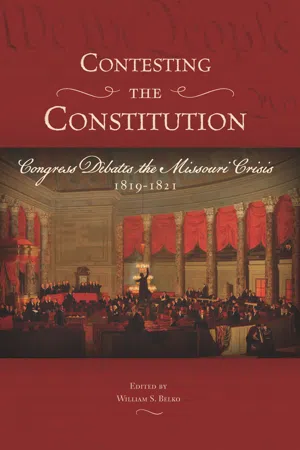
Contesting the Constitution
Congress Debates the Missouri Crisis, 1819-1821
- English
- ePUB (mobile friendly)
- Available on iOS & Android
eBook - ePub
About this book
Information
CHAPTER ONE
Introduction:
Reinterpreting the Constitution, 1819–1821
“BUT, THOUGH MY feelings are strong for the abolition of slavery, they are yet stronger for the Constitution of my country,” declared Massachusetts congressman John Holmes, representing the Maine District on the verge of joining the Union with her considerably more besieged partner, the Missouri Territory. “And, if I am reduced to the sad alternative to tolerate the holding of slaves in Missouri, or violate the Constitution of my country, I will not admit a doubt to cloud my choice. Sir, of what benefit would be abolition, if at a sacrifice of your Constitution?” Holmes’s overriding concern for the sanctity and preservation of the Constitution echoed throughout the halls of Congress during the debates over whether to admit Missouri as a state in the Union. Few congressmen could deny that the prospect of Missouri’s admission raised a plethora of constitutional questions of the highest order, ultimately exciting intensive and extensive reexamination of the U.S. Constitution. Not since the ratification debates of 1787–1788 had Americans so intensely scoured the Constitution and reconsidered numerous sections therein. The crux of the issue of admitting Missouri into the Union was, at its very foundation, a constitutional question. Fellow New Englander, New Hampshire congressman Clifton Claggett, recognized, as had so many of his colleagues in the House, that the “subject under consideration involves a Constitutional question of the first magnitude, in which the whole Union is deeply interested.” Simply put, the question ultimately to be resolved by Congress was whether that body possessed the authority to place conditions—in this instance, a restriction on the expansion of slavery in Missouri—on a territory before it would be admitted into the Union. To prove the point, for or against slavery restriction, nearly every article and section of the Constitution came under scrutiny, with little if any agreement from opposing sides. “One takes one part of the Constitution, another disclaims that and selects another part; and no two seem to agree throughout,” observed Kentucky congressman Benjamin Hardin. “They have hunted through every section of the Constitution; one fixes on one clause, another on another,” Virginia’s John Tyler concurred. From January of 1819 through the spring of 1821, restrictionists and anti-restrictionists in Congress assumed the garb of Federalists and Antifederalists of the ratification debates, and, as in 1787 and 1788, the fate of a union of states—and a constitution which defined it—initiated intense inspection.1
Congress was not the only governmental entity feeling the weight of the immense constitutional character of the subject before them. The president of the United States, James Monroe, likewise understood the constitutional import of the question under consideration. “As to the part which I may act, in all circumstances in which I may be placed, I have not made up my mind, nor shall I until the period arrives when it will be my duty to act, and then I shall weigh well the injunctions of the Constitution; which, according to my understanding of them, will be conclusive with me,” he wrote to fellow Virginian Spencer Roane in February of 1820. The president considered loyalty to the Constitution (albeit his interpretation of it) of the utmost importance, even ranking higher than his next consideration, that of “the preservation of the Union.” Decades later, in 1848, a U.S. senator from Florida, James Westcott, reflected on Monroe’s draft of a veto message on the 1820 Missouri Bill, declaring that the president had sacrificed his own opinions in order to preserve the Union. Still, the Constitution reigned as the president’s supreme consideration. “If he violated the Constitution,” declared Westcott, “it was to save the Constitution.” Congressmen representing every state in the Union, delegates to every state legislature, newspaper editors across the country, and citizens from free states and slave, all understood the constitutional crisis before them.2
The following chapters address the most consistently contested parts of the Constitution during the debates that formed the political heart of what came to be called the “Missouri Crisis.” Congressmen dissected Article IV above all other sections. The power of Congress to admit new states (Article IV, Section 3, Clause 1), the power of Congress to govern and regulate the nation’s territories (Article IV, Section 3, Clause, 2), the Privileges and Immunities Clause (Article IV, Section 2, Clause 1), and the Guarantee Clause (Article IV, Section 4) all came under close and intense scrutiny as the friends and foes of slavery restriction in Missouri attempted to justify their respective arguments in order to deny or to legitimate congressional power to implement the Tallmadge Amendment. New York congressman James Tallmadge, Jr. proposed this amendment very early on in the Missouri debates in an attempt to modify the Missouri Bill to restrict slavery there as a stipulation to its admission into the Union. Three other sections of the Constitution followed closely on the heels of Article IV—the infamous Three-Fifths Clause (Article I, Section 2, Clause 3), the misunderstood Migration and Importation Clause (Article I, Section 9, Clause 1), and the provocative Treaty-Making Power (Article II, Section 2, Clause 2). These sections combined to consume a considerable portion of the 1819–1821 congressional debates over Missouri’s admission into the Union. Of course, the specter of slavery lurked always behind these constitutional explorations, most definitely coloring the various interpretations and reinterpretations. In the end, few, if any, congressmen ever came to agreement on how to interpret these clauses. In the absence of a resolution to these disagreements, they left to the next generation sectional discord and bloody conflict.
The authors of each chapter herein focused overwhelmingly on the numerous speeches delivered in Congress, from the second session of the 15th Congress through the second session of the 16th Congress, treating the congressional debates in the exact manner as one would the ratification debates of 1787 to 1788. One must note, however, that this can be an imperfect approach, as the editors of the Annals of Congress, Joseph Gales and William Seaton, proved rather sloppy in their reporting. Reporters failed at times to attend a session of Congress, or they arrived too late to record some of the speeches in full. Often speeches were inaudible or background noise prevented the speaker from being fully heard. “The first observations of Mr. L. were lost to the reporter, from the confusion arising from members changing their seats, &c.,” recorded one reporter, and another admitted that “Mr. S. made a few remarks which the reporter did not hear with sufficient distinctness to report them.” As for a two-hour speech by a Pennsylvania congressman, another reporter apologized that “the following must be considered as a free but not very full report.” At one point in the debates a congressman complained to Gales and Seaton that his remarks had been inaccurately recorded, to which the editors had to publish a correction: “We were so cramped for room in our report, that we were obliged to generalize the incidental remarks, and, in doing so, perhaps a wrong impression may have been given to Mr. L.’s observations.” In other instances, reporters referred to the fact that a speech was given, simply stating that a congressman advocated or opposed restriction “in a two-hour speech,” “in a speech of more than three hours,” or “spoke for some time,” and spoke “at considerable length.” Congressmen often handed copies of their speeches to Gales and Seaton for publication in the Annals, thus providing to the public an extended or amended version not always accurately representing what was said on the floor of the House or Senate. Still, the speeches provide the best source for defining the sundry approaches to the monumental constitutional issues being debated.3
The Missouri admission crisis coincided with another, equally intense and divisive, political debate consuming Congress in the decade following the end of the War of 1812, one that at its core was also constitutional and, like the debates concerning Missouri’s admission, greatly strained the unity of the reigning Republican party. The introduction of the American System—a national bank incorporated by Congress, federally sponsored internal improvements, and a protective tariff—preoccupied Congress throughout the Age of Jackson, stimulating divisive and heated arguments. Combined with the controversial decisions of the U.S. Supreme Court under the aegis of Chief Justice John Marshall, penetrating and passionate deliberation about the nature of the Union and the interpretation of its Constitution defined congressional deliberations in the first decade of the Jacksonian Era. At the heart of this ongoing debate stood the age-old struggle between power and liberty, manifested most generally in the struggle between the reserved and delegated powers, a contest that had defined the entire constitutional development of the United States from its colonial inception through independence, from confederation to the creation and ratification of the Constitution, and throughout its first half century.
The Missouri admission crisis became a central feature of this ideological, political, constitutional struggle, that is, over the proper allocation of power. Although the constitutional war over the implementation of the American System lasted well into the last decade of the Age of Jackson, the constitutional considerations inherent in admitting Missouri rivalled, and arguably surpassed, at least in emotional intensity, those of a national bank, internal improvements, and a protective tariff. The Missouri question involved the issue of slavery, which merely fueled and fanned the flames of political and constitutional contention, further intensifying that traditional contest of the reserved versus the delegated powers. The ideological lines in the Missouri debates followed closely, although never exactly, those defining the American System. Opponents of slavery restriction in Missouri defiantly defended the reserved powers, adhering to a strict construction of the powers of Congress, while the proponents of restricting slavery in Missouri tended to defend a broader definition of congressional powers, thus adopting a more liberal interpretation of the Constitution.
These positions regarding the distribution of power in a federal system were not, moreover, mere rhetorical tools for one side to expand slavery and for the other to prevent its spread. The positions taken throughout the Missouri debates (as with those covering the American System) regarding the reserved and delegated powers were not simply means to justify an end, whether it be proslavery or antislavery. They were not arguments made to advance self-interest, but sincere manifestations of how the individuals involved directly defined the constitutional system and the nature of the Union. The Missouri crisis must be viewed, therefore, in this larger constitutional struggle between the reserved and the delegated powers, of strict construction versus a liberal interpretation of the Constitution, for the episode cannot be dissected from the other prevailing constitutional debates of the day.
During the ratification debates of 1787–1788, Antifederalists constantly harangued their opponents with charges of corruption, conspiracy, and consolidation. This latter evil they felt confident would quickly become a certain consequence of adopting the proposed Constitution. The powers delegated in the Constitution, its opponents consistently claimed, could be open to abuse by way of a broad construction. Two clauses, both in Section 8 of Article I, concerned them above all—the Necessary and Proper Clause and the General Welfare Clause. These two passages in the Constitution had given the founding generation pause, since they empowered Congress with specified powers but might entail an expansion of such powers through a more liberal interpretation; the issue resurfaced in the Missouri debates. In fact, congressmen deliberating the fate of Missouri statehood turned to these two bugaboos in nearly every public address. Both the guardians of strict construction—overwhelmingly anti-restrictionist—and the friends of congressional supremacy—vastly restrictionist—employed these clauses in the attempt to address the legality of the expansion of slavery.
Friends of the Tallmadge Amendment argued that the Necessary and Proper and the General Welfare clauses clearly provided Congress the requisite power to prevent the spread of slavery. The proponents of restriction, nearly to a man, delivered lengthy enquiries “to prove that the Constitution, according to a fair and liberal construction of that instrument,” as Illinois’s Daniel Pope Cook confidently contended, “does vest the power in Congress to legislate upon this subject.” Pennsylvania’s John Sergeant praised the latest “fashion to insist upon a liberal construction of the Constitution,” which its “most extensive efficacy has been found in the implied powers it is supposed to confer.” All powers, he asserted, “are implied that are necessary for the execution of the enumerated powers,” a necessity that “need not be absolute,” as a “modified necessity or high degree of expediency is sufficient.” According to the accepted position of those seeking an emancipated Missouri, “an original power having been granted, every other power is implied which is necessary or useful for carrying that power into execution,” and this proved to be an “inherent, essential principle of the Constitution, altogether independent of its express words.” Vermont congressman Charles Rich went so far to claim that the Necessary and Proper Clause provided Congress the power to regulate slavery simply because of the express power to protect states from domestic violence. “If, then, it be true, that there is a danger of domestic violence from the existence of slavery, which I am confident none will deny, I should apprehend that a law, the object and certain tendency of which is to diminish the relative number of slaves in our country, and spread a free white population over the fairest portions of it,” he pondered, “must not only be proper, but indispensably necessary, to guard against the occurrence of violence, and preserve the United States in a condition to discharge its duties.” This assumption proved popular among many Northern congressmen.4
Opponents of implied congressional authority, however, greatly feared such assertions of constitutional interpretation by their opponents. They no more believed Congress had the power to incorporate a bank, levy a protective tariff, or fund internal improvements than it could place conditions on a state’s admission or interfere with a domestic institution. Anti-restrictionists repetitively reproached restrictionists for making “the most extravagant of all claims,” that of espousing a construction of Article I, Section 8 that “swallows up all the rest” of the enumerated powers. Their interpretation of the General Welfare Clause and the Necessary and Proper Clause, asserted Maine’s Holmes, “will not only absorb all other powers,” but will also “break down, destroy and overwhelm all prohibitions and restraints.” Give Congress such broad powers, he predicted, and it would not be enough. “Their powers are greater than those of any despot in the world.” Such assertions were widely accepted within anti-restrictionst circles in Congress.5
First, opponents of restriction fought the interpretation of the General Welfare Clause. “With a view to put an end to this claim on the part of Congress, of power to pass whatever law they please,” Virginia congressman Alexander Smyth turned to the Constitutional Convention to “prove the falsehood” of those who attempted to interpret the first clause under Section 8 into separate clauses, thereby providing Congress, under the general welfare reference, the authority to pass any legislation deemed beneficial for the general welfare. This clause, he maintained, was “a limitation of the power of taxation” only, which the framers of the Constitution intended “should not be carried further than was necessary to pay the debts and provide for the general welfare.” The General Welfare Clause, therefore, merely conferred a power to raise funds as a means of executing the other powers of Congress. “How the clause came to be divided into clauses,” he wondered, “cannot perhaps be now ascertained.” Hardin of Kentucky rebuked congressmen who argued that the General Welfare clause gave Congress the power to “enact and pass any law that may tend to the permanence, durability, and glory of the General Government.” According to such a construction of this clause, if Congress should ever feel that the state governments “retarded the advance and progress of the nation in its rapid and brilliant career of national prosperity,” then it could simply “extinguish and annihilate them.” Hardin considered this a “great departure from the good old democratic doctrine of 1788,” for the clause in question clearly contained no delegation of power other than to lay and collect taxes, duties, imposts, and excises, in order to pay the debts and provide common defense of the Union. “I am heartily tired with the continued and repeated claims of this General Welfare,” he ended. If a fellow congressman “be right in his principles of construction, taking the clause which gives general legislation to Congress—making, as he does, the sovereignty reside in the Government,” added Virginia congressman James Johnson, “it squints not only at monarchy, but at despotism—despotism as absolute as ever wielded.” By using the terms “common defence” [sic] and “general welfare,” Johnson acknowledged, “to point out the objects for which the specified and enumerated powers had been delegated,” Congress instituted a government “of the most indefinite and unlimited powers.”6
The opponents of slavery restriction likewise assailed the liberal construction of the Necessary and Proper Clause, agreeing ardently with Kentucky’s Hardin that it contained no delegation of power, neither adding to nor diminishing the powers of Congress. The clause, he believed, “was evidently introduced first to prevent those who were hostile to the General Government from alleging that it had no powers incidental to those expressly granted,” and which were “necessary to be exercised to effectuate the objects for which the Constitution was framed and adopted.” By employing the word “necessary,” therefore, the framers intended “to restrict and prevent” Congress from taking “too great a latitude” in its selection and adoption of the means “to carry into full effect the powers already granted.” The prevailing doctrine that Congress can enact any law it considers “needful and necessary for the health and prosperity of the General Government,” Hardin concluded, “is a most dangerous one,” and if this mo...
Table of contents
- Cover Page
- Half Title Page
- Title Page
- Copyright Page
- Contents
- Contributors
- Chapter One. Introduction: Reinterpreting the Constitution, 1819–1821
- Chapter Two. The Privileges and Immunities Clause
- Chapter Three. The Guarantee Clause
- Chapter Four. Rules of Membership: The Missouri Crisis and the Power to Admit New States
- Gallery
- Chapter Five. The Power to Regulate the Territories
- Chapter Six. The Three-Fifths Clause
- Chapter Seven. The Migration and Importation Clause
- Chapter Eight. The Treaty-Making Powers
- Index
Trusted by 375,005 students
Access to over 1.5 million titles for a fair monthly price.
Study more efficiently using our study tools.
Frequently asked questions
Yes, you can cancel anytime from the Subscription tab in your account settings on the Perlego website. Your subscription will stay active until the end of your current billing period. Learn how to cancel your subscription
No, books cannot be downloaded as external files, such as PDFs, for use outside of Perlego. However, you can download books within the Perlego app for offline reading on mobile or tablet. Learn how to download books offline
Perlego offers two plans: Essential and Complete
- Essential is ideal for learners and professionals who enjoy exploring a wide range of subjects. Access the Essential Library with 800,000+ trusted titles and best-sellers across business, personal growth, and the humanities. Includes unlimited reading time and Standard Read Aloud voice.
- Complete: Perfect for advanced learners and researchers needing full, unrestricted access. Unlock 1.5M+ books across hundreds of subjects, including academic and specialized titles. The Complete Plan also includes advanced features like Premium Read Aloud and Research Assistant.
We are an online textbook subscription service, where you can get access to an entire online library for less than the price of a single book per month. With over 1.5 million books across 990+ topics, we’ve got you covered! Learn about our mission
Look out for the read-aloud symbol on your next book to see if you can listen to it. The read-aloud tool reads text aloud for you, highlighting the text as it is being read. You can pause it, speed it up and slow it down. Learn more about Read Aloud
Yes! You can use the Perlego app on both iOS and Android devices to read anytime, anywhere — even offline. Perfect for commutes or when you’re on the go.
Please note we cannot support devices running on iOS 13 and Android 7 or earlier. Learn more about using the app
Please note we cannot support devices running on iOS 13 and Android 7 or earlier. Learn more about using the app
Yes, you can access Contesting the Constitution by William S. Belko in PDF and/or ePUB format, as well as other popular books in History & American Civil War History. We have over 1.5 million books available in our catalogue for you to explore.