An Introduction to Safety Grounding
eBook - ePub

An Introduction to Safety Grounding

  1. 170 pages
  2. English
  3. ePUB (mobile friendly)
  4. Available on iOS & Android
eBook - ePub

An Introduction to Safety Grounding

About this book

Safety or protective grounding is of vital importance for the protection of individuals from electric shock and structures and industrial concerns from potentially damaging lightning and electrostatic discharges. To many electrical engineers the notion of grounding is nebulous and safety grounding is quite often confused with neutral grounding of the power supply. The main objective of this book is to give the reader a better understanding of safety grounding, why it is needed, where it is needed, and what are the requirements which must be met in order to have an effective grounding system. The text as a whole serves to provide the reader with the necessary background for a better appreciation of the various National and International Standards concerned with safety grounding.

This book gives the reader a good understanding of the fundamentals of safety grounding. It is a practical guide that provides a comprehensive coverage of all types of grounding requirements and is intended for students and practicing electrical engineers alike.


  • Summarizes the physiological effects of current on the human body and the effect of current duration


  • Gives the various methods of measuring soil resistivity and measuring the resistance to ground of an electrode or grounding system


  • Reviews different types of ground electrodes and the effect of their geometry and numbers on the resistance to ground


  • Presents the components of a ground system, methods of improving soil resistivity, the types of welds and joints, the criteria for determining conductor cross-sections, galvanic corrosion, and a survey of the different grounding practices used at substations and the different types of grounding systems used for the protection of consumers


  • Deals with electrostatic and lightning hazards that can cause serious damage and the measures used to protect against such damage


  • Throughout the text frequent reference is made to various National and International Standards and their requirements as compliance with these standards is highly advised

Asser A. Zaky, Ph.D., FIET, F.Inst.P., FIEEE, is Emeritus Professor of Electrical Engineering at University of Alexandria, Egypt.
Frequently asked questions

Yes, you can cancel anytime from the Subscription tab in your account settings on the Perlego website. Your subscription will stay active until the end of your current billing period. Learn how to cancel your subscription.
No, books cannot be downloaded as external files, such as PDFs, for use outside of Perlego. However, you can download books within the Perlego app for offline reading on mobile or tablet. Learn more here.
Perlego offers two plans: Essential and Complete
  • Essential is ideal for learners and professionals who enjoy exploring a wide range of subjects. Access the Essential Library with 800,000+ trusted titles and best-sellers across business, personal growth, and the humanities. Includes unlimited reading time and Standard Read Aloud voice.
  • Complete: Perfect for advanced learners and researchers needing full, unrestricted access. Unlock 1.4M+ books across hundreds of subjects, including academic and specialized titles. The Complete Plan also includes advanced features like Premium Read Aloud and Research Assistant.
Both plans are available with monthly, semester, or annual billing cycles.
We are an online textbook subscription service, where you can get access to an entire online library for less than the price of a single book per month. With over 1 million books across 1000+ topics, we’ve got you covered! Learn more here.
Look out for the read-aloud symbol on your next book to see if you can listen to it. The read-aloud tool reads text aloud for you, highlighting the text as it is being read. You can pause it, speed it up and slow it down. Learn more here.
Yes! You can use the Perlego app on both iOS or Android devices to read anytime, anywhere — even offline. Perfect for commutes or when you’re on the go.
Please note we cannot support devices running on iOS 13 and Android 7 or earlier. Learn more about using the app.
Yes, you can access An Introduction to Safety Grounding by Asser A. Zaky in PDF and/or ePUB format, as well as other popular books in Tecnología e ingeniería & Ingeniería eléctrica y telecomunicaciones. We have over one million books available in our catalogue for you to explore.

1 Effect of Current on the Human Body

1.1 Introduction

There are essentially two types of grounding:1
  1. System grounding
  2. Protective or equipment grounding
In the first type of grounding the star points of the equipment may be solidly grounded or grounded through a resistance or an inductance (Petersen coil) according to the operating requirements of the network. These requirements depend on several factors such as the maximum permissible stress on the insulation, the magnitude of the short circuit current, and the overall protective characteristics of the network.
The second type of grounding, which is the subject of this book, has two objectives:
  1. To protect people (and animals) in the event of the occurrence of a fault to ground.
  2. To protect buildings and installations against fire and lightning.
In order to protect people (operators, maintenance and repair technicians, and the public at large) against electric shock if they come in contact with metal parts which normally are not live and do not carry any current, it must be ensured that under fault conditions the potential of such parts does not rise to a value which would be considered dangerous to persons or give rise to leakage currents which, even if very small, can with time raise the temperature of the material through which it flows to a value sufficient to initiate a fire if the material is readily inflammable. Protection is provided by deliberate grounding of all metal structures, motor, generator and transformer frames, metal enclosures of all tools and control equipment, connection boxes, cable trays, and all other metal bodies which contain or are adjacent to electric circuits and which are within reach of any person.
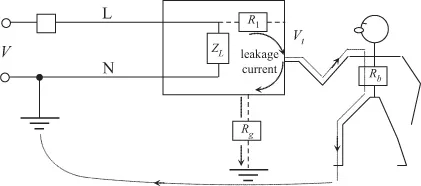
Figure 1.1 shows the equivalent circuit of an electrical equipment connected to a supply source of voltage V. The resistances shown are as follows:
The figure shows how a man touching an ungrounded metal casing of an energized electrical equipment can experience an electric shock as a current passes through his body to ground.
FIGURE 1.1 Isolated equipment.
R1: resistance of the insulation between live parts and equipment case,
Rg: resistance between casing and ground, and
Rb: resistance of a person’s body to ground.
1 The terms grounding and earthing are used interchangeably.
The voltage Vt which appears on the case is
Vt = V RgR1 + Rg(1.1)
When a short circuit occurs between the live conductor and the case (R1 = 0), Vt becomes equal to V and the current which flows through the body of a person who touches the frame is
Ib=V/Rb.
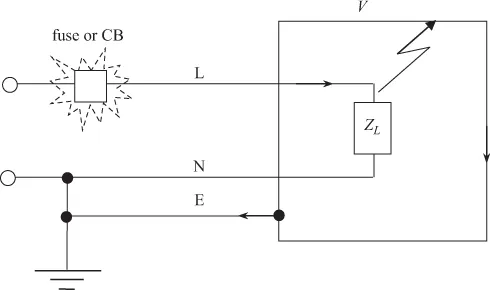
If the case were connected to a perfect ground such that Rg = 0 then the case would always be at zero potential. However, in practice the resistance to ground is never zero so that under fault conditions the case voltage is V and remains at that value until the protective device (fuse or circuit breaker) disconnects the supply (Figure 1.2). To make certain that the person who touches the case is not at risk the circuit must be disconnected within a specified time (see Section 1.3); since the operating time of the protective devices depends on the magnitude of the short circuit current, it is necessary to ensure that the resistance between the case and ground is sufficiently small to allow the passage to ground of a current whose value is sufficient to operate the protective device within the permitted time. To fulfill this requirement the resistance to ground must not exceed a certain value usually specified by national or international standards. This value varies between 1 and 25 Ω depending on the magnitude of the short circuit current.
When the metal casing of an electrical equipment is grounded a fault between a line wire and the casing will cause a fuse or circuit breaker to disconnect the supply.
FIGURE 1.2 Earthed equipment.
As for the protection of buildings and installations against lightning strikes, this is accomplished by earthing systems especially designed for this purpose and its implementation is determined by how critical such a protection is. Protection of structures against lightning is dealt with in Chapter 8.
In all of the national and international specifications protective grounding of all equipment is an obligatory safety requirement irrespective of other considerations such as electromagnetic compatibility, for example. It is therefore of primary importance that there be a close cooperation between the engineering consultant responsible for the design of supply and grounding system of any installation and the designer of the electronic equipment to be installed in the building in order to choose the optimum system which will meet both the safety requirements and the compatibility requirements within the electromagnetic environment at the premises.

1.2 Effect of Electric Shock on Human Beings

A person is subjected to an electric shock if he touches any live conductor or other metallic body while at the same time touching another grounded body or standing on a moist ground or is barefooted. Although the common belief is that the voltage is the cause of the shock, the consequences and severity of the shock depend on many factors, the most important of which is the magnitude of the current which flows through the body, the path of this current, and its duration.
Numerous studies and observations have shown that the effect of a low-frequency current (0–300 Hz) on the human body varies with the magnitude of the current which flows through the chest area. Table 1.1 shows a summary of the effects produced...

Table of contents

  1. Cover
  2. Half Title
  3. Title Page
  4. Copyright Page
  5. Table of Contents
  6. Preface
  7. Chapter 1 Effect of Current on the Human Body
  8. Chapter 2 Resistance to Ground
  9. Chapter 3 Earthing Electrodes
  10. Chapter 4 Step, Touch, and Transfer Voltages
  11. Chapter 5 Grounding Systems
  12. Chapter 6 Substation Grounding Systems
  13. Chapter 7 Static Electrification
  14. Chapter 8 Protection against Lightning
  15. Appendix A: Wire Sizes
  16. Bibliography
  17. Index