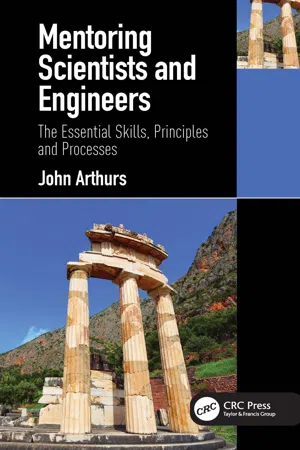
Mentoring is very much more than simple one-to-one informal instruction, or what used to be called 'coaching'. Modern mentoring techniques are modelled on those of executive coaching as well as expert academic tutoring. Mentoring is simple but not necessarily easy. An estimated 40% of all mentoring schemes fail through lack of mentor training and understanding. No great effort is required to study the literature but, for mentoring to be effective, adherence to basic principles and exercising specific skills is absolutely necessary. The book provides an introduction to what we mean by mentoring and its basic skills – skilful questioning, active listening, building trust, self-management and giving advice and feedback. It further covers mentoring principles, how to conduct mentoring sessions and a wide range of practical applications. The final chapter gives the outlines and principles for creating a basic mentoring scheme within an organisational context.
This book is written for those practitioners in science, technology, engineering and mathematics, the STEM fields, who have been pitched into the role of mentor without any prior training. Its objective is to alleviate anxiety, frustration and stress caused by not knowing exactly what is expected. In offering an introduction to mentoring it gives practical guidance as a quick and easy read.
Being pitched into the role of mentor without any prior training is a common experience for senior practitioners in the world of science, technology, engineering and mathematics (the STEM fields). For many otherwise highly trained experts who find themselves in this situation, mentoring can cause anxiety, frustration and stress. Most of us are following a wholly absorbing vocation. Up to this point we will probably neither have had the time nor the inclination to seek mentor training. If that describes your situation then ‘Mentoring Scientists and Engineers’ is expressly written for you. It offers an introduction to mentoring along with practical guidance on the basic skills, principles and processes in what is intended as a quick and easy read. The harder bit comes with the practice.
Being a new mentor describes my situation about 20 years ago, engaged as I was in a busy career in applied geoscience in mineral exploration and government scientific service. Now, looking back, I wish I had known the principles, process and skills covered here at a very much earlier stage in my life. They are things that I learned by receiving good mentoring and professional executive coaching, by undergoing coach training myself and then through years of practice. It’s not that the difficult interpersonal situations I met on the way would not have arisen, they probably would. It’s rather that I would have known better how to manage such situations and so created better outcomes. As an expression of my own learning, this book is an eclectic and idiosyncratic compilation of many different sources and subjects ranging through coaching and mentoring, popular psychology and social science, communication and management studies. The ideas are generic and widely applicable. The book was written in the hope that they will help you in whatever branch of science, technology and engineering that you practise.
As professional scientists and engineers we are all the beneficiaries of a magnificent history of scholarship that stretches back over a thousand years. While our universities do an excellent job of primary training, think back to how you were when you graduated or how it is now to work with recent graduates. We see performance gaps showing up in unexpected ways. Although not lacking basic technical knowledge, it is clear that recent graduates do not have all of the skills they need. Common lapses appear as ignorance of essential techniques, in critical thinking, in communication skills both written and interpersonal, in under-developed professional attitudes and in understanding of our employer’s purpose and organisational culture. All these kinds of knowledge and skills we lump together under the vague heading of ‘experience’. When you have this experience we believe, then you become really useful and effective in your job. In spite of excellent post-graduate technical training and the wide availability of training courses in the so-called soft skills, the process of gathering professional experience is still mainly informal, ad hoc and unstructured. In fact, we learn mainly from our peers and our seniors on the job. That begs the question at the heart of this book – what is the best way to help our younger colleagues gain experience and develop as professionals?
There is a widespread belief, in my view mistaken, that mentoring is just a kind of on-the-job, one-to-one technical training that some people mistakenly call coaching. This kind of informal training is what is called in the UK Civil Service, ‘Sitting with Nellie’. If you have either been Nellie or sat beside her, you will know that she needs much more than knowledge of the job alone to be effective. She must also be in possession of a specific set of interpersonal skills. You’ll have an inkling of what these skills are if you reflect on good mentoring you have received in the past, perhaps mentoring that inspired you and opened your eyes to what you really wanted to do in your life and career. In later life it may have occurred to you to ask yourself, “How exactly did she do that?”
Looking back into our own personal history, everyone has felt the influence of other people on the development of their career. Learning from a mentor ranges on a spectrum from an occasional, casual and incremental piece of useful knowledge at one extreme, to a series of life-changing realisations that influence the whole of one’s life and career at the other. As a mentor you can derive enormous satisfaction from watching your mentees’ successes. It is, however, a vicarious satisfaction. One of the most powerful motivations to become a mentor is to repay the debt that you feel you owe for knowledge and skill that you received from your own mentors in the past.
Social science research over the last two decades has confirmed our everyday wisdom that says mentoring helps both mentees and mentors. Repeated surveys of successful mentoring among widely diverse organisations have shown that both mentees and mentors draw higher salaries, climb their career ladders faster and are more satisfied with their careers overall. See, for example, Allen et al. (2006) and Holland (2009) (Note: bibliographic details are given at the end of the book in References).
Managers of STEM organisations carry the responsibility to ensure best practice, to protect their organisations against the risk of professional error and to encourage their professional employees to develop their careers. While formal training is the proper response, in fact many conventional training courses yield a disappointing return on investment. Research studies have shown that mentoring in support of training courses greatly helps trainees to remember and to transfer the material they have been learning into their occupations. See, for example, Olivero et al. (1997).
Formal mentoring schemes may seem like the obvious management response to promote and enhance the very significant benefits that mentoring can provide. In spite of the best intentions of their organisers, however, these formal schemes are often dysfunctional and a great many just fade away. One of the UK’s leading and best-known authorities on mentoring, David Clutterbuck, writes:
Estimates of what proportion of mentoring programmes fail to deliver significant benefits vary widely, depending on how success or failure is assessed. A good working estimate, however, would be that at least 40% do not meet one or more of the following criteria:
Achieving a clear business purpose (e.g. improving retention in a target group of mentees by 25% or more)
Achievement of most mentees’ personal development objectives
Learning by most of the mentors
Willingness of both parties to engage in mentoring (as mentor or mentee) again… and many meet none of these.
So how should we avoid dysfunctional mentoring? Everyone knows there is more to it than just giving some good-natured advice. But what exactly is that ‘more’? Since 2016, one of the world’s great learned societies, the Geological Society, has sponsored training workshops for mentors, represented by groups of very experienced and highly qualified senior geoscientists. As the organisers of these events, we asked the participants before they started what it was that they wanted to learn about mentoring. At the time we were surprised by the high proportion of this group of very experienced scientists (97%) who seem to have found themselves thrown in at the deep end of mentoring without any training at all.
The overwhelming majority (92%) wanted to find out about interpersonal mentoring skills, processes and structure and not, as you might expect, tips on giving technical instruction in geology. Just over a third of the total sample (36%) simply wanted some generic guidance, such as, “An increased awareness of techniques to assist individuals in meeting their full potential”, “To have a clearer understanding of the differences between mentoring and coaching” and “Where is the line (if any) between technical mentoring and personal mentoring?” In a related request, about 15% wanted to know how to structure the mentoring process, for example, “… strategy for mentoring, including how to prepare for meetings with mentees. Also, advice on what I need to do better/differently for the mentee to get the most out of my mentoring”. For many, confidence in their own ability to mentor was the major issue. Echoing the views of many, one person asked, “What level of responsibility do I have for my mentee?” With a hint of desperation, another reflected, “... worried that I didn’t know what I was doing.” One remarked, “I find it difficult to discuss challenging behaviours and issues”. These concerns were closely related to problems about motivating early career scientists who are resistant to gaining chartership and in other matters. Commonly desired interpersonal skills included managing the mentoring relationship and expectations around managing time, such as, “How much to give and how to cope with mentoring in the midst of an already busy work schedule?”
Overall, a feeling of floundering, worry and frustration ran through the responses to our questionnaires. It is now abundantly clear that a large majority in our sample of otherwise successful geoscientists found themselves in a mentoring role without really understanding what they should be doing. Since then, talking to colleagues in other scientific and engineering professions, it has become equally clear that this experience is widespread.
Mentoring is simple but not necessarily easy. No great effort is required to study the literature, but adherence to a small number of principles and exercising specific skills is absolutely necessary for mentoring to be effective. Many of the skills are closely similar to those practiced in counselling but applied in a non-therapeutic context. These skills rest firmly on a set of professional ethics and a client-centred approach. Some mentors have spontaneously developed these ideas and skills for themselves and so need little training. Most of us, however, need some guidance and practice to enhance our mentoring within our own professions. This book provides an introduction.
To begin with, all mentors need three essential attributes:
1 Specialist knowledge and skill in the same profession as their mentees,
2 Possession of, or willingness to acquire, the knowledge and interpersonal skills needed to create a productive mentoring relationship, and,
3 The time and inclination to be a mentor,
What you will find in subsequent chapters is:
Chapter 2. What is a Mentor? This chapter provides definitions, gives an overview of what a mentor does and shows how that differs from other learning and development techniques.
Chapter 3. Essential Mentoring Skills. A good mentor is not only a high performing practitioner in his /her own profession but also exercises five essential interpersonal skills: (1) Skilful questioning, (2) Active listening, (3) Building trust, (4) Self-management, and, (5) Giving constructive advice and structured feedback. The first four skills (questioning, listening, self-management and trust building) form part of the more extensive skill set of professional and executive coaching. The final skill (giving advice and feedback) is that of professional advisors such as lawyers and doctors. Finally, other desirable competencies are briefly described. They include explaining, raising awareness, designing strategies, using intuition and understanding leadership issues.
Chapter 4. Mentoring Principles & Process. Practical advice is given about how to manage the mentoring process and reduce the risk of a dysfunctional relationship. The meanings and consequences of each of five principles are explained: (1) Creating awareness is the primary purpose, (2) Client-centred mentoring, (3) Self-responsibility, (4) Intrinsic self-motivation and (5) Ethical responsibility. A four-stage structured framework for a mentoring engagement in a short series of time-limited sessions is described:
1 Connecting, how a mentoring pair comes together
2 Scoping explores whether or not the pair actually should work together. If agreed, a mutual understanding of what ...
Table of contents
Cover
Half Title
Title Page
Copyright Page
Table of Contents
Foreword
Acknowledgements
Author
1. Introduction
2. What is a mentor?
3. Essential mentoring skills
4. Mentoring principles and process
5. Mentoring in practice
6. Mentor training and organisational mentoring schemes
References
Index
Trusted by 375,005 students
Access to over 1.5 million titles for a fair monthly price.
Study more efficiently using our study tools.
Frequently asked questions
Yes, you can cancel anytime from the Subscription tab in your account settings on the Perlego website. Your subscription will stay active until the end of your current billing period. Learn how to cancel your subscription
No, books cannot be downloaded as external files, such as PDFs, for use outside of Perlego. However, you can download books within the Perlego app for offline reading on mobile or tablet. Learn how to download books offline
Perlego offers two plans: Essential and Complete
Essential is ideal for learners and professionals who enjoy exploring a wide range of subjects. Access the Essential Library with 800,000+ trusted titles and best-sellers across business, personal growth, and the humanities. Includes unlimited reading time and Standard Read Aloud voice.
Complete: Perfect for advanced learners and researchers needing full, unrestricted access. Unlock 1.5M+ books across hundreds of subjects, including academic and specialized titles. The Complete Plan also includes advanced features like Premium Read Aloud and Research Assistant.
Both plans are available with monthly, semester, or annual billing cycles.
We are an online textbook subscription service, where you can get access to an entire online library for less than the price of a single book per month. With over 1.5 million books across 990+ topics, we’ve got you covered! Learn about our mission
Look out for the read-aloud symbol on your next book to see if you can listen to it. The read-aloud tool reads text aloud for you, highlighting the text as it is being read. You can pause it, speed it up and slow it down. Learn more about Read Aloud
Yes! You can use the Perlego app on both iOS and Android devices to read anytime, anywhere — even offline. Perfect for commutes or when you’re on the go. Please note we cannot support devices running on iOS 13 and Android 7 or earlier. Learn more about using the app
Yes, you can access Mentoring Scientists and Engineers by John Arthurs in PDF and/or ePUB format, as well as other popular books in Business & Human Resource Management. We have over 1.5 million books available in our catalogue for you to explore.