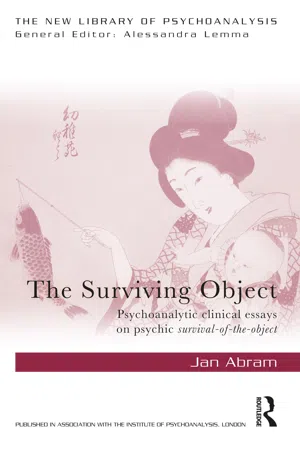
In this book, Abram proposes and elaborates the dual concept of an intrapsychic surviving and non surviving object and examines how psychic survival-of-the-object places the early m/Other at the centre of the nascent psyche before innate factors are relevant.
Abram's clinical-theoretical elaborations advance several of Winnicott's key concepts. Moreover, the clinical illustrations show how her advances arise out of the transference-countertransference matrix of the analyzing situation. Chapter by chapter the reader witnesses the evolution of her proposals that not only enhance an appreciation of Winnicott's original clinical paradigm but also demonstrate how much more there is to glean from his texts especially in the contemporary consulting room. The Surviving Object comprises 8 chapters covering themes such as: the incommunicado self; violation of the self; the paradox of communication; terror at the roots of non survival; an implicit theory of desire; the fear of WOMAN underlying misogyny; the meaning of infantile sexuality; the 'father in the nursing mother's mind' as an 'integrate' in the nascent psyche; formlessness preceding integration; a theory of madness.
The volume will appeal to psychoanalysts and psychoanalytically-informed psychotherapists of all levels who are inspired by clinical psychoanalysis and the study of human nature.
While all Freudian analysts expect their patients to lie on the couch and to say whatever comes to mind, why did Winnicott suggest that it was the patient’s prerogative not to say whatever comes to mind? Despite his agreement on free association as an invaluable method for psychoanalysis his late proposal emphasised a paradox. While communication is essential and enriches relationships at the same time each one of us also has the right not to communicate even, and perhaps especially, at the very beginning of life and on the analyst’s couch. Winnicott addresses the topic of communicating and not communicating and raises another important question on intrapsychic and interpsychic communicating: ‘…how to be isolated without having to be insulated?’ (Winnicott [1963a] 1965a: 187).
What are the key elements to the capacity to feel real and to feel seen and recognised? Towards the end of his life Winnicott wrote a short and succinct poem to highlight his ideas on how a subjective sense of self comes into being. The process is contingent on being seen.
When I look I am seen, so I exist.
I can now afford to look and see.
I now look creatively and what I apperceive I also perceive.
(Winnicott [1967a] 1971: 114)
These lines speak for the infant who cannot use words and yet has reached the major psychic developmental point of being able to distinguish between Me and Not-me. The baby in the Ukiyo-e wood print (Figure 1) represents a good example of that developmental moment in which they had reached the stage of Relative Dependence (Winnicott [1963] 1965: 84). The baby still requires holding by the mother, but the mother intuitively knows that her baby is ready to be introduced to a third – represented by the carp fish streamer.1 It indicates that this particular baby has internalised the experience of their mother’s ‘ordinary devotion’ to every infantile need to such an extent that the ability to perceive Me from Not-me has been reached. Subsequent to that psychic achievement they are able to start the process of seeing another Not-me. The details of how the newborn achieves this psychic capacity was Winnicott’s lifelong quest to understand and to formulate. The key to the analyst being able to discern the ‘clinical infant’ (Green & Stern 2005) in the adult lying on the couch is based on the profound appreciation of early psychic processes that emanate from the analyst’s own ‘clinical infant’ (Winnicott [1967b] 1989).2
* * *
Even his name – Winni – cott – conjures up Christopher Robin’s favourite transitional object and every baby’s holding environment outside of mother’s arms.3
In 1972, a year after his death, Marion Milner shared memories of her friend and colleague Donald, at a Memorial Meeting held by the British Psychoanalytical Society. 1957 – somewhere in France – the little clown she saw in a small town square, who appeared not to be able to do what the other acrobats were doing as he jumped up to the trapeze bar, but then suddenly when he finally did reach the bar, he whirled himself round faster than anyone else – delighting and thrilling the crowd – like a Catherine wheel. This was another of Marion Milner’s images reminding her of Winnicott. The dark centre of the spinning firework reminded her of Winnicott’s writings on the unknowable core self (Winnicott [1962] 1965c: 187).
One of the images I particularly enjoy of Milner’s is a cartoon from the New Yorker of two hippopotami surfacing from the water with one mouth wide open. The caption underneath reads: ‘I keep thinking it’s Tuesday’. She showed this to Winnicott during WW2, and it was a joke they shared for years after.
The cartoon resonates with psychoanalytic preoccupations concerning the threshold of consciousness between the surface of the water as the place of submergence or emergence. There are several other Winnicottian themes depicted by this simple cartoon: transitional space, aggression, communication and friendship; the sharing of an experience of absent-mindedness, which is something that Milner herself was preoccupied with when she suggested that ‘ordinarily’ human beings ‘think on two different levels in an oscillating rhythm’ and emerging from absent-mindedness into a more conscious state of mind makes it difficult to know where we had been (Milner 1972: 195).
Good clowns, like good jokes, strike home, taking us to the essence of something inside us that is felt but may not yet be thought in the conscious mind. This is true of great poets, writers and artists and, to my mind, why André Green once said of Winnicott ‘that he was the next greatest mind in psychoanalysis after Freud’.4
This essay is a reflection on Winnicott’s concept of the Self and pays particular attention to the ‘incommunicado self’, as Winnicott describes it in 1963, and how this relates to Marion Milner’s comments from her 1972 paper, ‘Winnicott and the Two Way Journey’ (see Milner 1972 in Abram 2013). The clinical example aims to illustrate these themes in the context of the analytic setting.
The Self
Winnicott writes that during a Scientific Meeting (of the British Psychoanalytical Society), he suddenly realised ‘there’s no such thing as a baby’ (Winnicott [1952] 1958b). This realisation led to him to formulate his thinking on the nascent psyche at the very beginning of life in which he proposed a stage of development that preceded object relationships. This has become one of the hallmarks of his work and it was a radical proposal. At that time (circa 1942) object relations according to Kleinian theory were seen to exist from the start of life. By focusing on the merger between infant and mother at the beginning, Winnicott advanced the concept of primary narcissism (Roussillon 2010 in Abram 2013; cf. Abram & Hinshelwood 2018: 29–35). In 1952, Winnicott clarified what he meant by ‘there’s no such thing as a baby’. He considered that the ‘centre of gravity’ of each individual started off in the ‘environment–individual set-up’ or what he also described as the ‘total set-up’. He referred to the shell as the parents who were gradually taken over by the kernel, ‘which has looked like a human baby’ ([1952]1958b: 99).
In the same year as presenting ‘Anxiety Associated with Insecurity’ he wrote another paper ‘Psychoses and Child Care’ and set out clearly what he suggested as the earliest patterns of relating. There is a healthy pattern of relationship and, conversely, a pathological pattern of relationship (Winnicott [1952] 1958c).
The essential point Winnicott stresses is that the pattern of relationship is set up from the very beginning and is absolutely contingent on the environment. In his late work he categorised two types of babies based on these proposals in both papers. Either the baby had been held or not. Up until the end of his life he maintained this position, i.e. that the mental health of the individual is founded on the earliest environment. Based on this theory, I have recently suggested that there are two Winnicottian babies: a baby who knows at a corporeal level what it means to be held and a baby who does not (Abram & Hinshelwood 2018: 46). This contrasts with Klein, who proposed that the paranoid-schizoid position is universal. For Winnicott, the state of mind depicted by the paranoid-schizoid position demonstrated a failure of the earliest stage of psychic development in which the infant had suffered gross impingement.
For Winnicott, there are two qualities of environmental impingement. A benign impingement is accepted by the infant because in the context of being held the baby is ready for an experience and therefore will be enriched by the impingement. Whereas, in the pathological pattern of relating, the infant is not emotionally ready and is obliged to react to the impingement. The impingement thus becomes a ‘gross impingement’, as Winnicott described because the infant’s reaction (without thought) constitutes trauma. The emphasis here is that the subjective reaction to impingement is the cause of internal breaks in the continuity-of-being which distorts ordinary development.
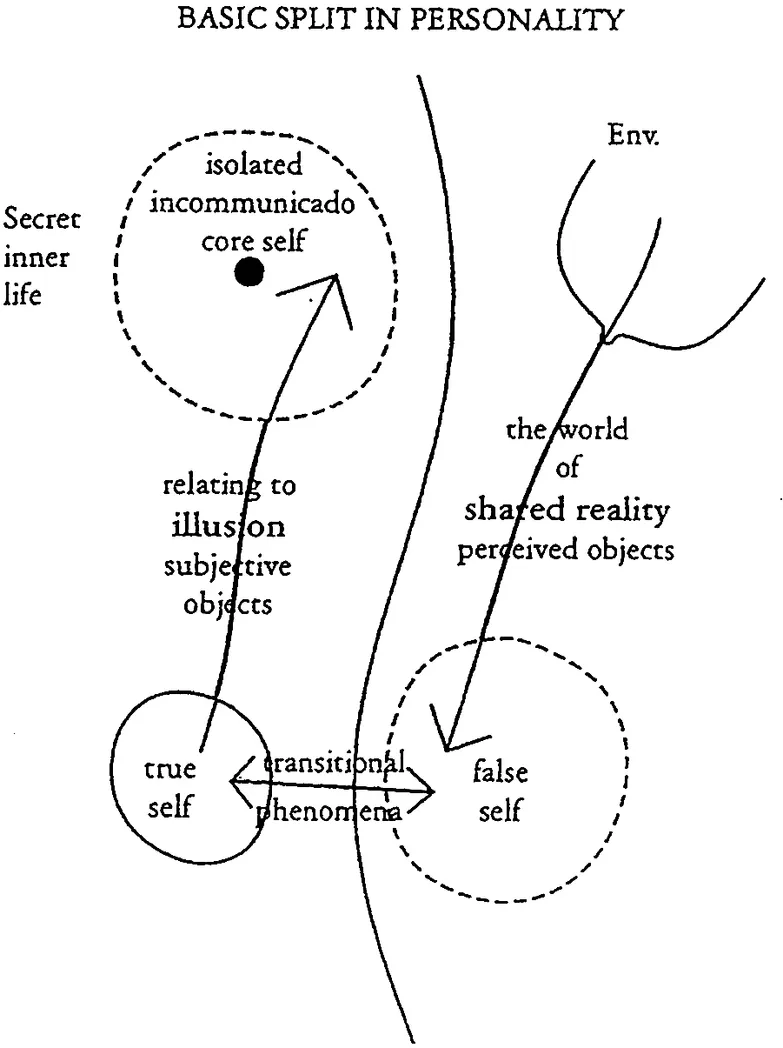
From this same paper Winnicott introduces the notion of the ‘isolate core self’. Here we see what could be described as a divided self.5 Winnicott refers to the ‘basic split in the personality’ that is pathological and as a result of a failing environment. He suggests that a failing environment causes the individual to create a ‘secret inner life’ and this inner life is truly incommunicado because it has ‘very little in it from external reality’ (Winnicott [1952] 1958c): 224–225).
In the following diagram, based on Winnicott’s original 1952 diagram, I add Winnicott’s later concepts on the self: the true self in relation to the false self and the incommunicado, core self as outlined in his paper on Communication in 1963 (Winnicott [1960b] 1965c, [1963b] 1965d).
Let me elaborate. In 1960, Winnicott writes ‘Ego Distortion in Terms of True and False Self’. In this paper he outlines five different classifications of the false self that span from pathological to healthy. The false self is set up in the individual to protect the true self. At the pathological end there is a total dissociation in which the false self is not connected to the true self. But the ‘healthy’ false self signifies the individual’s capacity to set up a necessary boundary between the outside world and the inside world. Therefore, there is a false self that constitutes a ‘healthy split’, because it protects rather than dissociates. Winnicott develops this notion later in his paper ‘Communicating and Not Communicating Leading to a Study of Certain Opposites’ (Winnicott 1965d) and introduces the notion of a healthy corollary to the pathological basic split of 1952. He proposes that there is a core self that ‘never communicates with the world of perceived objects’. Furthermore, he suggests that this core self should never be touched by external reality because ‘each individual is an isolate, permanently non-communicating, permanently unknown, in fact unfound’ ([1963b] 1965d: 187). And this, he emphasises, is his main point i.e., communication for each human being is paradoxical: we need to communicate with each other and to be recognised but at the same time we are isolates and need to protect our inner core self.
For Winnicott, it is the failure of the environment in the earliest stages of life and the subsequent accumulation of painful, traumatic experiences that will lead to the individual organising primitive defences in order to protect the ‘isolated core’. And to emphasise that violation of the self is more psychological than physical, he writes ‘rape, and being eaten by cannibals, are mere bagatelles as compared with the violation of the self’s core…’ (idem. 187). Thus, the additions in my diagram (Figure 3) illustrate the healthy corollary of the pathological basic split in which the individual is engaged in the struggle of inter-relating ‘without having to be insulated’ (Winnicott [1963a] 1965a: 187).
Figure 3 Basic Split in Personality Abram elaboration (1996) of Winnicott’s Basic Split in Personality (1952) (Chapter 1).
Let us now turn to Winnicott’s notion of the ‘isolated incommunicado self’. Why must it never be communicated with and why must it always be ‘permanently isolated’? Marion Milner was not convinced by this notion and questioned Winnicott’s formulation.
In health, the withdrawal from relating is what Winnicott described as a ‘resting place’, and a place to ‘be’ and ‘feel real’. This is something that preoccupied Winnicott’s thought in his last decade, as seen in the collection of articles in Playing and Reality (1971). ‘To be’ and ‘to feel real’ are based on the experience of unintegration during the holding phase when, in health, the mother is in a state of primary maternal preoccupation. This experience of unintegration is a precursor to the capacity to enjoy, as we shall see.
Pathological withdrawal, however, is based on the experience of gross impingements from the environment in which the baby, who is not being held, has no other option but to react. This reaction, as indicated above, interrupts the continuity-of-being so that the place that should be for rest becomes a place of retreat from persecutions. Thus, violation of the self, according to Winnicott, constitutes ‘communication seeping through to the inner core’ of the self and later, in 1960, in his paper ‘Theory of the Parent–Infant Relationship’ he states that the impingements that the infant is not ready to respond to (rather than react to) will penetrate the ‘central core of the ego’ and this he adds ‘is the very nature of psychotic anxiety’ (Winnicott 1960a: 585). This infers that the core of psychotic anxiety is thus made up of accumulated cataloguings6 of violation [of the self] from the beginning of life. This conceptualising is reminiscent of Marion Milner’s image of the Catherine wheel, which has its origins in torture, punishment and death.7 Milner questions Winnicott’s notion of the incommunicado core self and while she understands what he means by integration emerging out of unintegration she writes that ‘she feels fairly certain that, in the right setting’ the core of the being can be connected with and can even find a place of re-birth. She follows this with her question on the body. What is the relation of the sense of being to the awareness of one’s own body? (Milner 1972; 1987: 250)
If we turn to Winnicott’s paper ‘Psychoses and Child Care’, as cited above, perhaps the beginning of an answer to Milner’s question can be found in a footnote when Winnicott says that the awareness of one’s own body is inextricably related to the environment–individual set-up ([1952b] 1958c: 222). By that time, he had already developed his notion of the psyche-in-dwelling-in-the-soma in his paper of 1949, ‘Mind and its relation to the psyche-soma’ (Winnicott [1949] 1954). For Winnicott, the awareness and relationship of the Self to one’s own body is always associated with the environment-mother, i.e. the mother’s body.
Survival of the object
Let us now turn to look in more detail at Winnicott’s paper, ‘The use of an object’ (Winnicott [1968] 1969: 711–716), where he develops the above themes. In this paper, and across the whole of his work, Winnicott states that there can be no true self...
Table of contents
Cover
Endorsement Page
Half Title
Series Page
Title Page
Copyright Page
Dedication
Contents
List of figures
Author
Acknowledgements
Preface
Why Winnicott?
1 Squiggles, clowns and Catherine wheels
2 The surviving object (2003)
3 The non surviving object
4 The fear of WOMAN/analysis
5 On Winnicott’s clinical innovations in the analysis of adults (2012)
6 On Winnicott’s area of formlessness
7 The Paternal Integrate and its role in the analysing situation (2013)
8 Fear of madness in the context of NACHTRÄGLICHKEIT and the negative therapeutic reaction (2018)
Appendix: The dating of ‘Fear of Breakdown’ and ‘The Psychology of Madness’ and why it matters (2018)
Afterword: Psychic survival-of-the-object in the context of Covid-19 (2020)
Abram Bibliography
Index
Trusted by 375,005 students
Access to over 1.5 million titles for a fair monthly price.
Study more efficiently using our study tools.
Frequently asked questions
Yes, you can cancel anytime from the Subscription tab in your account settings on the Perlego website. Your subscription will stay active until the end of your current billing period. Learn how to cancel your subscription
No, books cannot be downloaded as external files, such as PDFs, for use outside of Perlego. However, you can download books within the Perlego app for offline reading on mobile or tablet. Learn how to download books offline
Perlego offers two plans: Essential and Complete
Essential is ideal for learners and professionals who enjoy exploring a wide range of subjects. Access the Essential Library with 800,000+ trusted titles and best-sellers across business, personal growth, and the humanities. Includes unlimited reading time and Standard Read Aloud voice.
Complete: Perfect for advanced learners and researchers needing full, unrestricted access. Unlock 1.5M+ books across hundreds of subjects, including academic and specialized titles. The Complete Plan also includes advanced features like Premium Read Aloud and Research Assistant.
Both plans are available with monthly, semester, or annual billing cycles.
We are an online textbook subscription service, where you can get access to an entire online library for less than the price of a single book per month. With over 1.5 million books across 990+ topics, we’ve got you covered! Learn about our mission
Look out for the read-aloud symbol on your next book to see if you can listen to it. The read-aloud tool reads text aloud for you, highlighting the text as it is being read. You can pause it, speed it up and slow it down. Learn more about Read Aloud
Yes! You can use the Perlego app on both iOS and Android devices to read anytime, anywhere — even offline. Perfect for commutes or when you’re on the go. Please note we cannot support devices running on iOS 13 and Android 7 or earlier. Learn more about using the app
Yes, you can access The Surviving Object by Jan Abram in PDF and/or ePUB format, as well as other popular books in Psychology & Mental Health in Psychology. We have over 1.5 million books available in our catalogue for you to explore.