Advanced Materials and Technologies for Wastewater Treatment discusses the methods and technologies of physical, chemical, biological, and thermo-catalytic treatment techniques. It includes the treatment of waste generated by municipal, agro-industry, and other industries including chemical, biomedical, pharmaceutical, textile, and other sectors.
FEATURES
Covers implementation of advanced water and wastewater treatment techniques, with a focus on pollutant or pathogen removal
Includes qualitative and quantitative analyses
Focuses on physical, chemical, and biological treatment technologies
Discusses the advancements of materials and technologies applicable to both potable water and wastewater from industrial and municipal sources
Explores future challenges and viable solutions
This book is aimed at chemical and environmental engineers and researchers seeking a thorough treatment of innovative water treatment materials and techniques for practical applications.
Chemical Engineering Department, School of Engineering,
Institute of Technology Nirma University, Ahmedabad, India
DOI: 10.1201/9781003138303-1
Contents
1.1Introduction
1.2Wastewater
1.3Pollutants
1.4Characteristics of Wastewater
1.4.1Physical Characteristics of Wastewater
1.4.1.1Turbidity
1.4.1.2Color
1.4.1.3Odor
1.4.1.4Temperature
1.4.1.5Total Solids
1.4.1.6Total Suspended Solids
1.4.1.7Total Dissolved Solids
1.4.2Chemical Characteristics of Wastewater
1.4.2.1Organic Materials
1.4.2.2Inorganic Materials
1.4.2.3Gases
1.4.2.4Chemical Oxygen Demand
1.4.2.5pH
1.4.2.6Total Organic Carbon
1.4.2.7Heavy Metals
1.4.2.8Others
1.4.3Biological Characteristics of Wastewater
1.4.3.1Biochemical Oxygen Demand
1.4.3.2Nitrogenous Oxygen Demand
1.4.3.3Microbial Life in Wastewater
1.4.3.4Oil and Grease
1.5Wastewater Treatments — An Overview
1.5.1Stabilization
1.5.2Destabilization
1.5.3Precipitation
1.5.4Coprecipitation
1.5.5Coagulation
1.5.6Flocculation
1.6Novel Treatments and Materials for Wastewater Purification
1.6.1Adsorbents and Absorbents
1.6.2Coagulants
1.6.3Flocculants
1.6.3.1Polymeric Flocculants
1.6.3.2Synthetic Biopolymer Flocculants
1.6.4Nanomaterials for Wastewater Treatment
1.6.5Membrane Filtration Technique
1.6.6Eco-Friendly Techniques for the Remediation of Pollutants
1.6.7Photocatalysis as Oxidation Processes
1.6.8Smart Materials
1.6.9Ultrasonic Wastewater Treatment
1.7Challenges and Prospects
1.8Circular Economy in Wastewater Treatments
1.8.1Resource Recovery at the Wastewater Treatment Plant
References
1.1INTRODUCTION
Water is a necessity for the survival of all living beings, and it is the lifeline of the environment, plants, animals, and humans. Everything possible must be done to maintain its quality for today and the future. Water naturally exists in various sources. It is in the air, underground, in the rivers and springs, and in the ocean. Water is the lifeblood for living beings. It is needed for daily consumption, irrigation, aquatic life, recreational uses, fisheries, and reuse and recycling of sewage and industrial waste. Water circulation systems are critical for supplying safe water. Due to the increase in the worlds’ population, water consumption has increased hugely, and the resources are fewer; hence the water demand is growing day by day. Fresh liquid water must be accessible for human use such as drinking, preparing food, washing clothes, and other necessary functions. In dry areas, groundwater is used to supply drinking water, support farming, and agriculture. As long as the water is not withdrawn faster than nature can refill it, groundwater may be considered renewable, but in many regions the water does not renew by itself or it renews very slowly. Provision of good-quality water, usually in terms of its suitability for a specific purpose, is of prime importance. Acceptable values for chemical, physical, and biological parameters depend on the use and not on the source of the water. Each specific use has its quality criteria that must meet the standards for the application. Therefore, water suitable for one use may be not suitable for another. For instance, drinking water can be used for industry, but the water used for the industry or agriculture may not be appropriate for drinking purpose.1
From a technical aspect, quality is determined by the types and amounts of substances suspended and dissolved in the water and their effects on the inhabitants of the ecosystem. Physical and chemical criteria are fixed to the maximum amount of pollutants, acceptable ranges of physical parameters, and the minimum amount of desirable parameters, such as dissolved oxygen. Biological criteria describe the presence of species and classes of organisms such as viruses, bacteria, plants, and other entities, reasonable for public health and established values.
To protect the quality of water, administrations have fixed standards for concentration limits and issued scientifically determined guidelines that can be acceptable for particular water use such as drinking, irrigation, or recreation such as swimming. These standards are also applicable to the selection of raw water sources and the choice of treatment processes.
A process to remove impurities from collected wastewater to convert it into an effluent that can be recycled with an acceptable effect on the environment and reused for various purposes is called wastewater treatment. It is also known as water recovery.
1.2WASTEWATER
Any water that has been polluted by living beings is called wastewater. It can be defined as “water used from sources like domestic, industrial, commercial and agricultural activities, surface runoff, stormwater, sewer inflow/infiltration.” Therefore, wastewater is a by-product of these activities.
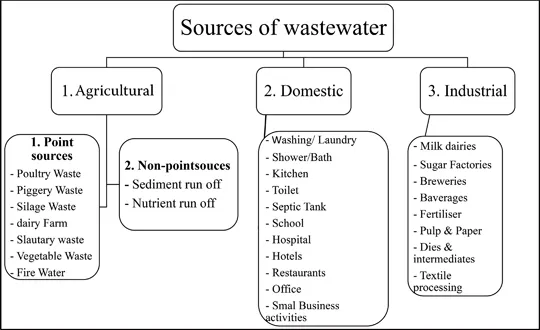
Human activities involve drainage components that can seriously affect surface water pollution. Very fine substances that are dispersed in the surface water are responsible for turbidity. These substances cannot be separated by sedimentation or filtration of the water. Water also contains soluble and insoluble pollutants. Groundwater, surface runoff, and stormwater can be further contaminated by the addition of man-made products such as petroleum, oil, road dust, and a variety of chemicals that get into it and make it unsafe and unfit for human use (Fig. 1.1).
FIGURE 1.1Sources of wastewater.
Apart from the main sources of water pollution such as industrial waste, sewage, agricultural waste, and other wastewater, mining activities, marine dumping, unplanned oil leakage, burning of fossil fuels, chemical fertilizers, pesticides, and leakage of sewer lines, etc. are also sources of water pollution as these add an excess of different contaminants, toxic waste, petroleum, and disease-causing microorganisms to water bodies.
1.3POLLUTANTS
Following are the main groups of pollutants that affect surface water:
Organic material: Wastewater contai...
Table of contents
Cover
Half Title
Series Page
Title Page
Copyright Page
Contents
Preface
Editors’ Biosketch
Contributors
Chapter 1 Introduction to Wastewater
Chapter 2 Qualitative and Quantitative Analysis of Water
Chapter 3 Need for Advanced Materials and Technologies: The Sustainability Argument
Chapter 4 Physical Processes in Wastewater Treatment
Chapter 5 Polymers as Coagulants for Wastewater Treatment
Chapter 6 Ultrasonic Wastewater Treatment
Chapter 7 Chemistry in Wastewater Treatment
Chapter 8 Advanced Oxidation Processes for Wastewater Treatment
Chapter 9 Catalytic Ozonation Processes for Wastewater Treatment
Chapter 10 Biological/Biochemical Processes in Wastewater Treatment
Chapter 11 Role of Biochar in Water Treatment
Chapter 12 Microalgae for Removing Pharmaceutical Compounds from Wastewater
Chapter 13 Processes for the Treatment of Industrial Wastewater
Chapter 14 Sustainable Technologies for Wastewater Treatment
Chapter 15 Challenges, Innovations, and Future Prospects in Transforming Future Wastewater Treatment Plants into Resource Recovery Facilities
Index
Trusted by 375,005 students
Access to over 1.5 million titles for a fair monthly price.
Study more efficiently using our study tools.
Frequently asked questions
Yes, you can cancel anytime from the Subscription tab in your account settings on the Perlego website. Your subscription will stay active until the end of your current billing period. Learn how to cancel your subscription
No, books cannot be downloaded as external files, such as PDFs, for use outside of Perlego. However, you can download books within the Perlego app for offline reading on mobile or tablet. Learn how to download books offline
Perlego offers two plans: Essential and Complete
Essential is ideal for learners and professionals who enjoy exploring a wide range of subjects. Access the Essential Library with 800,000+ trusted titles and best-sellers across business, personal growth, and the humanities. Includes unlimited reading time and Standard Read Aloud voice.
Complete: Perfect for advanced learners and researchers needing full, unrestricted access. Unlock 1.5M+ books across hundreds of subjects, including academic and specialized titles. The Complete Plan also includes advanced features like Premium Read Aloud and Research Assistant.
Both plans are available with monthly, semester, or annual billing cycles.
We are an online textbook subscription service, where you can get access to an entire online library for less than the price of a single book per month. With over 1.5 million books across 990+ topics, we’ve got you covered! Learn about our mission
Look out for the read-aloud symbol on your next book to see if you can listen to it. The read-aloud tool reads text aloud for you, highlighting the text as it is being read. You can pause it, speed it up and slow it down. Learn more about Read Aloud
Yes! You can use the Perlego app on both iOS and Android devices to read anytime, anywhere — even offline. Perfect for commutes or when you’re on the go. Please note we cannot support devices running on iOS 13 and Android 7 or earlier. Learn more about using the app
Yes, you can access Advanced Materials and Technologies for Wastewater Treatment by Sreedevi Upadhyayula, Amita Chaudhary, Sreedevi Upadhyayula,Amita Chaudhary in PDF and/or ePUB format, as well as other popular books in Technology & Engineering & Chemical & Biochemical Engineering. We have over 1.5 million books available in our catalogue for you to explore.