Compassion Focused Therapy Participant Workbook is a companion book to Compassion Focused Group Therapy for University Counseling Centers, a one-of-a-kind 12-session manual for conducting compassion focused group therapy on college campuses.
Compassion-based interventions have been shown to decrease symptoms of depression, anxiety, and psychological distress in students. This book's 12 sessions incorporate several aspects of compassionate living including defining and understanding compassion, mindfulness, shame, assertiveness, and forgiveness to help participants act in more compassionate ways with themselves and others, lower feelings of shame and self-criticism, and engage in self-reassuring behaviors. The workbook provides clients with summaries of each session, handouts, and key exercises and, along with the manual, can be followed session-by-session or adapted according to the needs of the group.
This workbook is designed to be used by clinicians and participants in a clinician-led group utilizing Compassion Focused Group Therapy for University Counseling Centers.
Talk about our tricky brains and evolutionary theory.
Discuss ways our minds get into unhelpful loops that we have the power to change.
Explore compassionate wisdom.
Wrap up with a compassionate cultivation meditation.
Introduction
Compassion focused therapy (CFT) is an approach that focuses on the interplay between biology, psychology, and your social environment. Our goal is to increase wisdom and understanding of how our hardware (brain) and software (past experiences) affect our daily lived experience. In each session, we will spend time learning skills that provide alternative ways to handle life.
In the first module we talk a bit about what compassion is and what compassion is not.
Compassion is:
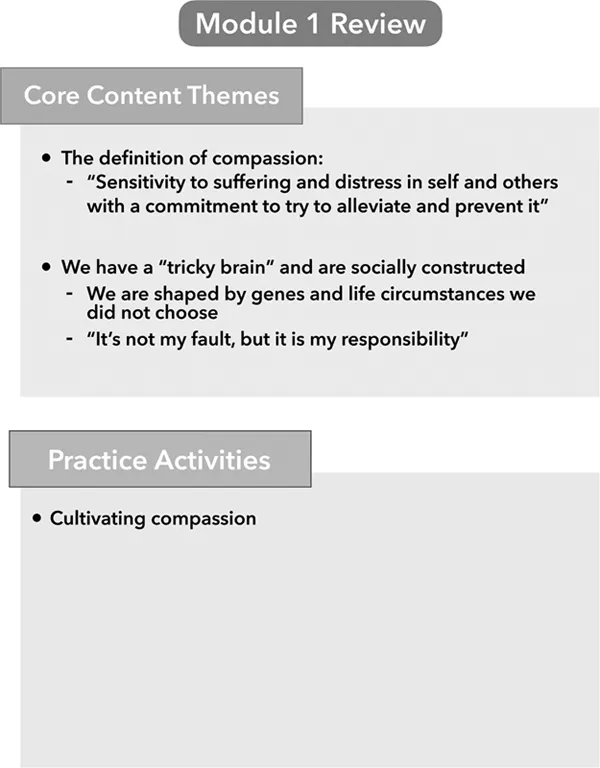
“Sensitivity to suffering and distress in self and others with a commitment to try to alleviate and prevent it.” One insightful group member in another group summarized all this as “empathy in action.”
Compassion is not:
just being kind,
feeling sorry for others,
being submissive…in fact, compassion can be quite assertive.
Sometimes, in order to better understand what compassion is, it can be useful to think about very compassionate people you know. What makes them compassionate? What do they do and say? How do these people behave?
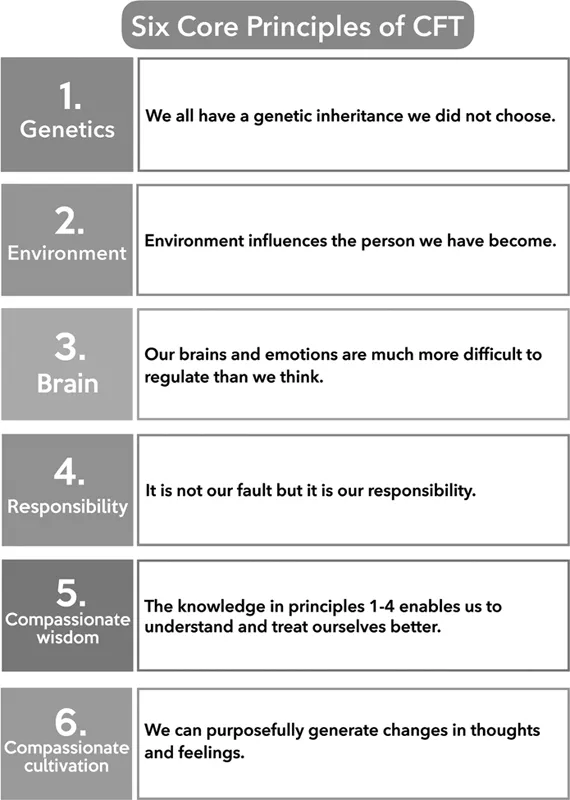
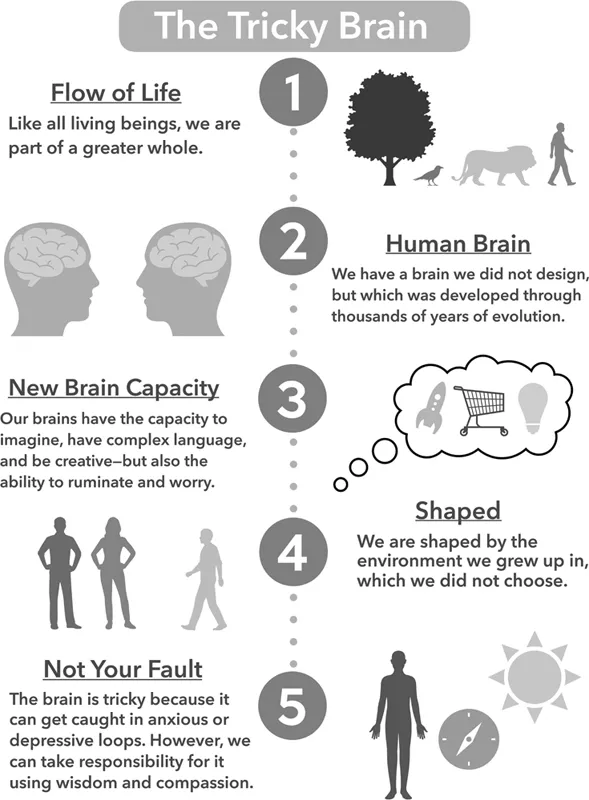
We all need compassion because we all just find ourselves here with a tricky brain having to cope with the ups and downs of life. Essentially, our brain was built for us, not by us. We have genes we did not choose and do not get to control. We are socially constructed, or shaped, by our experiences. While it's not our fault that our minds are like they are, it is our responsibility to learn how to work with our minds. For example, imagine you had been kidnapped as a three-day-old baby and grew up in a very different environment. You would obviously be a very different version of yourself.
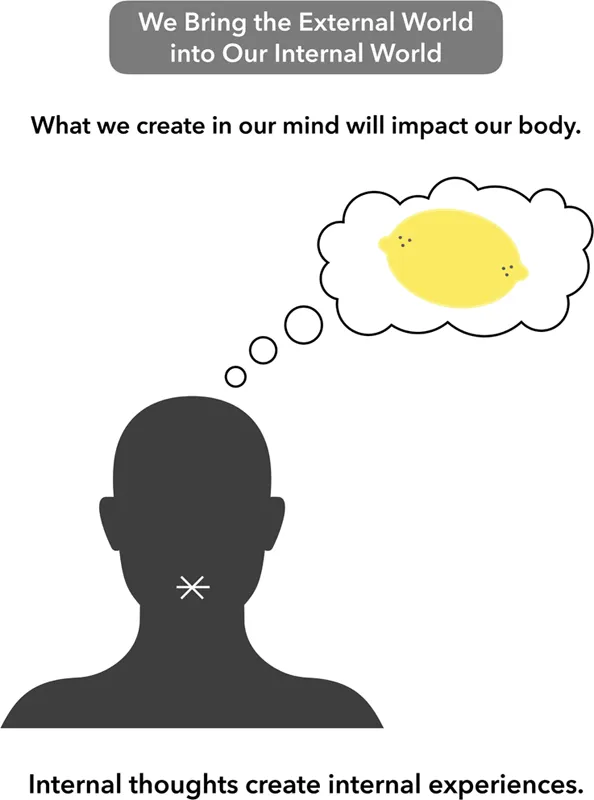
Despite the fact that we are influenced by things we didn't choose, we have the ability to be aware of ourselves and to monitor our minds. We can ruminate about the past and the future. This tricky brain leads us to develop feedback loops, thoughts about a threat that lead to unpleasant emotions, that lead to some type of action, that lead to more thoughts, and round it goes. These feedback loops often times are not very helpful. This ability to ruminate is not our fault, but it is our responsibility.
For example, imagine a zebra running away from a lion. Once they get away and can no longer see, hear, or smell the lion, there is nothing to keep them anxious, and in fact they settle down quite quickly. While a human will also be quite relieved to escape a lion, we tend to have thoughts such as: “Can you imagine if I'd been caught and what would it be like to be eaten by a lion?!” Our minds can suppose and create many frightening possibilities. Zebras don't do anything like this!
One of the aims of CFT is to help us recognize that there are several different versions of ourselves and start looking at the ways we can get stuck in patterns of thinking and feeling that are unhelpful. We are working toward choosing the version of ourselves we want to become; specifically, we hope to develop the compassionate version of ourselves.
One of the first steps we can take is acknowledging our compassionate wisdom. Our compassionate wisdom consists of recognizing that we are all just here with a very tricky brain and life experiences that we didn't choose. This is part of what it means to be human. This compassionate wisdom reminds us that we are not alone—everyone has a tricky brain, and this helps us experience a sense of common or shared humanity with those around us. It helps us see the wisdom in the phrase, “It's not my fault, but it is my responsibility.”
HANDOUT1.1
HANDOUT1.2
HANDOUT1.3
HANDOUT1.4
HANDOUT1.5
Cultivating Compassion
(Note: A digital copy will be provided by your group leader.)
To end this module, we are going to finish with a practice to help you start to cultivate compassion.
We start by closing our eyes or looking down and feeling how we are sitting on our chair right now. (Pause 15 seconds.)
Engage a compassionate posture by having your back straight and shoulders in line with your hips, with an open diaphragm. Now slow your breath, and with each slower and deeper breath say, with a friendly tone, “Mind slowing down,” and then “Body slowing down.” Alternate these phrases on each out breath. Gradually get that sense of grounding. Gradually feel a sense of stilling and slowing but also with alertness in your mind. Notice yourself becoming more grounded.
Allow time for this to settle in and focus on your breath. (Pause for one minute or so.)
Now tune in to your inner compassionate wisdom. Remember that we all just find ourselves here with a very tricky brain an...
Table of contents
Cover
Endorsements
Half Title
Title Page
Copyright Page
Contents
List of Handouts
How to Use This Workbook
Introduction & Welcome
Module 1 Introduction, Compassion, & Tricky Brain
Module 2 Three Systems of Emotion
Module 3 Mindfulness
Module 4 Feeling Safe and Receiving Compassion from Others
Module 5 Compassionate-Self
Module 6 Multiple Selves
Module 7 Self-Criticism
Module 8 Shame and Guilt
Module 9 Deepening Compassion for the Self
Module 10 Compassionate Assertiveness
Module 11 Forgiveness
Module 12 Envisioning a Compassionate Future
Index
Trusted by 375,005 students
Access to over 1.5 million titles for a fair monthly price.
Study more efficiently using our study tools.
Frequently asked questions
Yes, you can cancel anytime from the Subscription tab in your account settings on the Perlego website. Your subscription will stay active until the end of your current billing period. Learn how to cancel your subscription
No, books cannot be downloaded as external files, such as PDFs, for use outside of Perlego. However, you can download books within the Perlego app for offline reading on mobile or tablet. Learn how to download books offline
Perlego offers two plans: Essential and Complete
Essential is ideal for learners and professionals who enjoy exploring a wide range of subjects. Access the Essential Library with 800,000+ trusted titles and best-sellers across business, personal growth, and the humanities. Includes unlimited reading time and Standard Read Aloud voice.
Complete: Perfect for advanced learners and researchers needing full, unrestricted access. Unlock 1.5M+ books across hundreds of subjects, including academic and specialized titles. The Complete Plan also includes advanced features like Premium Read Aloud and Research Assistant.
Both plans are available with monthly, semester, or annual billing cycles.
We are an online textbook subscription service, where you can get access to an entire online library for less than the price of a single book per month. With over 1.5 million books across 990+ topics, we’ve got you covered! Learn about our mission
Look out for the read-aloud symbol on your next book to see if you can listen to it. The read-aloud tool reads text aloud for you, highlighting the text as it is being read. You can pause it, speed it up and slow it down. Learn more about Read Aloud
Yes! You can use the Perlego app on both iOS and Android devices to read anytime, anywhere — even offline. Perfect for commutes or when you’re on the go. Please note we cannot support devices running on iOS 13 and Android 7 or earlier. Learn more about using the app
Yes, you can access Compassion Focused Therapy Participant Workbook by Rachel Arnold,Cameron T. Alldredge,Kara Cattani,Derek Griner,David M. Erekson,Gary M. Burlingame,Mark E. Beecher in PDF and/or ePUB format, as well as other popular books in Psychology & Mental Health in Psychology. We have over 1.5 million books available in our catalogue for you to explore.