When it comes to talking to children and young people about sex and relationships, it is difficult to know what to say. How do you answer their questions? How much is too much? And what is age appropriate?
Sex Ed for Grown-Ups is an open and honest guide that empowers adults to talk to young people about all things sex and relationships.
Written by an independent relationships and sex education consultant, this light-hearted and accessible book encourages grown-ups to think and talk about the topics that scare them the most: from body parts, gender, puberty and first-time sex, to pornography, sexting and knowing what to do when things go wrong. Full of hints, tips and first-hand stories, it is a fun, compassionate and engaging exploration of relationships and sex, which will help adults to fully support young people as they develop a healthy view of both sex and themselves.
Sex Ed for Grown-Ups is essential reading for parents, teachers, youth workers, social workers and any adult who wants to have well-informed and positive conversations with the children and young people in their lives.
Before we get to the main event, it is probably worth taking some time to reflect.
When I am delivering training one of the first things I always try to do is start off by giving people time to explore their own attitudes and values. It can be a really helpful place to begin. I am aware that thinking about some of the issues we are going to cover in this book can be uncomfortable. Many of the topics we are going to unpick, on the surface, are things we often take for granted and accept as set in stone. In fact, as we will discuss in the following chapters, many of the assumptions we make about sex are based on falsehoods. As a result, we may simply be repeating the messages we were given as children without ever reflecting and wondering whether what we are saying actually helps.
In my experience, if we dive straight in to talking about private parts, abortion, sexting or pornography, people tend to react instinctively – they get their backs up and merely repeat the messages they have read in the media, with little thought. Instead, we are going to take a moment and mess with your head just a little bit…
So, let’s start at the beginning. As I mentioned in the introduction, the obvious starting point for any discussion about what we tell our children is this: what are we hoping for?
When it comes to our child’s intimate relationships and their first sexual experience what is it we want for them?
I know I raised this earlier, but we didn’t really have time to answer the question. Now I want you to properly think about it. Yes, it may feel a bit uncomfortable, especially if your child(ren) are still in primary school and have not yet started puberty. But this is the perfect time to start thinking about all this as you will have more time to make your answers a reality.
In an ideal world, what do you hope your child’s first sexual encounters will look like? This will probably bring back your own memories of your first encounter or the encounters in between. Unfortunately, odds are there will be a lot of people reading these sentences for whom memories of their first encounters will not be pleasant. For many of us that may simply be due to embarrassment or regret, or lack of knowledge, bodily control or what was spoken about in the hushed tones of rumours in the corridors at school the following Monday.
However, there will be some of you (too many of you) for whom thinking back to your own first intimate experience will not just be uncomfortable, it may be traumatic. It will be something that happened to you – something you will have spent a long time working through and getting over. For that, I am truly sorry. My intention is not to make you dredge up your demons. But the question remains: what can we all be doing to make sure that in the future there will be less people who feel this way? What can we say to our kids that will make sure they not only grow up with the tools and the knowledge to keep themselves safe but equally that they grow up not to be the person who harms someone else. We often forget that they were someone’s child too.
So, grab a pen and a piece of paper and write some things down. What do you hope for? Whether you are thinking about your son or daughter, or the kids in your class, or the young people you work with? If it could be all sunshine and rainbows, what do you hope their first experience will be like? Who will it be with? What will they be like? How old will they both be? What will their relationship be like? Where will it happen? How will they feel afterwards? What about protection?
If you have a partner, or if there are other adults who share care for the child you have in mind, ask them to write things down too. Compare notes. Are they the same?
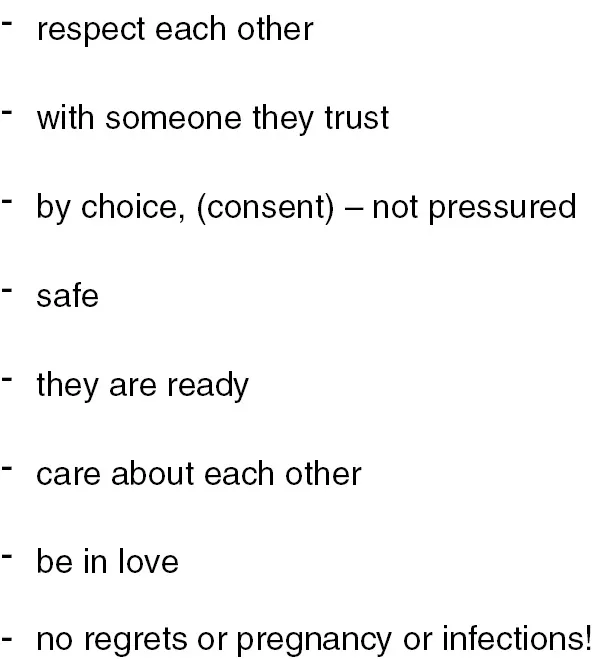
Obviously I am not psychic and certainly can’t read what you have written, or whether you have even bothered to pick up a pencil or have simply carried on reading after ignoring everything I just said… But, if you did bother, it is more than likely you’ve included some of the words listed in Figure I.I.
Figure I.I
Typically, people tend to focus on wanting their child to be safe. They focus on the things that could go wrong, such as unwanted pregnancy or catching an STI. I am pretty sure you included items around them not feeling pressured and that the encounter is consensual. Depending on your values and your personal beliefs, you may have written down that they should be in a committed relationship, or even that they are married.
Quick question: how many of you automatically imagined that your child would be with someone of the opposite sex? Just a thought.
More on that later…
However, back to the discussion at hand. One item that is, more often than not, conspicuous by its absence is the word PLEASURE.
(o)(o)
A few years ago, I was asked if I could attend a last minute parents’ briefing at one of the many primary schools I had been supporting that summer. A handful of the parents had read some of the supportive information that had been sent home and not been very happy. They had been calling the school, angry and upset at what they thought was ‘inappropriate content’ in the programme. I had already delivered a parent information evening at the school, where I had covered all the content of the programme, but the parents in question had failed to attend. The school called and asked if I would be able to help support them to talk to the parents and answer their questions.
In fact, I can be very specific – it was June 2015. I know, as I was supposed to be at Wembley watching the Foo Fighters, but unfortunately Dave Grohl had fallen off the stage in Sweden the week before and broken his leg – instead, I was stood in a very different mosh-pit in a school hall, in a somewhat heated meeting with a group of unhappy parents.
The programme the school was delivering was designed to be delivered intensively over a week. Children in every class from reception to year six would take part in a lesson each day. It was a spiral curriculum, with messages drip-fed over the years, slowly giving the children more information. It was a comprehensive programme, meaning it explored different types of families, emotional literacy, friendships, body privacy, safe and appropriate touching, how to ask for help and puberty for the older year groups.
The parents all had children in year 4. The lesson in question was an explanation of how babies are made. For some parents, naturally, this can be a contentious subject. However, the session was very nicely put together, and simply covered where babies live before they are born; how they grow; and how they are born. Sex education at this time was (and still is) optional. Parents had the right to opt their child out of the lesson – however, very few parents ever choose to. Usually, if parents are uncomfortable with this lesson it is because they have more conservative beliefs and they feel the topic itself is inappropriate. What was interesting in this case, was not that the parents had particular religious or cultural beliefs; the point of contention was not around the topic itself but around a single word.
After much talking, it became clear that the parents were happy for their children to receive the lesson. They thought it was important that the children understood how babies were made – they liked the explanation of ‘mummies and daddies bodies fitting together like two pieces of a jigsaw puzzle’ (Rutgers, 2014). The issue was the word ‘nice’.
As part of the explanation the lesson plan says that sex is something that grown-ups do, ‘it is the closest that two grown-ups can get’ and that it can ‘feel nice’. And this was the issue. The parents were uncomfortable with telling children that sex is something that should be enjoyable and worried that this may encourage the children to have sex.
I acknowledged their concerns and was in the middle of explaining that there is absolutely no evidence that would be the case. In fact, evidence suggests that children who receive these kinds of lessons actually have sex later (UNESCO, 2018). I explained that, in reality, their children were more likely to be disgusted by the idea rather than encouraged – in a ‘EWW! Why would you even want to kiss a girl! URGHH!’ – sort of way. That, in truth, they really would not be focused on the idea of it feeling nice.
Understandably, they questioned why, if that was the case, it was even included.
I tried to explain that for many children, this may be the only conversation they ever have with a safe adult about what sex actually is. The word nice is a little seed planted for years later… for many young people who are having their first experience, sex isn’t all that great. It is a disappointment at best. Sex is often something that happens to people – especially girls. If no one has ever told you it should feel good, then you are left with the feeling ‘maybe this is it’ – and assume that sex is supposed to be like that.
Equally, it is important for the small number of children in class who may have been abused. It is important they understand that what has happened to them was abuse and not sex. It is a small note of separation. I know this isn’t a very comfortable thought or very easy to talk about but that is one of the reasons we do this work – to help all children.
As I was slowly and calmly trying to explain the nuance of the inclusion, one of the dads had had enough. He banged his fists on the table and shouted: ‘I don’t care what you say – I don’t want my daughter to know that she should enjoy sex!’
It just burst out of him – to be fair, I think he was as shocked as everyone else in the room. And then he stopped. He had just realised what he had said.
Why would you not want your daughter to know that sex is something she should enjoy? What is the alternative? Would we rather that sex is something she does out of duty to please her partner? That sex is something that others do to her? Something she endures…
No. As a dad, and I am the dad of a daughter, that thought is horrifying.
As the dad of a daughter, I hope that when she is ready to have sex, it is something she enjoys. I hope she does it because it makes her feel good. That she fancies her partner, that she wants her partner. That she already understands her body and is brave enough to tell her partner what she likes and what she wants – as scary as that sounds, it is far less scary to me than the alternative.
Have you noticed that the worry always seems to be about girls? In my experience, there are very few parents of boys that share the same worries… but we will talk more about that later.
In my opinion, pleasure should be something we are talking to children and young people about. Yes, risk and safety are important too – but ‘at a public swimming pool we have gates, put up signs, have lifeguards and shallow ends, but we also teach children how to swim’ (Byron, 2008). By talking about pleasure, you can cover the risks too; sex is not pleasurable if it is pressured. Sex is not pleasurable if you are worried about pregnancy or sexually transmitted infections (STIs)… but equally, sex is not pleasurable if you feel used afterwards. Conversations about pleasure allow discussion about how we should treat people kindly and the emotions of sex rather than duty. Focusing only on risk is like teaching a cooking class and only talking about salmonella and food poisoning.
Unfortunately, there is a void of any ‘sex positive’ messages in the new Department for Education (DfE) RSE guidance.1 The word ‘pleasure’ is not used once in the entire document, despite the growing evidence of the benefits of a positive...
Table of contents
Cover
Access your online resources
Endorsements
Half Title
Title Page
Copyright Page
Dedication
Contents
Acknowledgements
Terms and abbreviations
Introduction: So… what was your sex education like?
Part I Before we get started
Part II Bodies
Part III Sex
Part IV Sex media
Index
Trusted by 375,005 students
Access to over 1.5 million titles for a fair monthly price.
Study more efficiently using our study tools.
Frequently asked questions
Yes, you can cancel anytime from the Subscription tab in your account settings on the Perlego website. Your subscription will stay active until the end of your current billing period. Learn how to cancel your subscription
No, books cannot be downloaded as external files, such as PDFs, for use outside of Perlego. However, you can download books within the Perlego app for offline reading on mobile or tablet. Learn how to download books offline
Perlego offers two plans: Essential and Complete
Essential is ideal for learners and professionals who enjoy exploring a wide range of subjects. Access the Essential Library with 800,000+ trusted titles and best-sellers across business, personal growth, and the humanities. Includes unlimited reading time and Standard Read Aloud voice.
Complete: Perfect for advanced learners and researchers needing full, unrestricted access. Unlock 1.5M+ books across hundreds of subjects, including academic and specialized titles. The Complete Plan also includes advanced features like Premium Read Aloud and Research Assistant.
Both plans are available with monthly, semester, or annual billing cycles.
We are an online textbook subscription service, where you can get access to an entire online library for less than the price of a single book per month. With over 1.5 million books across 990+ topics, we’ve got you covered! Learn about our mission
Look out for the read-aloud symbol on your next book to see if you can listen to it. The read-aloud tool reads text aloud for you, highlighting the text as it is being read. You can pause it, speed it up and slow it down. Learn more about Read Aloud
Yes! You can use the Perlego app on both iOS and Android devices to read anytime, anywhere — even offline. Perfect for commutes or when you’re on the go. Please note we cannot support devices running on iOS 13 and Android 7 or earlier. Learn more about using the app
Yes, you can access Sex Ed for Grown-Ups by Jonny Hunt in PDF and/or ePUB format, as well as other popular books in Education & Education General. We have over 1.5 million books available in our catalogue for you to explore.