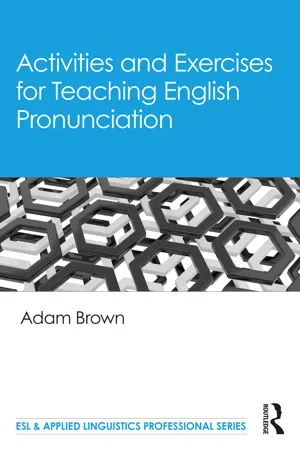
This book is a practical, comprehensive tool for busy teachers or educators teaching English pronunciation. Brown puts pronunciation into perspective with other aspects of language, highlighting the importance of teaching pronunciation from the start. Applicable for both British and American pronunciation, this book is organized by aspects of pronunciation and includes a wealth of photocopiable worksheets to use in the classroom. The engaging exercises include rhymes, games, puzzles, narratives, and more, all designed to promote learner engagement and understanding. Each worksheet is accompanied by supplementary resources and guidance, including recommendations for modifying lessons for different English learner proficiency levels; instructions for the teacher and learners; correct or expected answers; and tips for teachers to extend and create their own exercises. The versatility and adaptability of this book make it a beneficial resource for teachers of ESL/EFL/EAL, as well as educational professionals who consult and oversee teacher trainer programs and courses in TESOL.
- 144 pages
- English
- ePUB (mobile friendly)
- Available on iOS & Android
eBook - ePub
Activities and Exercises for Teaching English Pronunciation
About this book
Information
Section E
Vowels and Consonants
E1
Sounds in Common
Pronunciation point: In order to pronounce English words correctly, learners need to be able to keep pronunciations and spellings separate, and not be misled by the spellings. This exercise works in both AmE and BrE, although the pronunciations used may be slightly different, as shown in the Answers section below.
Minimum level: Two exercises are given, one at elementary level, and the other at intermediate (because of the vocabulary assumed).
Exercise type: A pen-and-paper exercise involving pronouncing out loud and thinking about sounds. It can be conducted individually or in pairs.
Approximate time: 15 minutes (exercise), 15 minutes (debrief) Preparation: Make one copy of the worksheet for each learner. Alternatively, to save paper, either make the worksheet accessible in soft copy on learners’ devices, or show the worksheet on a screen.
Introducing the exercise: Explain that the spelling system of English is probably less regular than that of the learners’ own native languages. Illustrate this by using a few simple homophones (e.g. hear, here) and homographs (e.g. wind: “breeze,” “turn”) (see exercise D2); homophones and homographs probably do not exist in the learners’ languages.
Conducting the exercise: The learners read the pairs of words, say them out loud, and work out which sound each pair has in common. Perhaps clarify this by working through the first one or two.
Debrief notes: Emphasize that English spelling can be a misleading indicator of the sounds in words. With more advanced learners, you could ask them to transcribe the words.
Answers
| # | Words | Sound in common | Transcriptions |
|---|---|---|---|
| 1 | soup, true | /u:/ | /su:p, tru:/ |
| 2 | chemist, bank | /k/ | /kemɪst, bæŋk/ |
| 3 | wished, better | /t/ | /wɪ∫t, betə(r)/ |
| 4 | flight, mine | /aɪ/ | /flaɪt, maɪn/ |
| 5 | gaming, hammer | /m/ | /ɡeɪmɪŋ, hæmə(r)/ |
| 6 | taxi, less | /s/ | /tæksi:, les/ |
| 7 | anyone, best | /e/ | /enɪwʌn, best/ |
| 8 | parachute, English | /∫/ | /pærə∫u:t, ɪŋɡlɪ∫/ |
| 9 | physics, rough | /f/ | /fɪzɪks, rʌf/ |
| 10 | feather, wedding | /e/ | /feðə(r), wedɪŋ/ |
| 11 | cheetah, helped | /t/ | /tʃi:tə, helpt/ |
| 12 | become, young | /ʌ/ | /bɪkʌm, jʌŋ/ |
| 13 | zoom, praise | /z/ | /zu:m, preɪz/ |
| 14 | debt, brand | /d/ | /det, brænd/ |
| 15 | machine, breathe | /i:/ | /mə∫i:n, bri:ð/ |
| 16 | guard, single | /g/ | /ɡɑ:(r)d, sɪŋɡəl/ |
| 17 | ceiling, grass | /s/ | /si:lɪŋ, ɡræs ~ ɡrɑ:s/ |
| 18 | rhythm, stitch | /ɪ/ | /rɪðəm, stɪt∫/ |
| 19 | queen, southwest | /w/ | /kwi:n, sa℧θwest/ |
| 20 | Matthew, yourself | /j/ | /mæθju:, jɔ:(r)self/ |
| | |||
| 1 | piece, Beatles | /i:/ | /pi:s, bi:təlz/ |
| 2 | design, cheese | /z/ | /dɪzaɪn, t∫i:z/ |
| 3 | worth, squeeze | /w/ | /wɜ:(r)θ, skwi:z/ |
| 4 | prove, juice | /u:/ | /pru:v, dʒu:s/ |
| 5 | passion, clichè | /∫/ | /pæ∫ən, kli:∫eɪ/ |
| 6 | doubt, brushed | /t/ | /da℧t, brʌ∫t/ |
| 7 | many, threat | /e/ | /meni, θret/ |
| 8 | lawless, proceed | /s/ | /lɔ:lɪs, prəsi:d/ |
| 9 | rehearse, whose | /h/ | /rɪhɜ:(r)s, hu:z/ |
| 10 | yacht, disuse | /j/ | /jɑ:t ~ jɒt, dɪsju:s/ |
| 11 | bullet, unhook | /℧/ | /b℧lɪt, ʌnh℧k/ |
| 12 | laughter, suffix | /f/ | /læftər ~ lɑ:ftə, sʌfɪks/ |
| 13 | income, strong | /ŋ/ | /ɪŋkəm, strɔ:ŋ ~ strɑŋ/ |
| 14 | business, hymn | /ɪ/ | /bɪznɪs, hɪm/ |
| 15 | Judith, hedge | /dʒ/ | /dʒu:dɪθ, hedʒ/ |
| 16 | kingdom, Gwyneth | /ɪ/ | /kɪŋdəm, ɡwɪnɪθ/ |
| 17 | language, reservoir | /w/ | /læŋɡwɪdʒ, rezə(r) vwɑ:(r)/ |
| 18 | hated, break | /eɪ/ | /heɪtɪd, breɪk/ |
| 19 | reflex, once | /s/ | /ri:fleks, wʌns/ |
| 20 | police, grieving | /i:/ | /pəli:s, ɡri:vɪŋ)/ |
Create your own materials: It is easy to create your own version, provided you are fairly familiar with sounds and phonemic symbols. You can concentrate on sounds that your learners mix up.
Worksheet 1
In each pair of words, only one sound occurs in both words. Say the words out loud, and work out the sound they share.
| Words | Sound in common (as a phonemic symbol) | |
|---|---|---|
| 1 | soup, true | |
| 2 | chemi... |
Table of contents
- Cover
- Half Title
- Title Page
- Copyright Page
- Contents
- Support Material
- Phonemic Symbols Used
- Introduction
- Section A The components of pronunciation
- Section B Suprasegmentals
- Section C Word stress
- Section D Spelling and phonemic symbols
- Section E Vowels and consonants
- References
Trusted by 375,005 students
Access to over 1.5 million titles for a fair monthly price.
Study more efficiently using our study tools.
Frequently asked questions
Yes, you can cancel anytime from the Subscription tab in your account settings on the Perlego website. Your subscription will stay active until the end of your current billing period. Learn how to cancel your subscription
No, books cannot be downloaded as external files, such as PDFs, for use outside of Perlego. However, you can download books within the Perlego app for offline reading on mobile or tablet. Learn how to download books offline
Perlego offers two plans: Essential and Complete
- Essential is ideal for learners and professionals who enjoy exploring a wide range of subjects. Access the Essential Library with 800,000+ trusted titles and best-sellers across business, personal growth, and the humanities. Includes unlimited reading time and Standard Read Aloud voice.
- Complete: Perfect for advanced learners and researchers needing full, unrestricted access. Unlock 1.5M+ books across hundreds of subjects, including academic and specialized titles. The Complete Plan also includes advanced features like Premium Read Aloud and Research Assistant.
We are an online textbook subscription service, where you can get access to an entire online library for less than the price of a single book per month. With over 1.5 million books across 990+ topics, we’ve got you covered! Learn about our mission
Look out for the read-aloud symbol on your next book to see if you can listen to it. The read-aloud tool reads text aloud for you, highlighting the text as it is being read. You can pause it, speed it up and slow it down. Learn more about Read Aloud
Yes! You can use the Perlego app on both iOS and Android devices to read anytime, anywhere — even offline. Perfect for commutes or when you’re on the go.
Please note we cannot support devices running on iOS 13 and Android 7 or earlier. Learn more about using the app
Please note we cannot support devices running on iOS 13 and Android 7 or earlier. Learn more about using the app
Yes, you can access Activities and Exercises for Teaching English Pronunciation by Adam Brown in PDF and/or ePUB format, as well as other popular books in Languages & Linguistics & Education General. We have over 1.5 million books available in our catalogue for you to explore.