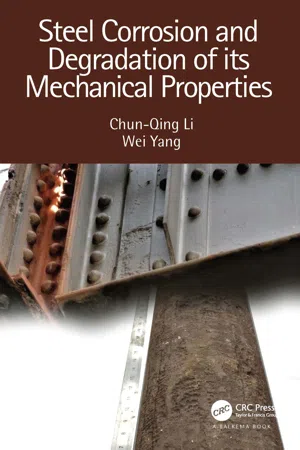
This book presents the state-of-the-art-knowledge on corrosion of steel, cast iron and ductile iron with a focus on corrosion-induced degradation of their mechanical properties. The information presented in the book is largely derived from the most current research on the effect of corrosion on degradation of mechanical properties. The book covers the basics of steel corrosion, including that of cast iron and ductile iron, that are not well covered in most literature. Models for corrosion-induced degradation of mechanical properties are presented in the book with a view to wider applications. The knowledge presented in the book can be used to prevent corrosion-induced failures of corrosion-affected structures, offering enormous benefits to the industry, business, society and community.
Key strengths of the book are that it can be employed by a variety of users for different purposes in designing and assessing corrosion-affected structures, and that the knowledge and techniques presented in the book can be easily applied by users in dealing with corrosion-affected structures, and the uniqueness in examining the corrosion effect on degradation of various mechanical properties.
Wtih examples of practical applications, the book is particularly useful for all stakeholders involved in steel manufacturing and construction, including engineering students, academicians, researchers, practitioners and asset managers.
Corrosion of steel is a well-trodden topic, and yet, it is still causing considerable problems to all stakeholders from manufacturers to designers and end users. There are many books written on steel corrosion, yet there is still a lack of sufficient knowledge on it. What would be new from this book that will keep its place in the ocean of literature on steel corrosion is not the corrosion itself which is supposed to know, but its effect on steel, which is yet to develop. This book discusses more about the mechanical properties of steel that are closely associated with corrosion, which makes it stand out from other books on steel corrosion. Steel in this book generally refers to ferrous metals, including steel, cast iron and ductile iron. In general, or in short, they are collectively called steel in this book.
1.1.1 Brief history of steel
The evolution of humankind is closely related to the use of metals. To some extent, the civilisation of humanities has by and large relied on the discovery and development of metals. As one of the most used metals, iron was discovered by accident when some ore was dropped into a fire and cooled into wrought iron. The first smelting of iron was around 3000 BC which led to the start of the Iron Age (1200 BC). The transition from the Bronze Age to the Iron Age occurred at different times in different places in the world, but when and where it did, the distinctive dark metal brought with it significant changes to daily life in ancient societies, from the way people grew crops to the way they fought wars (www.wikipedia.org).
Iron has remained an essential metal for more than 3,000 years, through the Industrial Revolution and into today in its more sophisticated form, i.e., steel. Even in the modern times, however, the quality of iron produced depends as much on the ore available as on the production methods. By the 17th century, the properties of iron were well understood, but increasing urbanisation in Europe demanded a more versatile metal for structural use. By the 19th century, the amount of iron being consumed due to railroad expansion provided metallurgists with the financial incentive to find a solution to iron’s brittleness and inefficient production processes.
The development of blast furnaces increased the production of cast iron. Various methods for reducing the carbon content to make iron more workable were experimented by metallurgists. By the late 1700s, ironmakers learned how to transform cast pig iron into a low-carbon content wrought iron (about 0.1% carbon content) using puddling furnaces. As the carbon content decreases, the melting point of iron increases so that the masses of iron would agglomerate in the furnace. These masses would be removed and worked with a forge hammer before being rolled into sheets or rails.
Blister steel is one of the earliest forms of steel, which began being produced in Germany and England in the 17th century and was produced by increasing the carbon content in molten pig iron using a process known as cementation. In this process, bars of wrought iron were layered with powdered charcoal in stone boxes and heated. Blister steel production grew in the 1740s when English clockmaker Benjamin Huntsman, whilst trying to develop high-quality steel for his clock springs, found that the metal could be melted in clay crucibles and refined with a special flux to remove slag that the cementation process left behind. The result was a crucible, or cast, steel. But due to the cost of production, both blister and cast steel were only ever used in speciality applications. As a result, cast iron made in puddling furnaces remained the primary structural metal in industrialising Britain during most of the 1800s.
The situation with steel being an unproven and yet costly structural metal changed in 1856 when Sir Henry Bessemer, an English engineer and inventor, developed a more effective way to introduce oxygen into molten iron for reducing the carbon content in the iron. Bessemer designed a pear-shaped receptacle, referred to as a “converter”, in which iron could be heated whilst oxygen could be blown through the molten metal. As oxygen passed through the molten metal, it would react with the carbon, releasing carbon dioxide and producing a purer iron. The process was fast and inexpensive, removing carbon and silicon from iron in a matter of minutes, but since it was too efficient, too much carbon was removed with too much oxygen remaining in the final product. Bessemer ultimately had to repay his investors until he could find a method to increase the carbon content and remove the unwanted oxygen. Nevertheless, the development of what is known now as the Bessemer process is considered to be the beginning of the modern steel industry.
At about the same time, British metallurgist Robert Mushet started to test a compound made up of iron, carbon and manganese, known as spiegeleisen. Manganese was known to remove oxygen from molten iron and the carbon content in the spiegeleisen. If the correct amount of manganese was added in this compound, it would solve the problem of too much oxygen encountered by Bessemer. The addition of the manganese to the conversion process of iron was a great success. But it was until 1876 when Welshman Sidney Gilchrist Thomas developed an innovative solution to the Bessemer process, i.e., adding limestone, iron ore from anywhere in the world could be used to make steel. As a result, the cost of steel production began to decrease significantly by about 80% between 1867 and 1884, which initiated the growth of the world steel industry. Since then, there were other new developments in the history of steel making, notably the open hearth process, the electric arc furnace and the oxygen furnaces.
Fast forward to the 21st century, the modern process of steel making is all standardised with more advanced technology. As a result, the quality and versatility of steel increase, whilst the cost of steel making decreases. According to the World Steel Association (2019), the crude steel production stands at 1,808 million tonnes in 2018 with an increase of about ten times from 189 million tonnes in 1950.
1.1.2 Advantages of steel
Steel remains one of the most important conduction and machinery materials since its advent. This is because it has many advantages as compared with other building materials, such as concrete, masonry and timber. The most recognised advantages of steel can be summarised as follows (NIST NCSTAR 1-3D 2005):
High strength. With the modern technology of steel making, the tensile strength of steel can reach 2000 MPa (N/mm2). This is incomparable with almost all other building materials. For commonly used structural steel, the strength is in the range of 250–450 MPa which is still much stronger than most building materials. The next strongest building material could be concrete in compression with compressive strength in the range of 30–50 MPa.
Great lightness. Steel has the best strength to weight ratio amongst almost all other major building materials. The strength to weight ratio of steel is in a range of 30–40 for commonly used structural steels, i.e., mild steel. This is about three times higher than concrete which is another most used building material. The strength to weight ratio of some high-strength steel, e.g., chromoly steel, can reach 85.
Excellent ductility. Steel, in particular, mild steel, has excellent ductility which is its ability to be drawn or plastically deformed without fracture or rupture. Because of good ductility, steel is extremely flexible with many product forms and shapes, easy to bend and tough to fracture.
Extreme tautness. Steel can be stretched or pulled tight without slacks. This is because of its good elastic behaviour. Together with other mechanical properties, good tautness makes steel more workable, formable and versatile. Structural steel sections can be bent and rolled to create non-linear members to enhance the aesthetic appeal of the structure. This is in particular useful for steel fabrication in situ or ex situ.
Transparency and elegancy. Steel products are either hot-rolled or cold-formed with various cross sections, such as, I section, hollow section, channel section and angles. All of these sections are transparent. With the great lightness, steel members are relatively slender and look more elegant when they are erected. The structures constructed of steel are usually in the form of frame which looks spacious and transparent. Architects admire the natural beauty of steel and emphasise the grace, slenderness, strength and transparency in their designs.
In addition to these advantages, structural steel brings numerous benefits to construction projects, including the speed of construction due to its shop fabrication and site erection resulting in lower project time and costs, aesthetic appeal due to its transparency and slenderness, high strength due to its restraint power, sustainability due to its recyclability, modifiability due to its easy fabrication, innovativeness due to the versatility of steel and its products, efficiency due to optimal use of building space and reliability and predictability due to the high quality assurance processes in steel making. These advantages in steel construction warrant another book to fully describe and appreciate.
Whilst every coin has two sides, steel is no exception, but the disadvantages of steel are not as many as its advantages. The most notable disadvantages are its susceptibility to fire and corrosion since both of these can be catastrophic. The mechanical properties of steel are usually constant with temperature only when it is within a certain limit, depending on the type of steel. For some structural steel, the yield strength and elastic modulus start to decrease when the temperature exceeds 200°C (www.engineeringtoolbox.com). There are many examples of collapses of steel structures under the elevated temperature, i.e., fire. One of the earliest disasters under fire could be the Crystal Palace, which was originally built in Hyde Park, London, to house the Great Exhibition of 1851 and then relocated to an area of South London in 1854. The Crystal Palace was constructed of cast iron and plate glass and completely destroyed by fire in November 1936. The most recent disaster could be the collapse of twin towers of World Trade Center in New York. The structure of both towers was steel tube frame. Under the fire, both towers were destroyed within a couple of hours. Obviously, fire is one of the most catastrophic hazards to steel structures. Another one is corrosion which is the subject of this book.
With the advancement of theories of mechanics and structures and the development of new technology in structural design, fire hazard as a failure mechanism in structural design can be designed out in most cases or can be prevented to some extent. One failure mechanism that may not be designed out is the corrosion of steel with surrounding environments since it is natural. Corrosion-induced failures occur almost every year and everywhere from small mishaps to catastrophic disasters, some of which are to be presented in Section 1.2.1.
1.1.3 Application of steel
Throughout the history of humanities, metals are used for various purposes. Gold is perhaps the first and most valuable metal to be used, which was fashioned into jewellery in the Stone Age (6000 BC). Due to its scarcity, gold was used as exchange of values and throughout the history as one of the bases of monetary values. Copper, on the other hand, was possibly the first metal to be used for practical purposes. Even in the Stone Age, copper was used to make tools, implements and weapons.
It can be said in general that iron and steel can be used anywhere and almost for everything. Undoubtedly, the major use of steel is in construction with 43% of total steel production in 2018 (Li et al. 2018). Steel has been used in almost all structures, including concrete structures, where reinforcing steel is essential to overcome the weakness of concrete in tension, masonry structures and even timber structures where steel is important for, e.g., connection and reinforcement. Historically, the use of iron and steel can be highlighted in some landmark structures in the world.
Cast iron made its debut in the construction industry in 1779 with the bridge at Coalbrookdale in England, which was considered to be the first large-scale use of cast iron for structural purposes. Iron structures soon began to find their way into textile factories, stage construction and glasshouses. The central market building in Paris, Les Halles, built in 1853, was the first building in France to openly display its metalwork. It opened the way for the construction of new types of edifice required by an industrialised society, such as railway stations, markets, factories, large stores, glass-roofed buildings, pavilions and exhibition halls. The use of iron in architecture spread widely and became one of the most original and spectacular forms of creative expression of the nineteenth century because of its lightness, its transparency and the elegant way it rises into the air, coupled with its brute strength, its restrained power and its extreme tautness.
Amongst these many magnificent structures made of iron and steel, the Eiffel Tower (Figure 1.1) excels all and has become a global cultural icon of France and one of the most recognisable structures in the world. It is also a monumental example of material properties and structural performance. The Eiffel Tower was constructed of wrought iron from 1887 to 1889 as the entrance to the 1889 World’s Fair. A total of 7,000 metric tons of iron was used. The tower is 324 m tall, about the same height as an 81-storey building and remains the tallest structure in Paris. It was the first structure to reach a height of 300 m. By the year 1885, the time when the Tower was being constructed, the use of iron and steel in bridges and building frameworks had become widespread.
Figure1.1 Eiffel Tower.
The bridge over the Firth of River Forth in Scotland is another such example. Dubbed as Scotland’s Eiffel Tower, the breath-taking Forth Railway Bridge stands at Queensferry Narrows, about 15 km west of Edinburgh, where it carries trains for one and a half miles over the Firth of River Forth. The Forth Railway Bridge is a remarkable cantilever structure which is still regarded as an engineering marvel. The structure of the bridge consists of its three massive cantilever towers each 104 m high and achieves a record span of 521 m. The construction began in 1883, and after 7 years, with 55,000 tons of steel, 18,122 m3 of granite, 8 million rivets and the loss of 57 lives, the bridge was completed in 1889. At the opening ceremony on 4 March 1890, the Prince of Wales (later King Edward VII) drove in the last rivet, which was gold-plated and inscribed to record the event.
The Empire State Building is the first skyscraper constructed of steel and was built in 1931. With 102 stories, the building stands a total of 443.2 m tall, including its antenna. The Empire State Building is composed of 60,000 tons of steel with steel columns and beams forming a stable three-dimensional frame throughout the entire structure. The building remained the tallest building in the world for 41 years until 1972 when the World Trade Center claimed this distinction. Today, despite being surpassed in height by many other buildings, the Empire State Building remai...
Table of contents
Cover
Half Title
Title Page
Copyright Page
Dedication
Table of Contents
Preface
Acknowledgements
1 Introduction
2 Basics of steel corrosion
3 Corrosion impact on mechanical properties of steel
4 Corrosion impact on mechanical properties of cast iron and ductile iron
5 Other corrosion damages
6 Practical application and future outlook
Bibliography
Index
Trusted by 375,005 students
Access to over 1.5 million titles for a fair monthly price.
Study more efficiently using our study tools.
Frequently asked questions
Yes, you can cancel anytime from the Subscription tab in your account settings on the Perlego website. Your subscription will stay active until the end of your current billing period. Learn how to cancel your subscription
No, books cannot be downloaded as external files, such as PDFs, for use outside of Perlego. However, you can download books within the Perlego app for offline reading on mobile or tablet. Learn how to download books offline
Perlego offers two plans: Essential and Complete
Essential is ideal for learners and professionals who enjoy exploring a wide range of subjects. Access the Essential Library with 800,000+ trusted titles and best-sellers across business, personal growth, and the humanities. Includes unlimited reading time and Standard Read Aloud voice.
Complete: Perfect for advanced learners and researchers needing full, unrestricted access. Unlock 1.5M+ books across hundreds of subjects, including academic and specialized titles. The Complete Plan also includes advanced features like Premium Read Aloud and Research Assistant.
Both plans are available with monthly, semester, or annual billing cycles.
We are an online textbook subscription service, where you can get access to an entire online library for less than the price of a single book per month. With over 1.5 million books across 990+ topics, we’ve got you covered! Learn about our mission
Look out for the read-aloud symbol on your next book to see if you can listen to it. The read-aloud tool reads text aloud for you, highlighting the text as it is being read. You can pause it, speed it up and slow it down. Learn more about Read Aloud
Yes! You can use the Perlego app on both iOS and Android devices to read anytime, anywhere — even offline. Perfect for commutes or when you’re on the go. Please note we cannot support devices running on iOS 13 and Android 7 or earlier. Learn more about using the app
Yes, you can access Steel Corrosion and Degradation of its Mechanical Properties by Chun-Qing Li,Wei Yang in PDF and/or ePUB format, as well as other popular books in Technology & Engineering & Civil Engineering. We have over 1.5 million books available in our catalogue for you to explore.