This book promotes the development of nontraditional literacies in adult education, especially as these critical literacies relate to global citizenship, equity, and social justice. As this edited collection argues, a rapidly changing global environment and proliferation of new media technologies have greatly expanded the kinds of literacies that one requires in order to be an engaged global citizen. It is imperative for adult educators and learners to understand systems, organizations, and relationships that influence our lives as citizens of the world. By compiling a comprehensive list of foundational, sociocultural, technological and informational, psychosocial and environmental, and social justice literacies, this volume offers readers theoretical foundations, practical strategies, and additional resources.
eBook - ePub
Global Citizenship for Adult Education
Advancing Critical Literacies for Equity and Social Justice
- 396 pages
- English
- ePUB (mobile friendly)
- Available on iOS & Android
eBook - ePub
Global Citizenship for Adult Education
Advancing Critical Literacies for Equity and Social Justice
About this book
Information
Part I
Introduction
1The Critical Literacies Advancement Model
Its History, Evolution, and Future Potential
Petra A. Robinson
The Genesis
Having worked in several leadership positions in the area of human resources, and likely because of the way I was socialized, I have always had concern for people and their personal and professional development. Over the course of my career, my work often saw me preoccupied with determining what knowledge, skills, abilities, competencies, and attitudes were essential for high-quality performance and organizational success and how I could address any related gaps in these areas. It was not entirely mechanical, but it often meant distilling circumstances in systematic, evaluative ways that were focused on defining success in terms of key performance indicators and metrics such as productivity, efficiency, and profit. Over time, my perspective shifted from one that mostly focused on inputs and outputs to one that focused on the developmental process. After pursuing a PhD in adult education and having focused my scholarly work on diversity, inclusion, equity, and social justice, the ways in which I conceptualized success expanded my thoughts to a more macro, global level, beyond personal or organizational frames of reference. Additionally, my academic training, background, and life experiences helped me to create a meaningful structure to my thoughts and perspectives.
Admittedly, these shifts were gradual, not entirely due to formal education, and likely took on more meaning after having children and being tasked with the joint responsibility to raise decent human beings. For quite some time, I found myself thinking about what tangible and intangible skills or ways of living are required for us as people living in a global society to thrive, not at the expense of others who may be different from us, all the while affording us the chance and desire to acknowledge and celebrate our individuality and uniqueness.
I began thinking of these skills more broadly, in terms of literacy skills—primarily nontraditional literacies, some of which would likely be measurable, others not as easily. As I concretized my thoughts and engaged in literature reviews, it occurred to me that these literacies were even more relevant given the context of our technologically dependent, complex, media-pervasive, dynamic, inequitable, capitalistic, and globalized society. The scholarship was clear, especially in terms of teaching and learning; students needed new literacies to fully participate in today’s society, especially in terms of its digital and other technological advancements. It was also clear that these new literacies were not being considered as replacements of the more traditional literacies such as reading, writing, numeracy, and so on. What was not evident in the literature was a comprehensive cohesive list of skills or literacies needed to thrive in a global society. I tasked myself with designing a framework for quick access or for easy understanding of a broad set of skills beyond those that are technological or digital in nature to capture what was required for global citizenship.
I found my work was being influenced by scholars such as Freire and others whose critical scholarship helped me to position my own contributions in context and relation to other academic work. To put some structure and organization to my thoughts, I made a list of these literacies of which I had been mentally keeping track and started the documentation process of what has now become the Critical Literacies Advancement Model (CLAM) (Robinson, 2020).
Structuring and Publishing the Model
Critical theory forms the foundational base upon which CLAM is set. The main focus of critical theory (Horkheimer, 1972) is squarely centered on emancipation from systems and structures that oppress and marginalize people. As critical theory seeks to challenge the ways in which power and privilege manifest in inequity, it effectively supports and, in this case, gives rise to critical literacy. Defining critical literacy in terms of CLAM is to show that critical literacy is the practical application of critical theory. This applicability is reflected in the model through arrows leading from critical theory, as the base to the critical section of the model.
Structurally, CLAM organizes critical nontraditional literacies into five major literacy categories and while it does not include an exhaustive list (e.g., it does not specifically mention discourse literacy, evaluative literacy, community literacy, and others), the categories are broad in nature and so additional literacies could be subsumed under each category. In the first iteration of the model (see Robinson, 2020 for more detail), the five literacy categories (italicized here to emphasize the parent categories as distinct from specific literacies), with sample literacies in each include the following:
1.Foundational literacies (foundational, scientific, futures, etc.).
2.Sociocultural literacies (global, mother tongue, multilingual, cultural, intercultural, etc.).
3.Human and social justice literacies (information, visual, aural, digital, computational, coding, game, cybersecurity, data, news, media, etc.).
4.Psychosocial and environmental literacies (health, emotional, food, financial, ethical/moral, civic, environmental, etc.).
5.Technological and informational literacies (human rights, gender, racial, equity, etc.).
After careful deliberation and further study, I have refined the model to more suitably organize and capture my thoughts about the categories of literacies. I also show through this evolution how critical literacy skills can further the development of various nontraditional, critical literacy skills. The result of this development is in practical literacy skills that can lead to informed decisions, behaviors, and actions that ultimately have implications for advancing positive social change.
Refining the Model
Given the importance of building knowledge, contributing to scholarship, and actively participating in the academic dialogue on these nontraditional literacies, and ensuring that my framing of these literacies would coherently express my true motivations for positing and describing their importance, I drafted and published the first version—“The Critical Literacies Advancement Model (CLAM): A Framework for Promoting Positive Social Change” (Robinson, 2020). This initial version provided an opportunity to meld my ideas together and to further develop them based on how the model has been applied or could be applied in a variety of research contexts. In refining my ideas about the model and how it could be used to frame this book on global citizenship, and after further engaging in research on the individual literacies as represented in this book, there are a few modifications to the first version, as further outlined here.
To be more explicit about the philosophical motivations (the not-so-hidden agenda) in the model, the label “Informed Behaviors and Actions” has been edited to “Informed Decisions, Behaviors, and Actions.” This was done to indicate the long-term implications of these literacy skills and the way in which the development of these literacies can influence our thoughts and actions accordingly. Next, another higher-level implication, “Positive Social Change” was added as a separate section on the top portion of the model. These edits more pointedly describe how one can, through the development of critical, nontraditional literacy skills, make more informed decisions, behave accordingly (in the short and long term), and take specific actions that are based on these newly developed skills. The goal of these kinds of decisions, behaviors, and actions would lead to promoting positive social change.
Further, while the model still only lists sample literacies, I have added cross-cultural literacy as a sociocultural literacy to more closely align with the book chapter on cross-cultural literacy. Additional edits to the model include a reclassification of mother tongue literacy as a foundational literacy, moving moral literacy to the social justice category, to which I also added social justice literacy. To underscore the interconnectedness between literacies, there are still no separation lines drawn between the categories and there are now bidirectional arrows between the sample literacies section of the model and the “Practical Literacy Skills” section of the model to highlight that developing literacy skills in one literacy can contribute to the development of other practical literacy skills. A graphic representation of the revised model can be seen in Figure 1.1.
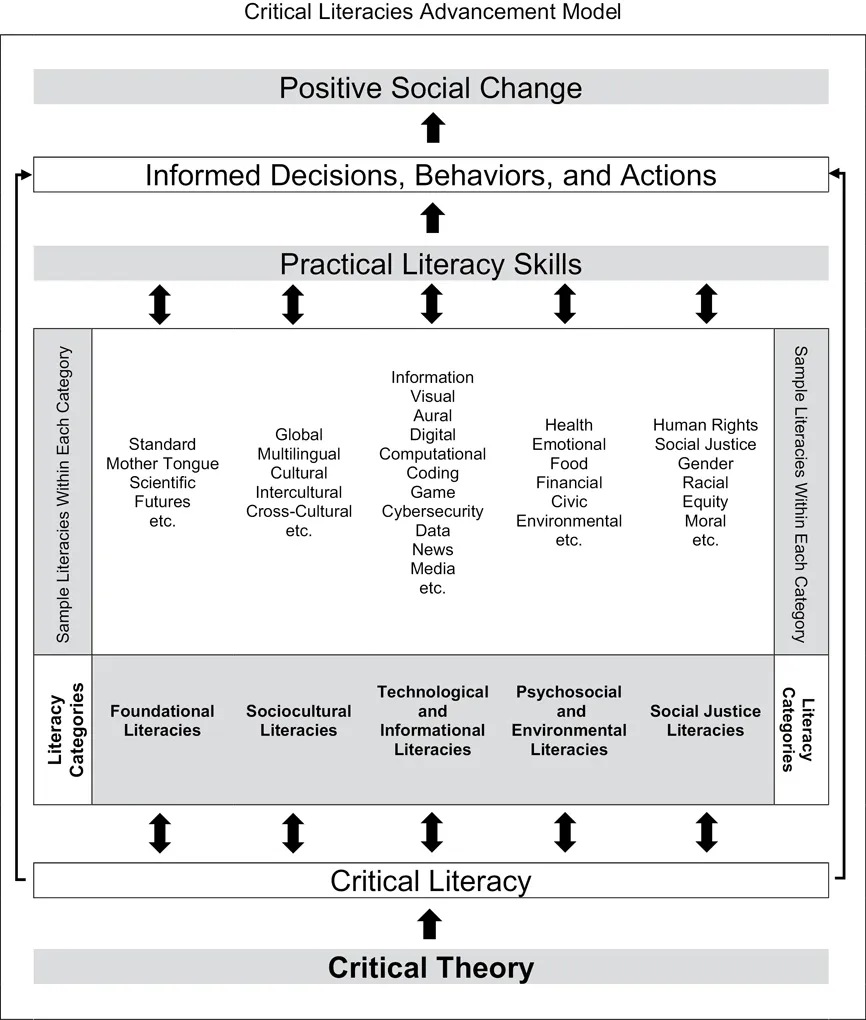
Figure 1.1Critical Literacies Advancement Model (CLAM)
Source: © Robinson (2020). Adapted with permission.
Future Prospects and Potential
Since its publication, CLAM has been featured as an analytical framework for critiquing colorism and skin bleaching (Robinson & Barbel, 2020); as a practical tool for adult educators to help them incorporate human rights literacy into their curriculum (Robinson & Stojanović, in press); as part of supporting a conceptual framework for empowerment, equity, and social justice in educational contexts (Robinson et al., in press); and as a building block of a conceptual framework on developing positive Black female identity (Robinson et al., in press); This indicates there is lot of potential for the model.
Many scholars have published competency models and although this model speaks directly to the development of skills, and while it has implications for competencies, it takes a broader approach in that it addresses skills that are applicable across a variety of disciplines, fields, contexts, and stages of the lifespan. My goal in creating this model was to create a comprehensive, holistic, and dynamic framework that integrates literacies that are essential to true global citizenship. From an academic perspective, my goal was to make a contribution in advancing knowledge regarding critical literacies, global citizenship, and on issues related to diversity, inclusion, equity, and social justice.
My hope for the model is that scholars who approach their work from various methodological and epistemological paradigms across a wide variety of disciplines will see the value and utilize it to help further our understanding of what it means to be a global citizen. It is ripe for testing various components as well as primed for applicability across disciplines and sectors. The framework is poised as an analytical lens to frame studies that can distill the skills needed towards a stance of human and planetary well-being. CLAM can help articulate an agenda that supports goals that extend beyond traditional measures of success such as economic measures (income, market share, profit), to gauge success in terms of sustainability, peace, equity, and justice for all. Recognizing that we will not all have mastery in each of the literacy areas, nor is that even required, the model underscores the need to increase our awareness and to engage in critical thinking as lifelong learners committed to disrupting and dismantling systems of oppression and injustice. This continuous learning effort can help us widen our sphere of influence to include our families, local, and global communities. As we think about raising the next generation with an awareness and appreciation for others, their responsibility for global human conditions, and respect for the environment, my hope is that we can use this framework to advance the goal of equity and justice in the world.
References
- Horkheimer, M. (1972). Critical theory. Seabury Press.
- Robinson, P. A. (2020). The Critical Literacies Advancement Model (CLAM): A framework for promoting positive social change. https://digitalcommons.lsu.edu/cgi/viewcontent.cgi?article=1000&context=shrewd_pubs.
- Robinson, P. A., Allen-Handy, A., & Burrell-Craft, K. (in press). Critical media literacy and Black female identity politics: A conceptual framework for empowerment, equity, and social justice in education. Journal of Media Literacy Education.
- Robinson, P. A., & Barbel, P. A. (2020). Colorism and skin bleaching: Implications for advancing multiple critical literacies for equity and social justice. In K. M. Woodson (Ed.), Colorism: Investigating a global phenomenon, with implications for research, policy, and practice (pp. 324–336). Fielding University Press.
- Robinson, P. A., & Stojanović, M. (in press). The Critical Literacies Advancement Model (CLAM) as a tool for curriculum development: Advancing human rights literacy in adult education. In M. V. Alfred, P. A. Robinson, & E. Roumell (Eds.), Advancing the global agenda for human rights, vulnerable populations, and environmental s...
Table of contents
- Cover
- Endorsements
- Half Title
- Title Page
- Copyright Page
- Contents
- Notes on Contributors
- Foreword
- Preface
- Acknowledgments
- Part I Introduction
- Part II Foundational Literacies
- Practical Resources
- Part III Sociocultural Literacies
- Practical Resources
- Part IV Human and Social Justice Literacies
- Practical Resources
- Part V Psychosocial and Environmental Literacies
- Practical Resources
- Part VI Technological and Informational Literacies
- Practical Resources
- Conclusion
- Index
Trusted by 375,005 students
Access to over 1.5 million titles for a fair monthly price.
Study more efficiently using our study tools.
Frequently asked questions
Yes, you can cancel anytime from the Subscription tab in your account settings on the Perlego website. Your subscription will stay active until the end of your current billing period. Learn how to cancel your subscription
No, books cannot be downloaded as external files, such as PDFs, for use outside of Perlego. However, you can download books within the Perlego app for offline reading on mobile or tablet. Learn how to download books offline
We are an online textbook subscription service, where you can get access to an entire online library for less than the price of a single book per month. With over 1.5 million books across 990+ topics, we’ve got you covered! Learn about our mission
Look out for the read-aloud symbol on your next book to see if you can listen to it. The read-aloud tool reads text aloud for you, highlighting the text as it is being read. You can pause it, speed it up and slow it down. Learn more about Read Aloud
Yes! You can use the Perlego app on both iOS and Android devices to read anytime, anywhere — even offline. Perfect for commutes or when you’re on the go.
Please note we cannot support devices running on iOS 13 and Android 7 or earlier. Learn more about using the app
Please note we cannot support devices running on iOS 13 and Android 7 or earlier. Learn more about using the app
Yes, you can access Global Citizenship for Adult Education by Petra A. Robinson, Kamala V. Williams, Maja Stojanović, Petra A. Robinson,Kamala V. Williams,Maja Stojanović in PDF and/or ePUB format, as well as other popular books in Education & Adult Education. We have over 1.5 million books available in our catalogue for you to explore.