The book explores modern sensor technologies while also discussing security issues, which is the dominant factor for many types of Internet of Things (IoT) applications. It also covers recent (IoT) applications such as the Markovian Arrival Process, fog computing, real-time solar energy monitoring, healthcare, and agriculture.
Fundamental concepts of gathering, processing, and analyzing different Artificial Intelligence (AI) models in IoT applications are covered along with recent detection mechanisms for different types of attacks for effective network communication. On par with the standards laid out by international organizations in related fields, the book focuses on both core concepts of IoT along with major application areas.
Designed for technical developers, academicians, data scientists, industrial researchers, professionals, and students, this book is useful in uncovering the latest innovations in the field of IoT.
This chapter contributes to the dialogue surrounding Internet of Things (IoT) and its prospective impact during the present time of mass digitization. With the ushering of the Fourth Industrial Revolution (Industry 4.0), society has been increasingly immersed in the technical fad of IoT. Industry 4.0 is usually used interchangeably with the notion of the Fourth Industrial Revolution. This global buzz that is connected through mobile and smart digital technologies, is quickly gaining popularity because of its massive real-world applications ranging from consumer and enterprise IoT to manufacturing and industrial IoT (IIoT). For the household segment, consumers use computers and smartphones to remotely take control of their smart homes. Many invest in smart appliances that can be connected to heating appliances, lighting, and electronic devices, to name a few. Similarly, smart buildings use sensors to detect the number of occupants in a given vicinity and auto-adjust the room temperature based on the occupancy. Health care and pharmaceutical facilities also benefit from IoT systems for their inventory management systems. IoT in the agricultural industry and smart farming can monitor weather conditions, plant health, mineral and moisture levels, cattle and poultry health, and more.
1.2 The Evolution of IoT
The Internet has been in a constant state of evolution ever since the historical inception of the packet-switching network, Advanced Research Projects Agency Network (ARPANET), created for the American military intelligence in the late 1960s (Kutlu, 2020). Picking up from the turn of the century when things were initially linked to the Internet using radio frequency identification (RFID) tags and operational efficiency took center stage, IoT today has innovatively evolved as an enabler of enhanced living, enticing users with its futuristic appeal through some of the intelligent assistants such as Google Assistant, Apple Siri, and Amazon Alexa (Alieyan et al., 2020; Angrishi, 2017). RFID bourgeoned as the first generation of IoT’s tagged things and panned out as the founding technology of IoT. Whitmore et al. (2015) produced documented evidence to suggest that the tracking capabilities of RFID are generally understood to be the precursor of IoT.
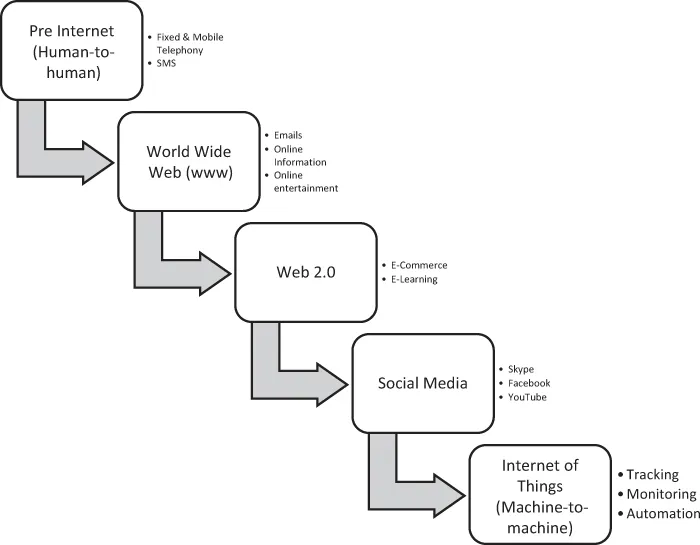
Figure 1.1 unravels the evolution of IoT from its days of pre-Internet to the present-day IoT. The pre-Internet 1980s era was the ‘Short Message Service’ (SMS) or human-to-human (H2H) era where people popularly communicated through SMS. In March 1989, the World Wide Web (www), which is not synonymous with the Internet (Shackelford, 2020), emerged as a virtual platform that used hypertext transfer protocol (HTTP) to transfer files on the web (Kaushik & Tarimala, 2020). By the mid-1990s, the ‘www’, commonly known as the ‘web’, grew to be a major communication infrastructure, during the dot-com hysteria; the web was used mostly for email communications or for accessing contextually rich information. The early growth of the web was a vast collection of hypertext markup language (HTML) documents that were hyperlinked (electronically connected) through three types of protocols: HTML, HTTP, and uniform resource locator (URL) (Whitmore et al., 2015). HTML is the language that web pages are written in, while HTTP is the most common protocol, developed specifically for the World Wide Web and was known for its user-friendliness and speed. The URL is the address that locates where any given electronic document resides on the web. Web pages were created when hypertext was combined with the Internet, giving the web browser its name – the World Wide Web.
Figure 1.1 Evolution of the Internet of Things.
During the period from 2003 to 2004, Javascript paved the way for the web to be less static and so was created Web 2.0, known as the more interactive and dynamic version of its predecessor, Web 1.0. The phenomenon of Web 2.0 was driven in part by the widespread nascence of blogs, wikis, forums, and e-commerce (Xu et al., 2020; Gross, 2019). Soon thereafter, social media was recognized as a set of Internet-based applications manifested by the popular affordances of Web 2.0, namely, Skype (2003), Facebook (2004), YouTube (2005), and Twitter (2006) (McCarthy et al., 2020; Ghani et al., 2019; McLoughlin & Alam, 2019). Finally, the global economy entered a new wave of growth with the advent of machine-to-machine (M2M) communications that paved IoT’s new age of intelligence (Holler et al., 2014; Chen, 2012). IoT witnessed the enormous number of potential devices and applications equipped with identification, tracking, monitoring, metering, automation, sensing, and processing capabilities that ultimately enabled these IoT devices to be ubiquitous, context-aware, and ambient intelligent (Whitmore et al., 2015). With the ever-increasing number of smart technologies given greater visibility, the reception of IoT devices has widened people’s general perceptions of IoT as an enhanced-living enabler to that of vulnerabilities for cybercriminals (Alieyan et al., 2020). Over time, the widespread adoption of IoT burgeoned out of the advancements made in Internet connectivity, wireless networking technologies, cloud computing, the reduced cost of sensors, memory, and the multitude of connected devices.
1.3 IoT Hype
The hype of IoT is all about the adoption of IoT technology and its exponential surge. Coined from two words, ‘Internet’ and ‘things’, the denotation ‘IoT’ was coined in 1999 by Kevin Aston, a pioneer on digital innovation. Although the beginning of IoT may be traced back to Aston’s RFID experiment and what it originally stood for, nevertheless IoT is in the present day broadly associated with the vast circuitry of gadgets and widgets that leverage on Internet connectivity, operating in real time at an ultra-high-powered gigahertz (GHz) frequency. IoT is a technological paradigm that offers a revolutionary cloud-based infrastructure with an unrestricted constellation of devices, gadgets, electrical appliances, equipment or any form of disparate, physical objects that are coherently connected to the Internet.
The baseline definition of IoT is viewed as a massive web that interconnects physical things of the real world with the virtual world. At any rate, digitalization has made the world more volatile as machines and things are being fitted with digital technology and harnessed for shaping and automating processes. Notwithstanding, it is generally understood that the implementation of IoT is regarded as a plausible solution that helps with the seamless automation of jobs. The integration of IoT, embedded with intelligent sensors and actuators, is essentially crucial in facilitating automation of remotely managed appliances that can enable new ways of production, value creation, and real-time optimization.
On the industrial front, IIoT has proved to be the game changer of industrial automation. IIoT has drawn on the interest of businesses and industry settings with its M2M applications, wireless networks, big data, combination of sensors, artificial intelligence (AI), and analytics that evolved to be the topmost mainstream business growth driver that measured and optimized business processes. As for smart home systems embedded with IoT functionalities, home residents are able to remotely configure and monitor their home appliances such as air-conditioning, light bulbs, TVs, computers, refrigerators, washing machines, and dryers, using either a wall-mounted terminal or a mobile unit that is connected to the Internet and hosted on a cloud infrastructure. Eventually, the IoT hype manifested in homes and offices with smart appliances and devices was taken as a phenomenon that grew relevant to almost anyone.
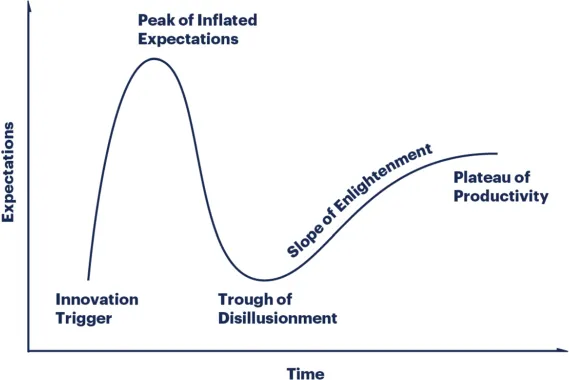
The five key phases of an IoT technology lifecycle are as follows:
Innovation trigger
Peak of inflated expectations
Trough of disillusionment
Slope of enlightenment
Plateau of productivity
Figure 1.2 is a graphical representation of the hype cycle for IoT, which zeros in on the five phases of how emerging technologies and trends evolve throughout its maturity lifecycle. It suggests that every new emerging technology follows through these five phases from its conception to its widespread adoption, representing its perceived value in terms of technological trend or innovation and its relative market promotion.
Figure 1.2 IoT hype cycle.
IoT is about managing tasks from any part of the globe that has Internet connectivity. This connectivity trend poised for growth in the digital age consists of lightweight cryptography (LWC) algorithm developed for smart devices. IoT is referred to as interoperable, smart devices connected through RFID, Bluetooth, QR codes, sensor networks, and wireless technologies (Alieyan et al., 2020). The sensors or actuators embedded within these ‘things’, add a level of digital intelligence to these ‘things’ that would otherwise be dumb, enabling them to act in unison and transmit real-time data through an Internet protocol (IP) address. Typically, the IoT value chain is underpinned by IP-based networks that transmit a very l...
Table of contents
Cover
Half Title
Series Page
Title Page
Copyright Page
Dedication
Table of Contents
Preface
Acknowledgements
Editors
Contributors
Chapter 1 IoT: The Technological Fad of the Digital Age
Chapter 2 Significance of Smart Sensors in IoT Applications
Chapter 3 Stochastic Modeling in the Internet of Things
Chapter 4 FTLB: An Algorithm for Fault Tolerant Load Balancing in Fog Computing
Chapter 5 Real-Time Solar Energy Monitoring Using Internet of Things
Chapter 6 Machine Learning Techniques in IoT Applications: A State of The Art
Chapter 7 The Farmer’s Support System: IoT in Agriculture
Chapter 8 Development of Intelligent Internet of Things (IoT)-Based System for Smart Agriculture
Chapter 9 IoT in Health Care in the Context of COVID-19: An Overview on Design, Challenges, and Application
Chapter 10 Applications of IoT in Health Care: Challenges and Benefits
Chapter 11 Machine Learning-Based Smart Health-care Systems
Chapter 12 An Exhaustive Survey of Privacy and Security Based on IoT Networks
Chapter 13 Distributed Denial-of-Service Attacks in IoT Using Botnet: Recent Trends and Challenges
Chapter 14 Detection of Node Cloning Attack in WSN to Secure IoT-based Application: A Systematic Survey
Index
Trusted by 375,005 students
Access to over 1.5 million titles for a fair monthly price.
Study more efficiently using our study tools.
Frequently asked questions
Yes, you can cancel anytime from the Subscription tab in your account settings on the Perlego website. Your subscription will stay active until the end of your current billing period. Learn how to cancel your subscription
No, books cannot be downloaded as external files, such as PDFs, for use outside of Perlego. However, you can download books within the Perlego app for offline reading on mobile or tablet. Learn how to download books offline
Perlego offers two plans: Essential and Complete
Essential is ideal for learners and professionals who enjoy exploring a wide range of subjects. Access the Essential Library with 800,000+ trusted titles and best-sellers across business, personal growth, and the humanities. Includes unlimited reading time and Standard Read Aloud voice.
Complete: Perfect for advanced learners and researchers needing full, unrestricted access. Unlock 1.5M+ books across hundreds of subjects, including academic and specialized titles. The Complete Plan also includes advanced features like Premium Read Aloud and Research Assistant.
Both plans are available with monthly, semester, or annual billing cycles.
We are an online textbook subscription service, where you can get access to an entire online library for less than the price of a single book per month. With over 1.5 million books across 990+ topics, we’ve got you covered! Learn about our mission
Look out for the read-aloud symbol on your next book to see if you can listen to it. The read-aloud tool reads text aloud for you, highlighting the text as it is being read. You can pause it, speed it up and slow it down. Learn more about Read Aloud
Yes! You can use the Perlego app on both iOS and Android devices to read anytime, anywhere — even offline. Perfect for commutes or when you’re on the go. Please note we cannot support devices running on iOS 13 and Android 7 or earlier. Learn more about using the app
Yes, you can access IoT Applications, Security Threats, and Countermeasures by Padmalaya Nayak, Niranjan Ray, P. Ravichandran, Padmalaya Nayak,Niranjan Ray,P. Ravichandran in PDF and/or ePUB format, as well as other popular books in Technology & Engineering & Computer Science General. We have over 1.5 million books available in our catalogue for you to explore.