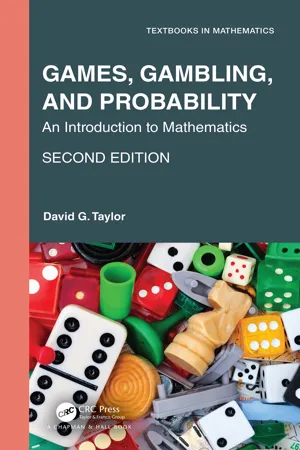
Games, Gambling, and Probability
eBook - ePub

Games, Gambling, and Probability

An Introduction to Mathematics

  1. 494 pages
  2. English
  3. ePUB (mobile friendly)
  4. Available on iOS & Android
eBook - ePub

Games, Gambling, and Probability

An Introduction to Mathematics

About this book

Many experiments have shown the human brain generally has very serious problems dealing with probability and chance. A greater understanding of probability can help develop the intuition necessary to approach risk with the ability to make more informed (and better) decisions.

The first four chapters offer the standard content for an introductory probability course, albeit presented in a much different way and order. The chapters afterward include some discussion of different games, different "ideas" that relate to the law of large numbers, and many more mathematical topics not typically seen in such a book. The use of games is meant to make the book (and course) feel like fun!

Since many of the early games discussed are casino games, the study of those games, along with an understanding of the material in later chapters, should remind you that gambling is a bad idea; you should think of placing bets in a casino as paying for entertainment. Winning can, obviously, be a fun reward, but should not ever be expected.

Changes for the Second Edition:

  • New chapter on Game Theory
  • New chapter on Sports Mathematics
  • The chapter on Blackjack, which was Chapter 4 in the first edition, appears later in the book.
  • Reorganization has been done to improve the flow of topics and learning.
  • New sections on Arkham Horror, Uno, and Scrabble have been added.
  • Even more exercises were added!

The goal for this textbook is to complement the inquiry-based learning movement. In my mind, concepts and ideas will stick with the reader more when they are motivated in an interesting way. Here, we use questions about various games (not just casino games) to motivate the mathematics, and I would say that the writing emphasizes a "just-in-time" mathematics approach. Topics are presented mathematically as questions about the games themselves are posed.

Table of Contents

Preface
1. Mathematics and Probability
2. Roulette and Craps: Expected Value
3. Counting: Poker Hands
4. More Dice: Counting and Combinations, and Statistics
5. Game Theory: Poker Bluffing and Other Games
6. Probability/Stochastic Matrices: Board Game Movement
7. Sports Mathematics: Probability Meets Athletics
8. Blackjack: Previous Methods Revisited
9. A Mix of Other Games
10. Betting Systems: Can You Beat the System?
11. Potpourri: Assorted Adventures in Probability
Appendices
Tables
Answers and Selected Solutions
Bibliography

Biography

Dr. David G. Taylor is a professor of mathematics and an associate dean for academic affairs at Roanoke College in southwest Virginia. He attended Lebanon Valley College for his B.S. in computer science and mathematics and went to the University of Virginia for his Ph.D. While his graduate school focus was on studying infinite dimensional Lie algebras, he started studying the mathematics of various games in order to have a more undergraduate-friendly research agenda. Work done with two Roanoke College students, Heather Cook and Jonathan Marino, appears in this book! Currently he owns over 100 different board games and enjoys using probability in his decision-making while playing most of those games. In his spare time, he enjoys reading, cooking, coding, playing his board games, and spending time with his six-year-old dog Lilly.

Trusted by 375,005 students

Access to over 1.5 million titles for a fair monthly price.

Study more efficiently using our study tools.

Information

Year
2021
Print ISBN
9781032018126
9780367820435
Edition
2
eBook ISBN
9781000400212

1

Mathematics and Probability

1.1 Introduction

If you have access to some dice, go ahead and grab six standard 6-sided dice and roll them. Without even seeing the exact dice that you rolled, I'm pretty sure that you rolled at least two of the same number (for the approximately 1.5% of you that rolled exactly one of each number, I apologize for being incorrect). How did I know that? The behavior of (fair) 6-sided dice is pretty easy to model – if you were talking to a friend, you would probably say that each of the six numbers is equally likely to be rolled. After that, it only takes a modest understanding of the rules of probability to determine the “expected” probability that, when rolling six dice, you will get exactly one of each number. As a side note, the chance of getting exactly one of each number is just slightly more common than the probability of being born a twin (in North America at least) and slightly less common than drawing the A from a thoroughly shuffled deck of cards with jokers included!
If you roll those six dice again, chances are you still will not have gotten exactly one of each number. The probability that you do is still the same, but for the 0.024% of you that rolled exactly one of each number on both rolls, you might be skeptical. And with good reason! Understanding how the mathematics of probability applies to chance events and actually observing what happens in practice can sometimes be at odds with one another. If you were going merely on “observed” probability, you might think that rolling one of each number is a common event. By the way, you are twice as likely to die by slipping and falling in the shower or bathtub compared to rolling exactly one of each number on both of the rolls!
The problem lies in the fact that repeating the same experiment a small number of times will probably not reflect what will happen long-term. If you have time, you might try rolling those six dice ten more times, or maybe a hundred more times. If you're really struggling to find something to do, a thousand or even ten thousand repetitions might convince you that my estimates above are correct (and you may even get numbers close to mine), but you are not likely at all to discover those percentages by only observing what happens!
This chapter is about introducing some of the language of probability, some of the mathematical principles and calculations that can be used right from the start, and some more thoughts about why being able to compute probabilities mathematically doesn't replace what you see, but rather compliments it quite well. As a small disclaimer, while the rest of this book focuses on what I consider “fun” games, many of which are probably familiar to you, this chapter strips out the idea of “game” and “rules” in favor of using just dice, coins, and candy to motivate our study. As will be usual throughout this book, though, the mathematics and examples will generally appear after the question we are trying to answer. The questions we ask about the various games and situations will drive us to develop the mathematics needed to answer those very questions!

1.2 About Mathematics

Most of this book is about a subfield of mathematics known as probability, but before we get into the details, we should spend a few moments talking about mathematics in general. Many of you have had many different “math” classes at various stages of being in school. I use quotes there because the mathematics covered in elementary school through high school is very specific and focused, at least initially, on calculations. Students first learn about numbers and counting, followed by addition, subtraction, multiplication, and division; these topics fall into a very small part of mathematics called arithmetic and are really not topics that mathematicians would think of when discussion the subject at all. Indeed, it is not until students start experiencing algebra, where early equations such as 2+x=5 and x49 pique our interests. These first equations give us a glimpse into what mathematics really is: the science of patterns.
Before we continue, let's take time for a brief side note. It's oftentimes when learning about fractions, or when getting to a first algebra course in middle school or high school, that some students start thinking that they're “not good at math” or that they “don't enjoy math.” This feeling can continue throughout someone's schooling and into a majority (or all) of their adult life. I firmly believe that this does not need to be the case, and should not be the case. Some say that there are math people and “not math” people, a notion that I think should be eliminated as much as we possibly can. Sure, mathematics may come more naturally to some people and others may need to put in a bit more time, but this is exactly the same for anything else in life. Consider basketball as an example. Anyone can learn the game and to shoot hoops somewhat well by just watching and playing the game; by putting in more practice, anyone can shoot hoops better, and with hours of practice, it's possible for virtually everyone to shoot pretty well and likely play on a high school team (yes, there are other skills in the game other than shooting hoops, but any of the skills can also be learned and practiced). With enough time and effort, anyone can be good at basketball; sure, not everyone has the raw talent, time, or desire to become the next NBA star, but the same is true of mathematics. With time and effort, everyone can be good at mathematics, and not everyone may have that time, desire, or even the equivalent of raw talent, to become a professional mathematician. I firmly believe that the w...

Table of contents

  1. Cover
  2. Half Title
  3. Series Page
  4. Title Page
  5. Copyright Page
  6. Dedication
  7. Contents
  8. List of Figures
  9. List of Tables
  10. Preface
  11. 1 Mathematics and Probability
  12. 2 Roulette and Craps: Expected Value
  13. 3 Counting: Poker Hands
  14. 4 More Dice: Counting and Combinations, and Statistics
  15. 5 Game Theory: Poker Bluffing and Other Games
  16. 6 Probability/Stochastic Matrices: Board Game Movement
  17. 7 Sports Mathematics: Probability Meets Athletics
  18. 8 Blackjack: Previous Methods Revisited
  19. 9 A Mix of Other Games
  20. 10 Betting Systems: Can You Beat the System?
  21. 11 Potpourri: Assorted Adventures in Probability
  22. Appendices
  23. Tables
  24. Answers and Selected Solutions
  25. Bibliography
  26. Image Credits
  27. Index

Frequently asked questions

Yes, you can cancel anytime from the Subscription tab in your account settings on the Perlego website. Your subscription will stay active until the end of your current billing period. Learn how to cancel your subscription
No, books cannot be downloaded as external files, such as PDFs, for use outside of Perlego. However, you can download books within the Perlego app for offline reading on mobile or tablet. Learn how to download books offline
We are an online textbook subscription service, where you can get access to an entire online library for less than the price of a single book per month. With over 1.5 million books across 990+ topics, we’ve got you covered! Learn about our mission
Look out for the read-aloud symbol on your next book to see if you can listen to it. The read-aloud tool reads text aloud for you, highlighting the text as it is being read. You can pause it, speed it up and slow it down. Learn more about Read Aloud
Yes! You can use the Perlego app on both iOS and Android devices to read anytime, anywhere — even offline. Perfect for commutes or when you’re on the go.
Please note we cannot support devices running on iOS 13 and Android 7 or earlier. Learn more about using the app
Yes, you can access Games, Gambling, and Probability by David G. Taylor in PDF and/or ePUB format, as well as other popular books in Mathematics & Game Theory. We have over 1.5 million books available in our catalogue for you to explore.