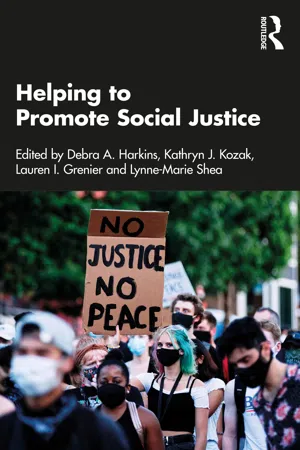
Helping to Promote Social Justice is a richly informed and practical guide for advanced students and young professionals to become helpers capable of promoting social justice with whomever they collaborate with, mentor, serve and consult. Filled with insight and supplemental exercises, the book will direct readers to think critically and reflect on the broader social and political systems that create our current social injustices.
Beginning with a strong theoretical focus on power, social identity and intersectionality, the authors engage with readers' assumptions on helping, their value systems and their understandings of power and privilege when helping communities in need. The rest of the book focuses on the application of these critical concepts, guiding future helpers to consider how to intervene, assess need, lead, build a team, address conflict and work to promote change from a position of social justice.
Written by academic faculty with expertise in teaching, coaching and consulting, Helping to Promote Social Justice should be considered essential reading for students in social work, psychology and counselling.
As recent civil unrest shakes the very foundation of United States society, basic assumptions of who we are, how we got here and how we should function are being questioned and challenged. Americans are enculturated to believe that America was founded based on the principles of “freedom and liberty for all”; yet, we often conveniently forget that we founded this country through the genocide of 4.7 million Indigenous peoples, that we enslaved African Americans for over 245 years, and that as recently as the 20th century, we interned Japanese Americans (1942–1946). Today, many Americans believe that we addressed most of our social injustices during the Civil Rights era, and while significant progress was made during the 1960s, those outside of middle-class America would beg to differ. Recent civil unrest related to the Black Lives Matter movement and the recent immigration concentration camps that have sprung up along our Southern border and have continued up until this writing remind us yet again that American citizens have a lot of unfinished business regarding social justice.
Why do we in the US struggle so hard to acknowledge the social injustice in our society? What makes it so difficult for us to see the injustices happening around us? Why can some of us see it and others cannot? What is needed for those who are mentally blind to the injustices happening around them to be able to see? This chapter explores many of these questions.
We hypothesize that the challenge many Americans have with seeing and believing that social injustice is occurring all around us relates to our strong individual-focused cultural mindset (Hofstede, 1985). This idea of US individualism impacting our ahistorical cultural norms was first proposed more than 35 years ago. After studying the effects of cultural values on human behavior in more than 90 countries, Dutch organizational anthropologist Geert Hofstede found that cultures varied significantly on whether they focused most heavily on the individual or the group. He found that some cultures focused heavily on the individual with loose ties to all except his or her immediate family. In these individually focused countries, the emphasis was on the “I” over the “we” (i.e., valuing individual needs over the group needs). Other cultures focused heavily on the group with strong ties to extended family and other in-groups, focusing more on the “we” over the “I” (i.e., valuing group and community needs over individual needs). Hofstede found that all cultures can be found somewhere along this individualist-versus-collectivist continuum. While not surprising to many of us, Hofstede confirmed that the US has the most individualistically focused values of all the cultures that he studied. While globalization is changing this cultural landscape, more recent research continues to support his findings (Hofstede, 2001, 2011).
As Hofstede found, and most of us in the US can attest, a high value is placed on pursuing our own individual needs. This individual focus can be seen in how we as helpers help and is revealed in the primacy of individual-focused helping promoted by the American Counseling Association (2011), the American Psychological Association (2012), the field of social work (Cree, Jain, & Hillen, 2019), the National Institute on Drug Abuse (2018) and the World Health Report (2003). By individually focused helping, we mean helping practices that seek to help an individual develop, achieve or regain “normal” functioning. We know that psychiatry, psychology, social work, counseling and other helping professions provide important and meaningful help to millions of individuals suffering from mental disorders related to anxiety, mood, personality, eating, adjustment, dementia and psychosis, to name just a few. Millions of these individuals who seek professional help can attest to how it has helped them in relieving some or all of their suffering. Clinical, counseling and social work and other helping professions help.
Unfortunately, as the US Surgeon General’s Report on Mental Health, Culture, Race and Ethnicity (2001) revealed, mental health professionals are not helping those outside of the hegemony. More recent research (Algería et al., 2008; Blair et al., 2013; Burkard & Knox, 2004; Shin, Smith, Welch, & Ezeofor, 2016) continues to find this differential impact of helpers not successfully helping those outside of middle-class white America.
Hegemony: the social, cultural, ideological or economic influence exerted by a dominant group. In our case, the assumption of white, middle-class men as the normative experience reflects the perspective of those in power, not the makeup of the population.
In this chapter, we explore how helping is intimately tied to the US ideological systems of individualism and capitalism that promote our assumptions about development, intelligence, science, family, morality and economics. As we become more aware of our biased and faulty thinking, we can become overwhelmed and disheartened when we realize that our ways of helping might be contributing to social injustice. However, deconstructing our biases is the first step in critical thinking that allows us to reimagine how we can engage in more empowering forms of helping. We end this chapter on a positive note with ways that we can liberate ourselves from these ideological traps that prevent us from engaging in more socially just forms of helping that can benefit all segments of society.
Capitalism and Helping
Most forms of helping in the US were formed under the economic umbrella of capitalism, the notion of private property, the Protestant focus on work and individualism, and the promise of science. While each of these movements led to the rapid rise of the US as a superpower with incredible innovations, scientific discoveries and life-saving medical treatments, we often ignore the darker side of our political, economic and moral framework. We explore how this darker side of our capitalist and ideological system impacts social justice later in this chapter.
Helping within the US often mirrors the economic, scientific and moral frameworks highly valued in the Western world (Parker, 2007). For example, most of us begin helping with the unexamined assumption that helping should mean helping someone with the emphasis on person (i.e., individual therapy, counseling and pastoring) and that helping the individual will reduce or relieve symptoms. This is true for many individuals, but we must examine if it is true for all. Who is helped and not helped by this unexamined Western notion of personal helping? What is unexamined for many helpers is how mental health may be a symptom of a social ill. This may be particularly true for those in oppressed communities (i.e., women, people of color (POC), LGBTQ+, low-income, disabled, non-Christian etc.) within our Western system. Helpers in this system often come to the field without the kind of education, training or resources needed to examine the ways in which social ills can create or maintain oppressive systems and without being provided with the time and tools necessary to consider how to address those social ills.
Given this socio-historical situation, it is not surprising to learn that the field of psychology and the helping disciplines in general are some of the most popular majors in every college and university in the US. This likely has a lot to do with the fact that for many, learning about helping from a Western lens feels “intuitively” right. That is, the notion that the individual is in control of their own thoughts and feelings and the sense of power and control this assumption provides to us as the helper feel just right to those learning how to help. This assumption about an individual’s behavior gives us a tool that many already accept as truth to create behavioral changes in others. Unfortunately, many of us do not explore how this intuitive feeling may be a signal that something is amiss, that we are being co-opted into the Western framework of how one “should” help others. Ironically, these popular majors unintentionally train students to be the managers of the hegemony of our social system.
Unfortunately, individual helping is not enough for everyone. While traditional forms of helping work for some individuals, this framework does not consider whether it is helpful to those suffering from collective and historical oppression. Many physical and mental health issues that result from collective and historical oppression are bigger than any individual help can provide. Symptoms at an individual level may mask social ills that cannot be solved privately. For example, examination of the US COVID-19 death rates by race (see Figure 1.1) reveals stark differences related to racial injustice, the very argument being expressed through the Black Lives Matter movement. Without addressing racial injustice impacting this differential death rate, there is little we as individuals can do to help those experiencing “mental health” issues.
Figure 1.1 US COVID-19 death rate (per 100,000)
The symptoms that are addressed in traditional forms of helping may, inadvertently, keep people from attending to the impact that larger issues may be having on their physical and mental health. Sadly, little attention is paid to the reality that a capitalist ideology often creates physical and mental strain on those at the bottom of the social and economic ladder. Sonya Renee Taylor (2018) describes our societal structure as a kind of ladder—one that each of us climbs in an attempt to get to the rung that affords us happiness and wellbeing and validates our worth. This ladder, though, only exists because we climb it. Taylor explains that we all work to maintain the societal systems that relegate all those who fall outside of the (white, middle-class) default body identity to lower rungs. We do so through our ongoing work to climb to a higher rung on the ladder—one that our systems tell us we are inherently unworthy of reaching (Taylor, 2018).
But just because someone is oppressed does not necessarily mean that they understand how they are oppressed within the current social and economic system. In fact, the strength of the hegemony is that our system is hidden, in plain sight, from us.
Some people believe that the field of social work solves this problem. Despite standing out as a field that incorporates social issues in individual work, social workers do not typically engage in helping that creates transformational social change. While social work goes beyond other helping professions by working in clients’ communities, focusing on the impact of race and diversity on mental health, and seeking social services to alleviate suffering, social workers, like other helping professionals, still focus on helping the individual.
As a social worker, we often work with clients to help with dayto-day activities. We work with a client to enhance their coping skills to address social injustices hoping that such changes improve their lives. As a field, we are dependent upon the ideologies of political institutions—liberal, moderate or conservative—that directly influence the scope of our role as a social worker. For example, I have found that a conservative ideology is less open to social change hence under such leadership, I realize my best bet is to simply help the client to cope.
—Mary William, MSW
When one learns to examine these unexamined approaches to helping to which we are all inoculated, we can begin to question these taken-for-granted assumptions. Once we do this work, we prepare ourselves to consider and then address the systemic factors that impact those help seekers oppressed by our society.
Take a moment to examine how you have thought about helping in the past and what challenges to helping might exist within a broader social, economic and political perspective.
How can you help others to examine some of these unexamined assumptions around helping? How can we engage in helping that is more socially just? How can you help others approach helping from a place of trying to create freedom for those oppressed?
What have these questions raised for you? Have they made you feel uncomfortable or overwhelmed? In what ways might they make others uncomfortable or overwhelmed?
This book seeks to help you and those you mentor, coach, teach, consult and/or supervise. Leaning into the discomfort that results from examining helping from a more socio-political perspective will allow you to create more socially just helping prac...
Table of contents
Cover
Half Title
Title Page
Copyright Page
Contents
Foreword
Contributor Bios
Introduction
Part 1 Helping Promote Liberation
Part 2 Helping Build Empowering Skills
Part 3 Helping Expand Social Justice
Author and Subject Index
Trusted by 375,005 students
Access to over 1.5 million titles for a fair monthly price.
Study more efficiently using our study tools.
Frequently asked questions
Yes, you can cancel anytime from the Subscription tab in your account settings on the Perlego website. Your subscription will stay active until the end of your current billing period. Learn how to cancel your subscription
No, books cannot be downloaded as external files, such as PDFs, for use outside of Perlego. However, you can download books within the Perlego app for offline reading on mobile or tablet. Learn how to download books offline
Perlego offers two plans: Essential and Complete
Essential is ideal for learners and professionals who enjoy exploring a wide range of subjects. Access the Essential Library with 800,000+ trusted titles and best-sellers across business, personal growth, and the humanities. Includes unlimited reading time and Standard Read Aloud voice.
Complete: Perfect for advanced learners and researchers needing full, unrestricted access. Unlock 1.5M+ books across hundreds of subjects, including academic and specialized titles. The Complete Plan also includes advanced features like Premium Read Aloud and Research Assistant.
Both plans are available with monthly, semester, or annual billing cycles.
We are an online textbook subscription service, where you can get access to an entire online library for less than the price of a single book per month. With over 1.5 million books across 990+ topics, we’ve got you covered! Learn about our mission
Look out for the read-aloud symbol on your next book to see if you can listen to it. The read-aloud tool reads text aloud for you, highlighting the text as it is being read. You can pause it, speed it up and slow it down. Learn more about Read Aloud
Yes! You can use the Perlego app on both iOS and Android devices to read anytime, anywhere — even offline. Perfect for commutes or when you’re on the go. Please note we cannot support devices running on iOS 13 and Android 7 or earlier. Learn more about using the app
Yes, you can access Helping to Promote Social Justice by Debra A. Harkins in PDF and/or ePUB format, as well as other popular books in Social Sciences & Social Psychology. We have over 1.5 million books available in our catalogue for you to explore.