Being an effective city planner means being an effective leader. You need to be prepared to convince people that good planning matters. Often a well-written, thoughtful and inclusive plan doesn't result in meaningful action, because planners don't show leadership skills. At some point, some city planners become cynical and worn down, wondering why no one listens to them but not doing the self-reflection about how that could change.
Leadership in Planning explains how to get support for planning initiatives so they don't just fade from memory. It will guide city planners to think less about organizational charts and more about:
· being a respected voice within your organization, both with staff and with your boss;
· being a good communicator with people outside your organization; and
· being able to understand how and when to push for good planning ideas to turn them into actions.
Along the way, case studies bring these concepts to the real world of municipal planning. In addition, past planning figures' actions are explored to see what they did right and what mistakes they made.
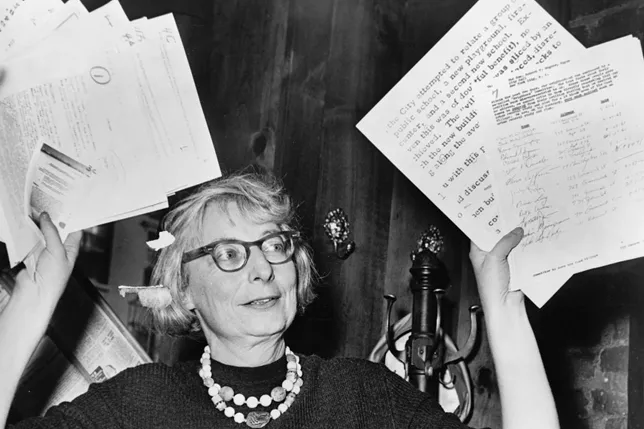
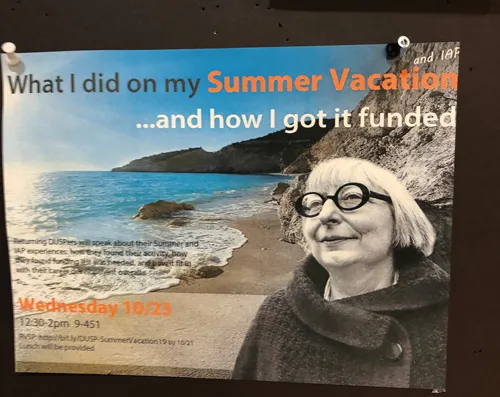
In the world of planning, it often comes back to Jane Jacobs. This is particularly true in the world of planning education. From public testimony to comprehensive plans, her books and actions are often seen as the gold standard of city planning practice. It’s hard to miss her face or the iconic image of her holding up documents, whether on city planning social media feeds or in the halls of planning programs. Want to “planner” a normal image up? Add Jane’s face to it!
Jacobs is an interesting icon, given that she didn’t think much of the planning profession as a whole. In fact, in The Death and Life of Great American Cities, she dismissed the whole field of planning in stating (in parentheses, no less): “(The pseudoscience of planning seems almost neurotic in its determination to imitate empiric failure and ignore empiric success)” (Jacobs 1992 [1961], 183).
Regardless, the love for all things “Jane” seems to permeate planning and a field. It’s an interesting statement on the current planning profession that the icon of the field disliked planners, although admittedly, not as much as other activists such as Robert Goodman, a planning school dropout who called planners “the soft cops.” In his book After the Planners, Goodman wrote that planners were like the people who got the U.S. into the Vietnam War. He even rejected advocacy planning—a popular concept created in the 1960s suggesting that planners can promote equity—as ineffective.
Figure 1.1 Jane Jacobs. Credit: Library of Congress, Prints and Photographs Division, LC-USZ62–104052.
It’s fair to say that Jacobs and many of her intellectual peers felt cities had no need for planners.
It’s not hard to understand why. The planning profession had just gone through several decades of wide-scale demolition and social experimentation in the name of “urban renewal.” Planning after urban renewal was put in an interesting place. On the one hand, the excesses and arrogance of many urban renewal projects cannot be denied. On the other hand, if the true path is to do nothing and let cities be, what is the point of planning? While some turned to advocacy planning and more public participation as the solution, even that role was dismissed by experienced experts like Goodman.
The message may be “be humble.” It may also be “don’t repeat the mistakes of the past.” These are both good messages for planners to heed. But where is the positive direction in those messages? If we should not repeat past mistakes, what should we do instead? Find a different field of work, as Jacobs and Goodman would suggest? Re-invent planning as a tool of public engagement and outreach? What is the role of the professional planner if the entire idea of civic action causes more problems than it cures?
Figure 1.2 Jane Jacobs on flyer. Credit: Author. Original image: Library of Congress, Prints and Photographs Division, LC-USZ62–104052.
In Jacob’s eyes, the leadership of the planner involves getting out of the way. At a minimum, planning leadership in her eyes means listening to the public (and, some would add, the educated, white, somewhat affluent public) and just doing what they say. That’s one way to look at the issue. On the other hand, it assumes that you as a planner have no wisdom to offer to the public. If planning is a profession, you have to have some wisdom to offer, right? If not, why are you in the profession?
An Ideal Arch-enemy?
Of course, Jacobs and her peer thinkers had easy targets in the urban renewal movement. Flush with federal cash and filled with post-World War II American hubris, many planners of the day took on very real problems with untested solutions. Slums are dirty and unsafe? Get rid of them and build some of those Corbusier-inspired towers in a field! Trolley systems are run down and don’t go where they need to? Replace them with a new system of highways based, ironically, on the German autobahn! Worried about atomic annihilation of US cities? Disperse residents into the countryside where they will be harder to target!
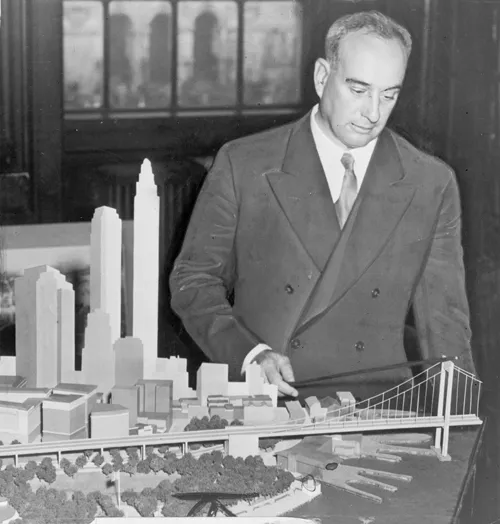
Just as planners present Jacobs as their unlikely hero, they similarly vilify Robert Moses. Moses, the target of much of Jacobs’ ire when he tried to run a highway through her neighborhood, is an unsympathetic figure. Born into affluence and starting his career in politics, he quickly found a more powerful role behind the scenes in the New York urban renewal efforts of the mid-twentieth century. Tall, well-dressed, and arrogant, he was almost custom-made to represent the concept of planner arrogance.
Starting off as a good government reformer, Moses worked to rid New York state politics of patronage. After connecting with Governor Al Smith in the 1920s, Moses gained early attention working on state parks on Long Island. When the New Deal started funding parks, roadways, and bridges, he followed the resources and entered the main period of his career, where he worked on the modern New York City transportation and park systems.
Moses was well known for being a shrewd administrator and an effective implementor of projects. In some ways, he was an excellent leader for planning projects. However, the biases of the times, and his own biases, were significant shortcomings. He was said to be racist and classist, and many of his actions suggest that he was. He did not spend much time thinking about transit, believing that the automobile was the transportation mode of the future. Many planning historians go further and suggest that he hated transit and sought to undermine it by promoting automobile use. He was even rumored to try to keep African Americans out of public pools by keeping them cold, in the belief that they preferred warm water.
Figure 1.4 Robert Moses. Credit: C.M. Stieglitz, World Telegram staff photographer—Library of Congress. New York World-Telegram & Sun Collection.http://hdl.loc.gov/loc.pnp/cph.3c36079.
Another of Moses’ strengths was his strategic prowess. He understood politicians well. That may be in part because he was himself a failed political candidate. He generally knew what they liked and didn’t like, and figured out ways to keep them happy. He knew the politicians loved ribbon-cuttings, so he would start projects as soon as possible.
Moses also understood that they hated admitting failure. A strategy that combined both of these ideas was to start a project before he had enough funding to complete it. Once it was under way and the grand beginning was announced, he knew that politicians would not want it to fail. He would then return to them and ask for more funds to complete the project, and would usually succeed. Later, he would have access to his own dedicated sources of funding through the various authorities he headed and he wouldn’t even have to ask for more money.
Bureaucracy was Moses’ friend and ally. He was able to create positions in the various quasi-public agencies around New York and then convince decision makers to float bonds to fund activities. Until the bonds were paid off, the organization had a secure existence because the bond holders wanted their dividend. Long before they were paid off, he would float more bonds and make sure his spot was secure. For most of his career, he was involved with several agencies. At the peak of his powers, he had leadership roles in more than ten.
While it’s theoretically appealing to admire Moses’ survival skills, his leadership style had some significant weaknesses. He had little tolerance for dissent. He had no regard for the impacts of his decisions on residents, displacing them with little notice and no sympathy. His most famous quote to justify his actions compared what he was doing to surgery that was necessary to save the city:
You can draw any kind of picture you want on a clean slate and indulge your every whim in the wilderness in laying out a New Delhi, Canberra, or Brasilia, but when you operate in an overbuilt metropolis, you have to hack your way with a meat ax. (Caro 1975, 849)
Moses led in an aggressive, military way that was not unusual in the post-war period. It’s not that rare today either. It can be remarkably effective if you are good at it. However, it’s not a good long-term approach to planning leadership. Effective planning leaders will factor in other people’s views and will be open to evidence-based adjustments to their plans.
Moses began to run into resistance from Jacobs—and public sentiment generally—in the 1960s. He showed himself unwilling to adapt to these changes. As will be seen below, some of his peers were more willing to temper their strong personalities.
This is not a biography of Moses, so we are not going to spend a lot of time going through his life and actions in detail. But suffice it to say that, in his time, this approach was not unpopular. In his 1952 book Robert Moses: Builder for Democracy, Cleveland Rogers provided a positive perspective on his achievements to date, while acknowledging that Moses was “intolerant of opposition.”
Even the New York Times Review of Books was highly positive of Moses at that time. “New York thanks God for Robert Moses as a man of action,” wrote William Ogden in his review of Robert Moses: Buil...
Table of contents
Cover
Half Title
Title Page
Copyright Page
Table of Contents
List of Figures and Tables
About the Author
Acknowledgements
Introduction
1 Leading Is Complicated
2 Why Do You Want to Lead Anyway?
3 Leading Your Office
4 Managing Up
5 Leading Public Opinion
6 Leading by Listening
7 Facilitative Leadership
8 Strategic Planning and Leadership
9 Five Steps to Leadership
Conclusion: Combing a Giant Hairball
Afterword
Index
Trusted by 375,005 students
Access to over 1.5 million titles for a fair monthly price.
Study more efficiently using our study tools.
Frequently asked questions
Yes, you can cancel anytime from the Subscription tab in your account settings on the Perlego website. Your subscription will stay active until the end of your current billing period. Learn how to cancel your subscription
No, books cannot be downloaded as external files, such as PDFs, for use outside of Perlego. However, you can download books within the Perlego app for offline reading on mobile or tablet. Learn how to download books offline
Perlego offers two plans: Essential and Complete
Essential is ideal for learners and professionals who enjoy exploring a wide range of subjects. Access the Essential Library with 800,000+ trusted titles and best-sellers across business, personal growth, and the humanities. Includes unlimited reading time and Standard Read Aloud voice.
Complete: Perfect for advanced learners and researchers needing full, unrestricted access. Unlock 1.5M+ books across hundreds of subjects, including academic and specialized titles. The Complete Plan also includes advanced features like Premium Read Aloud and Research Assistant.
Both plans are available with monthly, semester, or annual billing cycles.
We are an online textbook subscription service, where you can get access to an entire online library for less than the price of a single book per month. With over 1.5 million books across 990+ topics, we’ve got you covered! Learn about our mission
Look out for the read-aloud symbol on your next book to see if you can listen to it. The read-aloud tool reads text aloud for you, highlighting the text as it is being read. You can pause it, speed it up and slow it down. Learn more about Read Aloud
Yes! You can use the Perlego app on both iOS and Android devices to read anytime, anywhere — even offline. Perfect for commutes or when you’re on the go. Please note we cannot support devices running on iOS 13 and Android 7 or earlier. Learn more about using the app
Yes, you can access Leadership in Planning by Jeff Levine in PDF and/or ePUB format, as well as other popular books in Architettura & Pianificazione urbana e paesaggistica. We have over 1.5 million books available in our catalogue for you to explore.