The increasing use of composite materials over conventional materials has been a continual trend for over a decade. While the fundamental understanding of fiber reinforcement has not changed, many new material advancements have occurred, especially in manufacturing methods, and there is an ever-growing number of composite material applications across various industries. Polymer-Based Composites: Design, Manufacturing, and Applications presents the concepts and methods involved in the development of various fiber-reinforced composite materials.
Features:
Offers a comprehensive view of materials, mechanics, processing, design, and applications
Bridges the gap between research, manufacturing science, and analysis and design
Discusses composite materials composed of continuous synthetic fibers and matrices for use in engineering structures
Presents codes and standards related to fiber-reinforced polymer composites
Includes case studies and examples based on industrial, automotive, aerospace, and household applications
This book is a valuable resource for advanced students, researchers, and industry personnel to understand recent advances in the field and achieve practical results in the development, manufacture, and application of advanced composite materials.
P. Sivasubramanian, K. Mayandi, V. Arumugaprabu, N. Rajini, and S. Rajesh
Kalasalingam Academy of Research and Education
Contents
1.1 Definition of Composites
1.2 Definition of Polymers
1.3 Need for Polymer-based Composites
1.4 Polymer Matrix Types
1.4.1 Thermoset Polymers
1.4.1.1 Polyester
1.4.1.2 Epoxy
1.4.1.3 Vinyl Ester
1.4.1.4 Phenolic Resins
1.4.1.5 Polyamides and Bismaleimides
1.4.2 Thermoplastic Polymers
1.4.2.1 Thermoplastic Properties
1.4.2.2 Thermoplastic Processing
1.5 Types of Polymer-based Composites
1.5.1 Matrix Phase
1.5.1.1 Polymer Matrix Composites (PMC)
1.5.1.2 Ceramic Matrix Composites (CMC)
1.5.1.3 Metal Matrix Composites (MMCs)
1.5.2 Reinforcements
1.5.2.1 Fiber
1.5.2.2 Particle
1.5.2.3 Sheet
1.5.3 Scale
1.5.3.1 Nanocomposites
1.5.4 Biocomposites
1.6 Types of Reinforcements
1.7 Applications
1.7.1 Polymers Composites in the Transportation Industry
1.7.2 Polymer Composites in the Medical Device Industry
1.7.2.1 Benefits Provided by Polymer Composites
1.7.3 Polymers and Polymer-based Composites in Different Applications: The Sporting Goods Industry
1.7.3.1 Building, Construction, and Civil Engineering Sectors
1.7.4 Use of Polymers and Polymer-based Composites in Energy-related Applications
1.7.5 Oil and Gas Exploration, Production, Transport, and Storage
References
1.1 Definition of Composites
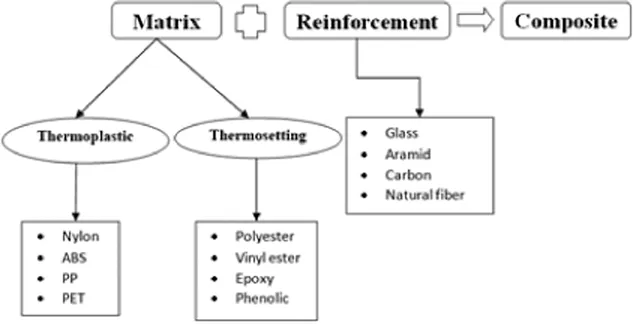
A new type of engineering material emerged in the mid-20th century viz., composite materials. Two or more things with different behaviors combining to form a new thing are termed composites. Similarly, “composite materials” are formed by combining two materials with different properties. Figure 1.1 shows some examples of the combination of two materials.
FIGURE 1.1 Combinations of two materials.
Historically, the term compositeis not new as its usage existed in the ancient ages. A few good examples are: bricks made by ancient civilizations were composed of mud and straw,the ancient Japanese-made Samurai swords, Damascus gun barrels made using layers of iron and steel, and mud walls built using bamboo shoots. Progress results in technological developments, which mainly depends on innovations in materials. In this sense, applications of composite materials are gradually increasing, replacing conventional materials. The excellent merits offered by composite materials, such as low weight, high strength, and availability, make it as leader among the various types of materials used. Furthermore, composites may be of natural origin or industrially produced.
Nature itself has some good examples, mainly from animal and plant sources, where composite materials are used. Composites consist of two phases, namely, the matrix phase and the reinforcement phase. Matrix is the primary phase having a continuous character, and reinforcement is the secondary phase having a discontinuous form. Some matrices are usually more ductile and less rigid, consisting of polymers, ceramics, or metals as one of the three major material types. In composite materials, the matrix is the main component, and the reinforcement phase is discontinuously integrated into the matrix. The dispersed phase is usually more complicated than the continuous phase and is referred to as reinforcement. It enhances composites and improves the mechanical properties of the matrix. The three familiar types of matrices involved in the production of composites for various applications include polymer matrix, metal matrix, and ceramic matrix-based composites.
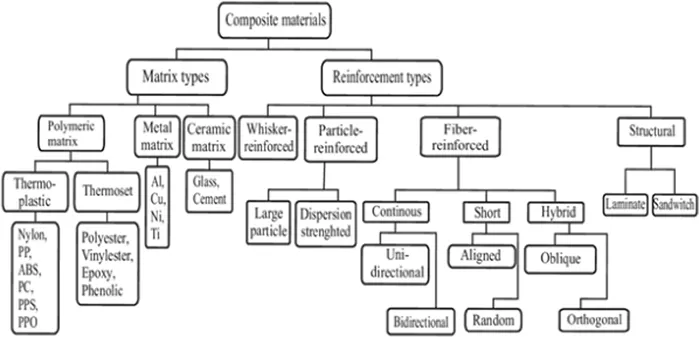
The following three types of reinforcements are commonly used: fibers, particulates, and laminates. Figure 1.2 shows the family tree of composites. The term composites as it refers to composite materials is defined as “Two or more materials combined on a macroscopic scale to form a third new material which possesses certain special property characteristics.”
FIGURE 1.2 Family tree of composites.
Forming composite materials, leads to improvement in characteristics such as weight, strength, stiffness, wear resistance, corrosion resistance, electrical resistance, acoustic enhancement, thermal property, temperature resistance, moisture resistance, chemical resistance, and fatigue. Currently, many composites are developed based on the environmental aspect so that usage of wastes as filler or reinforcement and matrices leads to tremendous improvement in the properties. Moreover, the concept of biocomposites is attracting the world in such a way that complete degradation is possible. The more important thing is that we should not consider all two or more materials as composites, as a composite material must satisfy three essential criteria as given below:
The two materials combining should be able to fabricate.
It needs to have two or more physically or chemically distinct phases with an interface separating the two materials.
The final material property obtained must be a new property that does not reflect any one of the specific material properties among the two.
Our focus in this book is on the fabrication of polymer matrix composites (PMCs) using natural fiber reinforcements, as well as its mechanical properties, wear properties, erosion properties, and fatigue properties. Furthermore, the development of nanocomposites, biocomposites using the different types of polymer matrices, hybrid composites, and the failure analysis of composites are discussed in detail. Finally, a discussion on the various applications of PMCs is also presented.
1.2 Definition of Polymers
The term polymer is not new as it has been used since the ancient period. Polymers are made from pieces (known as monomers) that can be easily connected into a long piece similar to a chain (known as polymers). Let us begin with monomers. They are low-molecular-weight compounds that combine to form a polymer, which a high-molecular-weight molecule composed of small repeated units. According to the International Union of Pure and Applied Chemistry, “A polymer is a substance composed of molecules characterized by the multiple repetitions of one or more species of atoms or groups of atoms (constitutional repeating units) linked to each other in amounts sufficient to provide a set of properties that do not vary markedly with the addition of one or a few of the constitutional repeating units.”
Naturally occurring polymers used for centuries include wood, cotton, leather, rubber, wool, and silk. An excellent example of a human made-made polymer is nylon. Polymers are broadly classified into the following four types:
(a) Thermoset – A cross-linked polymer not able to melt, for example, rubbers and tires.
(b) Thermoplastic – A cross-linked polymer that can melt, for example, plastic.
(c) Elastomer – A polymer that undergoes deformation, that is, stretch and returns to its original form. It is also known as thermoset polymers.
(d) Thermoplastic elastomer – An elastic polymer that can melt, for example, footwear and sole of shoes.
In addition to the above, other polymer families include (i) polyolefin, made from monomers linked with olefin; (ii) polyesters, amide, urethanes, made from monomers linked with ester, amide, urethanes, and other functional groups; and (iii) natural polymers such as DNA, proteins, and polysaccharides.
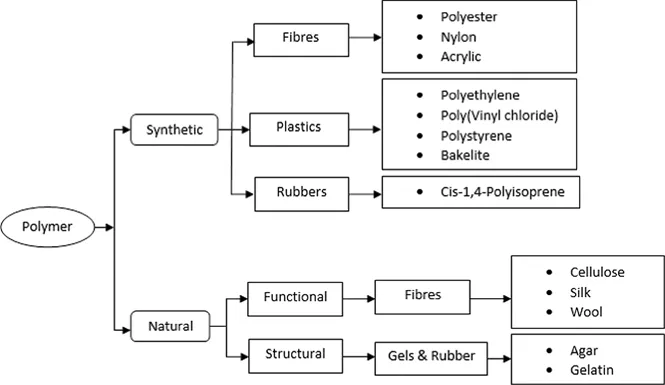
Figure 1.3 shows the broad types of natural and synthetic polymers used widely in various applications. The key point that makes polymers unique is that they comprise larger molecules or macromolecules that give new properties compared to the smaller monomers. Another excellent feature that makes polymers unique is that the chain mesh, longer polymer chains meshed, provides more flexibility. Polymers are produced using two common mechanisms, polymerization and step-growth polymerization. In addition to polymerization, polymers are manufactured by sequentially adding monomers using reaction; in which the growth of the polymer chain is linear. On the other hand, in step-growth polymerization or condensation polymerization, monomers initially react together and form small oligomers, which then lead to the formation of polymers. Another process of manufacturing polymers is by condensation reaction including monomers containing two functional groups, in which even small molecules like water are eliminated. An excellent example of a polymer manufactured using a condensation reaction is nylon. In addition, the copolymers concept plays a significant role in producing polymers. Copolymers are composed of more than one monomer; an excellent example of this is proteins formed by combining many amino acids. The condensation polymer and copolymer have a mutual relationship with each other with respect to their function. All natural polymers are copolymers. The polymer structure depends on its molecular shape and mass. As the polymers have long chains, the molecular weight plays a vital role in the structure of the polymer. Polymers have a high molecular mass. Moreover, the polymer chain can bend more flexibly, making it capable of producing different shapes with unique characteristics. The two essential physical properties of polymers are strength and flexibility, which depend on the various parameters such as chain length, side groups, branching, and cross-linking. The polymer structure is divided into the following categories:
FIGURE 1.3 Types of natural and synthetic polymers.
Linear polymers
Branched polymers
Cross-linked polymers
Network polymers
Linear polymers are single flexible chains in which monomers are joined end to end. Examples of linear polymers include polyethylene, polyvinyl chloride, polystyrene, and nylon. Branched polymers have branched chains connected to the main chain. The branches, considered part of the main chain, are formed during side reactions during the synthesis of polymers. Cross-linking is achieved either during synthesis or by a nonreversible chemical response usually carried out at an elevated temperature. Rubber is an example of a cross-linked polymer. Network polymers have trifunctional monomer units with distinct mechanical and thermal properties. Examples of network polymers include epoxies and other Adhesives.
Chapter 6 Polymer Nanocomposites: Polymer Composites: Design, Manufacturing, and Applications
Chapter 7 Analysis of Various Parameters on Polymer Matrix Composites
Chapter 8 Tribo Performance Analysis on Polymer-Based Composites
Chapter 9 Failure Analysis of Polymer-Based Composites
Chapter 10 Applications of Various Types of Polymer-Based Composites
Index
Trusted by 375,005 students
Access to over 1.5 million titles for a fair monthly price.
Study more efficiently using our study tools.
Frequently asked questions
Yes, you can cancel anytime from the Subscription tab in your account settings on the Perlego website. Your subscription will stay active until the end of your current billing period. Learn how to cancel your subscription
No, books cannot be downloaded as external files, such as PDFs, for use outside of Perlego. However, you can download books within the Perlego app for offline reading on mobile or tablet. Learn how to download books offline
Perlego offers two plans: Essential and Complete
Essential is ideal for learners and professionals who enjoy exploring a wide range of subjects. Access the Essential Library with 800,000+ trusted titles and best-sellers across business, personal growth, and the humanities. Includes unlimited reading time and Standard Read Aloud voice.
Complete: Perfect for advanced learners and researchers needing full, unrestricted access. Unlock 1.5M+ books across hundreds of subjects, including academic and specialized titles. The Complete Plan also includes advanced features like Premium Read Aloud and Research Assistant.
Both plans are available with monthly, semester, or annual billing cycles.
We are an online textbook subscription service, where you can get access to an entire online library for less than the price of a single book per month. With over 1.5 million books across 990+ topics, we’ve got you covered! Learn about our mission
Look out for the read-aloud symbol on your next book to see if you can listen to it. The read-aloud tool reads text aloud for you, highlighting the text as it is being read. You can pause it, speed it up and slow it down. Learn more about Read Aloud
Yes! You can use the Perlego app on both iOS and Android devices to read anytime, anywhere — even offline. Perfect for commutes or when you’re on the go. Please note we cannot support devices running on iOS 13 and Android 7 or earlier. Learn more about using the app
Yes, you can access Polymer-Based Composites by V. Arumugaprabu, R. Deepak Joel Johnson, M. Uthayakumar, P. Sivaranjana, V. Arumugaprabu,R. Deepak Joel Johnson,M. Uthayakumar,P. Sivaranjana in PDF and/or ePUB format, as well as other popular books in Technology & Engineering & Industrial Engineering. We have over 1.5 million books available in our catalogue for you to explore.