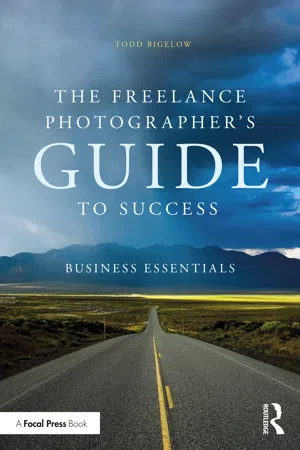
Grounded in real-life experiences and scenarios, this practical guide offers editorial, non-profit, foundation, and corporate photographers an honest and insightful approach to running a freelance photography business.
Pulling from thirty years of experience as a freelance photographer, veteran Todd Bigelow presents a timely and detailed account of the methods and tactics best used to navigate and succeed in the profession. He explores the topics that define the business of freelancing, including: analyzing photography contracts; creating and maintaining an image archive; licensing for revenue; client development; registering for copyright; combating copyright infringement; and understanding tax issues, freelance business structures, and more. Chapters feature examples of real contract clauses and emails to better prepare readers for the practical daily activities that are essential to growing a success business. Likewise, Bigelow shares conversational anecdotes throughout to provide real insight into the world of freelancing.
Based on the author's sought-after Business of Photography Workshop, this book is an essential guide for emerging, mid-career, and experienced photographers interested in starting or improving their own freelance business.
A steady stream of data and news reports about publications being shuttered or mass layoffs clearly indicates a continual shift toward a freelance-dominated profession.
One need not have a business degree to understand the direction of the economy, and there is no need to pull you into a discussion on macroeconomics, or the general factors influencing economic direction. However, it’s necessary that you understand our overall economy has moved away from being employee based toward one of independent contractors offering their services on a freelance basis. Whether the transformation is a result of employers looking to shed the cost of employees or is more reflective of a new generation of workers seeking more freedom in the labor market is, for the purposes of this guide, relatively irrelevant. The fact remains that the gig economy, buoyed by technological advances that make remote work far more possible and efficient than in the past, a fact clearly proven by the world wide shift to remote work during the Covid-19 pandemic, is clearly here to stay and freelancers should feel comfortable knowing they’re not alone.
The number of people freelancing in 2019, according to an article in Fast Company in October 2019, had grown to 57 million people, up from 53 million in five short years. That means in 2019 a substantial portion of the nation’s workforce, 35%, were engaged in a wide range of gig-economy work such as driving for ride-sharing companies or picking up daily work delivering food “on demand” for companies like DoorDash or Postmates. It should come as no surprise that media companies and publishers are very active participants in the gig economy as editorial publications deal with contraction. The Washington Post reported in an August 2019 article that “employment in the newspaper industry fell about 47% between 2008–2018, a decline worse than coal mining over the same period.” That decline in employment, unfortunately, is not projected to change and points toward an increasing reliance on a freelance workforce.
The rise of the Internet and the pivot to digital publishing beginning mainly in the 1990s set into motion a series of events that inflicted serious pain on publishers. Chief among the radical changes publishers in general have faced over the last twenty-five years is the loss of valuable advertising revenue that came in the form of print ads. As print began a slow, accelerating spiral, so did the advertising revenue at major media companies that subsequently initiated a considerable shift from costly staff employment to the reliance on freelancers. And that is certain to continue. “Newspapers are continuing to be pummeled by layoffs,” Elizabeth Grieco, Senior Writer and Editor at the Pew Research Center, was quoted as saying in an August 2019, USA Today story titled “Newspapers, Digital News Operations, Hit with Layoffs.”
It’s vital to understand how the world of photojournalism and photography have been hit hard over the past dozen years so that you can make reasonable projections for where the profession will be in the future (both immediate and distant) and surmise whether the prospect for earning a viable living is there for you. I can’t make that decision for you because, as I noted in the Preface, we all have individual realities that make a universal answer inappropriate. However, what is universal to us all is the need to know what the future of careers in photography and photojournalism holds for us so we can reasonably assess whether we want to pursue it. And the future is clearly and unequivocally pointing toward a freelance-dominated profession.
Some of you may wonder whether that is good or bad and your perspective is likely influenced by your age. Younger photographers are starting careers without ever really knowing what being an employee offers, whereas many of my friends and colleagues who once held staff positions are now facing continuing careers as freelancers. Therefore it’s worth noting the primary differences between freelancing and staff photography:
Table 1.1
Differences between freelancers and staff photographers
Freelance Photographer
Staff Photographer
You Own the Copyright to Photos
No Paycheck/Income Guarantee
No Health Care Benefits Provided
No Retirement Benefits Provided
You Purchase/Maintain Own Equipment
You Pay All Social Security and Medicar
You are Responsible for Tax Withholdings and Payments
Employer Owns the Copyright to Photos
Paycheck/Income Guaranteed
Health Care Benefits Provided
Retirement Benefits Provided
Employer Purchases/Maintains Equipment
Employer Pays Half Social Security and Medicare
Employer is Responsible for Your Tax Withholdings and Payments
If you consider the table above you will come to a couple of simple, rather obvious conclusions that should influence your decisions going forward. One, freelancing means you will take on the responsibilities of the employer and the employee. To frame it another way, you better know how to do a lot more than taking photos if you plan on running a free-lance business because it’s all on you. Staffphotographers can concentrate wholly on taking photographs since the employer is running the business. Two, you and you alone are responsible for your financial health. There’s no guarantee if, when or from where the next paycheck will come.
Whether you like the idea of running your own business or not, the likelihood that you will freelance at some point in your career is rather high, especially in newspapers and magazines. “More companies are pushing work onto freelancers, temps, contractors and franchisees in the quest for an ever more nimble profit-making machine” is how The New York Times phrased it in a November 11, 2017 story titled “Plugging Into the Gig Economy.” Of course, I’d be remiss if I didn’t point out what so many photojournalists believe to be the case; The New York Times is arguably the leader when it comes to hiring freelancers as opposed to expanding their roster of staff employees. On any given day there are multiple “for The New York Times” photo credits accompanying images from the front page through the Sports section and beyond. (Note: A name followed by “for The New York Times” is how the paper credits free-lancer photographers).
The US Department of Labor, Bureau of Labor Statistics, which provides official data on employment, wages and more, has also weighed in on the outlook for the photography business in general. They listed the following projections in 2018:
Salaried jobs may be more difficult to obtain as companies increasingly contract with freelancers rather than hire their own photographers.
Photographers will face strong competition for jobs.
“Because of reduced barriers of entry,” qualified candidates for jobs will greatly outpace openings.
Job prospects will be best for those “who are multitalented and possess related skills, such as editing pictures and capturing digital video.”
Confronted with statistics from a government research agency predicting a future of strong competition and the likelihood of unstable income will undoubtedly cause concern for those entering the profession. Keep in mind, though, these facts and projections are not meant to necessarily dissuade anyone from pursuing freelance photography and should be accepted as necessary information to consider before pursuing a freelance life. In other words, it’s vital that the statistical analysis be presented here so an informed opinion can be made on whether, or how, you should proceed. The knowledge will help you prepare financially and set realistic goals for advancement as you get your business off the ground and running. In fact, it’s virtually no different for any entrepreneur running a business. If you don’t know the trends, competition and direction for your industry, you’re more likely to run head-on into what should have been avoidable obstacles.
The trend for photography is clearly toward an expanding free-lance market amid shrinking staffs. Yes, there are sure to be short-term aberrations as media companies expand and contract with the flow of the economy in general but the long-term outlook is clear. For example, media outlets such as The NY Times, The Washington Post, LA Times and The Atlantic were benefiting from a strong news cycle and even adding a staffposition here and there amid their record-setting digital growth, yet when the Covid-19 pandemic sent the global economy into a tailspin, all were deeply impacted. The LA Times had to furlough staff one day per week and The Atlantic laid off 68 editorial staffers. The rate of hiring for staff photographers compared to the overall trend toward freelancing is overwhelming evidence that a return to employment levels of previous decades is extremely unlikely.
Freelancing is here to stay. To drive that point home, here are some more statistics from the US Department of Labor, Bureau of Labor Statistics “Outlook for Photography 2018–2028”:
“Employment” is expected to decline 6% overall.
Freelancers projected to grow 11% to just shy of 75% of the occupation.
Decreasing cost of digital cameras and the increasing number of amateur photographers and hobbyists will reduce the need for professional photographers.
Stock photographic services (Getty, Shutterstock, etc.) will possibly “dampen the demand for photographers.”
Drone photography is seen as having growth potential.
Demand for portrait photographers will remain constant.
Corporations will continue to hire photographers for advertising campaigns.
There will be “reduced demand for news photographers to provide still images for print.”
Newspaper photojournalism staffjobs projected to drop 33%.
I remember when I decided to leave the LA Times and the relative security of a steady paycheck as a contract photographer in the mid 1990s to enter the world of magazine freelancing. News magazines such as Time, Newsweek, US News & World Report and German news weeklies with big US distributions like Der Spiegel and Stern were all doing well and I was picking up steady assignment work while also catching on with Black Star Photo Agency and then Aurora Photos. But even then, it was a constant grind to generate work and that will never change. Keep that in mind as you progress through this guide because despite the radical transformation from staff to freelance and all that came with it, those who are willing to evolve and adhere to sound business principles will be fine.
2 FREELANCING 101
BASICS TO ALWAYS KEEP IN MIND
Developing multiple revenue streams is key to survival as publications and media companies in general continue to suffer from staff and budget contractions.
If I were obligated to write just one single sentence to summarize the evolution of freelancing over the past fifteen years, it would be the one above. That’s how important having a variety of income is to sustaining a career as a freelance photographer today.
Let me lay it out in succinct, personal terms; ten to fifteen years ago about 80% of my income was derived from a handful of magazines for which I did assignment work. And those magazines were mostly under the same Time Inc. media umbrella and consisted of Sports Illustrated, Time and People, in addition to their kid versions SI for Kids and Time for Kids. The income was flowing in steadily but, like many of my colleagues, I was concerned as it became more apparent that budgets and layoffs were accelerating throughout the media sphere, not just at select publications. The writing was on the wall and I was heavily dependent on one source of income; editorial assignment work. The one source was also heavily concentrated under the Time, Inc. corporate umbrella. That had to change.
Today, my income stream is essentially the polar opposite of what it was 15 years ago. Some of that is definitely by choice due to the rapid growth in Work For Hire and other rights-grabbing contracts (more on that later) that I will not agree to, and some of that is because those publications are mere shells of what they once were or are completely gone. Budgets were decimated, they’ve been sold and sold again and many of the editors who did the hiring have left the profession. Now, my income reflects a more diversified client base in addition to new revenue created to fill the void previously occupied by editorial publications. This is how it breaks down today:
That’s a substantial difference in a relatively short period of time and it reflects the need for freelancers to be flexible and evolve with the market, so to speak. The reality is that it’s nearly impossible to freelance for just one segment of the market, such as editorial, as I had fifteen years ago unless you’re willing to give away, via egregious contracts, long-term prosperity for short-term gain. Even then you will be hard-pressed to receive enough work simply because the vol...
Table of contents
Cover
Half Title
Title Page
Copyright Page
Dedication Page
Contents
Acknowledgments
About the Author
Preface
1 Where We’ve Been and Where We’re Going
2 Freelancing 101: Basics to Always Keep in Mind
3 Creating Versus Earning Revenue
4 Client Development
5 Analyzing and Negotiating Photo Contracts
6 Understanding Copyright and Copyright Infringement
7 Licensing for Life: Leveraging Your Images for Income
8 Rates and Terms
9 The 1099 Life
Glossary of Terms and Phrases
Resources and Suggestions
Index
Trusted by 375,005 students
Access to over 1.5 million titles for a fair monthly price.
Study more efficiently using our study tools.
Frequently asked questions
Yes, you can cancel anytime from the Subscription tab in your account settings on the Perlego website. Your subscription will stay active until the end of your current billing period. Learn how to cancel your subscription
No, books cannot be downloaded as external files, such as PDFs, for use outside of Perlego. However, you can download books within the Perlego app for offline reading on mobile or tablet. Learn how to download books offline
Perlego offers two plans: Essential and Complete
Essential is ideal for learners and professionals who enjoy exploring a wide range of subjects. Access the Essential Library with 800,000+ trusted titles and best-sellers across business, personal growth, and the humanities. Includes unlimited reading time and Standard Read Aloud voice.
Complete: Perfect for advanced learners and researchers needing full, unrestricted access. Unlock 1.5M+ books across hundreds of subjects, including academic and specialized titles. The Complete Plan also includes advanced features like Premium Read Aloud and Research Assistant.
Both plans are available with monthly, semester, or annual billing cycles.
We are an online textbook subscription service, where you can get access to an entire online library for less than the price of a single book per month. With over 1.5 million books across 990+ topics, we’ve got you covered! Learn about our mission
Look out for the read-aloud symbol on your next book to see if you can listen to it. The read-aloud tool reads text aloud for you, highlighting the text as it is being read. You can pause it, speed it up and slow it down. Learn more about Read Aloud
Yes! You can use the Perlego app on both iOS and Android devices to read anytime, anywhere — even offline. Perfect for commutes or when you’re on the go. Please note we cannot support devices running on iOS 13 and Android 7 or earlier. Learn more about using the app
Yes, you can access The Freelance Photographer’s Guide To Success by Todd Bigelow in PDF and/or ePUB format, as well as other popular books in Art & Business General. We have over 1.5 million books available in our catalogue for you to explore.