The wide range of challenges in studying Earth system dynamics due to uncertainties in climate change and complex interference from human activities is creating difficulties in managing land and water resources and ensuring their sustainable use. Mapping, Monitoring, and Modeling Land and Water Resources brings together real-world case studies accurately surveyed and assessed through spatial modeling. The book focuses on the effectiveness of combining remote sensing, geographic information systems, and R. The use of open source software for different spatial modeling cases in various fields, along with the use of remote sensing and geographic information systems, will aid researchers, students, and practitioners to understand better the phenomena and the predictions by future analyses for problem-solving and decision-making.
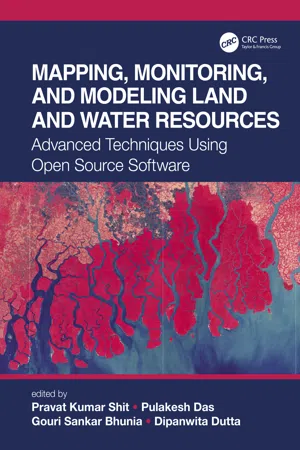
eBook - ePub
Mapping, Monitoring, and Modeling Land and Water Resources
Advanced Techniques Using Open Source Software
- 20 pages
- English
- ePUB (mobile friendly)
- Available on iOS & Android
eBook - ePub
Mapping, Monitoring, and Modeling Land and Water Resources
Advanced Techniques Using Open Source Software
About this book
Information
1 Introduction to Part I
Mapping, Monitoring, and Modeling of Land Resources
Pravat Kumar Shit and Gouri Sankar Bhunia
Contents
1.1 Introduction
1.2 Individual Chapters
References
1.1 Introduction
Land use has a global perspective. “Land” applies to the area of the earth that is not filled by oceans, lakes, or rivers. It contains the entire geographical area of continents and islands. Land may legitimately be pointed to as the original root of all material riches. A country’s economic stability is strongly connected to its ecosystem’s services. Most of the land and its service operations are subject to central trade policies, including food processing and food production. There is also a strong connection to climate change in the way we utilize land and soil. Soil contains large quantities of carbon and nitrogen, which can be emitted into the ecosystem based on how we treat the land (Shit et al. 2015). The global greenhouse gas imbalance could be worsened, with increased emissions, by eliminating tropical forests for cattle grazing and harvesting (Shit et al. 2020). These authors assume that the multipurpose essence of land entails multiple trade-offs favoring one use to the detriment of another. Land appraisal integrates the knowledge from soil surveys, atmosphere, vegetation, and other land factors with the particular application for which the land is measured. There are many considerations that are primarily associated with scale but are also determined by the survey process, the mapping date (a measure of the information’s dependability), and the difficulty of the land mapping. In addition, such research permits the key limiting factors for agricultural production to be established and allows decision-makers, including land owners, land use managers, and agricultural support services, to establish a crop management mechanism capable of addressing these limitations, thus increasing productivity (Bhunia et al. 2018). This analysis offers details of the limits to, and possibilities for, land use and thereby informs decisions on the best use of the asset; this understanding is necessary for the planning and growth of land use.
Modeling of land use at a global scale is difficult for three main reasons (e.g., constraint of measurement, scale pertinency of the retrieval models, and conglomeration of land surface and the features of linearity/nonlinearity of the retrieval models) relative to smaller-scale solutions. However, inherently, land cover simulation is an interdisciplinary practice. In order to ensure the development of accurate and usable landscape projections, as well as the application of the resulting model projections to resolve issues of societal significance, we focus on elements of socioeconomics, geography, hydrology, environment, and other sciences. There are actually three kinds of models of spatial land use change: numerical models of estimation, dynamic models of simulation, and models of rule-based simulation. The majority of dynamic models are unable to integrate adequate socioeconomic conditions. Cellular Automata (CA) models can simulate spatial patterns as a rule-based simulation tool but cannot view spatiotemporal land use transition processes and are more difficult to create. Empirical estimation approaches using statistical techniques will, therefore, simulate the relationships between changes in land use and drivers. A scenario model is used that helps land managers to forecast and respond to a broad variety of possible potential trends due to the high degree of complexity involved in forecasting future changes in dynamic socio-environmental environments. For landscape simulation, remote sensing offers an essential source of data. Several techniques focused on geographic information systems (GIS) and remote sensing (RS) approaches have become beneficial for land management in recent years. The integration into GIS of multi-criteria appraisal approaches has emerged as an exciting research field attracting numerous planners and managers. For instance, the concept of fuzzy predicates was implemented via ordered weighted averaging (OWA) into the GIS-based land suitability analysis. A standardized hierarchical land suitability index framework was proposed to provide a strategic environmental evaluation of land use growth for policy making. The biophysical variables influencing land use decision-making by multiple stakeholders have been shown to expose a spatially and temporally explicit multi-scale decision support system. Land use development models help in understanding this dynamic mechanism and can provide useful evidence on potential future configurations for land use. It has been shown that open data initiative programs have a profound effect on scientific research. The development of data and software has expanded to a point where some people also talk of democratizing access to knowledge, especially in developed countries but also increasingly in developing countries. Enabled by the cloud-based Big Data platform, mass analysis of Landsat data has opened new venues for studying long-term ecological and land cover dynamics. A variety of satellite data from multiple sources with a wide range of spatial, spectral, temporal, and radiometric resolutions are now available free of charge to all user categories. Building local capacities for evidence-based policy in this way will promote local context alignment and ultimately contribute to more effective data analyses. The growing availability of free geospatial data and tools provides new possibilities for greater openness and expanded citizen interest in environmental management. To build land resource development (LRD) and water resource development (WRD) plan generation tools, MapWinGIS is used. While a range of free open source (FOS) raster analysis packages are available, such as GRASS, White Box, and Integrated Land and Water Information System (ILWIS), the FOS software SAGA GIS provides
- A one-step procedure for land data visualization
- A simple, one-step process for erudite hydrological and terrain modeling
- A compact package that does not necessitate installation and is thus easy to share
A variety of guidelines for streamlining geospatial web resources, including a web coverage service and a web map service, have been developed by the Open Geospatial Consortium (OGC) for individual users to use in a client–server spatial computing context. The method thus allows spatial data from diversified sources to be integrated together to interpret and create useful knowledge for decision-makers to support their planning activities. This brings many new possibilities, including real-time maps, more regular and affordable data changes, and geographic knowledge exchange among users around the globe.
The first section of the book provides a succinct guide to the present incarnation of the models of land use, their implications for aspects of spatial policy, and the key research aspects in this era using open source software.
1.2 Individual Chapters
There are eight chapters in this section, which address the soil and land use and landscape dynamic. Chapter 2 deals with how landscape change dynamics triggered by mining disturbance have been examined by geospatial techniques, especially using open source software, and how to combat this by alternate land use practices. Chapter 3, written by a group of researchers under the lead of Singh, describes a pilot study to map and quantify suitable areas for growing short duration pulses (lentil) in rice fallows using GIS and geostatistical techniques. In Chapter 4, Teja et al. examine the spatial distribution of desertification using long-term Moderate Resolution Imaging Spectroradiometer (MODIS) and rainfall data in Himachal Pradesh (India). Chapter 5 describes an overview of the decadal changes of land use/land cover (LULC) and their transformations of Odisha coastal zone using temporal Landsat series satellite images (1990–2017). The LULC maps for each year are prepared by the introduction of a hybrid classification system, which involves image interpretation, band ratios (normalized difference vegetation index [NDVI], normalized difference built-up index [NDBI]), and supervised and unsupervised techniques.
Chapter 6, written by a group of researchers under the lead of Kumar et al., discusses long-term transformation of LULC as well as fragmentation of landscape in the Jamunia watershed of Jharkhand state of India using ILWIS, quantum geographical information system (QGIS), and FRAGSTATS and Patch Analysis. Chapter 7 highlights the spatiotemporal distribution of drought and soil erosion problems in Puruliya district, a semi-arid district of the western part of West Bengal, India.
In Chapter 8, Ahmed et al. describe the recent trend and feasibility of open source software applications and datasets, focusing on freely available Sentinel-2A Multi-spectral Instrument (MSI) datasets of pre– and post–Cyclone Fani phases of Puri town, India. Chapter 9 deals with the role of advances in open source geospatial data and techniques for land resource mapping and monitoring, modeling, and sustainable management strategies.
References
- Bhunia, GS; Shit, PK and Maiti R (2018). Comparison of GIS-based interpolation methods for spatial distribution of soil organic carbon (SOC). Journal of the Saudi Society of Agricultural Sciences 17 (2), 114–126.
- Shit, PK; Nandi, AS and Bhunia GS (2015). Soil erosion risk mapping using RUSLE model on Jhargram sub-division at West Bengal in India. Modeling Earth Systems and Environment 1 (3), 28.
- Shit, PK; Pourghasemi, HR; Das, P and Bhunia, GS (2020). Spatial Modeling in Forest Resources Management, Springer, 675 pp. DOI: 10.1007/978-3-030-56542-8
2 Spatio-Temporal Investigation of Mining Activity and Its Effect on Landscape Dynamics
A Geo-Spatial Study of Beejoliya Tehsil, Rajasthan (India)
Brijmohan Bairwa, Rashmi Sharma, Arnab Kundu, and K. K. Chattoraj
Contents
2.1 Introduction
2.2 Materials and Methods
2.2.1 Study Area
2.2.2 Data Used
2.2.3 M...
Table of contents
- Cover
- Half-Title
- Title
- Copyright
- Dedication
- Contents
- Preface
- Acknowledgments
- Editors
- Contributors
- Chapter 1 Introduction to Part I: Mapping, Monitoring, and Modeling of Land Resources
- Chapter 2 Spatio-Temporal Investigation of Mining Activity and Its Effect on Landscape Dynamics: A Geo-Spatial Study of Beejoliya Tehsil, Rajasthan (India)
- Chapter 3 Mapping Areas for Growing Pulses in Rice Fallows Using Multi-Criteria Spatial Decisions
- Chapter 4 Assessing Desertification Using Long-Term MODIS and Rainfall Data in Himachal Pradesh (India)
- Chapter 5 Land Use/Land Cover Characteristics of Odisha Coastal Zone: A Retrospective Analysis during the Period between 1990 and 2017
- Chapter 6 Evaluating Landscape Dynamics in Jamunia Watershed, Jharkhand (India) Using Earth Observation Datasets
- Chapter 7 Drought Frequency and Soil Erosion Problems in Puruliya District of West Bengal, India: A Geo-Environmental Study
- Chapter 8 Effects of Cyclone Fani on the Urban Landscape Characteristics of Puri Town, India: A Geospatial Study Using Free and Open Source Software
- Chapter 9 Land Resource Mapping and Monitoring: Advances of Open Source Geospatial Data and Techniques
- Chapter 10 Introduction to Part II: Mapping, Monitoring, and Modeling of Water Resources
- Chapter 11 Improving Wetland Mapping Techniques Using the Integration of Image Fusion Techniques and Artificial Neural Network (ANN)
- Chapter 12 Open Source Geospatial Technologies for Generation of Water Resource Development Plan
- Chapter 13 Geo-Spatial Enabled Water Resource Development Plan for Decentralized Planning in India: Myths and Facts
- Chapter 14 Automatic Extraction of Surface Waterbodies of Bilaspur District, Chhattisgarh (India)
- Chapter 15 Valuing Ecosystem Services for the Protection of Coastal Wetlands Using Benefit Transfer Approach: Evidence from Bangladesh
- Chapter 16 Identification of Groundwater Prospect of Bilaspur District: A Multi-Criteria Decision Making Approach
- Chapter 17 Long-Term Drought Assessment and Prediction Driven by CORDEX-RCM: A Study on a Hydro-Meteorologically Significant Watershed of West Bengal
- Chapter 18 Use of Open Source Software to Assess Spatio-Temporal Variation of Agricultural Drought at Regional Scale
- Chapter 19 Snow Cover Monitoring Using Topographical Parameters for Beas River Catchment Area
- Chapter 20 Land Surface Water Resource Monitoring and Climate Change
- Index
Trusted by 375,005 students
Access to over 1.5 million titles for a fair monthly price.
Study more efficiently using our study tools.
Frequently asked questions
Yes, you can cancel anytime from the Subscription tab in your account settings on the Perlego website. Your subscription will stay active until the end of your current billing period. Learn how to cancel your subscription
No, books cannot be downloaded as external files, such as PDFs, for use outside of Perlego. However, you can download books within the Perlego app for offline reading on mobile or tablet. Learn how to download books offline
Perlego offers two plans: Essential and Complete
- Essential is ideal for learners and professionals who enjoy exploring a wide range of subjects. Access the Essential Library with 800,000+ trusted titles and best-sellers across business, personal growth, and the humanities. Includes unlimited reading time and Standard Read Aloud voice.
- Complete: Perfect for advanced learners and researchers needing full, unrestricted access. Unlock 1.5M+ books across hundreds of subjects, including academic and specialized titles. The Complete Plan also includes advanced features like Premium Read Aloud and Research Assistant.
We are an online textbook subscription service, where you can get access to an entire online library for less than the price of a single book per month. With over 1.5 million books across 990+ topics, we’ve got you covered! Learn about our mission
Look out for the read-aloud symbol on your next book to see if you can listen to it. The read-aloud tool reads text aloud for you, highlighting the text as it is being read. You can pause it, speed it up and slow it down. Learn more about Read Aloud
Yes! You can use the Perlego app on both iOS and Android devices to read anytime, anywhere — even offline. Perfect for commutes or when you’re on the go.
Please note we cannot support devices running on iOS 13 and Android 7 or earlier. Learn more about using the app
Please note we cannot support devices running on iOS 13 and Android 7 or earlier. Learn more about using the app
Yes, you can access Mapping, Monitoring, and Modeling Land and Water Resources by Pravat Kumar Shit, Pulakesh Das, Gouri Sankar Bhunia, Dipanwita Dutta, Pravat Kumar Shit,Pulakesh Das,Gouri Sankar Bhunia,Dipanwita Dutta in PDF and/or ePUB format, as well as other popular books in Technology & Engineering & Data Processing. We have over 1.5 million books available in our catalogue for you to explore.