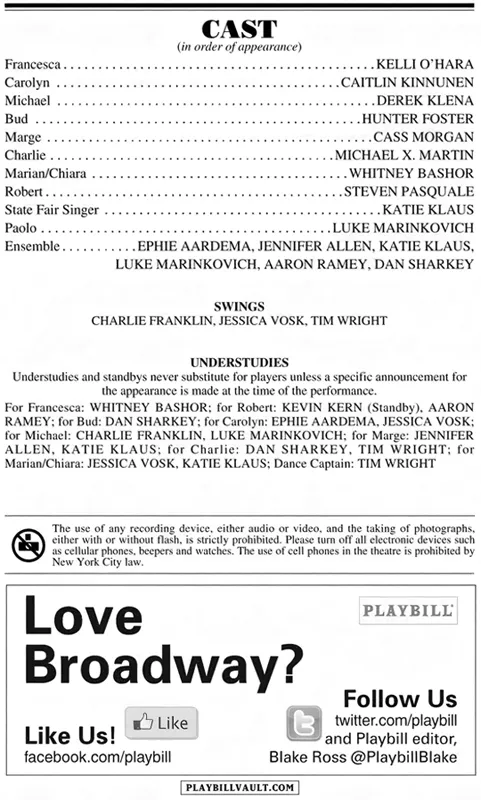
The Bridges of Madison County
An old (but provocative and enduring) lyric comes to mind:
“Looking through the window,
You can see a distant steeple;
Not a sign of people
Who needs people?”
“There's a Small Hotel” from On Your Toes, 1936
Lorenz “Larry” Hart, who penned those words, often made sense of what troubled him through the lens of a dreamer. The lyricist, half of the golden boy musical comedy writing team Rodgers and Hart, also came to terms at the bottom of a whiskey bottle.
Robert Kincaid, a National Geographic photographer, is a dreamer too, but less bleary-eyed about it. For Robert, deep contemplation of the world filters through a restrained, sober disposition and a camera lens that provides enough distance to self-preserve. Yet the Hart lyric frames and keeps Robert's present dilemma fittingly. The clock by the bed tick-tocks at an unyielding clip until the time has run out, yet it appears to be frozen as his gaze is cast out toward the steeple. No people either; that's a lucky break—because those interloper neighbors out there have nearly gotten an eyeful these last few days.
Then again, perhaps the same could be applied to the 1992 novel The Bridges of Madison County itself, a writing that became a subsequent film and was eventually musicalized for the stage. Here, time is frozen in Robert's memory, and arguably the most compelling element of the story takes place years after the fact once the lovers reunite in death. Only then can there be redemption and the impossible ending that could not have been those many years prior. “God or the universe or whatever one chooses to label the great systems of balance and order does not recognize Earth-time,” Robert writes in a late-in-life letter in the novel.
The Bridges of Madison County by Robert James Waller was some literary critics’ whipping boy of the early 1990s. Nevertheless, it leapt to the top of the New York Times bestseller list and eventually outsold Gone With the Wind. But the so-called literary elite found it mawkish and “bodice heaving,” with one editor publicly dismissing it out of hand and with a tart tongue: “People [they] buy it for the same reason they would buy a Mother's Day card.”
But by early August of 1993, as the summer waned and began taking most breezy summer reads with it, the book was celebrating its 52nd week on the New York Times bestseller list, with 2.9 million copies in print and still selling about 150,000 copies a week at bookstores. Considering the numbers, the “middle-aged and world-weary” set wasn’t shy about their affections for the story of a four-day illicit romance in rural Iowa in 1965. The book remained on the coveted list for over two more years.
At the center of the success was an unexpected writer and his unexpected path. Waller was a Ph.D. teaching business at the University of Northern Iowa and feeling increasingly stifled by the clutches of university life. His emancipation came through a self-imposed unpaid leave of absence from the school, at an age when most college teaching types are only starting to mull over a retirement escape route for themselves. Waller was burned out.
A creative at heart, Waller, like Kincaid, had a knack for photography, which eventually led him into photographic excursions and contemplations of nature. Folklore goes that Waller hatched the idea while photographing with a friend, when the pair took a departure and began photographing bridges in Madison County, Iowa. A music enthusiast and musician as well, Waller remembered a song he had written that depicted a dissatisfied housewife somewhere in Iowa. Shortly thereafter (in nine or eleven days, though some sources report two weeks), the manuscript for The Bridges of Madison County was more or less complete.
Some readers and critics found the characters in the story under-fleshed out. Eils Lotozo, the New York Times correspondent assigned to review the book, did so with restraint but was particularly put off by how characters “read,” finding the characterizations themselves under-developed. Other critics were more forthcoming with praise, one calling it “quietly powerful and thoroughly credible.” As for the killjoy crowd, Waller responded in a 2002 New York Times interview: “I really do have a small ego. I am open to rational discussion. If you don’t like the book and can say why, I am willing to listen. But the criticism turned to nastiness … I was stunned.”
Yet the reviews and chatter that dwelled in the dark side seemed to have little to no effect on sales, and there was an outpouring of interest in the story globally as well. Tourists arrived “by the busloads” to take in the bridges of Madison County, and in turn spiked the local economy of Winterset, Iowa, where the story takes place. The visitors were snatching up remembrances, like T-shirts and tote bags branded with the covered bridge logos, in heaps, and couples worldwide began descending on Madison County for wedding ceremonies at the site of the covered bridges. The sign identifying the “Men” and “Women” restrooms at the local Chamber of Commerce were re-monikered to “Robert's” and “Francesca's.”
And as for absolute affirmation of national proportions, Oprah Winfrey, the former American television hostess, broadcast her television show from Madison County during which she called the book “a gift to the country.” That endorsement alone might have been the slam dunk, pushing the book along into an astronomical sales bracket: 12 million copies translated into 40 languages.
But at the heart of the matter, and in the simplest of terms, here was a riveting story and characters that rang out as familiar. There was a ravenous appetite for a tale of human imperfections, dreams gone awry, and ultimately moral conundrums.
Steven Spielberg's production company had bought the film rights to the novel before the book was released and paid $25,000—a sum on the lower end of the book-to-film rights purchase spectrum. According to screenwriter and development executive Dan Hoffman, a book-to-film rights to produce contract can price out anywhere from $20,000 up to $500,000. He notes that it can even surge beyond that with pricier books that have been on the bestseller list, and adds “a standard option runs for about 18 months, in which you then have time to raise a budget to buy the actual adaptation rights.”
Clint Eastwood had been hired early on to star as Robert Kincaid. He was patiently waiting for the green light when the Hollywood game of motion picture chess shifted into a higher gear. For a movie studio, this involves approval of screenwriter adaptations, which are often obligated to occur on multiple levels of the studio totem pole. The process can take longer if parties beyond the studio are contractually within their rights to also sign off. The “waiting for the ‘go,’ especially with star schedules hanging in the balance, can be a nail biter,” said another Hollywood executive in an interview with the author. “The whole thing can go south fast if the star you want or have under contract has other obligations that conflict with your schedule. I’ve seen it happen and it can even cause studios to scrap or shelve the project if it happens.”
It took four screenwriters (including the Driving Miss Daisy playwright and Parade scriptwriter Alfred Uhry) taking a stab at the script to get it up to everyone's specifications. The version by screenwriter Richard LaGravenese eventually won the day. Spielberg had been so impressed with the LaGravenese version that he himself considered directing, but after more director musical chairs, the directorial obligations ultimately went to Eastwood. It was reported that Eastwood had always been of the mind that Meryl Streep would make an ideal choice for the role of Francesca. Spielberg expressed reticence over the pick, but ultimately backed down. Streep was offered the role, accepted, and later received an Academy Award nomination for her work.
The film version remained true by and large to the Waller book. However, a few dramatic devices were put into place in order to, as was thought by Spielberg, bring depth to the script and enhance the storytelling. Chief among them was the decision to begin the story as Francesca's children return to their Iowa home after Francesca's death. Soon, they discover three notebooks, a National Geographic magazine with a picture of Robert, and instructions to scatter her ashes at the Roseman Bridge, upending her earlier request to be buried beside her husband. The film received mostly favorable reviews, with much praise granted to Eastwood for his direction and general favor given to the film. “There are moments here … that are as powerful as anything the movies have given us,” raved New York Newsday film critic Dave Kerr. Lennie Niehaus, the film's composer, later said, “Clint has a way of taking something and making it his own.”
A “Novel Symphony for Actors and Orchestra”
It was Marsha Norman who pitched the idea of turning Bridges into a musical to Jason Robert Brown. The pair had had a rewarding, if brief, first collaboration of the theatrical sort. In 2011, Norman penned an adaptation of E.B. White's The Trumpet of the Swan, a 1970s children's story. The concept was straightforward and poignant: A swan, born without a voice, learns to play the trumpet to attract a beautiful swan named Serena, using professional actors and a live orchestra playing original music. In an interview, Norman explained that “there's no costumes, no set, no dancing and no singing,” having previously described it, “like Peter and the Wolf; dramatic reading with full orchestra paints the pictures.” Brown completed the score within a few weeks.
The alchemy of The Trumpet of the Swan drew praise, and the writers were keen to make a second date pressing forward toward working on a full-length musical. At the time, Brown was anxious to write a musically and vocally sweeping score that let the characters “really sing,” but he had had a great deal on his musical plate, and fervent romanticism had been on his back burner for some time.
“I had been working on 13 and Honeymoon in Vegas, which were both very broad shows and comic shows, and with comedy, you really have to be very sparing with your resources. It's not an opportunity to sort of let everybody sing out and take to the stage in that way. And so, I was itching for a show where everyone could really just make music and sing and let the drama encourage that.”
When Norman introduced the Bridges idea, Brown quickly realized that the emotional content of the story was the right fit for the show he wanted to write. There was, however, a certain undeniable paradox afoot. The story of Bridges is told through the prism of very compact environs over a few days’ time and with only a few principal actors. The music to accompany such a situation would most organically develop as an intimate chamber piece, accompanied by similarly restrained, economical music. But given the right footing, the emotional content of the story and the trajectories of the characters in such a vulnerable and exposed state was, in fact, fiercely musical and wildly theatrical. The music would be emotionally expansive with sweeping, grand opera-like gestures and would depict the character circumstances via musical style and orchestration. Brown and Norman had found their next collaboration.
As Norman went down the road of stage adaptation, she turned to the novel as the touchstone of the stage version, quietly stripping away some of the devices that the film had used. Meanwhile, Brown was composing the score in a way he hadn’t done before. Given the show's rural Iowa setting, Brown envisioned that the music should orbit around the guitar, revealing, “[The sound developed] specifically out of the new tonalities and sounds that I found having my fingers in a different place on a different machine—it was very instructive and I loved doing it a lot.”
In planning the score, Brown was particularly discerning about which orchestral instruments he chose to encompass both the era and locale. Brown's typical method—transitioning his music from one instrument to many—is unusual for the musical theatre, in the sense that he orchestrates his shows himself. There have been other notable exceptions. Leonard Bernstein, ever the absolute musician, orchestrated his own music to terrific success, but most musical theatre composers opt to take on an orchestrator for the task. Even Stephen Sondheim had a long-term and highly fruitful collaboration with ace orchestrator Jonathan Tunick, with Tunick orchestrating (brilliantly) the lion's share of the Sondheim oeuvre.
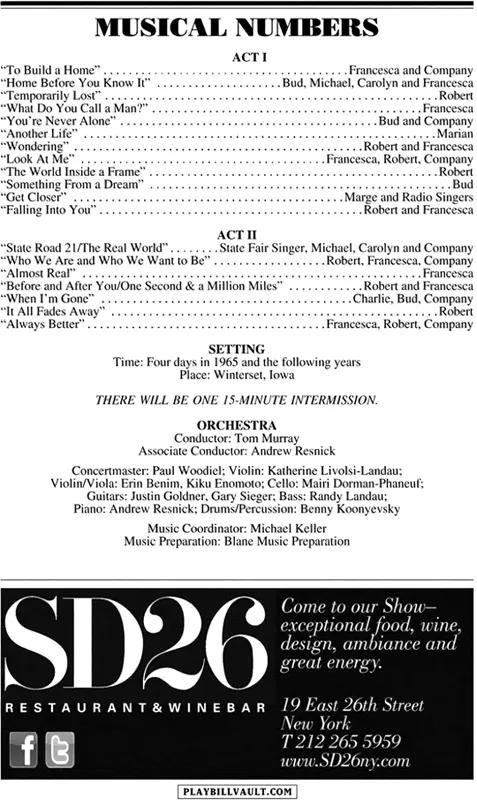
As an orchestrator does, Brown first distinguished which instruments would provide an appropriate soundscape consistent with the “feel,” atmosphere, and mood. Given the time period and the rural setting, Brown felt strongly that instruments serving the “folk” style of music were the obvious fit. Placing stringed instruments, guitar, percussion, ...