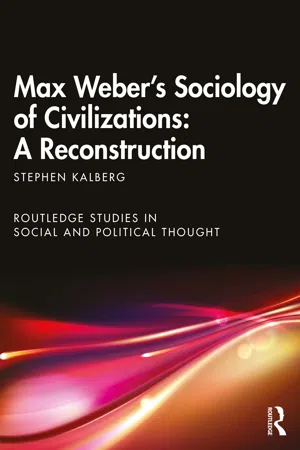
This volume examines civilizations through the broad lens articulated by the works of Max Weber. In focusing upon his comparative-historical mode of analysis and his causal explanations for the sources, contours, and trajectories of civilizations, this study reconstructs Weber's sociology in a manner that provides clear guidelines to researchers seeking to investigate civilizations systematically. Through detailed interpretations of the West's unique development from Antiquity to the Modern era, precise comparisons to the long-range and singular pathways taken by China and India, and careful demarcations of the "particular rationalisms" of several civilizations, the author addresses Weber's powerful model-building on the one hand and his opposition to organic holism and structural presuppositions on the other hand. Both a broad-ranging conceptual framework and case-based empirical investigations are pivotal to Weber. His research strategy emphasizes further the "subjective meanings" of actors East and West and the deep cultural origins of groups. Finally, this volume masterfully conveys Weber's contextual and multi-causal methodology rooted in a tight interweaving of the present with the past. Max Weber's Sociology of Civilizations: A Reconstruction will appeal to comparative sociologists and historians, as well as to theorists of all persuasions. The social scientist pursuing a cross-civilizational agenda will here discover the distinct contribution of Weber's "interpretive understanding" procedures to the now-essential field of civilizational analysis.
- 576 pages
- English
- ePUB (mobile friendly)
- Available on iOS & Android
eBook - ePub
Max Weber's Sociology of Civilizations: A Reconstruction
About this book
Information
PART I
Weber’s major themes and the foundational features of his methodology
Introduction
This reconstruction of Weber’s sociology of civilizations must turn at the outset to a clarification and definition of its major themes and methodology. Weber emphasizes, as noted in the Introduction, five wide-ranging themes. At their foundation stands his aim to identify and causally explain a civilization’s particular rationalism.
The investigation of every civilization requires rigorous constructs, he is convinced. Researchers must possess the tools to examine, for example, the varying subjective meaning of people in groups far and wide, the multiple causes behind patterned action, the embeddedness of regular action in contexts of patterned action, and the powerful influence of the past upon the present. The multiple components of Weber’s methodology, taken together, empower social scientists to formulate causal explanations for every civilization’s rationalism – namely, its complex origins, singular contours, and unique trajectory. His themes first command our attention.
1
Five civilizations themes
As noted in the Introduction, five major themes characterize Weber’s sociology of civilizations. They lay the groundwork and set the stage for innumerable discussions throughout this volume. This chapter offers a detailed examination.
Again, by investigating these themes, we seek to recognize Weber not only as an unusual practitioner of concept formation but as an analyst of the West’s modern capitalism and particular developmental pathway. In addition, scrutiny of these themes will reveal this classical Founder as a rigorous sociologist of civilizations.
The formation of subjective meaning and the causes behind its variation
Rather than referring “to an objectively ‘correct’ meaning or one which is ‘true’ in some metaphysical sense” (E&S, p. 4), Weber’s sociology concerns the investigation of “subjective meaning complexes.” Through interpretive understanding (verstehen), he seeks to “recapture” the manner in which subjective meaning motivates persons in demarcated groups in patterned ways. He does so by reconstructing, to the greatest degree possible, the variety of wider contexts of action in reference to which these patterns of action occur. Weberian researchers then seek to understand the ways in which actors, within their groups-based milieu, bestow subjective meaning upon their situations and act accordingly. On the basis of in-depth empirical research, motives can be comprehended by social scientists, indeed even patterns of meaning in distant civilizations, Weber contends.
He attempts, in his best-known example, to clarify in the ways in which the seventeenth-century Puritan endowed particular action with subjective meaning. To a certain extent, the belief and conduct of the “inner-worldly ascetic” depicted in The Protestant Ethic and the Spirit of Capitalism baffled Weber.1 From the standpoint of a “natural” attitude toward life that takes delight in diverse worldly pleasures, the Puritan’s strict asceticism could only be seen as strange. The enjoyment of eating, drinking, and relaxation was denied to the faithful. In addition, the single activity deserving of their energies – regular and systematic labor in a calling – connoted sheer drudgery and pain to most people. Even the cultivation of friendship and intimacy was prohibited to this believer; both constitute threats to the exclusive allegiance owed by the devout to God.
Hence, the actions of the ascetic faithful must be judged as “irrational” and “odd” if examined from the perspective of all “enjoyment of life” (PE, pp. 80, 92–94, 98, 130–31). However, a mode of analysis rooted in interpretive understanding can never uphold this conclusion. Weber insists that even the actions of Puritans, if their meaning complex is reconstructed through rigorous research, can be recognized as subjectively meaningful.
PE sought to comprehend why seventeenth-century Puritan believers in England, Holland, and Colonial America attributed meaning to systematic work and a concerted search for wealth and profit – even to the point of placing labor and material success at the very core of their lives. Through the careful study of diaries, sermons, autobiographies, and other documents, Weber aimed to reconstruct the meaning behind the intense faith of the devout and to understand the ways in which their search for salvation placed “psychological premiums” upon certain endeavors. Although seemingly strange, the meaningfulness of the faithful’s action would then become plausible and comprehensible to the social scientist. Published in 1904 and 1905, PE constitutes Weber’s most powerful demonstration of how a variety of motives held by sincere Puritan, Catholic, and Lutheran believers can influence activity in different ways.
This orientation to subjective meaning guided his empirical investigations. In EEWR, for example, he explored the origins of the beliefs and actions typical, among others, of Confucians, Daoists, Hindus, Buddhists, and Jews. Even the extreme withdrawal from the world of Buddhist mystics can be understood as meaningful if placed contextually within the framework of their perception of the transcendental realm (as dominated by an immanent and impersonal Being rather than an anthropomorphic and omnipotent Deity), definition of the goal of salvation (escape from the endless wheel of reincarnation), and view of the appropriate means toward its attainment (contemplation and the “silencing of the soul” that alone allows immersion into the All-One). Why, Weber queried further, for example, was scholarship meaningful to the Confucian Gentleman? And why were the commandments of an anthropomorphic God meaningful to the Old Testament prophets?
Weber emphasized that such cross-cultural and cross-epochal explorations must be acknowledged as complex and even precarious. “We moderns” can scarcely imagine the intensity of the Puritan’s devotion and focus upon the question of personal salvation, nor “how large a significance those components of our consciousness rooted in religious beliefs have actually had upon culture, …and the organization of life” (PE, p. 178).
This dual emphasis upon subjective meaning and its social context implies the rejection of a major axiom central to Marxism, neo-Marxism, organicism, and all structuralisms: external structures should constitute the major subject of sociological investigation. For Weber, a principled disjunction always remains between the influence upon action of “external forms” – classes, status groups, and organizations, for example – and the motivations of individuals. It may exist to such an extent that an entire range of motives can be found among persons who otherwise orient their action to a single class, status group, or organization (see E&S, pp. 29–38).
For example, the search for and legitimation of authority can be anchored in affectual motives (an emotional surrender to the ruler), traditional orientations (to customs and conventions), means-end rational calculations (conformity to conventions or obedience to laws for reasons of expediency and self-interest), and orientations to values (the belief in loyalty and duty, and in the rulership as just) – or a combination of all of these motives (see E&S, p. 31).2 As is obvious if the functioning of structurally identical bureaucracies is compared across cultures, a “bureaucratic ethos” motivates functionaries and managers to varying degrees. Similarly, whether a civil servant within a bureaucracy fulfills tasks motivated by values or means-end rational calculations, or a respect for an accustomed way of doing things, remains a question for empirical investigation, according to Weber (E&S, pp. 30–31) – one answered in different ways despite the formally similar features of this organization. He contends that even the extremely firm organizational structure of the religious sect will not entirely determine the subjective meaning of the devout.3
The assessment of the subjective meaning of persons in groups stands at the foundation of Weber’s sociology of civilizations as well as his sociology generally. The motives behind observed action vary widely across groups and civilizations, Weber is convinced. Hence, a methodology anchored in subjective meaning (and the interpretive understanding of it) proves indispensable. The particular action that is meaningful to persons in specific groups must now be investigated – and on its own terms. Weber’s abandonment of a fixed point implied to him that empirical explorations, which seek to define subjective meaning past and present in the civilizations of the East and West, must be conducted.
In essence, his sociology of civilizations defines and utilizes procedures that push aside Western-centric assumptions and allow an understanding from within – once the relevant research has been conducted in depth – even of patterns of action in groups radically different from groups familiar in the modern West. Weber’s empirically rooted sociology of subjective meaning opposed the set of “universal” concepts commonly utilized in his era by social scientists to evaluate other cultures. Indeed, his mode of analysis had the effect of de-legitimizing Western-centric value configurations and triumphalism. Albeit odd at first glance, the subjective meaning of persons in groups, however distant, must be investigated in terms of its own dynamics, he maintains. Let us turn to the second major theme in Weber’s sociology of civilizations.
The uniqueness of Western rationalism and modern Western rationalism
Weber also wishes to comprehend the ways in which the modern West can be appropriately understood as constituted from unique configurations of meaningful, patterned, and group-based actions. Only rigorous comparisons to China, India, the ancient Middle East, and the ancient and medieval West will enable a precise demarcation of this singularity, he insists. Here can be found a major focus of his sociology of civilizations. A further goal closely accompanied this orientation, as will become evident: Weber sought to explore the causal origins of the modern West’s uniqueness.
He embarked around 1910 upon his comparative-historical research. Now evident was an expanded, post-PE agenda. Weber’s introduction to the EEWR series, “Prefatory Remarks,” placed at its core a broad-ranging discussion of groups prominent only in the modern West. Central passages throughout E&S and EEWR turn to “a specifically formed ‘rationalism’ of Western civilization” (“PR,” p. 245).4
Its major aspects include, for example, a legal system characterized by procedures formulated in reference to abstract, universally applicable prescriptions and executed, as well as interpreted, by specially trained jurists (see E&S, p. 883; GEH, p. 313). Typical of large-scale organizations in the West was bureaucratic rulership as carried by officials and managers oriented to rules and laws who administered specialized tasks in an organized manner (E&S, p. 998; “PR,” p. 236). Parliaments, which involve regularly elected representatives, also possess Western roots, Weber contends (“PR,” p. 236).
Similarly, in the modern West, traditional forms of rulership (patriarchalism, feudalism, patrimonialism) have been replaced as the major “political organizations” by a constitutional state anchored in a “rationally enacted ‘constitution’ and rationally enacted laws” (“PR,” p. 236). Modern science, characterized by the dominance of highly trained and specialized personnel, called forth systematic procedures based upon the rigorous application of the experimental method (see “PR,” pp. 233–34).5 “Modern capitalism,” grounded in a systematic organization of free labor, businesses with fixed capital, certainty of calculation, and a unique “economic rationalism” rooted in a methodical economic ethic, came to dominate the West since the seventeenth century “as part of the rationalization of life in the public sphere which has become familiar in this part of the world” (“I,” p. 293; see also “PR,” pp. 236–37; E&S, p. 505).6
“Again and again,” Weber remarks, “[we] discover in the West, and only in the West, specific types of rationalism” (PR, p. 250; see GEH, pp. 311–12). He queries in general: “How did it happen that scientific, artistic, and economic development, as well as state-building, were not directed in China and India into those tracks of rationalization specific to the West” (“PR,” p. 245)? Although he remained convinced that modern capitalism, for example, could be adopted by, and would flourish in, a number of Eastern civilizations,7 he insisted that his query was different: the origin in a specific region of a new economic ethos and a new type of economy.8
Howeve...
Table of contents
- Cover
- Half Title
- Series Page
- Title Page
- Copyright Page
- Dedication
- Table of Contents
- Acknowledgments
- Abbreviations
- Introduction
- Part I Weber’s major themes and the foundational features of his methodology
- Index
Trusted by 375,005 students
Access to over 1.5 million titles for a fair monthly price.
Study more efficiently using our study tools.
Frequently asked questions
Yes, you can cancel anytime from the Subscription tab in your account settings on the Perlego website. Your subscription will stay active until the end of your current billing period. Learn how to cancel your subscription
No, books cannot be downloaded as external files, such as PDFs, for use outside of Perlego. However, you can download books within the Perlego app for offline reading on mobile or tablet. Learn how to download books offline
Perlego offers two plans: Essential and Complete
- Essential is ideal for learners and professionals who enjoy exploring a wide range of subjects. Access the Essential Library with 800,000+ trusted titles and best-sellers across business, personal growth, and the humanities. Includes unlimited reading time and Standard Read Aloud voice.
- Complete: Perfect for advanced learners and researchers needing full, unrestricted access. Unlock 1.5M+ books across hundreds of subjects, including academic and specialized titles. The Complete Plan also includes advanced features like Premium Read Aloud and Research Assistant.
We are an online textbook subscription service, where you can get access to an entire online library for less than the price of a single book per month. With over 1.5 million books across 990+ topics, we’ve got you covered! Learn about our mission
Look out for the read-aloud symbol on your next book to see if you can listen to it. The read-aloud tool reads text aloud for you, highlighting the text as it is being read. You can pause it, speed it up and slow it down. Learn more about Read Aloud
Yes! You can use the Perlego app on both iOS and Android devices to read anytime, anywhere — even offline. Perfect for commutes or when you’re on the go.
Please note we cannot support devices running on iOS 13 and Android 7 or earlier. Learn more about using the app
Please note we cannot support devices running on iOS 13 and Android 7 or earlier. Learn more about using the app
Yes, you can access Max Weber's Sociology of Civilizations: A Reconstruction by Stephen Kalberg in PDF and/or ePUB format, as well as other popular books in Social Sciences & World History. We have over 1.5 million books available in our catalogue for you to explore.