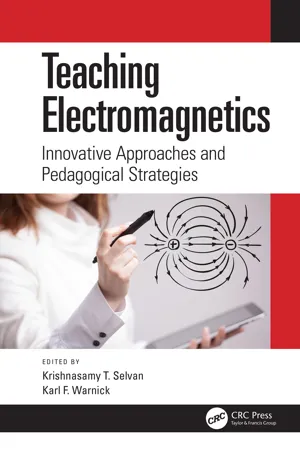
Teaching Electromagnetics
eBook - ePub

Teaching Electromagnetics

Innovative Approaches and Pedagogical Strategies

  1. 246 pages
  2. English
  3. ePUB (mobile friendly)
  4. Available on iOS & Android
eBook - ePub

Teaching Electromagnetics

Innovative Approaches and Pedagogical Strategies

About this book

Teaching Electromagnetics: Innovative Approaches and Pedagogical Strategies is a guide for educators addressing course content and pedagogical methods primarily at the undergraduate level in electromagnetic theory and its applications. Topics include teaching methods, lab experiences and hands-on learning, and course structures that help teachers respond effectively to trends in learning styles and evolving engineering curricula. The book grapples with issues related to the recent worldwide shift to remote teaching.

Each chapter begins with a high-level consideration of the topic, reviews previous work and publications, and gives the reader a broad picture of the topic before delving into details. Chapters include specific guidance for those who want to implement the methods and assessment results and evaluation of the effectiveness of the methods. Respecting the limited time available to the average teacher to try new methods, the chapters focus on why an instructor should adopt the methods proposed in it. Topics include virtual laboratories, computer-assisted learning, and MATLABÂŽ tools. The authors also review flipped classrooms and online teaching methods that support remote teaching and learning. The end result should be an impact on the reader represented by improvements to his or her practical teaching methods and curricular approach to electromagnetics education. The book is intended for electrical engineering professors, students, lab instructors, and practicing engineers with an interest in teaching and learning. In summary, this book:


  • Surveys methods and tools for teaching the foundations of wireless communications and electromagnetic theory


  • Presents practical experience and best practices for topical coverage, course sequencing, and content


  • Covers virtual laboratories, computer-assisted learning, and MATLAB tools


  • Reviews flipped classroom and online teaching methods that support remote teaching and learning


  • Helps instructors in RF systems, field theory, and wireless communications bring their teaching practice up to date

Dr. Krishnasamy T. Selvan is Professor in the Department of Electronics & Communication Engineering, SSN College of Engineering, since June 2012.

Dr. Karl F. Warnick is Professor in the Department of Electrical and Computer Engineering at BYU.

Frequently asked questions

Yes, you can cancel anytime from the Subscription tab in your account settings on the Perlego website. Your subscription will stay active until the end of your current billing period. Learn how to cancel your subscription.
At the moment all of our mobile-responsive ePub books are available to download via the app. Most of our PDFs are also available to download and we're working on making the final remaining ones downloadable now. Learn more here.
Perlego offers two plans: Essential and Complete
  • Essential is ideal for learners and professionals who enjoy exploring a wide range of subjects. Access the Essential Library with 800,000+ trusted titles and best-sellers across business, personal growth, and the humanities. Includes unlimited reading time and Standard Read Aloud voice.
  • Complete: Perfect for advanced learners and researchers needing full, unrestricted access. Unlock 1.4M+ books across hundreds of subjects, including academic and specialized titles. The Complete Plan also includes advanced features like Premium Read Aloud and Research Assistant.
Both plans are available with monthly, semester, or annual billing cycles.
We are an online textbook subscription service, where you can get access to an entire online library for less than the price of a single book per month. With over 1 million books across 1000+ topics, we’ve got you covered! Learn more here.
Look out for the read-aloud symbol on your next book to see if you can listen to it. The read-aloud tool reads text aloud for you, highlighting the text as it is being read. You can pause it, speed it up and slow it down. Learn more here.
Yes! You can use the Perlego app on both iOS or Android devices to read anytime, anywhere — even offline. Perfect for commutes or when you’re on the go.
Please note we cannot support devices running on iOS 13 and Android 7 or earlier. Learn more about using the app.
Yes, you can access Teaching Electromagnetics by Krishnasamy T. Selvan, Karl F. Warnick, Krishnasamy T. Selvan,Karl F. Warnick in PDF and/or ePUB format, as well as other popular books in Education & Teaching Science & Technology. We have over one million books available in our catalogue for you to explore.

Information

Publisher
CRC Press
Year
2021
Print ISBN
9780367710880
eBook ISBN
9781000400830

Table of contents

  1. Cover
  2. Half Title
  3. Title Page
  4. Copyright Page
  5. Dedication
  6. Table of Contents
  7. Acknowledgments
  8. Contributors
  9. Chapter 1: Introduction
  10. Chapter 2: Teaching and Learning Electromagnetics in 2020
  11. Chapter 3: An Experiential Learning Approach in Electromagnetics Education
  12. Chapter 4: Teaching and Learning Electromagnetics through MATLABÂŽ Programming of Electromagnetic Fields
  13. Chapter 5: Interactive Computational Tools for Electromagnetics Education Enhancement
  14. Chapter 6: Computational Electromagnetics and Mobile Apps for Electromagnetics Education
  15. Chapter 7: Teaching Electromagnetic Field Theory Using Differential Forms
  16. Chapter 8: Maxwell’s Displacement Current: A Teaching Approach Infusing Ideas of Innovation and Creativity
  17. Chapter 9: Teaching Electromagnetic Waves to Electrical Engineering Students: An Abridged Approach
  18. Chapter 10: Taking Electromagnetics Beyond Electrical and Electronics Engineering
  19. Chapter 11: HyFlex Flipping: Combining In-Person and On-Line Teaching for the Flexible Generation
  20. Chapter 12: Learning and Teaching in a Time of Pandemic
  21. Chapter 13: Conclusion and Outlook
  22. Index