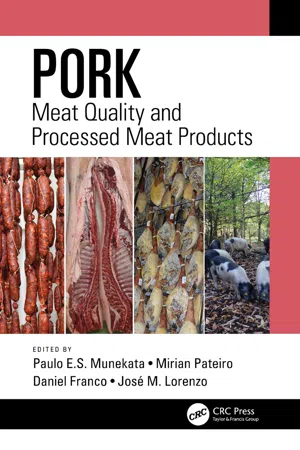
The processing of pork is a common technological practice that modifies the taste, flavor, texture and color of raw pork meat. Due to pork's accessible price and versatility, the manufacture of pork products to offer a variety of options to consumers is an important strategy of the meat industries in this sector to improve profits and expand into new markets at the local, regional and international levels.
The diversity of pork products reflects the diversity and history of many local cultures around the world, as well as a growing interest in preserving traditional processing practices.
Pork: Meat Quality and Processed Meat Products delves into the variouskinds of pork and the methods used to prepare it for consumption, including fresh meat products, fermented sausages, dry-cured products, blood sausages and cooked sausages. Each category starts with a specific raw material (entire cut vs. minced pork meat) to which is added a unique combination of ingredients (e.g., sodium chloride, starter cultures, blood, seasoning and spices). The method of processing (such as salting, drying, thermal processing and fermenting) takes consumer tastes and storage needs into account, as well as how each product will be consumed (cooked, sliced, spread and as an ingredient in other dishes, for instance). Consequently, a wide range of products made from pork are currently being produced worldwide. Added to this is the increasing importance of ingredients and health factors to consumers; the resulting demand for products that address specific health concerns is having a significant impact on research into and the production of pork meat products.
Key Features:
Comprehensively presents and discusses the wealth of information about pork products
Includes specific details about the processing, quality of final products and innovation in the industry
Presents innovative, health-oriented approaches to making traditional and commercial pork products
Discusses healthier pork meat products that address consumer trends and government recommendations
The production of health-oriented pork products is an emerging and promising investigation area with a direct impact on the currect market for meat products.
Trusted by 375,005 students
Access to over 1 million titles for a fair monthly price.
Breeds, Production, Meat Quality and Market: An Overview
Rubén Agregán,1 José M. Lorenzo,1 María López-Pedrouso,2 Jesús Cantalapiedra,3 Antonio Iglesias,4 Wangang Zhang,5 and Daniel Franco1
1Centro Tecnológico de la Carne de Galicia, Avd. Galicia 4, Parque Tecnológico de Galicia, San Cibrao das Viñas, 32900 Ourense, Spain
2Department of Zoology, Genetics and Physical Anthropology, University of Santiago de Compostela, Santiago de Compostela, Galicia, Spain
3Farm Counselling Services. Consellería do Medio Rural, Xunta de Galicia, Lugo, Spain
4Department of Anatomy, Animal Production and Veterinary Clinical Sciences, University of Santiago de Compostela, Santiago de Compostela, Galicia, Spain
5College of Food Science and Technology, Nanjing Agricultural University, Nanjing 210095, China
Contents
1.1 Introduction
1.1.1 Pig Origins and Perceptions of It as a Food Source
1.1.2 Production and Consumption of Pork Worldwide: Prospects
1.2 Porcine Breeds
1.2.1 Industrial Porcine Breeds
1.2.2 Autochthonous Porcine Breeds
1.3 Current Challenges of Pig Holdings
1.3.1 Animal Welfare and Sustainability
1.3.2 Genetic Improvement and Precision Livestock
1.4 Factors Affecting Pork Quality
1.4.1 Ante-Mortem Factors
1.4.2 Peri-Mortem Factors
1.4.3 Post-Mortem Factors
1.5 Pork Meat as a Component of Multiple Products Worldwide
References
1.1 Introduction
1.1.1 Pig Origins and Perceptions of It as a Food Source
The modern pig belongs to the order Artiodactyla, family Suidae and gender Sus, which includes the domestic pig and the European wild boar. The roots of the common pig come from a class of animals called Hyotherium, whose existence dates to ancient times. Historical data indicate that the pig was domesticated in China around 4900 BC and brought to Europe around 1500 BC. It was subsequently introduced to North America by Hernando de Soto in 1539 (Moeller & Crespo, 2009).
Pig has always played a vital role in food for humanity, providing meat for survival, but it is also an animal that has had, and it still has, a fundamental role in socio-cultural and religious traditions. Nowadays, pigs continue to be a fundamental source of food, due in part to their adaptability to multiple environmental conditions, allowing it to thrive in many habitats around the planet. An important factor that makes it so adaptable is that it is omnivorous, able to eat both forage-based and cereal grain-based feed. (Moeller & Crespo, 2009).
There is an extended culture of pork consumption in Western countries, whose origin seems to be in Greek and Roman civilizations, according to archaeology remains and documents in which the names of meat cuts are preserved. It is well known that Roman legions consumed manufactured products from pork, and they even carried out slaughters in some military bases (Swatland, 2010). Today, pork is consumed in many areas, playing an important economic role, especially in China, the UE and the USA (Ngapo et al., 2007). In the EU, pork is the most consumed, having a traditional place in the diet (Verbeke et al., 2011). However, pork does not have the same acceptance in all countries; for instance, in Muslim or Jewish ethnic populations, pork consumption is forbidden for religious and cultural reasons (Rosenblum, 2010). The appreciation of pork also varies even within countries, showing different degrees of consumption by different perceptions according to population groups.
A recent survey has shown different consumption levels and typology of products bought by pork consumers in the EU, taking into account factors such as social position, sex or location, observing that most of the pork consumers are families with high or medium-high incomes (Verbeke et al., 2010). Indeed, meat consumption data are an important indicator of the standard of living, according to sociologists and economists (Soare & Chiurciu, 2017). The survey states that the low or even absence of consumption is seen in women predominantly, noting that sex is an important factor that influences consumption. Moreover, this survey highlights that people living in rural areas of northern Europe are the biggest consumers of pork, with a frequency of up to several times a day, without predilection for any product. According to the survey, factors such as living in rural areas seem to increase pork consumption (Verbeke et al., 2010).
1.1.2 Production and Consumption of Pork Worldwide: Prospects
According to FAO, the swine production worldwide has increased steadily from 1961 to 2007 (Figure 1.1; Faostat, 2020); Asia is the continent with the highest production, with around the 50% of the world total. Among countries, China leads production in this continent and worldwide. Europe, with more than 25% of the world production, is the continent with the second-highest production, and Germany, Poland and Spain are countries with a remarkable rate of swine production. North and South America produce close to 20% of the total pig production worldwide, led by the USA and Brazil (Figure 1.1; Faostat, 2020).
Figure1.1 Distribution of swine production worldwide in two periods (Faostat, 2020).
Between 2007 and 2017 production increased in Asia, becoming the highest swine producer (almost 60% of the world total) with China assuming most of the production: more than 3,700 million pigs were produced during this time. This proves the strategic importance that the pig sector has for the culture of this area of the world (Szymańska, 2017), enhanced through a system of subsidies that stimulate production (Soare & Chiurciu, 2017). Europe and America have similar production percentages, highlighting the USA as the main producer. The swine production in the United States is concentrated in Minnesota, Iowa, Nebraska, Missouri, Illinois, Indiana and Ohio, due to factors such as large field areas available to cultivate feed, adequate climate and satisfactory economic conditions. Currently the USA is making advances technology, leading to the introduction of innovations in the sector. Following the USA, the largest pig-producing countries are Brazil, Mexico and Canada in the Americas, and Germany, Spain, Russia and France in Europe. EU member states have increased pork production in recent years. Brazil has consolidated itself as the third largest swine producer worldwide, and its position in the world ranking continues to strengthen. The rapid increase in swine production in this country is associated with higher possibilities of exporting pork meat to Russia, as well as to cover the greater demand in the domestic market (Szymańska, 2017). Between 2007 and 2017, a decrease of 13 million pigs was observed (Figure 1.2; Faostat, 2020). However, these data are very strongly influenced by Chinese rate production. The number of pigs in China significantly decreased during the last 4 years, especially, due to the application of an Environmental Protection Law, which restricts pig production in the southern part of the country. However, production is expected to increase in the following years (OECD/FAO, 2017).
Figure1.2 Evolution of pig production in the top ten producing countries between 2007 and 2017 (Faostat, 2020).
Regarding pork consumption, it increased from 1961 to 2013, with the Asian continent at the top of this growth, from 2.8 million tons in 1961 to 67.4 million tons in 2013, mainly due to consumption in China. Indeed, in 2013, pork demand in that country accounted for 80% of the Asian continent and around 50% worldwide. To a lesser extent, countries such as Japan, Vietnam and the Philippines stand out as large consumers of pork. On the other hand, there iwas also an increase in pork consumption in Europe and America during this period, although more gradually. Countries such as the USA, the former USSR, and now Russia and Germany, were the largest consumers. In 2013, total consumption in the USA accounted for more than 50% of the pork consumed throughout the Americas. Finally, consumption in Africa and Oceania was very low, reaching only 2% worldwide (Figure 1.3; Faostat, 2020).
Figure1.3 Evolution of pork consumption (tons) worldwide between 1961 and 2013 (Faostat, 2020).
There is a correlation between production and pork consumption, and the biggest producers are also the biggest consumers. Other countries are also worthy of mention since, although they do not stand out as pork producers, they have a high per-capita consumption, demonstrating a great tradition of consuming pork products, as in Hungary and Austria. Indeed, Hungary had, until the 1990s, the highest pork consumption per capita worldwide, reaching historical highs of almost 80 kg/inhabitant/year in the 1980s. Austria, similar to Germany, is known for the consumption of pork-derived products. Since the 1990s its consumption has been decreasing gradually, although it is still at values higher than 50 kg/inhabitant/year, at the level of the countries with the highest consumption, such as China and Hong Kong (Faostat, 2020).
According to data published by the OECD, there have been few changes in 2019 versus 2013 in the total consumption of pork, and China and the USA remain the main consumers, with 53 and almost 10 million tons, respectively. The EU countries also maintain a pork consumption of around 20 million tons, led by Russia, Germany, Spain and France. (Figure 1.4)
Figure1.4 Evolution of pork consumption worldwide in the top ten consumer countries between 1961 and 2013 (Faostat, 2020).
Swine production is expected to increase in the next three decades due to increased demand. This need is driven by continued population growth, as well as the dietary transition toward more animal protein per capita (Lassaletta et al., 2019). According to the report on agricultural prospects for the 2019–2028 period published by OECD and FAO (OECD/FAO, 2019), Asia will continue to be the main pork producer, and China will provide half of the worldwide production in the coming years. However, production is also expected to decrease in the EU in the next decade due to environmental and public concerns about manure management, in addition to the fact that pork is not considered an essential food in t...
Table of contents
Cover
Half Title
Title Page
Copyright Page
Table of Contents
Preface
About the Editors
Contributors
1 Pigs: Breeds, Production, Meat Quality and Market: An Overview
2 Dry-Cured Ham
3 Dry-Cured Shoulder Lacón: Manufacturing Process, Chemical Composition and Shelf Life
4 Fresh Pork Sausage: Manufacturing Process, Chemical Composition and Shelf Life
5 Chorizo and Chouriço de Carne: Varieties, Composition, Manufacturing Process, and Shelf Life
6 Pork Sausages in Asia
7 Traditional Pork Sausages in Serbia: Manufacturing Process, Chemical Composition and Shelf Life
8 Development of Innovative Dry-Cured Product from Pork Shoulder—The Cuore di Spalla Case Study: Salting Time Optimization According to the Crossbreed Used
9 Traditional Pork Sausages in Bulgaria: Composition and Shelf Life
10 Traditional Pork Sausages in Brazil: Manufacturing Process, Chemical Composition and Shelf Life
11 Indian Traditional Pork Products and Their Quality Attributes
12 Italian Salami: A Comprehensive Analysis
13 Salchichón (Spanish Dry-Cured Sausage): An Integrated Point of View Through Culture, Technology and Innovation
14 Manufacture of Whole Muscle Cook-In Ham
15 Bacon: The Processing, Shelf Life, and Macronutrient Composition of Bacon Manufactured from Pork Bellies
16 Bologna Sausages: Manufacturing Process, Physico-chemical Composition, and Shelf Life
17 Morcilla and Butifarra Sausage: Manufacturing Process, Chemical Composition and Shelf Life
18 Morcela de Arroz Sausage: Manufacturing Process, Chemical Composition and Shelf Life
Index
Frequently asked questions
Yes, you can cancel anytime from the Subscription tab in your account settings on the Perlego website. Your subscription will stay active until the end of your current billing period. Learn how to cancel your subscription
No, books cannot be downloaded as external files, such as PDFs, for use outside of Perlego. However, you can download books within the Perlego app for offline reading on mobile or tablet. Learn how to download books offline
Perlego offers two plans: Essential and Complete
Essential is ideal for learners and professionals who enjoy exploring a wide range of subjects. Access the Essential Library with 800,000+ trusted titles and best-sellers across business, personal growth, and the humanities. Includes unlimited reading time and Standard Read Aloud voice.
Complete: Perfect for advanced learners and researchers needing full, unrestricted access. Unlock 1.4M+ books across hundreds of subjects, including academic and specialized titles. The Complete Plan also includes advanced features like Premium Read Aloud and Research Assistant.
Both plans are available with monthly, semester, or annual billing cycles.
We are an online textbook subscription service, where you can get access to an entire online library for less than the price of a single book per month. With over 1 million books across 990+ topics, we’ve got you covered! Learn about our mission
Look out for the read-aloud symbol on your next book to see if you can listen to it. The read-aloud tool reads text aloud for you, highlighting the text as it is being read. You can pause it, speed it up and slow it down. Learn more about Read Aloud
Yes! You can use the Perlego app on both iOS and Android devices to read anytime, anywhere — even offline. Perfect for commutes or when you’re on the go. Please note we cannot support devices running on iOS 13 and Android 7 or earlier. Learn more about using the app
Yes, you can access Pork by Paulo E.S. Munekata, Mirian Pateiro, Daniel Franco, José M. Lorenzo, Paulo E.S. Munekata,Mirian Pateiro,Daniel Franco,José M. Lorenzo, Paulo E.S. Munekata, Mirian Paterio, Daniel Franco, José M. Lorenzo in PDF and/or ePUB format, as well as other popular books in Technology & Engineering & Food Science. We have over one million books available in our catalogue for you to explore.