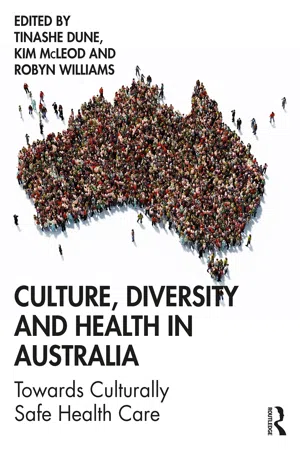
Culture, Diversity and Health in Australia
eBook - ePub

Culture, Diversity and Health in Australia

Towards Culturally Safe Health Care

  1. 336 pages
  2. English
  3. ePUB (mobile friendly)
  4. Available on iOS & Android
eBook - ePub

Culture, Diversity and Health in Australia

Towards Culturally Safe Health Care

About this book

Australia is increasingly recognised as a multicultural and diverse society. Nationally, all accrediting bodies for allied health, nursing, midwifery and medical professions require tertiary educated students to be culturally safe with regards to cultural and social diversity. This text, drawing on experts from a range of disciplines, including public health, nursing and sociology, shows how the theory and practice of cultural safety can inform effective health care practices with all kinds of diverse populations.

Part 1 explores key themes and concepts, including social determinants of health and cultural models of health and health care. There is a particular focus on how different models of health, including the biomedical and Indigenous perspectives, intersect in Australia today. Part 2 looks at culturally safe health care practice focusing on principles and practice as well as policy and advocacy. The authors consider the practices that can be most effective, including meaningful communication skills and cultural responsiveness. Part 3 examines the practice issues in working with diverse populations, including Indigenous Australians, Culturally and Linguistically Diverse Australians, Australians with disabilities, Australians of diverse sexual orientation and gender identity, and ageing Australians. Part 4 combines all learnings from Parts 1–3 into practical learning activities, assessments and feedback for learners engaging with this textbook.

Culture, Diversity and Health in Australia is a sensitive, richly nuanced and comprehensive guide to effective health practice in Australia today and is a key reference text for either undergraduate or postgraduate students studying health care. It will also be of interest to professional health care practitioners and policy administrators.

Frequently asked questions

Yes, you can cancel anytime from the Subscription tab in your account settings on the Perlego website. Your subscription will stay active until the end of your current billing period. Learn how to cancel your subscription.
At the moment all of our mobile-responsive ePub books are available to download via the app. Most of our PDFs are also available to download and we're working on making the final remaining ones downloadable now. Learn more here.
Perlego offers two plans: Essential and Complete
  • Essential is ideal for learners and professionals who enjoy exploring a wide range of subjects. Access the Essential Library with 800,000+ trusted titles and best-sellers across business, personal growth, and the humanities. Includes unlimited reading time and Standard Read Aloud voice.
  • Complete: Perfect for advanced learners and researchers needing full, unrestricted access. Unlock 1.4M+ books across hundreds of subjects, including academic and specialized titles. The Complete Plan also includes advanced features like Premium Read Aloud and Research Assistant.
Both plans are available with monthly, semester, or annual billing cycles.
We are an online textbook subscription service, where you can get access to an entire online library for less than the price of a single book per month. With over 1 million books across 1000+ topics, we’ve got you covered! Learn more here.
Look out for the read-aloud symbol on your next book to see if you can listen to it. The read-aloud tool reads text aloud for you, highlighting the text as it is being read. You can pause it, speed it up and slow it down. Learn more here.
Yes! You can use the Perlego app on both iOS or Android devices to read anytime, anywhere — even offline. Perfect for commutes or when you’re on the go.
Please note we cannot support devices running on iOS 13 and Android 7 or earlier. Learn more about using the app.
Yes, you can access Culture, Diversity and Health in Australia by Tinashe Dune,Kim McLeod,Robyn Williams in PDF and/or ePUB format, as well as other popular books in Medicine & Health Care Delivery. We have over one million books available in our catalogue for you to explore.

Information

Year
2021
eBook ISBN
9781000347210
Edition
1

Part I

Understanding culture, diversity and health

1An introduction to culture, diversity and health in Australia

Tinashe Dune, Kim McLeod and Robyn Williams

Learning outcomes

After working through this chapter, students should be able to:
  1. Explore statistics related to Australia’s ethnic, cultural, racial and religious diversity.
  2. Reflect on the role of social determinants of health in a diverse Australian context.
  3. Understand what social constructs are, and consider their role in determining experiences of health and wellbeing.
  4. Consider what health and wellbeing means to people from diverse Australian perspectives.
  5. Understand what is meant by cultural safety and its significance in Australia.

Key terms

Cultural safety: An environment that is spiritually, socially and emotionally safe, as well as physically safe for people; where there is no assault challenge or denial of their identity, of who they are and what they need.
Culture: The evolved human capacity to classify and represent experiences with symbols and to act imaginatively and creatively. Cultures are differentiated by the distinct ways that people, who live differently, classify and represent their experiences.
Diversity: Degree of variation of cultures, identities and other social and economic factors within a given society.
Ethnicity: A category or group of people who identify with each other, usually on the basis of presumed similarities such as common language, geography, ancestry, history, society, culture and/or social treatment.
Identity: Identity is a person’s conception and expression of their individuality or group affiliations.
Intersectionality: The interconnected nature of social categorisations such as race, class, and gender as they apply to a given individual or group, regarded as creating overlapping and interdependent systems of discrimination or disadvantage.
Race: A socially constructed grouping of humans based on shared physical categories generally viewed as distinct by a society.
Social construct: A perception of an individual, group, or idea that is “constructed” through cultural or social practice.
Social determinants of health: Conditions in which people are born, grow, work, live, and age, and the wider set of forces and systems shaping the conditions of daily life. These forces and systems include economic policies and systems, development agendas, social norms, social policies and political systems.

Chapter summary

This chapter introduces students to the social and cultural diversity of Australia. It defines diversity and notes the extent of diversities across the Australian population. Students then review introductory aspects of health and wellbeing in relation to diversity in Australia and the concept of social determinants of health. In this chapter students will begin the process of self-awareness and self-reflection and be tasked with exploring their own identities within Australia’s diverse context and the ways in which this may impact their health and wellbeing. The chapter finally engages students to start thinking about their role as health care professionals in Australia’s multicultural society and how they can engage with the concepts presented within the book. This chapter will briefly introduce the concept of cultural safety and provide a summary of the book’s three major parts.

Diversity in Australia

Australia is quickly becoming known as one of the most diverse Western nations in the world. The most recent Census indicates that Australians represent over 300 separately identified ancestries (Australian Bureau of Statistics, 2016). Australia is therefore well known for its multicultural population characterised by a vast diversity of cultural, ethnic, religious and linguistic groups. As such, a review of Australian statistics can help to orient students to a small slice of Australia’s diversity.

Country of birth, ethnicity and ancestry

In the 2016 Census, Australia’s Aboriginal and Torres Strait Islander people represented 2.8% of the population—an increase from 2.5% in 2011 and 2.3% in 2006. Of the 649,171 people who identified as Aboriginal and/or Torres Strait Islander in 2016, 91% were of Aboriginal origin, 5.0% were of Torres Strait Islander origin and 4.1% identified as being of both Aboriginal and Torre...

Table of contents

  1. Cover
  2. Half Title
  3. Title Page
  4. Copyright Page
  5. Dedication
  6. Table of Contents
  7. List of figures
  8. List of tables
  9. List of boxes
  10. List of contributors
  11. Acknowledgements
  12. List of abbreviations
  13. Part I: Understanding culture, diversity and health
  14. Part II: Culturally safe health care practice
  15. Part III: Working with diverse populations
  16. Part IV: Culturally safe teaching and learning
  17. Glossary
  18. Index