This book addresses challenges that higher education institutions face when bridging the gap between internationalisation as a key university strategy and their delivery of interculturally competent and responsible graduates. Combining international case studies and research outcomes, it provides an in-depth understanding of the role educational developers can play in the internationalisation of higher education and in the provision of an internationalised learning experience for all students.
The book situates international education in global and local contexts and contributes to the design and delivery of internationalised curricula in very concrete terms. In doing so, it suggests how academic staff may enhance the quality of their programmes by leveraging the opportunities of international classrooms where students have diverse academic, linguistic, and cultural backgrounds. The content of the book is therefore also foundational for continuing professional development (CPD) programmes that enhance staff competences for designing and teaching inclusive internationalised programmes and include topics such as:
An international competence profile for educational developers
Intercultural competence as a graduate attribute
Internationalised curriculum design and delivery
Intercultural group dynamics
The role of languages in internationalised higher education classrooms
Reflective processes for teaching and learning in the international classroom
This book is essential reading and a go-to resource for any academic looking to internationalise their education programmes. It will also be of interest to those directly involved in curriculum development, learning, and teaching as well as those who have more strategic responsibilities within and beyond HEIs, or who are involved in higher education research.
Higher education institutions (HEIs) across the globe are confronted with increasingly varied and sometimes contradicting expectations from the societies in which they are situated. On the one hand, it is assumed that they will generate knowledge and deliver graduates that can address or mitigate current and emerging global challenges, thereby benefiting communities both in their local environments and across the world. On the other hand, they are obliged by the authorities to serve national agendas and contribute to their countries’ global economic competitiveness and human capital resources (Ilieva, Beck and Waterstone, 2014). In addition, students expect – as do their families – that they will have opportunities and benefits, such as income, status, and upward social mobility at home and abroad when whey graduate (Marginson, 2016). Against the backdrop of these expectations, HEIs are constantly challenged to attune their academic provision and consider how they may enhance the quality of research and education and, at the same time, demonstrate that they serve wider societal goals.
The internationalisation of higher education (HE) is typically seen as an institutional strategy to achieve this. The term internationalisation is multifaceted and understood in different ways by different people, some of whom prefer global engagement or other terms to cover a range of activities in higher education, research, capacity building, and outreach to civil society. For the purpose of this book, we take De Wit et al.’s definition of higher education internationalisation as our point of departure:
[Internationalisation of Higher Education is] the intentional process of integrating an international, intercultural, or global dimension into the purpose, functions or delivery of post-secondary education, in order to enhance the quality of education and research for all students and staff, and to make a meaningful contribution to society.
(De Wit et al., 2015, p. 29)
De Wit et al.’s definition serves as the framework within which we discuss how the educational development of internationalised curricula (Leask, 2015) contributes to enhancing the quality of education for all students. It does not limit itself to considering English medium instruction (EMI) or the mobility of students and staff as the defining characteristics of HE internationalisation. Rather, EMI and mobility are some of the tools in the HE internationalisation toolbox, and internationalised programmes may be taught and studied in any language (or lingua franca) shared by lecturers and their students.
Closely aligned with De Wit et al.’s definition of HE internationalisation is Leask’s concept of the internationalised curriculum:
Internationalization of the curriculum is the incorporation of international, intercultural, and/or global dimensions into the content of the curriculum as well as the learning outcomes, assessment tasks, teaching methods, and support services of a program of study.
(Leask, 2015, p. 9)
Taken together, these conceptual underpinnings of HE internationalisation will offer students an internationalised learning experience (Lauridsen, 2020) that provides all students with the opportunity to develop and become globally competent graduates (Gregersen-Hermans, 2016b).
In view of the above, HEIs may essentially identify themselves within one of three strategic options at a given point in time: a scenario in which they work on enhancing the quality of teaching, one in which they integrate the development of intercultural and global competences in the curriculum, or one in which they rethink the core purpose and focus of the curriculum and what this implies for the purpose of teaching and learning in the international classroom (see Gregersen-Hermans and Lauridsen in Chapter 1). The three options may be considered stages in a development or a continuum, and HEIs may obviously choose to either stay or move forward in this development process at their discretion, depending on their specific societal contexts. The three possible scenarios describe the extent to which HEIs develop inclusive environments and incorporate international, intercultural, and global dimensions in the design and delivery of their curricula, including the assessment of student achievements.
Even as internationalisation is considered a quality driver in higher education, many HE leaders find it a challenge to move the internationalisation process forward in very concrete terms (Lauridsen, 2020). Translating good intentions in institutional policies and strategies into concrete initiatives in curriculum design, delivery, and assessment is not as straightforward as it may seem. Concrete manifestations in curriculum delivery will take different forms in different disciplines, and the link between institutional policies and lecturers’ academic practice is typically not linear (Söderlundh, 2018). Graduate attributes may be defined at institutional and programme levels, but educators are not necessarily sure how they may incorporate the development of these competences in the content and in the teaching, learning, and assessment activities of their courses or whole programmes of study.
Against the backdrop of this situation, it is the aim of this book to contribute to the development and delivery of internationalised curricula and of continuing professional development (CPD) programmes that enhance staff competences for designing and teaching inclusive internationalised programmes. It is informed by research literature on internationalisation of higher education and intercultural competence development in higher education, combined with literature on educational development, on teaching and learning in higher education, and on teaching through a second or third language. Yet in all of this, it has a unique perspective in that it brings together the critical and interrelated elements of academic practice that need to be considered when academic staff are given the task of incorporating international, intercultural, and global dimensions into curriculum design and delivery. While these elements of academic practice are indeed interrelated, they are – at least to a certain extent – addressed in separate chapters, but with cross-references throughout the book. Educational development perspectives are outlined and discussed as are the educational development expertise and the CPD required to design and teach fully internationalised curricula.
Educational development and educational developers
We have based this book on the following understanding of educational development:
Educational development is the iterative process of developing the quality and societal relevance of higher education.
The agents in this process are a diverse group of educators: The HEI decision makers – leadership and management teams – and the lecturers actually teaching the programmes, of course, but in between these two levels in the organisational hierarchy are the educational developers, academic and administrative staff tasked with the responsibility of supporting and furthering this quality enhancement process.
Educational developers (EDs) are a very disparate group of people – a ‘family of strangers’ in the higher education sector (Green and Little, 2016; Harland and Staniforth, 2008). Known as educational or academic or faculty developers, or something else entirely, these members of faculty or staff take on the professional role of ‘supporting lecturers in designing programmes and courses and delivering teaching, often through courses, workshops and consultations about teaching and learning in higher education’ (Cozart and Gregersen-Hermans in Chapter 3, p. 38). EDs may work full time in this role, e.g. in a centre for teaching and learning at different levels of the organisation (these centres may also have different names, e.g. educational development or faculty development centre); or the role of ED may be only a part of their responsibility in an academic or administrative staff position. They may or may not have an obligation to carry out educational development research. That said, many HEIs around the world would claim that they do not have educational development centres and – formally, at least – no EDs even though there are still people in the organisation who are given the responsibility of leading, coordinating or supporting what we term educational development (Dafouz, Haines and Pagèze, 2020).
When it comes to the development of internationalised curricula, and in many cases EMI, the idea of an ED becomes even more complex. Traditionally, EDs have only rarely been involved in or trained to develop internationalised curricula (Dafouz, Haines and Pagèze, 2020; Wimpenny, Beelen and King, 2019). Instead, academics or other staff with very diverse backgrounds are given the role of an ED supporting the development of internationalised programmes. In addition to those already working as EDs and specialising e.g. in higher education pedagogy or in leveraging the use of educational technology, this group includes – among others – language teachers, applied linguists, experts in intercultural communication, lecturers in all disciplines, academics in leadership positions, international office staff, or special project teams (Dafouz, Haines and Pagèze, 2020). While the varied backgrounds of these academics may – and often do – enrich the development of internationalised curricula, it is unfortunately not rare to see that they exist in silos within their separate areas of expertise, so to speak, and do not collaborate across different units in a given HEI. The purpose of this book is therefore also to show how these different areas of expertise may enhance the quality of internationalised programmes, and that together they may actually contribute more than the sum of their parts by synthesising their different approaches to higher education internationalisation.
How this book came about
The ideas behind this book have grown out of two major European strategic partnership projects. The first of these, IntlUni, addressed the opportunities and challenges of the multilingual and multicultural learning space (Lauridsen and Lillemose, 2015). The terms multilingual and multicultural were chosen because students and their lecturers may all have different linguistic and cultural backgrounds when they meet in what is often referred to as the international classroom, but for the purpose of that project the term learning spaces was used to indicate that these spaces might be physical classrooms, but might also be virtual spaces online. While learning spaces are thus quite specifically physical or virtual, the international classroom is a much fuzzier term (see the section on terminology below).
The main outcomes of the IntlUni project were the IntlUni Principles for quality teaching and learning in the multilingual and multicultural learning space (Cozart et al., 2015) and a set of recommendations. One of these recommendations was that HEIs should ‘provide the necessary professional development and teacher training programmes that will allow HE teachers to appropriately develop their language proficiency as well as their professional and pedagogical knowledge, skills, and competences and thereby empower them to ensure the quality of their teaching – and their students’ learning – in the multilingual and multicultural learning space’ (Lauridsen et al., 2015, p. 12).
A recommendation like this one obviously begs the question how HEIs can provide such professional development. As already indicated above, this task may be allocated to a diverse group of actors, depending on the availability of relevant experts and on local decisions. However, in many cases such experts are not available, and lecturers are left to their own devices without any support in their professional development. In some cases, HEIs that are about to introduce or already have introduced EMI, will ask language teachers or applied linguists to train and support the lecturers teaching the programmes in English, especially in non-Anglophone contexts, but other experts may also be given a supportive role. That said, it is important to note that the linguistic aspects or the role of languages in the international classroom are only a part of the opportunities – and challenges – of internationalised programmes. This applies irrespective of whether the programme is offered in an Anglophone or non-Anglophone country, or whether the lecturers teaching the programme are native speakers of English or have English as their second or third language.
In addition to the disciplines in question, different areas of expertise are needed in order for HEIs to enhance the societal relevance and quality of their academic provision. The EQUiiP Project – Educational Quality at Universities for inclusive international Programmes (2016–2019), a strategic partnership between seven European universities, therefore brought together a group of experts with more diverse backgrounds who together developed the EQUiiP Programme Designing and teaching inclusive international Programmes (EQUiiP, 2019a), an online platform with resources for training EDs and lecturers. The materials are available on the project website (www.equiip.eu) and ready-to-use in five modules with a User Guide:
Introduction to the International Classroom
Internationalising Course Design
Intercultural Group Dynamics
The Role of Language
Feedback and Reflective Processes
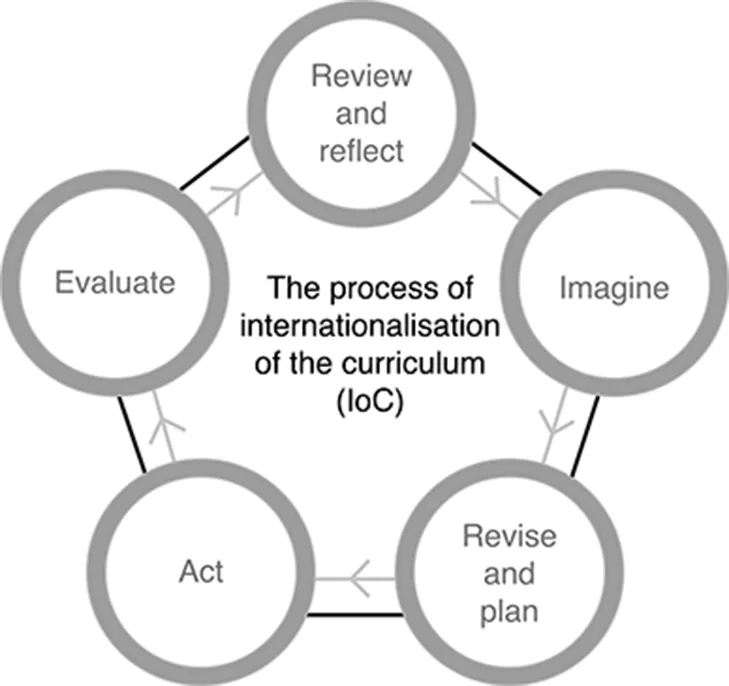
In the EQUiiP Project, we were fundamentally inspired by the works of Carroll (2015) and Leask (2015), and we basically followed Leask’s iterative process for internationalisation of the curriculum:
Figure 0.1 Leask's process of the internationalisation of the curriculum (Leask, 2015, p. 42).
In the course of the three years, we set out imagining what should go into the EQUiiP Programme, revised and planned, acted by piloting the modules in the partner institutions, evaluated, reviewed and piloted again; in the final year of the project, the piloting included two instantiations of the full programme in four-day training sessions. In this iterative process, the programme was adapted to cater to different institutional and disciplinary contexts, including very diverse local situations as regards the availability and organisation of educational development expertise. The whole programme has thus undergone a substantial quality assurance process.
From project to book
While there are short thematic introductions to the modules on the EQUiiP platform, there is so much more to be said on the topic of inclusive internationalised programmes in higher education, and we therefore invited some of the key actors in the project to join us in writing this book. In parts I, II, and IV, all chapters have been written by members of the project team who also co-authored the thematic introductions and other materials of the EQUiiP Pr...
Table of contents
Cover
Half Title
Series Page
Title Page
Copyright Page
Table of Contents
List of illustrations
Abbreviations
List of contributors
Acknowledgements
Foreword to the Series, Internationalization in Higher Education
PART 1: Setting the scene
PART 2: Educational development perspectives
PART 3: Voices from around the world: Case stories
PART 4: Research and future perspectives
References
Index
Trusted by 375,005 students
Access to over 1.5 million titles for a fair monthly price.
Study more efficiently using our study tools.
Frequently asked questions
Yes, you can cancel anytime from the Subscription tab in your account settings on the Perlego website. Your subscription will stay active until the end of your current billing period. Learn how to cancel your subscription
No, books cannot be downloaded as external files, such as PDFs, for use outside of Perlego. However, you can download books within the Perlego app for offline reading on mobile or tablet. Learn how to download books offline
Perlego offers two plans: Essential and Complete
Essential is ideal for learners and professionals who enjoy exploring a wide range of subjects. Access the Essential Library with 800,000+ trusted titles and best-sellers across business, personal growth, and the humanities. Includes unlimited reading time and Standard Read Aloud voice.
Complete: Perfect for advanced learners and researchers needing full, unrestricted access. Unlock 1.5M+ books across hundreds of subjects, including academic and specialized titles. The Complete Plan also includes advanced features like Premium Read Aloud and Research Assistant.
Both plans are available with monthly, semester, or annual billing cycles.
We are an online textbook subscription service, where you can get access to an entire online library for less than the price of a single book per month. With over 1.5 million books across 990+ topics, we’ve got you covered! Learn about our mission
Look out for the read-aloud symbol on your next book to see if you can listen to it. The read-aloud tool reads text aloud for you, highlighting the text as it is being read. You can pause it, speed it up and slow it down. Learn more about Read Aloud
Yes! You can use the Perlego app on both iOS and Android devices to read anytime, anywhere — even offline. Perfect for commutes or when you’re on the go. Please note we cannot support devices running on iOS 13 and Android 7 or earlier. Learn more about using the app
Yes, you can access Internationalising Programmes in Higher Education by Jeanine Gregersen-Hermans, Karen M. Lauridsen, Jeanine Gregersen-Hermans,Karen M. Lauridsen in PDF and/or ePUB format, as well as other popular books in Education & Education General. We have over 1.5 million books available in our catalogue for you to explore.