In Staying Online, one of our most respected online learning leaders offers uncommon insights into how to reimagine digital higher education. As colleges and universities increasingly recognize that online learning is central to the future of post-secondary education, faculty and senior leaders must now grapple with how to assimilate, manage, and grow effective programs. Looking deeply into the dynamics of online learning today, Robert Ubell maps its potential to boost marginalized students, stabilize shifts in retention and tuition, and balance nonprofit and commercial services. This impressive collection spans the author's day-to-day experiences as a digital learning pioneer, presents pragmatic yet forward-thinking solutions on scaling-up and digital economics, and prepares managers, administrators, provosts, and other leaders to educate our unsettled college students as online platforms fully integrate into the mainstream.
- 168 pages
- English
- ePUB (mobile friendly)
- Available on iOS & Android
eBook - ePub
About this book
Information
Section 1
Emergency Online Learning
1
We Are All Online Learners Now
Steering the giant lifeboat of academia from on campus to online in just a few weeks in the spring of 2020 has to count as one of the most unimaginable and exceptional feats ever achieved in higher education. Before the COVID-19 pandemic, only a third of U.S. college students were enrolled in online classes (Ubell, 2019b). Suddenly, nearly all of them were.
Under the threat of mass infection and with little or no preparation or planning, millions of professors and instructors around the world shifted their lectures, seminars, discussion sessions, and other in-person classes to online learning platforms. And millions of college students followed them.
Take a look at the following graph, created by noted edtech trend-spotter Phil Hill, illustrating the magical crossing in which U.S. higher education leaped almost entirely online (Hill, 2020a).
The COVID-19 pandemic forced U.S. colleges and universities to move courses online in a matter of weeks. As the rapidly climbing line shows, moving swiftly to the upper right corner in the graph, by the time U.S. campuses closed their gates on or around March 30, 2020, nearly all undergraduate and graduate courses had switched online.
Nothing in the history of higher education prepared our academic institutions to act with such uncanny speed. Similar moves occurred in Europe and Asia, but only in advanced economies was the transformation as swift as in the United States. For faculty and students in less developed countries, where internet service is poor or lacking and many don’t have digital devices, shifting online has not been nearly as swift or as easy.
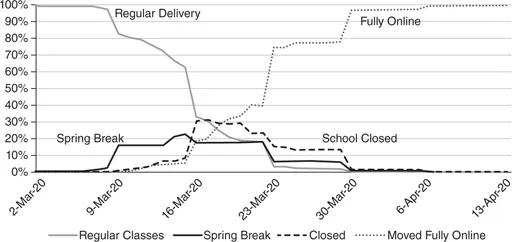
Figure 1.1 Percentage of US higher ed institutions moving to fully online delivery of traditional face-to-face courses during COVID-19 crisis
Source: Phil Hill/MindWires
In nonpandemic times, even the most modest change at a college or university can take months, if not years. Think of the committees, reports, reviews, and approvals needed to introduce even a timid curriculum revision. That millions of faculty members moved hundreds of thousands of courses online in a matter of weeks reveals the surprising resilience of academia in crisis.
In a breathtaking reversal, professors totally abandoned their familiar campus for an alien virtual world, suddenly dropping opposition to digital education. Fierce resistance dissolved practically overnight, with hardly anyone calling on institutions to stop their headlong plunge online. It was as if the university was on fire, with faculty rushing with digital buckets before the place burned down. Putting up a fight was useless. Defiance collapsed quickly, with hardly anyone raising a hand to stop it because there was no other way. Either go online—or close down the university.
Anju Sharma, an associate teaching professor of chemistry and chemical biology at Stevens Institute of Technology in Hoboken, N.J., had never taught online. Then, on Monday, March 9, 2020, she was notified that her freshman general chemistry course would go virtual. Two days later, even though she and her students were caught off guard, her class of about thirty undergrads met online without a hitch.
Sharma says she taught her online course almost exactly as she did on campus, except that instead of lecturing at the front of her classroom and displaying PowerPoint slides, she now lectures by videoconferencing and shares her digital images with students working on laptops at home.
“Students didn’t have to suffer. Their lives were not put on hold,” Sharma said of the decision to move courses online. “They seem to have grown up overnight.”
We Are All Online Learners Now
One thing that made the transition for Sharma and her students easier was that, like nearly all of us, we all participate in online learning informally every day, simply by shopping online, posting on social media, and streaming movies. Whenever we do email or chat with friends on FaceTime, we learn online. So even if faculty and students had never enrolled in or taught an online class before, most were already quite familiar with the virtual experience. We are all online learners now.
Beyond that, two key technologies really made a difference—learning management systems (LMSs) (Ubell, 2019a) and videoconferencing (Kagan, 2019). When the pandemic hit, nearly every U.S. college and university had already installed these two technologies. Without them, schools could never have been up and running online so seamlessly and so quickly.
Most of us by now are very familiar with videoconferencing services like Google Meet, Zoom, and Webex. Even before the pandemic, you may have joined webinars or participated in a videoconference at work. An LMS, on the other hand, is a far more structured platform. Designed especially for teaching and learning, it enables instructors to create course materials, assess student progress, and generate custom exams. With an LMS, students can communicate with their peers and instructors with text, voice, and video; they can also enroll in courses seamlessly, with attendance and grades recorded automatically. Many online courses employ both an LMS and some sort of videoconferencing service.
For those new to virtual teaching, Zoom and its many competitors, are very seductive. Videoconferencing platforms are surprisingly easy to master, and the on-screen, real-time experience replicates a sense of being in a classroom, face-to-face with students. Of course, your students are not actually seated before you; their images are arrayed in rows on your screen as in a stamp album. Instructors can easily adopt exactly the same conventional pedagogical approaches they followed on campus. Given how easy videoconferencing is to grasp, it’s unsurprising that its adoption at U.S. colleges leaped ahead of LMS usage during the crisis (Hill, 2020c).
Since the invasion of the coronavirus, a good part of the world shifted to working from home, with Zoom zooming past its videoconferencing rivals. Amazingly, just like Google, Zoom is now a verb. On March 23, 2020, Zoom was downloaded 2.13 million times worldwide. Just two months earlier, merely 56,000 applications were logged on (Kelly, 2020). Today, the company is valued at $140 billion (Macrotrends, 2020).
Earlier, in the fall of 2019, I led a Zoom class at The New School, a liberal-arts college in Manhattan, as part of a four-course online certificate, “Designing Online Learning Programs” (see Chapter 9). One crucial difference between my course and others in the spring 2020 pandemic semester is that my Zoom sessions weren’t the entirety of my students’ educational experience. Rather, each was the culmination of a week of other academic engagements that included watching brief video lectures I’d recorded earlier, reading excerpts from scholarly articles, and participating in a text-based, peer-to-peer discussion. My hour-long Zoom sessions were real-time discussions, wrapping-up what my students had learned throughout the week. I never delivered a lecture on Zoom.
Pandemic Pedagogy
Contrast that with pandemic pedagogy. Most faculty had no time to prepare a virtual course that drew thoughtfully on valuable pedagogical methods, like active learning, project-based inquiry, and peer-to-peer instruction. Such methods were championed early in the last century by progressive education giants such as John Dewey, Jean Piaget, and Paulo Freire. The benefits of active learning—whether on screen or on campus—are also supported by recent research in cognitive science and neuroscience (Feldman, 2020).
“What we did [in the spring 2020 semester] is not exactly online learning,” admitted Duke University’s Shawn Miller, director of Duke Learning Innovation, the school’s teaching and learning center, which led Duke’s online transition during the spring 2020 crisis. “It’s a first-aid approach. In well-designed online courses, faculty have time to prepare, to think about designing a course with prerecorded and other off-line materials. Without planning, faculty just take their face-to-face lectures and put them online.”
Compare that with the experience of students enrolled in well-designed digital courses. In numerous studies, most online learners come away with positive feelings. In a classic study, 94 percent said they learned as much or more in their digital course as they did on campus (Fredericksen, 2019).
Heading home in the pandemic didn’t provide shelter from the storm for all. Many student homes had no computer or internet access; others, limited bandwidth. While three-quarters of U.S. city inhabitants and 79 percent of suburban residents are plugged into broadband access, just two-thirds of rural Americans are covered. Because the FCC’s broadband maps classify a ZIP code as “served,” even if merely one home has access, it’s impossible to measure how widespread or underserved service actually is (Chin, 2020).
What Happened
Waiting for colleges and universities to reopen, it was anyone’s guess as to how many students would actually show up. Some imagined they would stay away out of fear of the continued threat of the disease or out of a desire to stay close to home. With millions out of work, many would be unable to pay tuition (Thompson, 2020). Some predicted crushing student enrollment declines of twenty to thirty percent.
That fall, in a National Student Clearinghouse Research Center count, undergraduate enrollment dropped four percent and community colleges, more than nine percent; while graduate numbers increased by nearly three percent, a jump commonly due to a constricting job market, when those who fail to find work turn to graduate school. But the biggest news was that colleges suffered a shattering loss of nearly 26 percent of first-time college students failing to show up (Hill, 2020c). The results weren’t as devastating as pessimists had estimated, but the losses shook higher ed as never before.
As the world economy skittered to the edge, with global consumption collapsing and unemployment surging, higher education was not spared. Colleges and universities were hit hard. Collectively, they stood to lose billions of dollars, with plummeting enrollments, sports events canceled, cafeterias and dorms closed, and nonpandemic research on hold. The University of Michigan, for example, expected a shortfall of $400 million to $1 billion (Fies and Hill, 2020). Some schools, struggling before COVID-19, simply closed their doors for good. In the eight terrible months since the pandemic terrified the country—from March to October 2020—eight U.S. colleges went under. The New York Times projected a loss of $23 billion in U.S. higher education revenue from the damage (New York Times, 2020).
According to the U.S. Bureau of Labor Statistics, the coronavirus was responsible for shedding seven percent of the nation’s college workforce. An estimated 337,000 fewer workers were employed by private and public colleges in the midst of the pandemic in August 2020, compared with higher ed employment just before COVID hit in February 2020 (Bauman, 2020). Not since the late nineteen-fifties did so many in higher education lose their jobs.
“Never in history has humanity experienced something along this scale and scope,” observed Columbia University’s Wafaa El-Sadr (Hessler, 2020).
Before the pandemic, more than a third of faculty at U.S. colleges said that online learning isn’t as good as face-to-face instruction (Lederman, 2019). No doubt, many of those who taught online in the pandemic still hold that view. In a Nature survey, many faculty members in the United States, United Kingdom, and European Union, delivering digital courses in the crisis, reported being unprepared, unsupported, and fearful of the forced culture change. They worried that virtual instruction will result in faculty obsolescence and, ultimately, unemployment (Watermeyer, 2020).
“It’s the end of the ‘traditional learning space’ as we know it,” one respondent lamented.
As colleges and universities around the world reopened, millions of instructors and their students reported conflicting reactions to the great experiment in pandemic pedagogy.
“Some faculty may come out of this experience not at all happy. They’ll be glad to return to face-to-face teaching when they go back to campus,” said Duke’s Miller. “Others may be surprised at how good the technology is. The stigma of online learning will be softened a bit.”
The astonishing lesson is that online education, so long derided by traditional academics, came to the rescue of conventional higher education.
* * *
By the time you read this, COVID-19 very likely will have passed through its worst phase. Most of the world may have largely returned to a semblance of normality. This is my best hope. But prediction, notoriously, is a very bad business, likely to hit its mark as often as it misses. The wisest move is not to make blind guesses, following Yogi Berra’s sage, contradictory advice, “It’s tough to make predictions, especially about the future.”
That’s why, as you read the chapters that follow, you will see that I hesitated to say much about the effects of the pandemic on the future of digital education. As I wr...
Table of contents
- Cover
- Half Title
- Title
- Copyright
- Dedication
- Contents
- Preface
- Acknowledgments
- Section 1 Emergency Online Learning
- Section 2 Theory and Practice
- Section 3 Scaling-up
- Section 4 Problems and Considerations
- Section 5 Changing My Mind
- Index
Trusted by 375,005 students
Access to over 1.5 million titles for a fair monthly price.
Study more efficiently using our study tools.
Frequently asked questions
Yes, you can cancel anytime from the Subscription tab in your account settings on the Perlego website. Your subscription will stay active until the end of your current billing period. Learn how to cancel your subscription
No, books cannot be downloaded as external files, such as PDFs, for use outside of Perlego. However, you can download books within the Perlego app for offline reading on mobile or tablet. Learn how to download books offline
Perlego offers two plans: Essential and Complete
- Essential is ideal for learners and professionals who enjoy exploring a wide range of subjects. Access the Essential Library with 800,000+ trusted titles and best-sellers across business, personal growth, and the humanities. Includes unlimited reading time and Standard Read Aloud voice.
- Complete: Perfect for advanced learners and researchers needing full, unrestricted access. Unlock 1.5M+ books across hundreds of subjects, including academic and specialized titles. The Complete Plan also includes advanced features like Premium Read Aloud and Research Assistant.
We are an online textbook subscription service, where you can get access to an entire online library for less than the price of a single book per month. With over 1.5 million books across 990+ topics, we’ve got you covered! Learn about our mission
Look out for the read-aloud symbol on your next book to see if you can listen to it. The read-aloud tool reads text aloud for you, highlighting the text as it is being read. You can pause it, speed it up and slow it down. Learn more about Read Aloud
Yes! You can use the Perlego app on both iOS and Android devices to read anytime, anywhere — even offline. Perfect for commutes or when you’re on the go.
Please note we cannot support devices running on iOS 13 and Android 7 or earlier. Learn more about using the app
Please note we cannot support devices running on iOS 13 and Android 7 or earlier. Learn more about using the app
Yes, you can access Staying Online by Robert Ubell in PDF and/or ePUB format, as well as other popular books in Education & Education General. We have over 1.5 million books available in our catalogue for you to explore.