Why are some work partnerships exceptional while most are not? How can we establish and sustain an enhanced level of cohesion, connection, and collaboration in the most important work relationship, the one between a manager and team? What could remedy the high levels of isolation and anxiety so many feel at work these days?
Silver and Franz explore the concept of 'meaningful partnership' in the workplace. They present meaningful partnership as a mindset where both leaders and their teams are fully committed to ensuring the support and success of the other. Then, they describe a model called ERTAP, which stands for Empathy, Respect, Trust, Alignment, and Partnership, which is the foundation for meaningful partnership. Finally, they detail a practical yet transformative relationship-building process referred to as the Workplace Covenant. This enables leaders and teams to create mutual commitments with obligatory weight that help them to feel accountable for the success of the relationship and each other.
The book includes real client stories that illustrate the dimensions of partnership and the Workplace Covenant process. Silver and Franz also outline other work relationships that can benefit from meaningful partnership, pitfalls to avoid, relevant research, and insights derived from years of consulting experience.
This book is a must-read for leaders interested in a better working relationship with their team; for teams who have critical work partnerships with other teams; for individuals who work closely with other individuals and need an exceptional 1:1 partnership; and finally for third-party experts in HR or continuous improvement who are seeking a new powerful way to help clients feel supported and be more successful.
Workplace relationships are the threads of the fabric we call our organization. The better your workplace relationships, the more satisfied and successful you will be.
Silver Bullet
The Basic Problem in Our Workplace
If you work in an organization, you know the obvious: not everyone loves their job. You probably also know this problem is not new. Organizations have tried for years to make the workplace better with various initiatives: situational leadership, total quality, empowerment, diversity training, career development, 360-degree feedback, seven habits, crucial conversations, five dysfunctions, employee engagement, scrums, and work from home. Despite all of these good efforts, the basic problem remains. Many employees, in fact at all levels, finish work feeling unsupported, unappreciated, and frustrated. Sure, some are highly satisfied and highly engaged in their job. But research consistently finds they are actually a small percentage of the workforce. So, why do most employees in most organizations feel either somewhat or significantly dissatisfied? What makes so many routinely complain about their work to family and friends? Why is it that almost all of us, at some point, seriously consider leaving our job and finding something better?
The Manager-Team Relationship is Crucial
We believe the answer is touched on by the above programs but has never been the main focus. It is the quality of our professional relationships that matter. The most important one is the crucial relationship between a manager and his/her team.
Think of it this way: organizations are like garments, an intricate tapestry woven together with the “threads” of intersecting, interdependent professional relationships. These relationships of connection and exchange profoundly influence what we do, how effective we are, and most importantly, how we think and feel about our work. Pull on one key thread, and the garment can unravel. If one major workplace relationship is off-track or in conflict, especially if it is with your boss, the result is usually frustration, stress, reduced productivity, and perhaps seeking something new.
Test this finding. If you, or someone you know, ever quit a job voluntarily, the odds are high the departure was due to poor interactions and a bad relationship with the immediate supervisor. By the way, the inverse is also true. If you or someone you know truly loves their job and is fully engaged, the odds are that a positive relationship with the manager is a major reason. This one relationship is perhaps the single biggest factor in our experience at work, whether you are an individual contributor, supervisor, manager, or executive. In other words, wherever you fall on the company “org chart”, unless you are the owner, you have a boss, and that one relationship largely determines your well-being and success at work.
So, why exactly is this relationship so critically important? Based on decades of research, it turns out that the manager-team relationship significantly impacts almost everything essential to being a high-success organization. It profoundly affects the levels of employee morale, engagement, and turnover. It affects sales, customer service, and customer loyalty. It affects innovation, cost-control, adherence to schedule, and quality. It affects staff attitudes toward work, levels of effort, teamwork, and job performance. It actually influences even more, but aren’t these enough?
Customer Relationships Matter, but Manager-Team Relationships Mostly Ignored
Now you may be wondering: if the manager-team relationship affects all of these key performance indicators (KPIs) that much, then why don’t organizations pay more attention to making sure they are both satisfying and effective? Good question! By contrast, many organizations are very focused on their relationship with customers/clients. They provide training on customer service, measure customer satisfaction, and seek customer feedback to improve what they do. For example, many hotels, rental car companies, online retailers, and even banks (who knew they cared?) send surveys or call you about your recent experience, asking how their interactions were with you. Considering what we know about the impact of the manager-team relationship, this contradiction is sort of absurd. Think about it.
On the one hand, smart organizations typically care a great deal about their customer relationships (after all no customers/clients, no organization) and have many processes and practices to ensure those interactions begin well and stay positive. Yet, on the other hand, most of these organizations seem almost indifferent to the quality of their manager-team relationships, despite the importance. Unless there is a crisis – in which case HR or lawyers get involved – the quality of the manager-team relationship is left basically to chance. Strange as it seems, there is seldom a formal standard process or practice to make sure this most critical relationship starts off right and then remains healthy and productive. Everyone just hopes they work out. As the old song goes: “Que sera, sera, what will be, will be”!
For the record, not all organizations make this mistake. One highly successful US East Coast supermarket chain, Wegmans, has lived by this slogan for decades: Employees first, customers second (Glanton & Lewis, 2017). This value statement, expressed often by the late founder, is on most employee business cards and company materials. He also said: Never think about yourself. Always help others (WHAM, 2017) which sometimes can be found on a simple plaque in their stores. Wegmans knows that only highly engaged and highly supported employees, who have strong positive relationships with their manager, can provide exceptional customer service. No surprise, Wegmans’ customer loyalty has long been number one in the industry, and they are consistently rated in the top ten “Best Places to Work” in America.
The Need for Partnership
So, again the question: why do most organizations not focus more on really making sure the manager-team relationship starts and stays satisfying and successful? We believe it is because they are using the wrong relationship model. They assume that since the manager has formal authority and power, the team is largely subordinate, even subservient to the manager. In fact, some managers still refer to their direct reports as “subordinates” (a condescending term, from the Latin word “sub” meaning “under”, implying employees are “under” or “less than”). This is the old hierarchical, “my boss is actually my primary customer” model, where accountability is effectively one-way: what the team owes the manager.
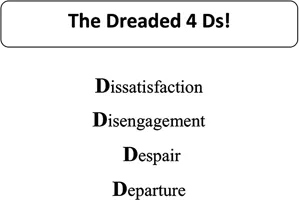
The problem with this approach is that it implies that the team's needs and expectations are not overly important. This is where the seeds of dissatisfaction, disengagement, despair, and eventually departure are sown. Or, as we call them, the Dreaded 4 Ds to avoid! Consider this: how well do one-way relationships, which are important and supposed to be long-term, actually work? If you are married or in a long-term personal relationship, how long would your partner accept that only your needs and your expectations should be met? Thought so! How long would your best friends accept a one-way relationship that only benefited you? You get the idea.
Quick Thought: Adverbs Matter. Thankfully, not many managers use the term “subordinate” these days, at least not in front of their staff. The newer politically correct terms are “associate” or “direct report”. But the mindset of “power over” is still there when a boss says “this person (or team) works for me”. As we know, employees work at organizations, they work with managers and colleagues, but they ultimately work for themselves, their families, and their futures. Perhaps some employees would say they work for their customers or clients. The point is, their paycheck is not signed by their manager. Adverbs matter! When a manager says “this person (or team) works for me”, they are minimizing the need for two-way accountability and subtly reinforcing the outdated, hierarchical model that can lead to the Dreaded 4 Ds!
Figure 1.1The Dreaded 4 Ds!
If team members are to be happy and fully effective, then managers have to make sure their team is their primary customer. In practice, this means that both the manager and the team must be focused on genuinely supporting each other and helping one another to achieve. They both must have the mindset of meaningful partnership. Frankly, this is a more intelligent and rational relationship model because it is two-way, and both sides in the partnership fully benefit.
In professional sports, the value of interdependence and partnership is clear. Imagine any head coach who didn’t care about team morale, constant losses, and who spent more time with other coaches or executives than their own team. What would happen? No question – that coach would be fired. A coach is only successful if his/her team is successful. When asked what attributes are required to be an excellent baseball manager, the ever-insightful Yogi Berra replied “great players”. He was on to something! As an old saying goes, “Leaders are only as effective as their followers”.
What is obvious in sports, but sometimes lost in our workplace, is that managers can’t succeed for long if their team feels unsupported or is struggling. Conversely, the team obviously can’t succeed for long if their manager feels unsupported and is struggling. It is truly a two-way meaningful partnership. Perhaps not of equals in authority, but definitely of equals in accountability for well-being and success. The cartoon in Figure 1.2 depicts a situation when there is no mutual accountability between a leader and their team – a situation we all know happens too often. Managers and their teams are like spouses in a marriage or partners in a 50/50 business: they are in the same boat, they have to bail each other out, their fates are intertwin...
Table of contents
Cover
Half Title
Endorsements
Title Page
Copyright Page
Dedication
Contents
Acknowledgments
Authors
Introduction
Chapter 1 The Need for Meaningful Partnership
Chapter 2 What Is a Workplace Covenant?
Chapter 3 A Covenant Story
Chapter 4 What Is ERTAP?
Chapter 5 Another Covenant Story
Chapter 6 How the Process Works
Chapter 7 Show Me the Evidence
Chapter 8 Covenants in Times of Crisis (and During Virtual Work)
Chapter 9 Other Applications for Workplace Covenants
Chapter 10 What Could Go Wrong?
Chapter 11 Wherever You Are, How Do You Start?
Chapter 12 A Last Covenant Story
Chapter 13 Final Thoughts
Appendix I: Slides to Run a Workplace Covenant Session
Appendix II: Measuring ERTAP
References
Index
Trusted by 375,005 students
Access to over 1.5 million titles for a fair monthly price.
Study more efficiently using our study tools.
Frequently asked questions
Yes, you can cancel anytime from the Subscription tab in your account settings on the Perlego website. Your subscription will stay active until the end of your current billing period. Learn how to cancel your subscription
No, books cannot be downloaded as external files, such as PDFs, for use outside of Perlego. However, you can download books within the Perlego app for offline reading on mobile or tablet. Learn how to download books offline
Perlego offers two plans: Essential and Complete
Essential is ideal for learners and professionals who enjoy exploring a wide range of subjects. Access the Essential Library with 800,000+ trusted titles and best-sellers across business, personal growth, and the humanities. Includes unlimited reading time and Standard Read Aloud voice.
Complete: Perfect for advanced learners and researchers needing full, unrestricted access. Unlock 1.5M+ books across hundreds of subjects, including academic and specialized titles. The Complete Plan also includes advanced features like Premium Read Aloud and Research Assistant.
Both plans are available with monthly, semester, or annual billing cycles.
We are an online textbook subscription service, where you can get access to an entire online library for less than the price of a single book per month. With over 1.5 million books across 990+ topics, we’ve got you covered! Learn about our mission
Look out for the read-aloud symbol on your next book to see if you can listen to it. The read-aloud tool reads text aloud for you, highlighting the text as it is being read. You can pause it, speed it up and slow it down. Learn more about Read Aloud
Yes! You can use the Perlego app on both iOS and Android devices to read anytime, anywhere — even offline. Perfect for commutes or when you’re on the go. Please note we cannot support devices running on iOS 13 and Android 7 or earlier. Learn more about using the app
Yes, you can access Meaningful Partnership at Work by Seth Silver,Timothy Franz in PDF and/or ePUB format, as well as other popular books in Business & Human Resource Management. We have over 1.5 million books available in our catalogue for you to explore.