Improving Global Worker Health and Safety Through Collaborative Capacity Building Initiatives
eBook - ePub

Improving Global Worker Health and Safety Through Collaborative Capacity Building Initiatives

  1. 200 pages
  2. English
  3. ePUB (mobile friendly)
  4. Available on iOS & Android
eBook - ePub

Improving Global Worker Health and Safety Through Collaborative Capacity Building Initiatives

About this book

Many economically developing countries and nations without robust occupational hygiene (OH) educational programs endure a shortage of qualified occupational hygienists, resulting in higher rates of workplace injury, illness, and fatality. Damage to valuable infrastructure, environment, and public health also occurs without adequate support.

Improving Global Worker Health and Safety Through Collaborative Capacity Building Initiatives outlines a broad variety of capacity building projects in OH. It also introduces detailed experiences of occupational hygienists working abroad and working on special global topics including a discussion of how global trade agreements influence the practice and policy within OH. It describes the special needs of informal workers who do not have a "typical" employer and special challenges of creating university curricular guidelines for OH, building competency, and increasing capacity. This book also informs experienced professionals in international OH-capacity building initiatives and directions.

Features:


  • Presents the global impact and importance of occupational hygienists


  • Outlines knowledge and collaboration through networking


  • Provides case studies on real world situations and problems

This text will be useful for professionals and graduate students in the fields of occupational health and safety and public health.

Frequently asked questions

Yes, you can cancel anytime from the Subscription tab in your account settings on the Perlego website. Your subscription will stay active until the end of your current billing period. Learn how to cancel your subscription.
No, books cannot be downloaded as external files, such as PDFs, for use outside of Perlego. However, you can download books within the Perlego app for offline reading on mobile or tablet. Learn more here.
Perlego offers two plans: Essential and Complete
  • Essential is ideal for learners and professionals who enjoy exploring a wide range of subjects. Access the Essential Library with 800,000+ trusted titles and best-sellers across business, personal growth, and the humanities. Includes unlimited reading time and Standard Read Aloud voice.
  • Complete: Perfect for advanced learners and researchers needing full, unrestricted access. Unlock 1.4M+ books across hundreds of subjects, including academic and specialized titles. The Complete Plan also includes advanced features like Premium Read Aloud and Research Assistant.
Both plans are available with monthly, semester, or annual billing cycles.
We are an online textbook subscription service, where you can get access to an entire online library for less than the price of a single book per month. With over 1 million books across 1000+ topics, we’ve got you covered! Learn more here.
Look out for the read-aloud symbol on your next book to see if you can listen to it. The read-aloud tool reads text aloud for you, highlighting the text as it is being read. You can pause it, speed it up and slow it down. Learn more here.
Yes! You can use the Perlego app on both iOS or Android devices to read anytime, anywhere — even offline. Perfect for commutes or when you’re on the go.
Please note we cannot support devices running on iOS 13 and Android 7 or earlier. Learn more about using the app.
Yes, you can access Improving Global Worker Health and Safety Through Collaborative Capacity Building Initiatives by Thomas P. Fuller in PDF and/or ePUB format, as well as other popular books in Technology & Engineering & Environmental Science. We have over one million books available in our catalogue for you to explore.

1 Foundations and Networks of Occupational Hygiene Capacity

Thomas P. Fuller
Illinois State University and the International Occupational Hygiene Association

Contents

1.1 Introduction
1.2 American Industrial Hygiene Association
1.2.1 International Affairs Committee
1.2.2 Emerging Economies Microgrant Subcommittee
1.2.3 Collaboration with the International Occupational Hygiene Association
1.3 International Occupational Hygiene Association
1.3.1 IOHA History
1.3.2 IOHA Committees and Activities
1.3.2.1 Governance
1.3.2.2 Communications
1.3.2.3 Stakeholder Relations
1.3.2.4 National Accreditation Recognition Committee
1.3.2.5 Education
1.3.2.6 Conferences
1.3.2.7 IOHA Awards
1.4 Conclusions
References

1.1 Introduction

There are approximately 3,514,988,000 workers in the world over the age of 15 (ILO, 2020a). Each year 2.78 million workers will die on the job as a result of accidents and exposures to toxic chemical, physical, and biological agents (HƤmƤlƤinen, 2017). This amounts to five workers around the world dying every minute. Worldwide, there are around 340 million occupational accidents and 160 million victims of work-related illnesses annually (ILO, 2020b). And in many countries, these numbers are grossly underreported.
In the early part of the last century during the industrial revolution, a new profession was created to anticipate, recognize, evaluate, and control workplace hazards as a means to reduce work-related injury, illness, and death. This profession is called occupational/industrial hygiene.
Today there are approximately 20,000 occupational hygienists striving to make workplaces safer and healthier throughout the world. Yet despite this number, workers continue to be injured and die as the result of workplace hazards. The toll of workplace injury, illness, and death is indicative of the urgent need for additional occupational hygiene knowledge and person power globally. Almost every fifth grader knows the title ā€œnurseā€ and generally knows what nurses do. But unfortunately, not everyone is as familiar with what an occupational hygienist does. Furthermore, the shift of basic manufacturing away from the United States due to neoliberal and anti-regulatory policies has reduced industry-based employment for occupational hygienists. This has resulted in universities struggling to attract enough students into the field of study.
In countries with more advanced economies, where more regulations have been promulgated that require employers to take certain actions to protect workers from workplace hazards, there tends to be more occupational hygiene capacity in terms of educational institutions that provide specialized coursework, and thus a larger pool of qualified and competent practicing professionals. Often in these same economically advanced nations, businesses and organizations have realized the clear financial benefits of having a safe and healthy workforce, fewer accidents that destroy infrastructure and disrupt business, and reduced insurance premiums related to both. The value of occupational hygiene capacity in these nations is fairly well understood to not all, but many, business and government organizations.
Approximately 8,000 occupational hygienists are in the United States; half of them are certified. The United States also has the most academic Occupational Hygiene (OH) programs with more than 75 schools offering degrees at all levels. Canada has the second largest number of industrial hygienists, with more than 600. China, the most populous country in the world, has proposed a fast track in its development of safety and health systems by quickly moving to a mandated management systems approach while trying to establish the professional resources to carry this out.
Globalization has shifted worldwide manufacturing from the economically advanced nations to Asia, India, Mexico, and other regions. As a result, more occupational hygiene professionals are dealing with international issues even if only limited to requirements for exports. It also has led to the growth of occupational hygiene outside the United States, along with some concepts such as the ā€œGreen Movementā€ and ā€œSustainable Developmentā€ from Europe and other places.
In many developing nations, the economic and social benefits of investment in occupational hygiene have been relatively underreported and are therefore less understood and utilized by governments and businesses. Not only is the creation of new health ...
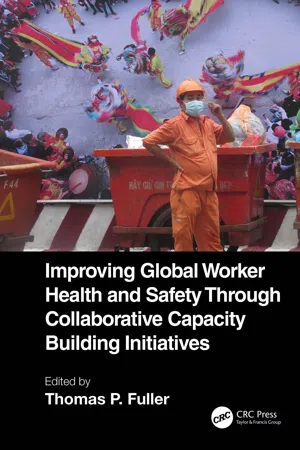
Table of contents

  1. Cover
  2. Half Title
  3. Title Page
  4. Copyright Page
  5. Table of Contents
  6. Preface
  7. Acknowledgments
  8. Editor
  9. Contributors
  10. Chapter 1 Foundations and Networks of Occupational Hygiene Capacity
  11. Chapter 2 Building OHS Capacity at the Grass Roots: A Case Study of the Maquiladora Health & Safety Support Network and Its Global Partners
  12. Chapter 3 Workplace Health Without Borders: Engaging Volunteers to Improve Workplace Health and Safety in Underserved Regions around the Globe
  13. Chapter 4 Promotion of Occupational and Environmental Hygiene through Education: A Case Study of the Occupational Hygiene Training Association (OHTA)
  14. Chapter 5 The Developing World Outreach Initiative: Expansion of Occupational Hygiene through Volunteerism and Networking
  15. Chapter 6 International Education, Research, and Service Opportunities for Students and Faculty in Higher Learning Institutions
  16. Chapter 7 The Role of Equipment and Services Vendors in Advancing Occupational Hygiene Globally
  17. Chapter 8 Capacity Crashing: The Ongoing Transfer of Dangerous Jobs and Processes to Underdeveloped Regions
  18. Chapter 9 Challenges of Managing Occupational Health, Safety, and Environment on International Hydropower Construction Projects
  19. Chapter 10 An Analysis of the Impacts of National Regulation on Occupational Safety and Health: How Regulations Protect Workers and Their Employers
  20. Chapter 11 International Trade Agreements and Their Impact on Worker Health and Safety
  21. Chapter 12 Creating and Expanding the European Network Education and Training in Occupational Safety and Health (ENETOSH) to Build Capacity in OSH and Education
  22. Chapter 13 International Occupational Health Outreach: One Step at a Time – Vietnam Progress Report
  23. Chapter 14 Pathways Forward in New Collaborations for Capacity Building in Occupational Hygiene
  24. Index