This book identifies specific changes to bring U.S. social policy in accord with the Information Age of the 21st century, in contrast to the policy infrastructure of industrial America.
Welfare State 3.0: Social Policy after the Pandemic acknowledges the existing social infrastructure, considers viable options, and provides supporting data to suggest social policy reform by four strategies: consolidating programs, harmonizing applications, expanding equity, and conducting experiments. The book favors discreet, poignant proposals of social programs. In 12 chapters, the text provides an analysis that honors past accomplishments, recognizes the influence of established stakeholders, and concedes program inadequacies, while plotting specific opportunities for policy improvement. In contrast to liberalism's tendency toward idealism, the book adopts a realpolitik appreciation for social policy.
Written by one of the most respected academics of U.S. social policy, this book will be required reading for all undergraduate and postgraduate students of social policy, social work, sociology, and U.S. politics more broadly.
Nations introduce major changes in social policy in response to crisis. Thus, 9/11 introduced the Department of Homeland Security, consolidating several existing agencies into the largest federal agency. The Great Recession, the worst since the Great Depression, was addressed by an unprecedented infusion of fiscal stimulus by the Treasury under the Bush II and Obama administrations. Similarly, the coronavirus promises to upend the status quo as developed nations struggle to sustain economic activity. Among the most conservative news outlets, The Financial Times confessed that its pro-market orientation was passé, announcing the need for “radical reforms” over the complacency of the previous four decades:
Government will have to accept a more active role in the economy. They must see public services as investments rather than liabilities, and look for ways to make labour markets less insecure. Redistribution will again be on the agenda; the privileges of the elderly and wealthy in question. Policies until recently considered eccentric, such as basic income and wealth taxes, will have to be in the mix.1
Thus, the pandemic could well portend major changes in the welfare state.
Understandably, political victors of new social programs tend to invoke compassion as a motive, while the vanquished complain of irreparable harm to established institutional arrangements.2 In this respect, social policy is no different from policy undergirding defense or diplomacy; instability requires abrupt departures from the status quo, lest the status quo be consigned to the dustbin of history. Realpolitik demands innovation. Thus, Chancellor Otto von Bismarck, confronted by socialist challenges to a newly integrated Germany and an economic collapse impeding industrialization, instituted a National Health Plan for workers in 1883, followed by Accident Insurance in 1884, Disability Insurance in 1889, and Unemployment Insurance in 1927, taking the wind out of the radicals’ sails by establishing the first national welfare state.3
Ditto Australia. In 1909 the newly established Federation of territories pioneered old-age pensions, “invalid pensions” in 1910, and “maternity allowances” in 1912. But the Great Depression and World War II boosted the fledgling Australian welfare state, using Keynesian economics to fund a robust array of programs serving children, widows, the unemployed, and a national healthcare program. Drawing on English social philosophy, Australia would become a full-fledged welfare state by the century’s end.4
Similarly, the American welfare state originated with the Social Security Act of 1935, enacted six long years after the 1929 Wall Street crash. The toll of the Great Depression included widespread bank failures, farmers and businesses plunged into bankruptcy, and an unemployment rate of 25 percent. Desperate people resorted to radical tactics, some joining the Industrial Workers of the World, the “wobblies,” which organized strikes and destroyed property in a campaign against capitalism. One historian chronicled,
by the fall of 1932, the nation faced a serious threat. Disorder spread and talk of revolution was heard, many destitute and starving citizens had only contempt for the government and the system that was responsible for their plight but that did little to alleviate their distress.5
As Bismarck had done a half-century before, Franklin Delano Roosevelt’s New Deal defused a precarious polity by establishing the American welfare state.
And the British replicated the pattern after the devastation of World War II, which destroyed much of London and Birmingham. In 1942 William Beveridge authored Social Insurance and Allied Services, arguing for the establishment of a National Health Service, government-financed and government-managed healthcare for the entire population. “The Beveridge Report was received by the British population with unprecedented enthusiasm and became the blueprint for social legislation after the war.”6 Decades later, despite a series of Tory prime ministers averse to public monopolies, the NHS remains an impregnable fortress of the British welfare state.
Social insurance, which I call Welfare State 1.0, has been central to these innovations, requiring employers and workers to contribute to a state pension scheme designed to provide an adequate income for employees who become unemployed, retire, or become disabled. For rapidly industrializing economies, social insurance assured family breadwinners minimal financial security once they left the labor market. In so doing, social insurance facilitated labor mobility insofar as younger workers would not be encumbered with the care of their fathers. By the same token, social insurance was patriarchal, presuming that men would enjoy the fruits of public policy, while women provided important domestic services and child raising but were not covered. No minor consideration, social insurance defused leftist radicals who champed at the abuses of capital, leaving industrializing nations largely under the control of businessmen, who readily distributed income, assets, and opportunities to their compatriots.7 To paraphrase Winston Churchill, social insurance may not have been perfect, but it has been far superior to the alternative: no security for workers and their families, at all.
As depression and war have prompted previous innovations in social policy, will the novel coronavirus presage the next articulation of the welfare state?
The structure of welfare states
As the institutional manifestation of sovereign nations, welfare states vary, being products of history, economics, politics, and happenstance. Regardless, a welfare state is one in which “individuals belonging to a defined community (typically a national community) were entitled, through their status as citizens, to a range of social goods guaranteed by the central state designed to meet their basic needs (food, shelter, education, health, etc.).”8 Previous forms of social care included charity, often through religious institutions, or the local government, such as the “poor house” or “workhouse,” places deemed so loathsome that only the most indigent would resort to them. With the inception of the welfare state, the national government asserted a defining role.9 In doing so, nations modulated capitalism, establishing an alternative to fascism and communism; typically, welfare states consisted of social insurance for workers, welfare for the poor, public social services in the form of mental health, education, and childcare, and personal social services for the wayward.10
In 1990 Gosta Esping-Andersen introduced an important classification of “developed”—capitalist and technologically advanced nations—dividing welfare states into three clusters: “liberal” welfare states predicated on employment, which split social insurance for workers from public assistance for the poor, such as Canada, Australia, the U.K., and the U.S.; “corporatist” welfare states founded on social rights supporting traditional families, supported by the Church, such as France, Austria, Germany, and Italy; and “social democratic” welfare states where the emphasis is on universal benefits to the middle class, primarily the nations of Scandinavia.11 This clustering of welfare states omits important variations that are nation specific. For example, Canada, Australia, and the U.S. have all been especially negligent to First Peoples/Nations; moreover, Australia established penal camps for illegal immigrants fleeing persecution. The scheme also omits important nations as well as groups of nations. Since 1990, the “four tigers” of Asia—Hong Kong, Singapore, Taiwan, and South Korea—have evolved social infrastructures quite different than those that emerged in the West. Equally important, former colonial nations of Southeast Asia and Sub-Saharan Africa have struggled economically, many losing ground developmentally since achieving independence. The demise of the Soviet Union and Warsaw Pact is another change; conceived as a “workers’ paradise,” nations within the Soviet orbit degraded to the point of a joke: “We pretend to work; you pretend to pay us.” Other nations have managed resources for better or worse, affecting the wellbeing of citizens over time. The fate of Argentina, a rich nation early in the 20th century, stands in contrast to China a century later. Blessed with natural resources, vast lands for cattle and sheep, and talented immigrants from Europe (without female partners, Italian men conceived a sensuous dance: tango!), an autocrat, Juan Peron, squandered opportunities, leaving Argentina among the developing nations of the world.
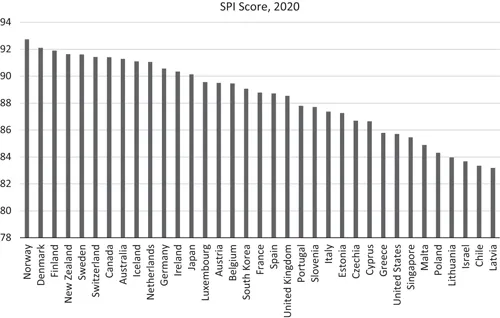
The advent of the Information Age has been accompanied by data permitting the evaluation of nations with respect to important components of development. This was first done in the UN’s Human Development Index (HDI), based on three factors: income, longevity, and education. Later, gender, poverty, and political participation have been added, amplifying the HDI.12 Subsequently, researchers from Harvard University generated the Social Progress Index (SPI) comprising a dozen variables: basic human needs (nutrition and basic medical care, water and sanitation, shelter, and personal safety), foundations of wellbeing (access to knowledge, access to information and communication, health and wellness, and environmental quality), and opportunity (personal rights, personal freedom and choice, inclusiveness, and access to advanced education). These factors are converted to numerical values, permitting the ranking of nations, as shown in Figure 1.1, which depicts developed countries.13
Figure 1.1 SPI score, 2020.
The nations ranked include several “liberal” welfare states: Canada, the U.K., and Australia, each ranking far better than the U.S., which is ranked at 28. No doubt Americans would object, citing the usual factors: the U.S. is far larger than many countries and it is a more heterogeneous population. But these objections fail in light of the size of Australia, for example, constituting an entire continent, or the diversity of Canada, which resembles that of the U.S.
In a sense, the SPI is a report card on the adequacy of welfare states. Notably, the more “universal” welfare states of Scandinavia have risen to the top of the rankings, followed in mixed fashion by the “liberal” and “corporatist” nations, as presented by Esping-Andersen. At 28, the U.S. ranks well behind most of them. While many Americans like to think of their country as “USA #1,” the data suggest otherwise; by factors other than economic prowess and military might, the U.S. keeps company with nations of lesser stature.14 This is due, in part, to depressed regions, such as Appalachia, Indian reservations, and the Mississippi Delta, but it also reflects the inadequacy of America’s social infrastructure, affecting a wide spectrum of the population
How the U.S. would slip in international league tables from an incandescent beacon of prosperity and opportunity during most of the 20th century to a flickering light early in the 21st has much to do with America’s welfare state.
Welfare State 0.0
The welfare state is a relatively modern invention, conceived during the 17th and 18th. centuries by the social contract philosophers. According to Kurt Andersen,
Social contracts are unwritten but real, taken seriously but not literally. They consist of all the principles and norms governing how members of a society are expected to treat one another, the balance between economic rights and responsibi...
Table of contents
Cover
Half-Title
Title
Copyright
Contents
Prologue: Mary and her baby
1 Crisis
2 Forsaking African Americans
3 Framing the welfare state
4 Lyndon Johnson’s War on Poverty
5 Convolution
6 The problem from purgatory
7 Policy paradigms
8 Consolidate programs
9 Harmonize applications
10 Expand equity
11 Conduct experiments
12 Inflection
Acknowledgments
Index
Trusted by 375,005 students
Access to over 1.5 million titles for a fair monthly price.
Study more efficiently using our study tools.
Frequently asked questions
Yes, you can cancel anytime from the Subscription tab in your account settings on the Perlego website. Your subscription will stay active until the end of your current billing period. Learn how to cancel your subscription
No, books cannot be downloaded as external files, such as PDFs, for use outside of Perlego. However, you can download books within the Perlego app for offline reading on mobile or tablet. Learn how to download books offline
Perlego offers two plans: Essential and Complete
Essential is ideal for learners and professionals who enjoy exploring a wide range of subjects. Access the Essential Library with 800,000+ trusted titles and best-sellers across business, personal growth, and the humanities. Includes unlimited reading time and Standard Read Aloud voice.
Complete: Perfect for advanced learners and researchers needing full, unrestricted access. Unlock 1.5M+ books across hundreds of subjects, including academic and specialized titles. The Complete Plan also includes advanced features like Premium Read Aloud and Research Assistant.
Both plans are available with monthly, semester, or annual billing cycles.
We are an online textbook subscription service, where you can get access to an entire online library for less than the price of a single book per month. With over 1.5 million books across 990+ topics, we’ve got you covered! Learn about our mission
Look out for the read-aloud symbol on your next book to see if you can listen to it. The read-aloud tool reads text aloud for you, highlighting the text as it is being read. You can pause it, speed it up and slow it down. Learn more about Read Aloud
Yes! You can use the Perlego app on both iOS and Android devices to read anytime, anywhere — even offline. Perfect for commutes or when you’re on the go. Please note we cannot support devices running on iOS 13 and Android 7 or earlier. Learn more about using the app
Yes, you can access Welfare State 3.0 by David Stoesz in PDF and/or ePUB format, as well as other popular books in Politics & International Relations & American Government. We have over 1.5 million books available in our catalogue for you to explore.