The Restorative Prison
eBook - ePub

The Restorative Prison

Essays on Inmate Peer Ministry and Prosocial Corrections

  1. 166 pages
  2. English
  3. ePUB (mobile friendly)
  4. Available on iOS & Android
eBook - ePub

The Restorative Prison

Essays on Inmate Peer Ministry and Prosocial Corrections

About this book

Drawing on work from inside some of America's largest and toughest prisons, this book documents an alternative model of "restorative corrections" utilizing the lived experience of successful inmates, fast disrupting traditional models of correctional programming. While research documents a strong desire among those serving time in prison to redeem themselves, inmates often confront a profound lack of opportunity for achieving redemption. In a system that has become obsessively and dysfunctionally punitive, often fewer than 10% of prisoners receive any programming. Incarcerated citizens emerge from prisons in the United States to reoffend at profoundly high rates, with the majority of released prisoners ending up back in prison within five years. In this book, the authors describe a transformative agenda for incentivizing and rewarding good behavior inside prisons, rapidly proving to be a disruptive alternative to mainstream corrections and offering hope for a positive future.

The authors' expertise on the impact of faith-based programs on recidivism reduction and prisoner reentry allows them to delve into the principles behind inmate-led religious services and other prosocial programs—to show how those incarcerated may come to consider their existence as meaningful despite their criminal past and current incarceration. Religious practice is shown to facilitate the kind of transformational "identity work" that leads to desistance that involves a change in worldview and self-concept, and which may lead a prisoner to see and interpret reality in a fundamentally different way. With participation in religion protected by the U.S. Constitution, these model programs are helping prison administrators weather financial challenges while also helping make prisons less punitive, more transparent, and emotionally restorative.

This book is essential reading for scholars of corrections, offender reentry, community corrections, and religion and crime, as well as professionals and volunteers involved in correctional counseling and prison ministry.
Frequently asked questions

Yes, you can cancel anytime from the Subscription tab in your account settings on the Perlego website. Your subscription will stay active until the end of your current billing period. Learn how to cancel your subscription.
At the moment all of our mobile-responsive ePub books are available to download via the app. Most of our PDFs are also available to download and we're working on making the final remaining ones downloadable now. Learn more here.
Perlego offers two plans: Essential and Complete
  • Essential is ideal for learners and professionals who enjoy exploring a wide range of subjects. Access the Essential Library with 800,000+ trusted titles and best-sellers across business, personal growth, and the humanities. Includes unlimited reading time and Standard Read Aloud voice.
  • Complete: Perfect for advanced learners and researchers needing full, unrestricted access. Unlock 1.4M+ books across hundreds of subjects, including academic and specialized titles. The Complete Plan also includes advanced features like Premium Read Aloud and Research Assistant.
Both plans are available with monthly, semester, or annual billing cycles.
We are an online textbook subscription service, where you can get access to an entire online library for less than the price of a single book per month. With over 1 million books across 1000+ topics, we’ve got you covered! Learn more here.
Look out for the read-aloud symbol on your next book to see if you can listen to it. The read-aloud tool reads text aloud for you, highlighting the text as it is being read. You can pause it, speed it up and slow it down. Learn more here.
Yes! You can use the Perlego app on both iOS or Android devices to read anytime, anywhere — even offline. Perfect for commutes or when you’re on the go.
Please note we cannot support devices running on iOS 13 and Android 7 or earlier. Learn more about using the app.
Yes, you can access The Restorative Prison by Byron R. Johnson,Michael Hallett,Sung Joon Jang in PDF and/or ePUB format, as well as other popular books in Theology & Religion & Criminology. We have over one million books available in our catalogue for you to explore.

Information

1
The Consequences of Failing Prisons

DOI: 10.4324/9781003171744-1

The Human Drain: How Incarceration Affects Families

US prisons are comprised of convicted offenders largely coming from economically disadvantaged communities where poverty is pervasive and highly concentrated. Many prisoners were raised in broken and dysfunctional homes and may have had a parent that was incarcerated. In urban centers across the country, inner-city youth residing in distressed neighborhoods attend underperforming schools. Along with poor functioning inner-city schools, a disturbingly high percentage of students are dropping out from the educational process altogether. Indeed, the dropout rate in many disadvantaged urban environments can reach 60%—about twice the national average. Moreover, we know from decades of research that school performance and dropping out of school are significant predictors of delinquency and adult criminal behavior as well as the increased likelihood of incarceration.1 And while many believe that exhausting the limits of our nation’s criminal justice system brings resolution to society’s crime-related issues, there is considerable evidence that a prison sentence may actually reinforce a cyclical pattern of incarceration.2 The task before us requires confronting a series of great challenges—even notwithstanding those challenges newly brought about by the COVID-19 crisis. These challenges involve first-and-foremost crises in familial entropy, social division, and a tendency to over-rely upon criminal justice sanctions to resolve social problems—which has only contributed to a further breakdown in “traditional” social assets of family and neighborhood-level civic-resources such as churches, schools, and locally owned businesses.
Beyond the cyclical and individual impact of prison life, the ongoing generational impact of criminal behavior also contributes to the growing prison population epidemic. When a parent is incarcerated, the lives of children can be disrupted in tragic ways.3 Children of prisoners may end up in foster care placement. Repeated changes in family structure due to parental incarceration can be disruptive in children’s lives which often creates instability and insecurity that can be harmful to youth.4 Consider that children of prisoners are more likely to observe parental substance abuse, perform poorly in school, and experience poverty and disadvantage.5 As might be expected, youth and adolescents who have an incarcerated parent are also more likely to experience aggression, anxiety, and depression.6 Children of prisoners, therefore, are at-risk for alcohol and drug abuse, delinquency and crime, gang involvement, and subsequent incarceration.7 Regrettably, parental criminality is a key risk factor and an important link between the incarceration of a parent and a variety of antisocial behaviors among their children.8
Indeed, research confirms that children of prisoners experience much higher rates of criminal behavior and subsequent incarceration.9 Thus, the impact of one man’s incarceration may be felt by families and communities for decades. The nature of prison life yields a host of negative outcomes for all of society, and the cumulative effect of these outcomes will have important implications for generations to come.
Rather than providing offenders with the opportunities and resources necessary to achieve positive life-transformation, incarceration often merely further abuses and isolates inmates. America’s prisons are often today profoundly bereft of rehabilitation programming and inundated with violence. Amid reports of staff-coerced “gladiator fights,” broomstick rapes, and high staff turnover, Florida Department of Corrections Secretary Mark Inch recently highlighted the fact that only 6% of Florida’s inmates received any programming.10 Florida State Senator Jeff Brandeis, the Republican Chair of the Corrections Oversight Committee, stated “This is not a prison system that anybody can look you in the eye and tell you a person will be safe in the state’s care.”11 In short, America’s prison inmates often live in fear of physical harm, while experiencing few opportunities for self-improvement. Within a short period of time after release, many ex-offenders find themselves back in the same communities and circles of influence that enabled, if not encouraged, their criminal activity in the first place.

The Financial Drain: The Economic Impact of Overreliance on Incarceration

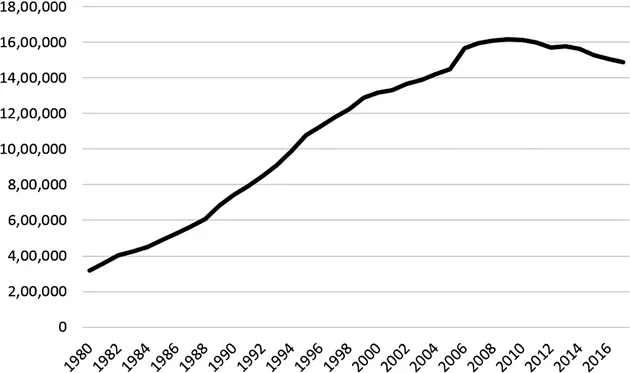
According to the Sourcebook of Criminal Justice Statistics,12 the total estimated US prison population increased by 377% (from 319,598 to 1,524,650) between 1980 and 2009, when it reached an all-time peak (see Figure 1.1). Using a more recent estimate of the 2009 prison population (1,615,500),13 the 30-year increase was even more dramatic (405%). After the peak, the US prison population began to decline and continued a downward trend through 2017 as Figure 1.1 shows, while the federal prison population (which made up about 12% to 14% of the total prison population between 2007 and 2017) peaked three years later (i.e., 2012).14 Despite the declining trend, almost 1.5 million (1,489,363) persons were incarcerated in prison in 2017.15
FIGURE 1.1 Total Estimated US Prison Population, 1980–2017.
Source: The Sourcebook of Criminal Justice Statistics Online (https://www.albany.edu/sourcebook/). Section 6. Table 6.1.2011, “Adults on probation, in jail and prison, and on parole, United States, 1980–2011” (https://www.albany.edu/sourcebook/pdf/t612011.pdf); Kaeble and Cowhig (2018). Table 1, “Number of persons supervised by U.S. adult correctional systems, by correctional status, 2000 and 2006–2016”; Bronson and Carson (2019). Table 1.1, “Prisoners under jurisdiction of stat or federal correctional authorities, by jurisdiction and sex, 2007–2017.”
To state the obvious, it is expensive to keep such a large number of people in correctional institutions. For example, between 1982 and 2001, total state expenditures on corrections increased annually from 15.0 billion to 53.5 billion dollars before they fluctuated between 53.4 billion and 48.4 billion dollars until 2010, when the expenditures totaled 48.5 billion dollars.16 The total amount a state spends on prisons increases when costs paid by other state agencies (e.g., employee health insurance, pension contributions, and inmate hospital care) are added to correctional budgets.17 According to a survey focusing on fiscal year of 2010, the total tax payer cost of prisons in 40 states that participated in the survey was 13.9% higher than the costs represented by their combined correctional budgets.
Although an increase in prison population does not always increase prison expenditures,18 the amount of state correctional expenditures seem to have roughly followed the trends of the total state prison population. Stated differently, the more offenders are sentenced to prison, the more state correctional expenditures increase.19 Specifically, state correctional institutions’ operational expenditures increased threefold (298%) from 9.7 billion to 38.6 billion dollars between 1982 and 2009 (see Figure 1.2). In addition, per capita expenditures ranged from $26,036 (in 1982) to $32,459 (in 2001) during the 19-year period with the average annual operating cost per state prisoner in 2009 being $29,270 or $80.19 per day.20 In...

Table of contents

  1. Cover
  2. Half Title
  3. Title Page
  4. Copyright Page
  5. Table of Contents
  6. Acknowledgments
  7. Foreword
  8. 1 The Consequences of Failing Prisons
  9. 2 Can Prisons Model Virtuous Behavior?
  10. 3 How Religion Contributes to Volunteerism, Prosocial Behavior, and Positive Criminology
  11. 4 The Disruptive Potential of Offender-led Programs: “Lived Experience” and Inmate Ministry
  12. 5 Offender-Led Religious Movements and Rethinking Incarceration
  13. 6 Wounded Healers in “Failed State” Prisons: A Case Study of Mississippi State Penitentiary at Parchman
  14. 7 Lessons We Can Learn from Prisoners
  15. 8 Toward Restorative Corrections: A Movement Well Underway
  16. 9 Epilogue
  17. Index