Forensic Engineering
eBook - ePub

Forensic Engineering

Damage Assessments for Residential and Commercial Structures

  1. 732 pages
  2. English
  3. ePUB (mobile friendly)
  4. Available on iOS & Android
eBook - ePub

Forensic Engineering

Damage Assessments for Residential and Commercial Structures

About this book

Serving as a comprehensive resource that builds a bridge between engineering disciplines and the building sciences and trades, Forensic Engineering: Damage Assessments for Residential and Commercial Structures, Second Edition provides an extensive look into the world of forensic engineering. Focusing on investigations associated with insurance industry claims, the book describes methodologies for performing insurance-related investigations, including the causation and origin of damage to residential and commercial structures and/or unhealthy interior environments and adverse effects on the occupants of these structures.

Edited by an industry expert with more than 40 years of experience and contributors with more than 100 years of experience in the field, the book takes the technical aspects of engineering and scientific principles and applies them to real-world issues in a nontechnical manner. The book provides readers with the experiences, investigation methodologies, and investigation protocols used in and derived from thousands of forensic engineering investigations.

FEATURES

  • Covers 24 topics in forensic engineering based on thousands of actual field investigations
  • Provides a proven methodology based on engineering and scientific principles, experience, and common sense to determine the causes of forensic failures pertaining to residential and commercial properties
  • Includes references to many codes, standards, technical literature, and industry best practices
  • Illustrates detailed and informative examples utilizing color photographs and figures for industry best practices as well as to identify improper installations
  • Combines information from a multitude of resources into one succinct, easy-to-use guide

This book details proven methodologies based on over 10,000 field investigations in which the related strategies can be practically applied and appreciated by both professionals and laymen alike.

Frequently asked questions

Yes, you can cancel anytime from the Subscription tab in your account settings on the Perlego website. Your subscription will stay active until the end of your current billing period. Learn how to cancel your subscription.
No, books cannot be downloaded as external files, such as PDFs, for use outside of Perlego. However, you can download books within the Perlego app for offline reading on mobile or tablet. Learn more here.
Perlego offers two plans: Essential and Complete
  • Essential is ideal for learners and professionals who enjoy exploring a wide range of subjects. Access the Essential Library with 800,000+ trusted titles and best-sellers across business, personal growth, and the humanities. Includes unlimited reading time and Standard Read Aloud voice.
  • Complete: Perfect for advanced learners and researchers needing full, unrestricted access. Unlock 1.4M+ books across hundreds of subjects, including academic and specialized titles. The Complete Plan also includes advanced features like Premium Read Aloud and Research Assistant.
Both plans are available with monthly, semester, or annual billing cycles.
We are an online textbook subscription service, where you can get access to an entire online library for less than the price of a single book per month. With over 1 million books across 1000+ topics, we’ve got you covered! Learn more here.
Look out for the read-aloud symbol on your next book to see if you can listen to it. The read-aloud tool reads text aloud for you, highlighting the text as it is being read. You can pause it, speed it up and slow it down. Learn more here.
Yes! You can use the Perlego app on both iOS or Android devices to read anytime, anywhere — even offline. Perfect for commutes or when you’re on the go.
Please note we cannot support devices running on iOS 13 and Android 7 or earlier. Learn more about using the app.
Yes, you can access Forensic Engineering by Stephen E. Petty in PDF and/or ePUB format, as well as other popular books in Technology & Engineering & Civil Engineering. We have over one million books available in our catalogue for you to explore.

1 Introduction

Stephen E. Petty
EES Group, Inc.

Contents

1.1 Definition of Forensic Engineering/Sciences
1.2 Why Forensic Engineering/Sciences?
1.3 Insurance Industry Claims Statistics
1.4 Standard Methodology for Forensic Inspections
1.4.1 Pre-Inspection File Preparation
1.4.1.1 Gathering Information and Allocating Resources
1.4.1.2 Inspection Equipment and Preparation
1.4.2 Basic Site Inspection Methodology
1.4.2.1 Basic Methodology – Site Arrival Best Practice
1.4.2.2 Basic Methodology – Property Owner/Point of Contact Interview
1.4.2.3 Basic Methodology – Interior Inspection
1.4.2.4 Basic Methodology – Exterior (Non-Roof) Inspection
1.4.2.5 Basic Methodology – Roof Inspection
1.4.2.6 Basic Methodology – Collection of Evidence
1.5 Written Inspection Reports – Why Necessary and Standard Components
1.5.1 Need for a Written Inspection Report
1.5.2 Basic Methodology – Elements of a Written Inspection Report
1.5.2.1 Title Page, Cause for Claim/Inspection, and Scope of Work
1.5.2.2 Documentation of Information Obtained During the Interview
1.5.2.3 Review of Structure Information and Applicable Data
1.5.2.4 Review of Weather Data (If Pertinent)
1.5.2.5 Summarization of Inspection Observations
1.5.2.6 Discussion Section Including Pertinent Analysis
1.5.2.7 Conclusions
1.5.2.8 Recommendations
1.5.2.9 Appendices
1.6 Terminology – Use of the Terms “Not Possible,” “Possible,” “Probable,” “Likely,” and “Certain”
References
Purpose/Objectives
The purpose of this chapter is to:
  • Define the term “Forensic Engineering” and explain why forensic engineering is needed.
  • Define areas within the insurance industry where forensic engineering services are often required.
  • Define a standard forensic engineering inspection protocol.
  • Explain why written reports are needed along with key elements of the basic forensic report.
  • Define how to use the terms “not possible,” “possible,” “probable,” “likely,” and “certain.”
Following the completion of this chapter, you should be able to:
  • Understand where forensic engineering services are likely to be needed, especially by the insurance industry.
  • Be able to conduct a forensic inspection using a standard protocol.
  • Recognize the value and key components of a written forensic inspection report.
  • Know and understand when and how to use the terms “possible,” “probable,” “likely,” and “certain.”

1.1 Definition of Forensic Engineering/Sciences

A detailed discussion of the definition of forensic engineering follows:
“Forensic engineering is the application of engineering principals and methodologies to answer questions of fact. These questions of fact are usually associated with accidents, crimes, catastrophic events, degradation of property, and various types of failures,”1 and further, “Forensic engineering is the application of engineering principles, knowledge, skills, and methodologies to answer questions of fact that may have legal ramifications.”1
While this definition is applied to forensic engineering, it should be acknowledged that this field is practiced by not only engineers, but also other specialists involved with areas such as roofing system sciences, building envelope sciences, accident reconstruction, industrial hygiene (e.g., mold, bacteria, asbestos, and indoor air quality), and meteorology (rain, wind, snow, ice, hail, tornados, and hurricanes). Thus, the term forensic engineering in this book has been expanded to forensic engineering/sciences. The fundamental questions of fact to be addressed are:
  • What are the failure(s) or condition(s) of concern?
  • What are the magnitude and extent of the failure(s)?
  • When did it occur (if this determination is needed and desired)?
  • Why did it occur?
As noted in the preface, this last question, “Why did the failure(s) or concern(s) occur?” is complex, and this causation question must often be answered at multiple levels. For example, if a high wind caused failure of the roof, the failure may be due to high winds, but may have occurred at lower-than-design wind speeds due to improper design and/or installation. This example touches on the issue of the ultimate “root cause” of the failure, which requires analysis based on detailed site inspection information and subsequent analysis and review of the literature, pertinent codes and standards, and other information such as that obtained from interviews. It is common to arrive at a topical conclusion regarding the cause of a failure (e.g., wind) that is not the root cause of failure (e.g., faulty installation). Often, whether in claims resolution discussions or in litigation, this differentiation between a topical cause and a root cause of failure is the core of the arguments between opposing parties involved in a dispute.
What makes forensic engineering/sciences different from other fields of science is that it couples the academic fields of engineering and science with the practical fields, such as building/construction sciences and the trades such as those associated with carpentry, masonry, and plumbing. Building and construction sciences consist of knowing terminology, practices, and methodologies of trades such as carpentry, heating, ventilation and air conditioning (HVAC), plumbing, and electrical. Knowledge of residential and commercial codes and standards is also a must and bridges across all these areas. New engineers and other science professionals are rarely adequately trained in the trades or codes and standards; disciplines, which must be learned by trained forensic investigation professionals through experience. The training of engineers and scientists in this field requires considerable training beyond academics since much of the information needed to make forensics causation opinions lies in the practical fields, areas typically not covered in colleges and universities. Interestingly, often those growing up in rural environments have better entry-level skills in this field than those being raised in urban environments; most likely this is because they must be creative problem-solvers (i.e., cause versus effect) with limited resources given the environment in which they live.
Regardless of experience, the forensic investigator must be able to recognize when they may not have the skill sets to solve a given situation and must feel comfortable to rely on other, m...
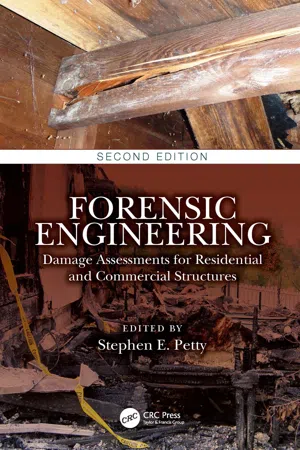
Table of contents

  1. Cover
  2. Half Title
  3. Title Page
  4. Copyright Page
  5. About the International Code Council
  6. Dedication
  7. Table of Contents
  8. Preface to the Second Edition
  9. Acknowledgments
  10. Editor
  11. Contributors
  12. Chapter 1 Introduction
  13. Chapter 2 Hail Fundamentals and General Hail-Strike Damage Assessment Methodology
  14. Chapter 3 Hail Damage Assessments for Residential and Light Commercial Exterior Finished Surfaces and Steep-Slope Roof Systems
  15. Chapter 4 Hail Damage Assessments to Low-Sloped Roof Systems
  16. Chapter 5 Synthetic Storm Damage (Fraud) to Roof Surfaces
  17. Chapter 6 Wind Damage Assessments for Residential and Light Commercial Roofing Systems and Finished Surfaces
  18. Chapter 7 Wind Damage Assessments for Low-Sloped Roof Systems
  19. Chapter 8 Water Infiltration – Cause and Origin Assessments Steep- and Low-Sloped Roof Systems
  20. Chapter 9 Water Infiltration – Cause and Origin Assessments Exterior Residential and Light Commercial Building Envelope
  21. Chapter 10 Water Infiltration into Basements
  22. Chapter 11 Indoor Environmental Quality
  23. Chapter 12 Attic and Crawlspace Ventilation
  24. Chapter 13 Mold and Bacteria
  25. Chapter 14 Forensic Inspection Assessments of Residential Wood Framing Systems
  26. Chapter 15 Forensic Inspection Assessments of Foundation Walls
  27. Chapter 16 Forensic Inspection Assessments of Brick Masonry Chimneys, Veneer Walls, and Porches/Decks
  28. Chapter 17 Fire Damage Structural Property Assessments
  29. Chapter 18 Vehicle Impact Structural Property Assessments
  30. Chapter 19 Tornado-Related Structural Property Damage Assessments
  31. Chapter 20 Blast and Explosion Damage Property Assessments
  32. Chapter 21 Lightning Damage Property Assessments
  33. Chapter 22 Plumbing/Piping/Tubing Failures
  34. Chapter 23 Equipment Failures and Investigations
  35. Chapter 24 Serving as an Expert Witness
  36. Index