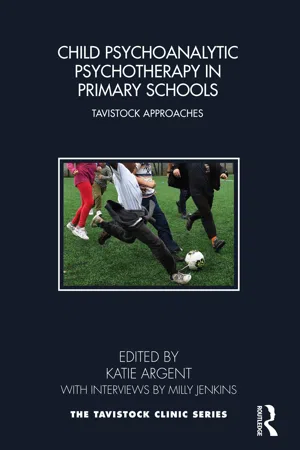
Child Psychoanalytic Psychotherapy in Primary Schools
eBook - ePub

Child Psychoanalytic Psychotherapy in Primary Schools

Tavistock Approaches

  1. 304 pages
  2. English
  3. ePUB (mobile friendly)
  4. Available on iOS & Android
eBook - ePub

Child Psychoanalytic Psychotherapy in Primary Schools

Tavistock Approaches

About this book

This book investigates the experiences of severely troubled children and their families, teachers, and child psychoanalytic psychotherapists working together in primary schools.

The book begins by looking at children's emotional life during the primary school years and what can disrupt ordinary, helpful social development and learning. It examines what child psychoanalytic psychotherapy is, how it works, and why it is offered in primary schools. The following chapters intersperse accounts of creative child psychoanalytic approaches with interviews with parents, carers, teachers, and clinicians. A section focusing on mainstream primary schools presents parent–child interventions for a nursery class; child group psychotherapy with children from traumatized families; and consultation to school staff, with personal accounts from parents, a kinship carer, a family support worker, a deputy head, and a child psychotherapist. Chapters then focus on alternative educational settings, featuring a school for children with severe physical and cognitive disabilities; a primary pupil referral unit; and a therapeutic school. These chapters show psychotherapy with a non-verbal boy with autism; therapy groups with children who have missed out on the building blocks of development alongside reflective groups for school staff; and child psychotherapy approaches at lunchtime and in breaks, with insights from a parent, a clinical lead nurse, a head teacher, and a child psychotherapist. Finally, there is an evaluation of evidence about the impact of child psychotherapy within primary schools.

Recognizing the increasing importance of attending to the emotional difficulties of children whose relationships and learning are in jeopardy, this book will be invaluable to all those working in primary schools, to commissioners of child mental health services, to parents and carers, and to experienced and training clinicians.

Frequently asked questions

Yes, you can cancel anytime from the Subscription tab in your account settings on the Perlego website. Your subscription will stay active until the end of your current billing period. Learn how to cancel your subscription.
At the moment all of our mobile-responsive ePub books are available to download via the app. Most of our PDFs are also available to download and we're working on making the final remaining ones downloadable now. Learn more here.
Perlego offers two plans: Essential and Complete
  • Essential is ideal for learners and professionals who enjoy exploring a wide range of subjects. Access the Essential Library with 800,000+ trusted titles and best-sellers across business, personal growth, and the humanities. Includes unlimited reading time and Standard Read Aloud voice.
  • Complete: Perfect for advanced learners and researchers needing full, unrestricted access. Unlock 1.4M+ books across hundreds of subjects, including academic and specialized titles. The Complete Plan also includes advanced features like Premium Read Aloud and Research Assistant.
Both plans are available with monthly, semester, or annual billing cycles.
We are an online textbook subscription service, where you can get access to an entire online library for less than the price of a single book per month. With over 1 million books across 1000+ topics, we’ve got you covered! Learn more here.
Look out for the read-aloud symbol on your next book to see if you can listen to it. The read-aloud tool reads text aloud for you, highlighting the text as it is being read. You can pause it, speed it up and slow it down. Learn more here.
Yes! You can use the Perlego app on both iOS or Android devices to read anytime, anywhere — even offline. Perfect for commutes or when you’re on the go.
Please note we cannot support devices running on iOS 13 and Android 7 or earlier. Learn more about using the app.
Yes, you can access Child Psychoanalytic Psychotherapy in Primary Schools by Katie Argent in PDF and/or ePUB format, as well as other popular books in Education & Education Counseling. We have over one million books available in our catalogue for you to explore.

Information

Publisher
Routledge
Year
2021
Print ISBN
9781032023182

Index

abandonment, and displacement, intergenerational family history of, 85
abuse:
experience of, 161, 229
intergenerational profound, parents’, 197
ACE, see Adverse Childhood Experience
ACE-aware schools, 214
ACP, see Association of Child Psychotherapists
acquired mental health disorders, 161
acting out, 175, 214, 221
class clown, 24, 26
children:
with ASD, 142
excluded, 163
and keeping sessions safe, 91–92, 98
mental health difficulties expressed via, 142–144
protecting self through, 97
in school, around holidays, 154
action plus status, 229–231
addiction, parental, 160
ADHD, see Attention Deficit Hyperactivity Disorder
Adverse Childhood Experience (ACE), 209
Ahlers, I., 227, 230
Aldgate, J., 111, 112, 114
Alvarez, A., 71, 153
Anna Freud Centre, 48, 55
Anscombe, E., 232
antisocial behaviour, 160
antisocial tendency, 160
anxiety, clinician’s, high levels of, 39
Argent, K., 1–10, 30–46, 55, 83
Armstrong, D., 25
art therapy, 2, 4, 218
ASD, see autism spectrum disorder
Ashley, C., 126
assessment sessions, 35, 36, 119, 231
Association of Child Psychotherapists (ACP), 40, 49
asylum claims, political, 161
attachment difficulties, 209, 214
attachment theory, 49
attention deficit hyperactivity disorder (ADHD), 70, 114, 161, 162, 209, 211
attention deficit-related disorders, 243
attention difficulties, 210
austerity measures, 22
autism assessment service, 187
autism diagnoses, 209
autism spectrum disorder (ASD), 131, 161, 162, 181, 18...

Table of contents

  1. Cover
  2. Half Title
  3. Series
  4. Title
  5. Copyright
  6. Dedication
  7. Contents
  8. Series editors’ preface
  9. Acknowledgements
  10. About the editor and contributors
  11. Introduction
  12. I Why have child psychoanalytic psychotherapy in primary schools?
  13. II Child psychoanalytic psychotherapy in mainstream primary school
  14. III Child psychoanalytic psychotherapy in alternative educational settings
  15. IV Evidence from experience and audit
  16. References
  17. Index