Circular Economy (CE) is considered as one of the important strategies in addressing Sustainable Development Goals. Practicing Circular Economy provides an overview of CE, covering its evolution, describing the key concepts, programs, policies, and regulations. It illustrates several business opportunities over a hundred hand-picked case studies that encompass numerous sectors, various scales of operations and geographies. Another unique feature of the book is the activities listed in each chapter to invoke thoughts, frame assignments, and generate discussions. Each chapter lists key additional reading materials and takeaways.
Aimed at mid- and senior-level managers, policy makers, investors, entrepreneurs, consultants, researchers, professors, and academic students involved in the subject of environmental management and sustainability, this book:
Introduces the evolution of CE to clarify the key concepts and introduce some of the important global programs and initiatives CE economy with case studies
Gives a global overview of adoption of CE covering countries such as India, Japan, Korea, China, EU, North America, Australia, and several more
Includes information on methodologies followed, tools, and knowledge resources for practicing CE
Provides insight to the business models with numerous case studies covering product design, manufacturing, and services and the role of innovation and financing
Presents a comprehensive overview of opportunities in CE in sectors such as textile, steel, agriculture, and food
Covers newly emerging paradigms of CE such as regional circular economy, circular supply chains, and sustainable procurement and impact of the COVID-19 pandemic on CE
Practicing Circular Economy is thus an important resource for every circular economy practitioner and especially to those who aspire to make a career in circular economy.
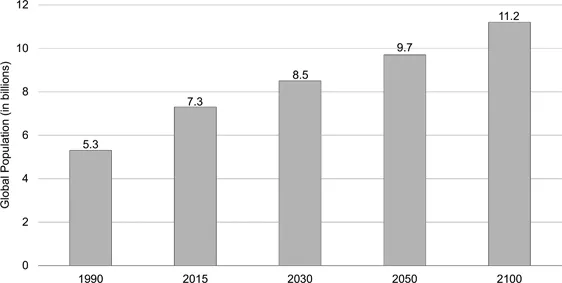
Resource consumption and waste generation have become critical concerns questioning the sustainability of the planet. Population growth has been one of the major drivers. It is estimated that the world population would more than double by 2100 compared to 19901. Do we have sufficient resources to meet this challenge? Figure 1.1 and Box 1.1 highlight some important statistics about global population growth.
FIGURE 1.1Global population until 21001.
Box 1.1Global Population Trends1
The world population is projected to reach 8.5 billion in 2030 and increase further to 9.7 billion in 2050 and 11.2 billion by 2100.
More than half of the global population growth between 2020 and 2050 is expected to occur in Africa.
Around 2027, India is projected to overtake China as the world's most populous country, while China's population is projected to decrease by 31.4 million between 2019 and 2050.
Population growth has significantly contributed to urbanization. The urban population of the world has grown rapidly from 751 million in 1950 to 4.2 billion in 2018. Studies conducted by the United Nations show that 68% of the world population is projected to live in urban areas by 2050.1 At present, 22 of the world's 33 megacities, each having 10 million or more people, are in Asia and Africa. It is predicted that by 2030, there will be 10 more megacities and 9 of them will be on these two continents2.
While cities act as economic hubs, they are plagued by issues such as overcrowding, traffic congestion, waste generation, quality of energy supply, air pollution, and income inequality. With rapid rise in urbanization, there will be a strain on the existing housing and transportation infrastructure, and essential services such as health and education. It is estimated that cities consume more than two-thirds of the world's energy and account for more than 70% of global CO2 emissions. With the majority of the world's urban areas situated on coastlines, cities are at high risk from some of the devastating impacts of climate change such as rising sea levels and powerful coastal storms3.
When cities expand, there is a threat to agricultural land, ecosystem services, and biodiversity, thereby affecting food production and climate resilience. This could also result in spatial inequalities and put a strain on economies. It is estimated that urban land area could increase by 80% globally between 2018 and 2030, assuming a Compound Annual Growth Rate (CAGR)4. This is alarming.
Apart from rise in population and urban area expansion, the “in-migration” of people from rural to urban areas causes rapid urbanization. In several Asia Pacific countries, in-migration from rural areas to cities has occurred due to natural resource depletion, calamities, civil conflicts, poverty, and other pressures on rural areas5. Economies in rural and urban contexts need to be supportive or collaborative to reduce the in-migration to cities.
1.2Rising Consumption and Impact of Trade Flows
Activity 1.1Identification of Regions With High Urbanization
The International Institute for Environment and Development has created an interactive data portal covering all cities with 500,000-plus inhabitants. It shows the urban population's growth and the rise in cities’ formation between the years 1800 and 2030.
Visit: https://www.iied.org/cities-interactive-data-visual to access the portal.
Instructions to use the portal6:
To access the data, click on the dateline button at the top and slide the scale to the right and advance through the years. This will enable you to see how and where cities of 500,000+ inhabitants have grown since 1800, plus predictions for future growth up to 2030. A summary of the wider global changes taking place can be found at the top.
By hovering the cursor over individual cities, precise data regarding those cities could be obtained. Alternatively, click on the “grid” view toward the visual's top right to see a chart of the individual cities and where they rank in terms of population.
How the populations have changed over time, and the predictions until 2030, can be seen by sliding the scale to the right.
Use the portal described above to identify the main regions that show rapid urbanization. Identify the decade in which there was a significant increase in urbanization. Also, identify the regions where a decrease in urbanization can be noticed. Can you think of the socioeconomic reasons leading to such a decline?
With the rise in the consumers’ affordibility, the demand for many goods and services is increasing rapidly. Rising consumer demand and infrastructure investments in prospect will fuel the world economy's growth. However, in this process, there will be a mounting strain on global natural and capital resources. The overall rise in the per capita income is leading to increased consumption and generation of wastes and residues. The middle class in the urban population is contributing significantly to resource consumption and waste generation.
Notwithstanding the recent economic disruptions due to the COVID-19 pandemic, reports have forecasted growth in every sector. According to a European Commission report, income growth in emerging economies has led to an increase in the consumption of higher-value products such as meats and dairy products7. The global sales of smartphones in 2020 were predicted to increase 3% year on year8, while the global white goods market (home and kitchen appliances) is projected to record a substantial CAGR of 7.9% in the forecast period of 2019–20269. This increase in demand has contributed in the global logistics sector's growth, which is predicted to grow at 3.48% CAGR to reach USD 12.26 trillion by 202210.
Global trade plays an essential role in the movement of materials that consist of resources (e.g., coal), products (e.g., automobiles), and wastes and residues. Over the years, the material flows across the globe are increasing and getting skewed. Advancements in communications, logistics and supply chain technologies, improved geopolitical relations, and more trade openness have been responsible factors.
For instance, agricultural produce is traded from regions where it is available in abundance or surpassing the national production needs. Sometimes the resources are obtainable at a lower price through inter-state trade, even when transportation costs are added. In some cases, trade is inevitable as the materials are not available locally. Often the products made in some developed countries travel back to the very countries that provide the raw resources but do not have local manufacturing facilities. Wastes are also transported and sold as secondary materials. Before the imposition of the “green fence” in China, nearly 45% of the world's wastes were traded to China11.
There has been a shift in the products that are getting traded. The international trade of “exotic” products under the fresh vegetables, fruits, and flowers categories has significantly increased during the past decade, in addition to the boom in the exports of by-products like biofuel made from crops. Such activities have led to a series of ecological issues in dry and semiarid regions. In such regions, high-water-consuming crops (such as Jatropha) compete for water and land with local communities, deplete and degrade local ecosystems, worsen local and national food sovereignty, and alter existing production modes and income distribution. Consider the following instances12:
The export of fruits and vegetables from Peru's dry desert coast increased tenfold from 2001 to 2015.
During the same period, Ecuador tripled its flower export from the fragile drought-prone Andean hill slopes North of Quito and is now the third flower-exporting cou...
Table of contents
Cover
Half Title
Title Page
Copyright Page
Contents
List of Figures
List of Tables
List of Boxes
List of Activities
Preface
Acknowledgement
Author Biography
List of Abbreviations
1. Challenges We Face Today
2. Key Concepts, Strategies, and Programs
3. Circular Economy Toolbox
4. 12 Rs of Circular Economy
5. Making Longer Lasting Products
6. Closing the Loop
7. Circular Economy in Select Sectors
8. Business Models in a Circular Economy
9. Innovation and Financing in Circular Economy
10. Governance in CE
11. More Insights and Way Forward
Index
Trusted by 375,005 students
Access to over 1.5 million titles for a fair monthly price.
Study more efficiently using our study tools.
Frequently asked questions
Yes, you can cancel anytime from the Subscription tab in your account settings on the Perlego website. Your subscription will stay active until the end of your current billing period. Learn how to cancel your subscription
No, books cannot be downloaded as external files, such as PDFs, for use outside of Perlego. However, you can download books within the Perlego app for offline reading on mobile or tablet. Learn how to download books offline
Perlego offers two plans: Essential and Complete
Essential is ideal for learners and professionals who enjoy exploring a wide range of subjects. Access the Essential Library with 800,000+ trusted titles and best-sellers across business, personal growth, and the humanities. Includes unlimited reading time and Standard Read Aloud voice.
Complete: Perfect for advanced learners and researchers needing full, unrestricted access. Unlock 1.5M+ books across hundreds of subjects, including academic and specialized titles. The Complete Plan also includes advanced features like Premium Read Aloud and Research Assistant.
Both plans are available with monthly, semester, or annual billing cycles.
We are an online textbook subscription service, where you can get access to an entire online library for less than the price of a single book per month. With over 1.5 million books across 990+ topics, we’ve got you covered! Learn about our mission
Look out for the read-aloud symbol on your next book to see if you can listen to it. The read-aloud tool reads text aloud for you, highlighting the text as it is being read. You can pause it, speed it up and slow it down. Learn more about Read Aloud
Yes! You can use the Perlego app on both iOS and Android devices to read anytime, anywhere — even offline. Perfect for commutes or when you’re on the go. Please note we cannot support devices running on iOS 13 and Android 7 or earlier. Learn more about using the app
Yes, you can access Practicing Circular Economy by Prasad Modak in PDF and/or ePUB format, as well as other popular books in Business & Management. We have over 1.5 million books available in our catalogue for you to explore.