Habits of Success: Getting Every Student Learning
eBook - ePub

Habits of Success: Getting Every Student Learning

  1. 160 pages
  2. English
  3. ePUB (mobile friendly)
  4. Available on iOS & Android
eBook - ePub

Habits of Success: Getting Every Student Learning

About this book

For students to benefit from lessons, they must attend, listen and try their best. But at times, almost all teachers struggle to manage classroom behaviour and to motivate students to learn. Drawing on decades of research on behavioural science, this book offers teachers practical strategies to get students learning. The key is students' habits. This book reveals simple yet powerful ways to help students build habits of success.

Harry Fletcher-Wood shows how teachers can use behavioural science techniques to increase motivation and improve behaviour. He offers clear guidance on topics such as using role models to motivate students, making detailed plans to help students act and building habits to ensure students keep going. The book addresses five challenges teachers face in encouraging desirable behaviour:

  • Choosing what change to prioritise
  • Convincing students to change
  • Encouraging students to commit to a plan
  • Making starting easy
  • Ensuring students keep going

Workshops, checklists and real-life examples illustrate how these ideas work in the classroom and make the book a resource to revisit and share. Distilling the evidence into clear principles, this innovative book is a valuable resource for new and experienced teachers alike.
Frequently asked questions

Yes, you can cancel anytime from the Subscription tab in your account settings on the Perlego website. Your subscription will stay active until the end of your current billing period. Learn how to cancel your subscription.
No, books cannot be downloaded as external files, such as PDFs, for use outside of Perlego. However, you can download books within the Perlego app for offline reading on mobile or tablet. Learn more here.
Perlego offers two plans: Essential and Complete
  • Essential is ideal for learners and professionals who enjoy exploring a wide range of subjects. Access the Essential Library with 800,000+ trusted titles and best-sellers across business, personal growth, and the humanities. Includes unlimited reading time and Standard Read Aloud voice.
  • Complete: Perfect for advanced learners and researchers needing full, unrestricted access. Unlock 1.4M+ books across hundreds of subjects, including academic and specialized titles. The Complete Plan also includes advanced features like Premium Read Aloud and Research Assistant.
Both plans are available with monthly, semester, or annual billing cycles.
We are an online textbook subscription service, where you can get access to an entire online library for less than the price of a single book per month. With over 1 million books across 1000+ topics, we’ve got you covered! Learn more here.
Look out for the read-aloud symbol on your next book to see if you can listen to it. The read-aloud tool reads text aloud for you, highlighting the text as it is being read. You can pause it, speed it up and slow it down. Learn more here.
Yes! You can use the Perlego app on both iOS or Android devices to read anytime, anywhere — even offline. Perfect for commutes or when you’re on the go.
Please note we cannot support devices running on iOS 13 and Android 7 or earlier. Learn more about using the app.
Yes, you can access Habits of Success: Getting Every Student Learning by Harry Fletcher-Wood in PDF and/or ePUB format, as well as other popular books in Education & Classroom Management. We have over one million books available in our catalogue for you to explore.

Information

Publisher
Routledge
Year
2021
Print ISBN
9780367444945
eBook ISBN
9781000411829
Edition
1

1 What should we ask students to change?

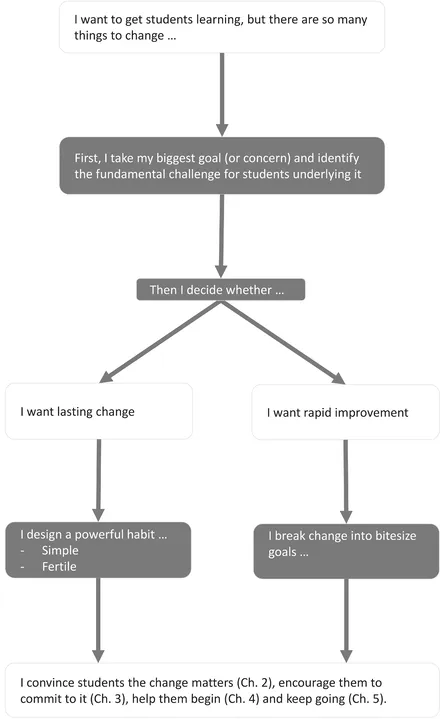
Specify the change: pick a priority, then choose a powerful habit or small step to achieve it
Inspire and motivate students to value the change
PLan change: ask students to commit to action
Initiate action: make starting easy
Follow up: help students keep going

Chapter map: what should we ask students to change?

The problem
All our students could be doing something better. For example:
  • Ellie Russell describes Joe, in her Year 11 Science class, as “bright, but often lazy.” He “regularly distracts peers and disrupts lessons. He wants attention from peers or me all the time: he’s equally happy to get negative or positive attention, as long as it is attention.”
  • Adele Finch has four pupils who are “reluctant to break words into chunks and sounds to help them spell. When I remind and support them to use a phonics mat and to segment words their spellings are accurate. Without support and reminders their spelling for ‘children’ looks like ‘chren.’”
  • Richard is worried about “whole-school apathy. . . We have cracked the serious disruption in school in general, but we are really struggling with our students’ attitude to learning. We want to build a culture where doing your best is the norm.”
How to get each student learning – what to change – may be less obvious than it seems however. For example, Ellie needs Joe to work harder, demand less attention and be less distracting: where should she start and what, exactly, should she ask him to do? We may want to change everything, but this would devour our time and dissipate our energy: what should we prioritise?
The principle: specify the change
To get students learning, we must first specify what we want them to do. This means prioritising the most fundamental challenge, then choosing a powerful habit or a bite-size step which addresses it.
Specifying the change should make it easier to convince students to act (Chapter 2), to plan action (Chapter 3), to begin (Chapter 4) and to keep going (Chapter 5).

1.1 If there are many things to change

There may be many things we would like students to do differently. Trying to change them all at once would be exhausting however, and likely unsuccessful: we must prioritise. For example, we may want Sofia to focus better, contribute more and structure answers more clearly – but we can neither expect nor support her to do all three at once. Instead, we need to begin with the most fundamental step: the change which makes other changes possible. This is easier with a sequence of steps in mind. For example, if students are to learn, they must:
  1. Focus on learning and avoid distractions
  2. Approach tasks using appropriate techniques
  3. Persevere, with increasing independence
  4. Contribute, speaking in discussions and helping one another, for example.
Separating these challenges may seem artificial: we can help students focus by reminding them about the technique; we can encourage them to persevere and to contribute in the same breath. However, a student can overcome each challenge only if they have mastered the preceding ones: if Sofia knows how to structure her answer, but isn’t focusing, she will achieve nothing; if she perseveres, but doesn’t know what structure to use, she will learn little; if she hasn’t tried, she can contribute little. If we want to make several changes, we must begin with the most fundamental.37
We can get students learning by prioritising the most fundamental challenge they face: success makes further improvements possible
The strategies described in this book can be used to help students do anything, including completing their homework, applying to university, avoiding conflict with peers, and getting a good night’s sleep. Whatever the goal, we are most likely to succeed if we take our biggest concern and identify the fundamental challenge underlying it. First, we pick an issue: Jack keeps calling out; students aren’t finishing their work. Then, we identify the underlying challenge: Jack isn’t focused; students are using inappropriate techniques. We could use the sequence suggested in the previous paragraph, but the crucial point is not the sequence itself, but the idea of sequencing – of ensuring we prioritise the first step towards improvement, not just the most obvious issue. This may be subject-specific: do students grasp the play’s outline well enough to analyse it? It may be physical: does students’ posture support them to form their letters properly? It may be social: are students listening before they comment? We may feel unsure whether the challenge we have chosen is the right one. If so, we could ask colleagues, or just try addressing it: if students attempt to change, but struggle to improve, we may need to pick something more fundamental. Whatever we want to change, we must take what concerns us and identify the fundamental challenge: the first step towards improvement.
We can prioritise by taking a concern and identifying the first step towards improvement
Applications
  • Joe isn’t working hard enough and is distracting peers. He knows what to do and needs no encouragement to contribute; the challenge is getting him to focus.
  • Adele wants her pupils to break words down. The problem isn’t focus – the children aren’t distracted or demotivated – it’s ensuring they apply the appropriate technique.
  • Richard wants to build a culture where “doing your best is the norm.” His students are willing to focus and know what techniques to use; he needs them to persevere.
By targeting the fundamental challenge, Ellie, Adele and Richard can go beyond immediate frustrations, like disruption or lack of effort, to lay foundations for success: getting students focused on learning, not just sitting quietly; encouraging perseverance, not just occasional effort. Success makes further improvement possible: once Joe focuses, Ellie can help him select effective techniques; once Richard’s students persevere, their contributions will be more valuable.
Key idea
Usually we know roughly what needs to change. But we struggle to narrow our focus to a priority (and to let other important things go in order to achieve it). Change is hard and, as we'll see in the next section, students form habits slowly. We cannot change everything: we must prioritise. We can do so by asking ourselves:
  1. What do I most want for students? What is concerning me most?
  2. What is the fundamental challenge? What is the first step towards improvement?
We must address the fundamental challenge before tackling other issues.
Having prioritised a challenge, we can overcome it by helping students form a powerful habit, or take a small step.

1.2 If we want students to make a lasting change

Students often make isolated improvements: they have a better lesson, or a better week. But isolated improvements don’t bring about consistent success. To do their homework – once – a student must want to do it, plan to do it, and stick to their plan. This kind of self-control is hard:38 they may succeed sometimes, but their motivation can slip, and their plans can go awry. Imagine, instead, that they start doing their homework on Saturday morning. If someone repeats an action in the same situation for long enough, they form a habit: the situation (in this case, Saturday morning) comes to prompt the action (doing homework).39 As we discussed in the Introduction, a habit is an automatic response to a situation. Having formed a habit, motivation, confidence and planning stop being barriers:40 Saturday morning prompts them to do their homework, however they feel. This makes habit the key to lasting change. Instead of isolated improvements (requiring fresh motivation, ongoing self-control, and substantial support from us), we need students to form habits of success: to focus whenever they have a task, pick the appropriate technique whenever they see a question, and contribute whenever they have the opportunity.
Habits are lasting solutions to fundamental challenges
Forming new habits is slow and difficult. Existing habits may be a barrier. I mentioned that habits form when people repeat actions in specific situations. Students face some situations frequently – being aske...

Table of contents

  1. Cover
  2. Half Title
  3. Title Page
  4. Copyright Page
  5. Dedication
  6. Contents
  7. Acknowledgements
  8. Introduction: how can we get every student learning?
  9. 1 What should we ask students to change?
  10. 2 How can we convince students to learn?
  11. 3 How can we help students to commit to action?
  12. 4 How can we encourage students to start?
  13. 5 How can we help students to keep going?
  14. 6 How can we help students to stop?
  15. 7 How can we encourage teachers to change?
  16. Conclusion
  17. Resources
  18. Notes
  19. References
  20. Index