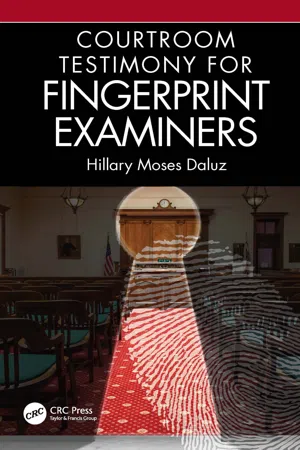
Fingerprint examiners today are expected to develop, research and defend the scientific basis of their conclusions. Recent emphasis placed on scientific rigor and transparency through documentation has created a culture shift in the field. Many examiners are baffled by the resulting cultural, procedural and scientific distinctions, often becoming overwhelmed when required to testify as an expert witness to explain such concepts in the courtroom.
Courtroom Testimony for Fingerprint Examiners addresses all aspects of courtroom testimony as the first book to focus solely on testifying on fingerprint evidence as a comparative science. The book is presented in two parts. Section I addresses general expert witnessing for forensic scientists. This serves as a primer for the novice or a review for experienced witnesses covering such topics as the structure of the criminal justice system and federal rules of evidence, the role of the expert witness, testimony as teaching, presenting challenging scientific concepts to the layperson, court preparation, the three phases of expert witness testimony and landmark court decisions that have shaped the modern landscape of forensic testimony.
Section II focuses on specific issues affecting fingerprint examiners and how to field questions during both direct and cross-examination. While such "hot button" topics are absent from currently available texts, this section pays particular attention to these salient, emerging topics. This includes evidentiary challenges to fingerprint evidence, relevant publications such as the PCAST report, nomenclature and standards development, issues surrounding cognitive bias and subjectivity, probability models, error rates and cases of error and how to address issues of minimum point standards in both the empirical and holistic traditions. Both Section I and Section II provide examples and present innovations applicable to latent and tenprint examiners.
Features include:
Presents a history of fingerprint evidence and current best practices and limits on characterizing fingerprint evidence in court, including appropriate nomenclature
Provides current guidelines and recommendations for standards and the courtroom
Illustrates how experts can work with attorneys so that the testimony process educates and informs jurors and judges rather than perpetuating an adversarial dynamic
Addresses important issues such as cognitive bias, subjectivity, error rates, probability models and ethics
As a forensic training instructor for professionals – and previously as a college professor – author Hillary Moses Daluz has spent the past ten years teaching courtroom testimony courses to forensic scientists. Courtroom Testimony for Fingerprint Examiners offers an invaluable resource to forensic scientists, latent print examiners, tenprint examiners, lab personnel in related comparative fields, attorneys, investigative professionals and students enrolled in forensic science university programs.
8 Evidentiary Challenges to Friction Ridge Evidence
8.1 United States v. Mitchell
There have been many evidentiary challenges to friction ridge analysis since the Court established, in the Joiner decision, that admissibility, relevance and reliability would be determined by the judge acting as the gatekeeper to prevent “bad science” from influencing a court proceeding.1 This chapter addresses some, but certainly not all, of those challenges in the United States. A vast majority of the challenges to the admissibility of friction ridge examinations have been unsuccessful. A general lack of success with evidentiary challenges to friction ridge evidence does not, however, suggest that they will eventually cease and the discipline will be granted unfettered access to the courtroom. Fingerprint examiners must be prepared to testify in an evidentiary hearing at any time in their careers.
The first significant Daubert challenge to latent prints was the case of United States v Byron Mitchell in 1999.2 In 1998, Mitchell was on trial for his participation in an armored truck robbery in which he was identified as the driver of the getaway vehicle.2 Two latent prints were subsequently developed on the vehicle and searched in the FBI’s automated fingerprint identification system (iAFIS): one latent print on the exterior door handle and one on the gear shift.2 FBI fingerprint examiners made a source identification to Byron Mitchell.2 The defense team made a motion to exclude the fingerprint evidence on the basis that friction ridge examination was unreliable and did not adhere to the Daubert standard. What resulted was a five-day Daubert hearing in 1999 during which time Judge J. Curtis Joyner heard testimony from eight proponents testifying to the reliability of friction ridge examination and three opponents to the science of friction ridge examination (Figure 8.1).2
The government’s experts included David Ashbaugh (Royal Canadian Mounted Police), Edward German (United States Army Criminal Investigations Laboratory), Pat Wertheim (professional instructor in the field of friction ridge analysis), Stephen Meagher (FBI), David Grieves (Illinois State Crime Laboratory), Donald Ziesig (Lockheed Martin), Bruce Budowle (FBI) and Dr. William Babler (Marquette University).2 Cumulatively, these experts testified to all aspects of foundational knowledge in the field of friction ridge examination. They addressed the three levels of detail in any given fingerprint: patterns, minutiae, pores and edge shapes. They detailed the embryological development of friction skin and its physiology, thereby asserting the “uniqueness and persistence” of friction ridge skin. They testified to the genetic basis of cellular generation and proliferation, volar pad formation and recession and friction ridge proliferation. ACE-V was also discussed in detail as a scientific methodology, including how the human brain observes and interprets patterns, issues arising from distortion, how the substrate and matrix affect the appearance of a latent print, the context in which the latent print is found and the “one dissimilarity doctrine”. The one dissimilarity doctrine stated that if one dissimilarity was observed between the questioned impression and the exemplar impression, the comparison would result in an exclusion.
The defense experts included Professor James Starrs (George Washington University School of Law), Dr. Simon Cole (University of California, Irvine) and Dr. David Stoney (McCrone Research Institute). These expert witnesses argued that there is a lack of scientific foundation for the examiner to form an opinion about a source identification. Scientists formulate hypotheses, then set out to disprove those hypotheses. Fingerprint examiners, the defense experts assert, do not set out to disprove a hypothesis. Instead, they set out to prove an association between a latent print and a suspect’s exemplar print. Another argument was the subjectivity of fingerprint examiners’ conclusions. Defense experts stated a lack of an empirical basis for “individualizations” as well as a lack of a statistical model for expressing the strength of conclusions. The specific Daubert standards (as described in Chapter 7) were considered by both the defense experts and the prosecution experts.3
8.1.1 General Acceptance
There was little discussion about whether or not friction ridge examination is generally accepted in the scientific community. Defense experts did not dispute this issue. While there was no issue with the “general acceptance” guideline in 1998, this issue has raised concerns in recent years. General acceptance does not ensure scientific rigor, and forensic sciences that were grandfathered under Frye are not always guaranteed acceptance under Daubert.
8.1.2 Rigorous Testing
Beyond the sheer volume of peer reviewed scientific journal articles supporting the testability of friction ridge evidence, proponents testifying as expert witnesses in this hearing also submitted several specific studies to support the reliability of the science. They relied on twin studies as well as research conducted by FBI examiners known as the “50k vs. 50k Fingerprint Comparison Test”.2 Judge Joyner was heavily influenced by these studies when making his determination of reliability.
Monozygotic (identical) twins have nearly identical DNA and therefore display little phenotypic variability. As there is a genetic basis for fingerprint volar pad inheritance, one would expect identical twins to have similar pattern types and ridge counts. However, identical twins do not have minutiae that correspond in type and location and thus do not have identical fingerprints. German testified to the non-correspondence between twins’ fingerprints, which has been more recently published by Jain et al.2,4 Expanding on the notion that even those with nearly identical DNA do not have identical fingerprints, the Court was shown an image of primate fingerprints from two monkeys.2 One of the monkeys was the genetic clone of the other. Even the cloned monkeys were found to have demonstrably different finger and palm impressions (Figure 8.2).2
Figure 8.2 Known palm print impressions of two monkeys cloned via embryo nuclear transfer were used as visual aids during the Mitchell Daubert hearing to illustrate that friction ridge skin is highly variable, even in genetic clones.
The “50k vs. 50k Fingerprint Comparison Test” was conducted by the FBI specifically for this Daubert hearing.2 In the study, two tests were performed in iAFIS. In the first test, 50,000 individual fingerprints (left slanted loops) were searched against a database of 50,000 tenprint cards (consisting of white males) in the FBI’s iAFIS system.2 The concept of the test was to search a large number of prints to demonstrate that even in such a large search there were no two prints that “matched”. The second test was analogous to latent print searches with a minimal number of minutiae. In this case, four minutiae were selected.2 Again, no “matches” were found in the database.
Statistical data arising from those searches concluded that there is 1/1027 chance of finding a matching print in that data set.2 The current population of the entire world is around ~8 × 10⁹, or 8 billion people. (It is important to note here that the statistics generated were not calculated according to a probability model specifically accepted and validated by the forensics community.) This test led the Court to assert that “the hypotheses that undergird the discipline of fingerprint identification are testable, if only to a lesser extent actually tested by experience.”2 Defense experts, however, criticized the study, noting that it neither addresses the human process of friction ridge comparisons nor the resulting accuracy of the examiner’s subjective conclusions.
8.1.3 Peer Review
When faced with the question of whether or not their work is peer reviewed, as befits proper scientific endeavors, the fingerprint experts referred to the verification stage of ACE-V. As ACE-V is an approximation of the scientific method, verification, they argued, is therefore an approximation of scientific peer review in the friction ridge examination process. Dr. Cole took issue with this concept, emphasizing that the friction ridge examination culture does not allow for true and unbiased peer review. He focused on the issue of an “occupational norm of unanimity,” asserting that fingerprint examiners have managed errors quietly, as a community, and have not been subject to the scientific norms of criticism that would normally expose unreliable “junk science”.2 It begs the question to what degree is conflict resolution subject to bias, a topic that is discussed at length in Chapter 11.
8.1.4 Error Rates
While prosecution experts argued that false-positive (erroneous identification) error rates were low, there were no large-scale error rate studies at the time to provide guidance as to how low they might be. Despite the lack of error rate data, the judge accepted that the error rate was low enough to be acceptable. Dr. Cole took exception to that idea, stating:
The characterization of the error rate of latent fingerprint identification as either zero or meaningless, strikes me as not particularly scientific. The attempt to draw distinction between a scientific error rate and a practitioner error rate really does not make any sense. To me it’s somewhat akin to saying automobiles have an extremely low scientific crash...
Table of contents
Cover
Half Title
Title Page
Copyright Page
Dedication
Table of Contents
List of Figures
Preface
Acknowledgments
Author
Section I: Courtroom Testimony
Section II: Hot Topics for Fingerprint Examiners
Index
Trusted by 375,005 students
Access to over 1.5 million titles for a fair monthly price.
Study more efficiently using our study tools.
Frequently asked questions
Yes, you can cancel anytime from the Subscription tab in your account settings on the Perlego website. Your subscription will stay active until the end of your current billing period. Learn how to cancel your subscription
No, books cannot be downloaded as external files, such as PDFs, for use outside of Perlego. However, you can download books within the Perlego app for offline reading on mobile or tablet. Learn how to download books offline
We are an online textbook subscription service, where you can get access to an entire online library for less than the price of a single book per month. With over 1.5 million books across 990+ topics, we’ve got you covered! Learn about our mission
Look out for the read-aloud symbol on your next book to see if you can listen to it. The read-aloud tool reads text aloud for you, highlighting the text as it is being read. You can pause it, speed it up and slow it down. Learn more about Read Aloud
Yes! You can use the Perlego app on both iOS and Android devices to read anytime, anywhere — even offline. Perfect for commutes or when you’re on the go. Please note we cannot support devices running on iOS 13 and Android 7 or earlier. Learn more about using the app
Yes, you can access Courtroom Testimony for Fingerprint Examiners by Hillary Moses Daluz in PDF and/or ePUB format, as well as other popular books in Law & Criminal Law. We have over 1.5 million books available in our catalogue for you to explore.