Most adults take at least one prescription medication for example, for high blood pressure, high cholesterol levels, depression, asthma, diabetes, COPD, or a variety of other reasons, but most people (and many healthcare providers) are totally unaware that medications can have direct negative effects on sexual functioning and performance. This informative and timely book written by three well-known medications experts explores the chemistry behind sexual arousal in men and women and clearly and authoritatively explains how the common categories of prescription and over-the-counter medications and abused substances might be the reason for their declining sexual performance or even interest.
eBook - ePub
How Prescription and Over-the-Counter Drugs Affect Sexual Performance
- 130 pages
- English
- ePUB (mobile friendly)
- Available on iOS & Android
eBook - ePub
How Prescription and Over-the-Counter Drugs Affect Sexual Performance
About this book
Information
1 Anatomy, Physiology, Arousal, Orgasm, and Hormones
1.1 Introduction: Background and Context
Human sexuality has inspired writers, musicians, painters, sculptors, poets, and other artists over the centuries (Fig. 1.1), but a complete understanding of the scientific basis of its functioning—and dysfunctioning—continues to elude scientists. While human sexuality remains a fundamental cornerstone of a happy, healthy life, what drives sexual response and contributes to sexual satisfaction has not been thoroughly elucidated. In part, this is because human sexuality involves the complex interplay of cerebral impulses, emotional responses, psychological attitudes, societal and religious mores, and physical behaviors; in part, it is because human sexuality is hard to quantify and until recently was rarely discussed as a legitimate scientific topic. The more we learn about the brain and its chemicals, the more we find that they drive sexual response, as do hormones and neurons and previous learned responses. Practically anything can affect human sexuality, including age, health, culture, and prior experiences. Things like stress and despair can defeat our sexual impulses, while the mysterious process of falling in love can rapidly sharpen sexual desires. Among the many things that can affect sexual function are drugs, and to better understand how drugs can change our sexual responses, it is necessary to have a thorough overview of what goes on in human sexuality.

Figure 1.1 Human sexuality expressed in works of art.
1.2 Anatomy and Physiology
The penis and the clitoris both contain a dense network of highly sensitive nerves and are very susceptible to sexual stimulation. The penis (Fig. 1.2) is filled with spongy tissue that becomes engorged with blood when sexually aroused, resulting in an erection (Fig. 1.3). This is possible because the skin of the penis is loose enough to accommodate what may be a substantial change in size and shape (Fig. 1.4). During an erection, the urethra (which normally carries urine) is blocked so that only semen can be expelled during orgasm. Sperm is produced in the two testicles (testes) contained in the saclike structure of the scrotum (Fig. 1.5). It is made in the seminiferous tubules within the testicles (Fig. 1.6) and then travels to the epididymis, where it is stored awaiting sexual arousal; this creates contractions that move the sperm from the epididymis into the vas deferens and then to the urethra, from which it is ejaculated (Fig. 1.7). Seminal vesicles are little pouches near the vas deferens at the base of the bladder that produce a fluid that gives the sperm motility. Most of the ejaculate material is actually seminal fluid. The fluid travels through the urethra, which takes it through the center of the prostate gland. The prostate gland is just below the bladder and produces fluid to aid in ejaculation. Most commonly, orgasm occurs with ejaculation.

Figure 1.2 Anatomical location of the penis.

Figure 1.3 Anatomy of penile erection.

Figure 1.4 Blood supply during penile erection.

Figure 1.5 The scrotum.

Figure 1.6 Gross anatomy of sperm production.

Figure 1.7 Sperm and testicle.
The vulva is an external sexual organ (Fig. 1.8). The labia majora and labia minora cover the vagina, which is located below the urethral opening (Fig. 1.9). At the top of the vulva, where the labia minora converge, there is a small spongy organ called the clitoris that is densely innervated and highly responsive to stimulation. It is made of spongy tissue that engorges with blood and becomes erect during sexual arousal. Although often compared to the penis because of its spongy tissue and sexual responsiveness, the clitoris holds the unique distinction of being the only human organ exclusively for the purpose of sexual pleasure. The vagina is a passageway that connects the external sexual organs to the uterus or womb (Fig. 1.10). The entrance to the uterus is called the cervix. The vagina may be thought of as folds of winkled skin about two to four inches long. When the woman is aroused, the vagina becomes engorged with blood and may extend to double its length or more as it expands to accommodate a penis.

Figure 1.8 The vulva.

Figure 1.9 Anatomical relationship of female sexual organs.

Figure 1.10 Gross anatomy of female reproductive organs.
The cervix or neck of the uterus is normally open; it is the passage through which menstrual blood sloughed off from the uterus passes on its way through the vagina and out of the body. When a person is pregnant, the cervix tightens to protect the uterus, but it expands, or dilates, when childbirth is imminent. During most deliverie, the cervix stretches to maximal capacity to permit the baby to exit the womb and enter the birth canal (Fig. 1.11). The uterus is a pear-shaped organ about the size of afist that stretches many times its original size to accommodate a baby during pregnancy (Fig. 1.12). When sexually aroused, the lower end of the uterus tilts toward the abdomen, providing extra space in the vagina for intercourse, in a process known as “tenting.”

Figure 1.11 The birth canal.

Figure 1.12 Cross section of the uterus.
Eggs are produced in ovaries (Fig. 1.13), two organs that also produce the hormones estrogen (estradiol), progesterone, and testosterone (Fig. 1.14). Eggs that are ready for fertilization are moved by fibers called fimbriae from the ovaries into the fallopian tubes (Fig. 1.15). It is in the fallopian tubes where sperm meets egg when conception occurs. Usually there are two ovaries, but it is typical that only one ovary produces an egg in each monthly cycle. The egg is discarded with menstrual blood if conception does not occur (Fig. 1.16).

Figure 1.13 Egg production in ovaries.

Figure 1.14 Chemical structures of estradiol, progesterone, and testosterone.
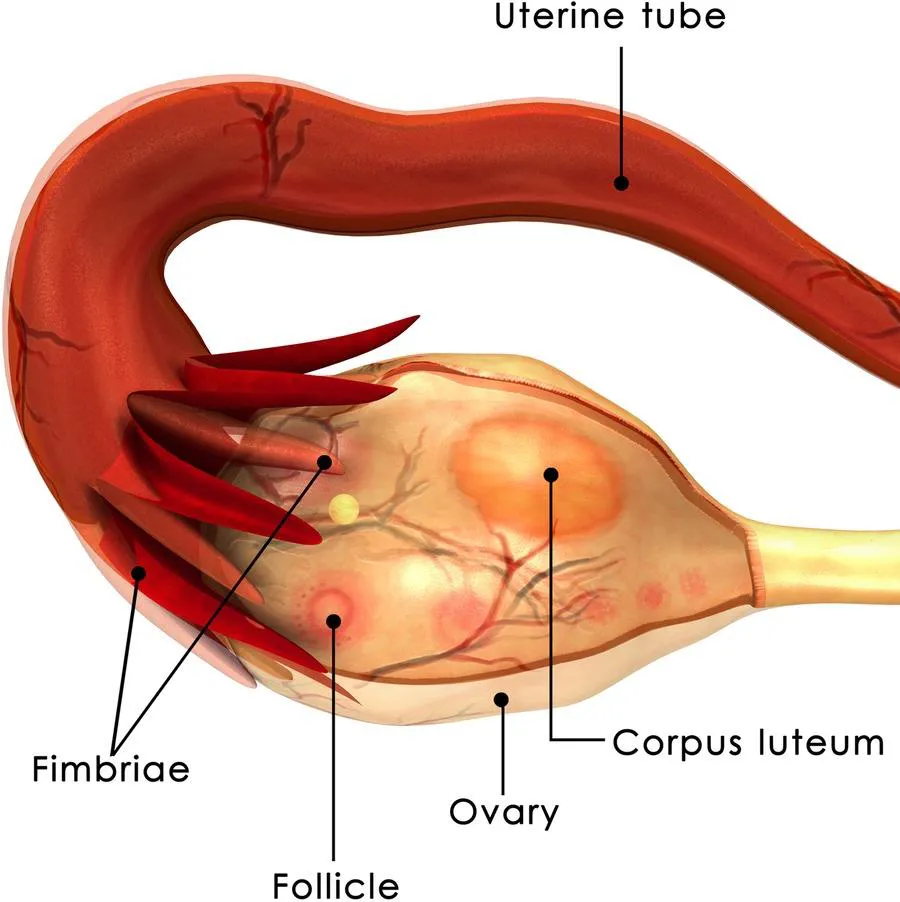
Figure 1.15 Ovary, fimbriae, and fallopian (uterine) tube.

Figure 1.16 Hormone levels and anatomical changes during the menstrual cycle.
The Gräfenberg spot, or G-spot, is a somewhat controversial landmark in anatomy, described as a highly sensitive area inside the vagina on the side of the body closest to the abdomen, about one or two inches deep inside. The G-spot, first defined in the 1950s as a highly erogenous zone, may or may not even exist.1,2 However, despite this controversy, the search to prove or refute the existence of the G-spot has led to considerable advances in our understanding of sexuality.3
1.3 Arousal
Arousal is a psychological, emotional, and physiological response to sexual stimuli that can be grouped into “reactive arousal,” which occurs in direct response to physical stimulation or a sexual encounter, and “spontaneous arousal,” which occurs in response to a person’s affective thoughts or fantasies. Arousal has a strong biological framework, in that it involves the interplay of neuroendocrine substances in the body and neural activation zones in the brain for sexual response. Sexual arousal is largely similar in terms of where and how the brain responds to sexual cues, but individuals can differ in emo...
Table of contents
- Cover
- Half Title
- Title Page
- Copyright Page
- Table of Contents
- Preface
- About the authors
- 1. Anatomy, Physiology, Arousal, Orgasm, and Hormones
- 2. Common Drugs and Their Sexual Side Effects
- 3. Drugs That Treat Sexual Dysfunction
- 4. Drugs That Enhance Desire or Improve Performance
- 5. Male-Physiology Fertility
- 6. Female-Physiology Fertility
- 7. Oral Contraception and Hormone Replacement Therapy
- 8. Pregnancy and Lactation
- 9. Recreational/Illicit Drugs and Sex
- 10. HIV Drugs and Sex
- 11. Performance Drugs (Anabolic-Androgenic Steroids) and Sex
- 12. Medical Devices and Alcohol
- Index
Trusted by 375,005 students
Access to over 1.5 million titles for a fair monthly price.
Study more efficiently using our study tools.
Frequently asked questions
Yes, you can cancel anytime from the Subscription tab in your account settings on the Perlego website. Your subscription will stay active until the end of your current billing period. Learn how to cancel your subscription
No, books cannot be downloaded as external files, such as PDFs, for use outside of Perlego. However, you can download books within the Perlego app for offline reading on mobile or tablet. Learn how to download books offline
Perlego offers two plans: Essential and Complete
- Essential is ideal for learners and professionals who enjoy exploring a wide range of subjects. Access the Essential Library with 800,000+ trusted titles and best-sellers across business, personal growth, and the humanities. Includes unlimited reading time and Standard Read Aloud voice.
- Complete: Perfect for advanced learners and researchers needing full, unrestricted access. Unlock 1.5M+ books across hundreds of subjects, including academic and specialized titles. The Complete Plan also includes advanced features like Premium Read Aloud and Research Assistant.
We are an online textbook subscription service, where you can get access to an entire online library for less than the price of a single book per month. With over 1.5 million books across 990+ topics, we’ve got you covered! Learn about our mission
Look out for the read-aloud symbol on your next book to see if you can listen to it. The read-aloud tool reads text aloud for you, highlighting the text as it is being read. You can pause it, speed it up and slow it down. Learn more about Read Aloud
Yes! You can use the Perlego app on both iOS and Android devices to read anytime, anywhere — even offline. Perfect for commutes or when you’re on the go.
Please note we cannot support devices running on iOS 13 and Android 7 or earlier. Learn more about using the app
Please note we cannot support devices running on iOS 13 and Android 7 or earlier. Learn more about using the app
Yes, you can access How Prescription and Over-the-Counter Drugs Affect Sexual Performance by Robert B. Raffa,Patricia J. Bush,Albert I. Wertheimer in PDF and/or ePUB format, as well as other popular books in Medicine & Biochemistry in Medicine. We have over 1.5 million books available in our catalogue for you to explore.