Adaptive Learning and the Human Condition provides a coherent and comprehensive introduction to the basic principles of classical (Pavlovian) and instrumental (Skinnerian) conditioning. When combined with observational learning and language, they are responsible for human accomplishment from the Stone Age to the digital age. This edition has been thoroughly updated throughout, relating adaptive learning principles to clinical applications as well as non-traditional topics such as parenting, moral development, and the helping professions.
Defining learning as an adaptive process enables students to understand the need to review the basic animal research literature in classical and operant conditioning and consider how it applies to human beings in our everyday lives. Divided into four parts, this book covers historical research into psychology and adaptive learning, principles of adaptive learning (prediction and control), adaptive learning and the human condition, and behavior modification and the helping professions.
The book showcases how an adaptive learning strategy can be practical, diagnostic, and prescriptive, making this an essential companion for psychology students and those enrolled in programs in professional schools and helping professions including psychiatry, special education, health psychology, and physical therapy.
The title of the first edition of this book was Adaptive Learning and the Human Condition (Levy, 2013). The title of the second edition has been expanded to Adaptive Learning and the Human Condition: Behavior Modification and the Helping Professions. The change in titles and coverage is the result of feedback received from reviewers and students. They responded favorably to key differences between my book and others used for the traditional undergraduate psychology course in Learning. My approach emphasized applications of the extensive animal learning research literature to humans and connected basic learning principles to developmental, abnormal, and social psychology. The current edition includes those same emphases but also targets students in the broad range of helping professions.
What brought me to psychology was the belief and hope that the power of the scientific method could be applied with the same degree of success as achieved in the disciplines of physics, chemistry, and biology. These sciences were successful in helping us understand nature and develop powerful technologies. I hoped psychology could help us understand and improve the human condition.
First Look at the Big Map
In a teaching journal, I used the metaphor of a long journey to describe a course (Levy, 1991). The same metaphor can be applied to a book. I suggested it was helpful to have both a “big map” and “small maps” to get the most out of the journey. The big map shows the journey from beginning to end, whereas the small maps provide the necessary details for each trip. Having both types of maps enables you to constantly keep in mind where you are with respect to the entire journey. As we begin, I wish to describe the big map, showing the sequence of different trips along the way. Your itinerary (book) can be divided into four major destinations (parts), each consisting of a small number of trips (chapters). The four parts of our book and corresponding chapters are as follows:
I A Science of Psychology and Adaptive Learning
1 A Science of Psychology and the Human Condition
2 A Science of Adaptive Learning
II Principles of Adaptive Learning
3 Predictive Learning
4 Predictive Learning – Theoretical Issues and Applications
5 Appetitive Control Learning
6 Aversive Control Learning
III Adaptive Learning and the Human Condition
7 Antecedents and Control Learning
8 Indirect Adaptive Learning
9 Adaptive Learning and the Human Condition
10 Problem Solving and Technology
11 Self-Actualization Through Self-Control
IV Behavior Modification and the Helping Professions
12 Helping Professions
13 Behavior Modification
14 Help
As we proceed, I suggest you refer to the big map along the way. It provides a summary of the story I am telling. The story starts by describing what it means for psychology to be a science of human behavior, and how adaptive learning relates to the human condition. We then describe the details and current understanding of what we mean by adaptive learning; acquiring the ability to predict, and where possible, control environmental events. This enables us to consider how adaptive learning principles enable us to understand the human condition, and provide a strategy for improving it, by helping ourselves and others. We begin our journey by looking at the first small map.
CHAPTER 1
A Science of Psychology and the Human Condition
DOI: 10.4324/9781003187967-2
The Changing Human Condition
The Scientific Revolution
Applying the Scientific Method to Psychology
Early History of Psychology
Psychology Today
Explanation in Psychology
Nature and Nurture
Nature as Explanation
Instincts and Evolutionary Psychology
Nurture as Explanation – The Pioneers of Adaptive Learning
Adaptive Learning and Hedonic Motivation
Conditioning and Learning
Adaptive Learning – Prediction and Control of Appetitive and Aversive Events
Attributions
Abstract
What we mean by the human condition can change dramatically from place to place and time to time. Within the past 400 years, humans have transformed the planet earth from its natural state, and we are now adapting to a rapidly changing human-constructed environment. The transition from relying upon personal experience and authority figures to the use of the scientific method to understand nature is responsible for this transformation. Science requires that its subject matter be observable and measurable. Although psychology was originally defined as the study of conscious experience (a.k.a. the study of the mind), it became apparent that advancement as a science required behavioral observation. Explanation within a science usually consists of cause-effect relationships. The scientific revolution resulted in humans acquiring the knowledge to understand nature and develop impactful technologies.
The current definition, goals, and methods of psychology evolved from the early structuralist, functionalist, Gestalt, and behaviorism schools. Psychology attempts to explain individual behavior (thinking and feeling, in addition to acting) as resulting from the interaction between nature (i.e., inherited characteristics) and nurture (experience). The human genome enables the four “tions,” essential to our ability to transform the environment and the human condition: imagination, communication, manipulation (of tools), and collaboration. Learning can be understood as an experience-based adaptive process enabling individuals to predict, and sometimes control, appetitive and aversive environmental events.
The Changing Human Condition
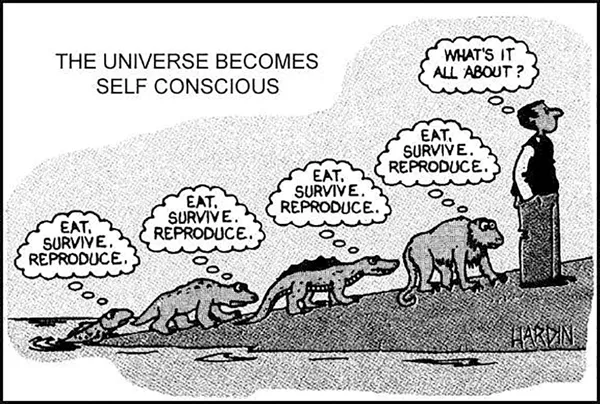
A recurring message of this book is that learning principles constitute very powerful explanations for human behavior and help us understand the way we live and how we can improve our lives. Hardin’s classic cartoon is perceptive as well as funny. The human being shares many basic needs and drives with the rest of the animal kingdom and must adapt to its environment to survive individually, and as a species. Yet, we seem more self-conscious than even our closest DNA relatives as we ponder the meaning and significance of our existence.
It is likely that communication will soon occur with the remaining few cultures not significantly impacted by current technologies. This could cause us to forget that the biological natural selection process, which continues albeit slowly, evolved over millions of years in an environment that has been significantly altered by human beings. “What’s it all about” depends on where you are and when you are there. Remove the clothes from Hardin’s person and place him/her in the Amazonian rain forest or Australian desert, and it becomes startlingly clear how similar our existence becomes to that of other animals. If you or I had been born in the rainforest or desert, we would be very different from the way we are and vice versa for the Amazonian or Australian young adult. Hopefully, consideration of such a prospect enables you to appreciate the importance of the adaptive learning process in determining who we become as individuals and cultures.
It is estimated that the universe is 13.8 billion years old and that the earth is 4.54 billion years old (Dalrymple, 2001; Gribbin, 2015). The earliest indisputable evidence for life on earth is at least from 3.5 billion years ago. Homo habilis, the first genus of the human species dates from about 2.8 million years ago. Homo erectus was the first human genus to emigrate out of Africa, reaching Asia and Europe over the next 500,000 years. Homo sapiens (anatomically modern humans) date from about 300,000 years ago and reached the Americas only about 15,000 years ago.
In Sapiens: A Brief History of Humankind, Yuval Noah Harari (2015) concludes, “The most important thing to know about prehistoric humans is that they were insignificant animals with no more impact on their environment than gorillas, fireflies or jellyfish.”
Figure 1.1 combines a computer-generated image of the way Manhattan Island (New York City) appeared in 1609, when Henry Hudson arrived there from Holland, with a photograph taken 400 years later. There is no reason to believe the geography of Manhattan Island was very different millennia before Henry Hudson reached shore. It is not hyperbole to conclude that recent modern humans have transformed the planet earth and thus, our own environmental conditions and adaptive learning requirements. Clearly, the species responsible for making such transformations is no longer insignificant!
FIGURE1.1 Manhattan Island in 1609 when Henry Hudson landed there (left-hand side) and in 2009 (right-hand side).
In his prescient book, Future Shock (1970), Alvin Toffler described how technological innovations were creating the equivalent of culture shock for individuals living in industrialized countries. In the same way that one must adapt to new customs and norms if moving to a different culture, one needs to adapt to new technologies as they emerge within one’s own lifetime. Adaptation is an essential capability for surviving and succeeding under one’s conditions, no matter the place and no matter the time.
Raymond Kurzweil (2001) ...
Table of contents
Cover
Half Title
Praise for the first edition
Title Page
Copyright Page
Dedication
Table of Contents
List of Figures
Preface
Acknowledgments
Part I A Science of Psychology and Adaptive Learning
Part II Principles of Adaptive Learning
Part III Adaptive Learning and the Human Condition
Part IV Behavior Modification and the Helping Professions
References
Index
Trusted by 375,005 students
Access to over 1.5 million titles for a fair monthly price.
Study more efficiently using our study tools.
Frequently asked questions
Yes, you can cancel anytime from the Subscription tab in your account settings on the Perlego website. Your subscription will stay active until the end of your current billing period. Learn how to cancel your subscription
No, books cannot be downloaded as external files, such as PDFs, for use outside of Perlego. However, you can download books within the Perlego app for offline reading on mobile or tablet. Learn how to download books offline
Perlego offers two plans: Essential and Complete
Essential is ideal for learners and professionals who enjoy exploring a wide range of subjects. Access the Essential Library with 800,000+ trusted titles and best-sellers across business, personal growth, and the humanities. Includes unlimited reading time and Standard Read Aloud voice.
Complete: Perfect for advanced learners and researchers needing full, unrestricted access. Unlock 1.5M+ books across hundreds of subjects, including academic and specialized titles. The Complete Plan also includes advanced features like Premium Read Aloud and Research Assistant.
Both plans are available with monthly, semester, or annual billing cycles.
We are an online textbook subscription service, where you can get access to an entire online library for less than the price of a single book per month. With over 1.5 million books across 990+ topics, we’ve got you covered! Learn about our mission
Look out for the read-aloud symbol on your next book to see if you can listen to it. The read-aloud tool reads text aloud for you, highlighting the text as it is being read. You can pause it, speed it up and slow it down. Learn more about Read Aloud
Yes! You can use the Perlego app on both iOS and Android devices to read anytime, anywhere — even offline. Perfect for commutes or when you’re on the go. Please note we cannot support devices running on iOS 13 and Android 7 or earlier. Learn more about using the app
Yes, you can access Adaptive Learning and the Human Condition by Jeffrey C. Levy in PDF and/or ePUB format, as well as other popular books in Psychology & Animal & Comparative Psychology. We have over 1.5 million books available in our catalogue for you to explore.