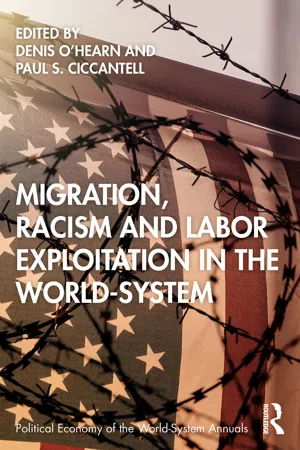
This book offers a historically sweeping yet detailed view of world-systemic migration as a racialized process. Since the early expansion of the world-system, the movement of people has been its central process. Not only have managers of capital moved to direct profitable expansion; they have also forced, cajoled or encouraged workers to move in order to extract, grow, refi ne, manufacture and transport materials and commodities. The book offers historical cases that show that migration introduces and deepens racial dominance in all zones of the world-system. This often forces indigenous and imported slaves or bonded labor to extract, process and move raw materials. Yet it also often creates a contradiction between capital's need to direct labor to where it enables profitability, and the desires of large sections of dominant populations to keep subordinate people of color marginalized and separate. Case studies reveal how core states are concurrently users and blockers of migrant labor. Key examples are Mexican migrants in the United States, both historically and in contemporary society. The United States even promotes of an image of a society that welcomes the immigrant—while policy realities often quite different. Nonetheless, the volume ends with a vision of a future whereby communities from below, both activists and people simply following their communal interests, can come together to create a society that overcomes racism. Its final chapter is a hopeful call by Immanuel Wallerstein for people to make small changes that, together, can bring real about real, revolutionary change.
eBook - ePub
Migration, Racism and Labor Exploitation in the World-System
- 208 pages
- English
- ePUB (mobile friendly)
- Available on iOS & Android
eBook - ePub
Migration, Racism and Labor Exploitation in the World-System
About this book
Information
Chapter 1
Introduction
This volume is the latest addition to the series of proceedings from annual conferences of the section on the Political Economy of the World-System (PEWS) of the American Sociological Association. It follows the death of Immanuel Wallerstein, who shepherded the PEWS conferences and their publications from their beginning in the 1970s until his death in August 2019. When Immanuel Wallerstein approached one of the editors (Denis O’Hearn, then at Texas A&M) with the proposal to hold the conference in Texas, they both agreed that “Migration in the World-System” would be an apt subject for the conference, given the long-term and recent importance of migration both to the Southwestern United States and to the world-system. As the presidency of Donald Trump had placed aggressive and racist nativism at the center of U.S. policy, this turned out to be a wise choice, and the conference was an academically and emotionally charged event.
The history of migration goes hand in hand with the central processes of the history of world-system formation and intensification. Not only do people move as new regions are incorporated into the world-system; capital, resources, and profits also move. Importantly, migration internal to countries in the world-system generally outweighs the international movement of people.
A central contradiction throughout this history of migration has been between: (1) capital’s need to direct labor where it enhances the stability and profitability of the system, and (2) the racially informed wish of large sections of dominant populations to keep people of color out (or, when that is impossible, to corral them into ghettoes, favelas, and reservations). This contradiction intensified after nearly 60 million white Europeans migrated to the United States between the mid-19th century and the 1930s, and subsequently restricted the migration of people of color. It is part of the on-again-off-again programs for seasonal Latinx labor migration (the rise and fall of the bracero program; the extension of the H-2A temporary agricultural workers program and its restriction under the Trump administration). The contradiction played a big role in the forced migration of African slaves to the Americas, followed by the encouragement of their descendants to move and take industrial jobs in Northern U.S. states, and then the move into their mass warehousing in prisons under the “new Jim Crow” (Wilson Gilmore 2007; Alexander 2012). It is no rare thing today for someone in the United States to say, out of one side of their mouth, that “we are a nation of immigrants” and, out of the other, that “the Mexican Government is forcing their most unwanted people into the United States … in many cases, criminals, drug dealers, rapists, etc.” Similar debates and contradictions rage in Europe and in the Asian core.
One of the main ideological supports for the world-systemic division of labor derives from neoclassical economic descendants of the Ricardian theory of comparative advantage like the Heckscher-Olin-Samuelson (H-O-S) model of international trade. These models purport to show that the free movement of goods and capital can promote the equalization of incomes across the globe, without the need for movement of labor (see Edwards 1985 for a critique of these theories). Yet, reality has shown us different. One way or another, people continue to move—and the ways that their movement continues to be related to changes in the world-system is the topic of this volume.
Part 1—Migration in the Longue Durée
The volume starts with the longue durée. Indeed, you could hardly get longer than James Fenelon’s sweeping analysis in Chapter 2 of people crossing land, oceans, and seas for more than 60,000 years. In telling this “greatest story ever told,” he forcefully points out how migration, particularly that of Europeans to the Americas in the last 500 years, is racism. Beginning with the old meme that the United States is a “nation of immigrants,” Fenelon unpacks the connections between migration and racism. The meme, he says, is mythical in its concentration on the movers to largely ignore of the dehumanizing impact of migration on the people who were already there (for an excellent analysis of the consequences of the notion that new world territories were terra nullius, see Lindqvist 2007). It is hegemonic in its production of new social systems aimed at producing profit through the exploitation of people and resources. It is partially accurate insofar as it does describe a system of producing human relations in which the movers have access to certain resources and advantages. Mostly, it is racially informed because it has a racist core construction wherein the system deploys racially codified groups in opposition to one another for the advantages of a small core group.
Fenelon goes on to contrast immigration (invasive) with migration (coercive, forced, captured) through an analysis of phases of migration from the Caribbean conquest to English colonization, U.S. expansion, and global capitalism. In each phase, he contrasts immigration to the forced migration of subordinate groups. He concludes by arguing that 500 years of “immigration, forced migration, displacement and extermination of racialized populations in the Americas has always been driven by the dual processes of producing a racially dominant group and elites and maintaining racially subordinated peoples for labor exploitation, historical land takings and ongoing resource development.”
The long-term ties between resource development and migration are the topic of the next two chapters, Paul Ciccantell and Paul Gellert’s general analysis in Chapter 3 of migration in “resource frontiers” and Denis O’Hearn’s exposition in Chapter 4 of a specific case of a resource frontier, the Aleutian Islands and Alaska in Russian America.
Ciccantell and Gellert’s analysis of migration and resource frontiers is firmly within the landscape that Fenelon provides about the long-term nature and effects of migration. Of course, in order to gain access to resources in peripheral zones for use in the core, people have to move, and as they do so, they not only develop institutions and practices to enable resource extraction, they always do so by labor exploitation and land expropriation. This is a phased process of incorporation—wherein indigenes lose control of land, resources, and control over their own labor—and peripheralization, where these institutions and practices are intensified. Most importantly for the central subject of this volume, migration (or, as Fenelon reminds us, immigration and migration) is central to the expansion of the resource frontier and then to the development of the extractive periphery. Thus, resource frontiers are not just about immigration by the outsider, but also about the forced movement of people within the zone.
Building on Fenelon’s points, Ciccantell and Gellert emphasize that the development of the resource frontier is always a gendered and a racialized process. Immigrants tend to be male and white (unless slaves are imported with white settlers), while they and their local collaborators build racialized systems that vary widely but always have a racist component. Racialized domination thus works to the detriment of indigenous populations but, interestingly, even white settlers can face challenging and exploitative conditions in the resource zone.
Typically, the resource frontier also has a life cycle. There is a tendency for zones to undergo establishment and boom, relative stability, and then decline. What follows decline is uncertain. It depends on the nature of the resource frontier and its relationship to the world-system (e.g. do new resources or industries arise to substitute for the exhausted resource?).
O’Hearn provides an example of the outworkings of a resource frontier in his analysis of the oft-ignored case of Russian America. There, beginning in the eighteenth century, the Russian state tried to build a profitable overseas empire based on killing fur-bearing sea mammals and foxes for trade in China. As the Russians moved across the Aleutian Islands to the Alaskan mainland, they reproduced many elements of European colonial experiences: naval power, the combination of corporate and governmental power in a giant multidivisional company (the Russian-American Company), gendered migration dominated by males, subjugation of unfree labor through slavery and indebted servitude, and a racialization of the division of labor. They also reproduced resource exhaustion in successive extinctions of fur-bearing mammals. Yet there were some interesting specificities in the Russian America case. One was the regime’s inability to get Russians to move to the frontier. In response, the company, later backed up by the Russian government and the Orthodox Church, encouraged the formation of an educated but cheap labor force of kreols, sons and daughters of Russian fathers and indigenous mothers. While this had racial aspects, especially after the United States bought Alaska from Russia in 1867, it was primarily the creation of a new class.
Methodologically, O’Hearn’s innovation is to combine historical analysis with new data from primary sources including genealogical sources. He traces several families through the phases of the resource frontier, as outlined by Ciccantell and Gellert, showing the impact of Russian migration and labor formation, kreolization, racialized “Americanization” after 1867, and the enduring impacts of starvation and disease on the Unangax population.
Part 2—Migration in the United States
The second part of this volume moves directly into the United States as a contradictory user and blocker of migratory labor, especially from Mexico, both historically and contemporaneously. Two chapters chart the historical processes of inviting and blocking Mexican labor from the time of railroad expansion to the present day, and the section ends with a chapter on the image of the United States as a “nation of migrants,” through images and cultural symbols, and asks in Fenelon’s words how much of this image is “mythical,” and whether it is a positive example for other world regions especially the European Union.
Calderon-Zaks introduces in Chapter 5 one of the first analyses of the roots of Mexican labor migration into the Southwestern United States in the expansion of the railroads. As a previous volume in this series showed, the industrial phase of expansion of the world-system relied heavily on new ways to transport resources and people, especially in the form of railways (Ciccantell and Bunker 1998). In this case, the westward expansion of the United States was dependent not only on the technology of railways, but also on the racialized migrant laborers who built them and, perhaps more importantly, maintained them. The last point is especially important in the story of Mexican migrant laborers who came first to work on the railroads out of the labor market centered in El Paso. Then, laborers on the railways went on to provide the migrant farm labor with which we are so familiar today. As a result, while scholars pay much attention to the influx of Europeans to the US during the half-century from 1880–1930, the Mexican-born population in the United States during that same period rose from 68,399 to 616,998, mostly due to railway maintenance workers.
This movement of labor also had an impact in Mexico, where the depopulation of ejidos, as their members moved northward for higher-wage employment, enabled speculators to profit off of the privatization of collective lands. The same process also placed new demands on mining districts in Central Mexico that needed labor.
The racialized nature of the system provides additional interest. Until the early twentieth century, nativists were more concerned about limiting the entry of Asians, and Mexican labor was rightly considered to be temporary or seasonal. It was later in the century that the attentions of nativists were turned to Mexicans, leading to many of the issues covered in Nancy Plankey-Videla’s analysis in Chapter 6 of the “deportability” regime in contemporary Texas.
Plankey-Videla argues that the previous U.S. presidential administration of Barack Obama created a deportability regime that creates fear and disrupts daily life not just for undocumented immigrants, but also for many members of the Latinx community in the United States. Mass deportation was not created by the Trump administration, but was instead begun under Obama, bringing together what Plankey-Videla considers to be the three foundational elements of racialized, classed, and gendered inequality: the carceral state, the public spectacle of threatening immigrants, and a variety of policies that facilitate deportation. The Trump administration and anti-immigrant laws in states like Texas and Arizona expanded and intensified this deportability regime, fomenting intense fear of deportation among not just undocumented immigrants from Mexico and Central America, but also in extended families and entire communities such as those in Bryan/College Station, Texas. Many families include varied combinations of U.S. citizens (often children), authorized immigrants, and undocumented immigrants. In these mixed-status families, for example, undocumented parents are now concerned about becoming visible to local law enforcement via traffic stops and, through law enforcement partnerships with ICE (U.S. Immigration and Customs Enforcement), to immigration authorities who could deport them and leave their U.S. citizen children alone. U.S. citizens and authorized immigrants worry about members of their extended family who are undocumented and vulnerable to the same threat of becoming visible to law enforcement and immigration agencies through any form of interaction with state agencies such as schools, medical care, and law enforcement. Plankey-Videla’s focus group interviews with residents of one urban area in Texas reveal both the nature of the deportability regime under the Obama administration and the dramatic intensification of the deportability regime in the Trump era, illustrating the fear and disruptions of daily life that now pervade the Latinx community. The powerful statements from these focus group participants reveal the human cost of the deportability regime.
Eric Mielants’ Chapter 7 examines the imagery of welcoming migrants in a variety of formats in the United States, emphasizing the roles of universities, cultural institutions, and heritage sites. Mielants argues that, in contrast to most European countries, the United States has long sought to create a model of active citizenship that is portrayed in museum exhibits, public statues, and other types of imagery that sought to incorporate immigrants into the culture and values of U.S. society and the U.S. political system. Notions of voluntarism, lifelong learning, celebrating diversity, multiculturalism, and creating feelings of belonging to U.S. society, Mielants finds, promote active citizenship and assimilation of immigrants, even in the context of systemic racism and structural inequality in the United States. The U.S. model incorporates immigrants into mainstream society more effectively and at a lower cost than does the European welfare state model.
Part 3—World Migrations Today
This section shifts analytic focus from the United States to the rest of the world. Migration flows between countries and within countries are reshaping politics, economics, racial formations, and labor conditions in many countries. The chapters in this section examine a variety of countries and of types of migratory movements, with a particular emphasis on South Asia.
Robert Schaeffer offers in Chapter 8 a comparative analysis of migration flows driven by political partitions that divided existing countries and created new ones, with a focus on the impacts of this process on social and political identities. He identifies two contrasting patterns that emerge from these partitions. In some cases, diverging social and political identities were created by state policies and voluntary and involuntary migration flows that led to sustained conflict. These cases include the Koreas, India, Pakistan, Yugoslavia, the post-Soviet republics, Ethiopia, Sudan, and Palestine, with these diverging identities and ongoing conflicts fueled by the strategies of major powers and of governments in partitioned states. In contrast, Schaeffer identifies other cases in which state policies and migratory flows led to shared and converging identities, including China, Taiwan, Cyprus, Czechoslovakia, Ireland, Vietnam, and Germany. These converging identities emerged and developed, and conflicts moved toward potential peaceful resolution, despite efforts by great powers and state actors to prevent the creation of these identities and to maintain conflictual situations. Schaeffer outlines five types of migratory flows that impact these two patterns of social and political identities and conflictual situations. The chapter highlights the key elements of a variety of cases to explain the emergence of these two very different patterns following partitions.
The next two chapters focus on South Asia and examine different elements of what both describe as the largest internal migration in the world: the movement of people within India, typically from rural to urban areas. Devparna Roy offers in Chapter 9 an innovative concept of ecoethnoscapes to analyze the history and potential future evolution of the bioregion of Bengal, emphasizing the connections between Bangladesh and Indian West Bengal. Roy argues that viewing this area as an ecoethnoscape, a bioregion with permeable boundaries, offers a way to conceive of a post-nationalist world that could resolve longstanding political conflicts that have become entwined with nationalist visions of nations and boundaries and with forced and voluntary migrations in South Asia. Inspired in part by recognition of bioregions in both natural and social scienc...
Table of contents
- Cover
- Half Title
- Series
- Title
- Copyright
- Dedication
- Contents
- 1 Introduction
- Part I Longue Durée
- Part II Migration in the US
- Part III World Migrations Today
- Part IV Conclusion—The Way Ahead
- Afterword
- Bibliography
- Notes on Contributors
- Index
Trusted by 375,005 students
Access to over 1.5 million titles for a fair monthly price.
Study more efficiently using our study tools.
Frequently asked questions
Yes, you can cancel anytime from the Subscription tab in your account settings on the Perlego website. Your subscription will stay active until the end of your current billing period. Learn how to cancel your subscription
No, books cannot be downloaded as external files, such as PDFs, for use outside of Perlego. However, you can download books within the Perlego app for offline reading on mobile or tablet. Learn how to download books offline
Perlego offers two plans: Essential and Complete
- Essential is ideal for learners and professionals who enjoy exploring a wide range of subjects. Access the Essential Library with 800,000+ trusted titles and best-sellers across business, personal growth, and the humanities. Includes unlimited reading time and Standard Read Aloud voice.
- Complete: Perfect for advanced learners and researchers needing full, unrestricted access. Unlock 1.5M+ books across hundreds of subjects, including academic and specialized titles. The Complete Plan also includes advanced features like Premium Read Aloud and Research Assistant.
We are an online textbook subscription service, where you can get access to an entire online library for less than the price of a single book per month. With over 1.5 million books across 990+ topics, we’ve got you covered! Learn about our mission
Look out for the read-aloud symbol on your next book to see if you can listen to it. The read-aloud tool reads text aloud for you, highlighting the text as it is being read. You can pause it, speed it up and slow it down. Learn more about Read Aloud
Yes! You can use the Perlego app on both iOS and Android devices to read anytime, anywhere — even offline. Perfect for commutes or when you’re on the go.
Please note we cannot support devices running on iOS 13 and Android 7 or earlier. Learn more about using the app
Please note we cannot support devices running on iOS 13 and Android 7 or earlier. Learn more about using the app
Yes, you can access Migration, Racism and Labor Exploitation in the World-System by Denis O'Hearn, Paul Ciccantell, Denis O'Hearn,Paul Ciccantell in PDF and/or ePUB format, as well as other popular books in Scienze sociali & Storia sociale. We have over 1.5 million books available in our catalogue for you to explore.