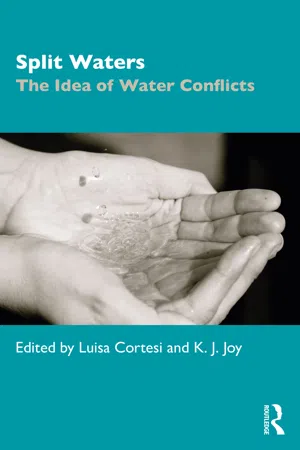
Split Waters
eBook - ePub

Split Waters

The Idea of Water Conflicts

  1. 264 pages
  2. English
  3. ePUB (mobile friendly)
  4. Available on iOS & Android
eBook - ePub

Split Waters

The Idea of Water Conflicts

About this book

Limited, finite, contaminated, unavailable or expensive, water divides people all around the globe. We all cannot do without water for long, but can for long enough to fight for it.

This commonsensical narration of water conflicts, however, follows a pattern of scarcity and necessity that is remarkably unvaried despite different social and geographical contexts.

Through in-depth case studies from around the globe, this volume investigates this similarity of narration—confronting the power of a single story by taking it seriously instead of dismissing it. In so doing, it invites the reader to rethink water conflicts and how they are commonly understood and managed.

This book:

  • Posits the existence of the idea of water conflict, and asks what it is and what it produces, thus how it is used to pursue particular interests and to legitimise specific historical, technological and environmental relations;
  • Examines the meaning and power of ideas as compared to other categories of knowledge, advancing theoretical frameworks related to environmental knowledge, discursive power, social constructivism;
  • Presents an alternative agenda to deepen the conversation around water conflicts among scholars and activists.

Of interest to scholars and activists alike, this volume is addressed to those involved with environmental conflicts, environmental knowledge and justice, disasters and climate change from the disciplinary angles of environmental anthropology and sociology, political ecology and economy, science and technology studies, human geography and environmental sciences, development and cooperation, public policy and peace studies.

Essays by Gina Bloodworth, Ben Bowles, Patrick Bresnihan, Luisa Cortesi, Mattia Grandi, K. J. Joy, Midori Kawabe, Adrianne Kroepsch, Vera Lazzaretti, Leslie Mabon, Renata Moreno Quintero, Madhu Ramnath, Jayaprakash Rao Polsani, Dik Roth, Theresa Selfa, Veronica Strang, Mieke van Hemert, Jeroen Warner and Madelinde Winnubst.

Trusted by 375,005 students

Access to over 1.5 million titles for a fair monthly price.

Study more efficiently using our study tools.

Information

Year
2021
Print ISBN
9780367371753
eBook ISBN
9781000405927

Part 1

Agential purchase of the idea

1
Can’t trust

The boaters of the waterways of South East England versus ‘the charity that makes you homeless’

Ben Bowles1

Introduction

The UK has over 2,000 miles of navigable waterways, a vast interweaving network of canals and rivers, all of which are populated (albeit some rather sparsely) by boat-dwellers who live in narrow steel boats, fibreglass cabin cruisers and barges. In the absence of a home mooring, some of these ‘Boaters’ travel the system, moving from place to place and thereby forming a number of interlinking itinerant communities and loosely affiliated groups. Over six years of living aboard a boat, including 13 months during which I was engaged in participant observation fieldwork with Boaters as part of my PhD studies at Brunel University, London, my travels have taken me around the comparatively highly populated canals and rivers of London and the South East.
Much of the Boaters’ interaction, and a large part of what binds them together as a community, is centred around a longstanding series of conflicts with the authority tasked with managing and maintaining the waterways:2 the charitable trust Canal and River Trust (CaRT), which took over the running of the waterways from a quango—British Waterways (BW)—in early 2012.3
The water conflict described here is intensely political: a conflict over access to water as a living space and the Boaters’ ability to remain on the waterways. After briefly introducing the Boaters, this chapter explores the fundamental aspects of this particular political situation. Following this, the chapter outlines two specific disputes that demonstrate how access to drinking and sanitation moorings via water points and facilities moorings can become central paradigmatic scenes (the concept used and understood by Davies [2010]) through which the relationship between the Boaters and CaRT can be seen to emerge. These are places where these independent travellers, who are not linked to national gas or electricity networks, must rely upon others, including agencies of the state. The most important of these places are the facilities moorings, where Boaters must access their drinking water and dispose of sanitary waste at locations provided and managed by CaRT.
It is ironic that, for people living on rivers, water provision can drag the Boaters into antagonistic contact with the sedentary world and with state forces. At these flashpoints, the Boaters and CaRT must engage with each other, and CaRT can therefore try to control the boating population through limiting the number and quality of the facilities. In this way, the Boaters’ fluid, liminal or water-like way of being in the world (Strang 2005) is pinned down or solidified by the material infrastructure of water management.
This chapter details the tension that arises when Boaters (who in many ways deliberately attempt to develop a flexible, transient and mobile lifestyle and identity against sedentary outsiders and the state) find that the instability of their relationship with the state (where they exist in a legal grey area and are subject to opaque and inconsistent surveillance and enforcement procedures) is one of their lifestyle’s greatest challenges.4 Some Boaters see this as a necessary evil, some relish the battle, while for others (particularly those poorest Boaters who are mainly afloat for reasons of economic necessity), ‘choice’ is actually too strong an expression.
This chapter describes the ‘arms’ length’ relationship wherein the Boaters, from the authority’s perspective, are a problematic and hard-to-govern acephalous mobile group, and the authority, from the Boaters’ perspective, is the inconsistent, unpredictable and frequently discriminatory tool of a state that is biased towards a sedentary and sedentarising logic. In addition, as I have written elsewhere (Bowles 2016, 2017), having an antagonist in the form of CaRT has an aggregative function: binding disparate Boaters together as a community against a powerful common aggressor.

Introducing the boaters

The Boaters are those who have taken to living aboard boats on the canals and rivers since the last of the population known as the ‘working Boaters’—professional goods-carrying boat-dwellers with their own long history going back to the boom of canal building (see Burton 1989; Smith 1974[1878]; Rolt 1999 [1944])—moved from the ‘cut’, as the canal is known, in the winter of 1962–63. This population has slowly increased as the canals and rivers have become cleaner, better maintained and more attractive as holiday and leisure destinations over the intervening years. In recent years, particularly since travelling on the highways of the UK has become more difficult, and again in the aftermath of the 2007 financial crash, boat-dwelling has become vastly more popular. The boating population has grown with particular speed around cities such as London, where a housing crisis (see Croucher 2015; Hill 2013) has left many unable to afford sky-high rent prices.
The histories and socioeconomic statuses of these live aboard (a term which simply means ‘those that live permanently on a boat’) are mixed, but most tend to be on the less affluent end of the socioeconomic spectrum, with some explicitly stating that they are living on boats as a way to avoid imminent homelessness. The Boaters are in a different position than sedentary people with regard to their position within state legibility (as they do not hold a postcode) and state taxation, as they pay only their boat license cost and thereby avoid local authority council tax. Their utilities are also generally cheaper, due to the Boaters’ ability to generate their own electricity from generators and solar panels and their right to gather water from CaRT-provided taps.
It is important to note, however, that Boaters are often quick to state that they live aboard for more personal reasons than economic reasons, and that it is important to ‘love the lifestyle’, particularly the freedom and mobility afforded by boat-dwelling. Some Boaters with families find it difficult to maintain itinerant lives due to the need to register for schools and, as such, Boaters tend to be younger, or single, or retired and with older children.
London, in particular, maintains a varied population of Boaters, especially as many more affluent individuals have chosen boating as a way of living in desirable areas and avoiding rent costs. However, there does exist a tension between more experienced Boaters and these ‘new’ or ‘newbie’ Boaters who are yet to become embedded in the community of practice on the waterways (see Wenger 1998; Lave and Wenger 1991). Being a ‘proper’ and respected Boater within this community of practice involves entering into practices and ethics of hard work, mastering practical skills, becoming as self-suff...

Table of contents

  1. Cover
  2. Endorsement Page
  3. Half Title
  4. Series Page
  5. Title Page
  6. Copyright Page
  7. Table of Contents
  8. Lists of figures
  9. List of tables
  10. List of contributors
  11. Foreword: Under the surface of water conflicts
  12. Acknowledgements
  13. Introduction: Water conflicts: the social life of an idea
  14. Part 1: Agential purchase of the idea of water conflict: Water conflicts: the social life of an idea
  15. Part 2: Instrumentalisation of the idea of water conflict: Water conflicts: the social life of an idea
  16. Part 3: Naturalisation of environmental, ecological, technological and historical relations: Water conflicts: the social life of an idea
  17. Conclusion: Deepening the conversation around water conflicts
  18. Index

Frequently asked questions

Yes, you can cancel anytime from the Subscription tab in your account settings on the Perlego website. Your subscription will stay active until the end of your current billing period. Learn how to cancel your subscription
No, books cannot be downloaded as external files, such as PDFs, for use outside of Perlego. However, you can download books within the Perlego app for offline reading on mobile or tablet. Learn how to download books offline
Perlego offers two plans: Essential and Complete
  • Essential is ideal for learners and professionals who enjoy exploring a wide range of subjects. Access the Essential Library with 800,000+ trusted titles and best-sellers across business, personal growth, and the humanities. Includes unlimited reading time and Standard Read Aloud voice.
  • Complete: Perfect for advanced learners and researchers needing full, unrestricted access. Unlock 1.5M+ books across hundreds of subjects, including academic and specialized titles. The Complete Plan also includes advanced features like Premium Read Aloud and Research Assistant.
Both plans are available with monthly, semester, or annual billing cycles.
We are an online textbook subscription service, where you can get access to an entire online library for less than the price of a single book per month. With over 1.5 million books across 990+ topics, we’ve got you covered! Learn about our mission
Look out for the read-aloud symbol on your next book to see if you can listen to it. The read-aloud tool reads text aloud for you, highlighting the text as it is being read. You can pause it, speed it up and slow it down. Learn more about Read Aloud
Yes! You can use the Perlego app on both iOS and Android devices to read anytime, anywhere — even offline. Perfect for commutes or when you’re on the go.
Please note we cannot support devices running on iOS 13 and Android 7 or earlier. Learn more about using the app
Yes, you can access Split Waters by Luisa Cortesi, K. J. Joy, Luisa Cortesi,K. J. Joy in PDF and/or ePUB format, as well as other popular books in Biological Sciences & Sustainable Development. We have over 1.5 million books available in our catalogue for you to explore.