Conservators and other museum professionals face a large number of issues involving the mechanical behavior of materials, including questions on craquelure, restoring physically damaged objects, art in transport, or the selection of adhesives. However, science in conservation and museum studies curricula focusses mostly on chemistry. This book fills this important gap in conservation training. It is the first such book written specifically for the conservation community and professionals with little or no background in (mechanical) engineering. It introduces the basics of mechanical properties and behavior of materials and objects with examples and exercises based on conservation practice. More complex issues of mechanical loading and advanced solutions are also introduced.
- 156 pages
- English
- ePUB (mobile friendly)
- Available on iOS & Android
eBook - ePub
About this book
Information
Topic
ArtSubtopic
Art GeneralChapter 1
Introduction
The scientific and technical world of the conservation and restoration of art and other objects of cultural heritage is largely based in chemistry. This is evident in the majority of questions which must be answered when making conservation decisions, such as
- what is the chemical composition of the materials in an object,
- what is the state of aging of the object,
- what kinds of chemicals and materials can be safely used for a conservation treatment, and
- what climate conditions, e.g., light, temperature and relative humidity, can an object be displayed and stored in?
However, conservators face a large number of questions in their work which involve the mechanical behavior of materials. Examples of problems which they have to deal with include
- bending and cracking in wooden objects such as panel paintings and furniture,
- reinforcing or repairing joints in statues,
- hanging of textile wall tapestries (Fig. 1.1a),
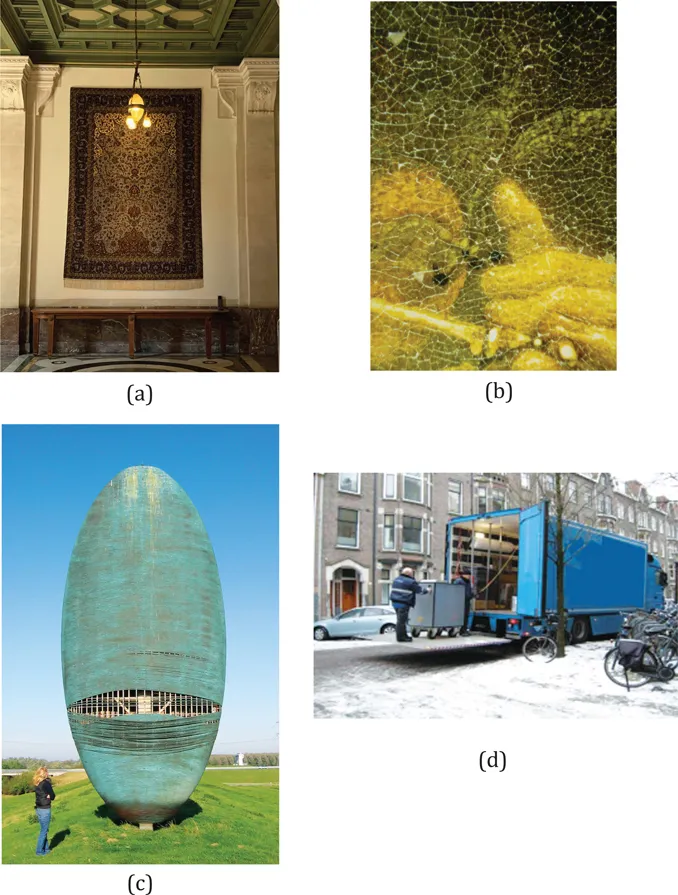 Figure 1.1 Examples of mechanical issues which face conservators: (a) Hanging of a wall tapestry, (b) craquelure in an oil painting, (c) failure of bonds holding copper coils to the metal frame of an outdoor sculpture (“Tong van Lucifer” (1993) by Ruud van de Wint, located on the Knardijk near the A6 highway, The Netherlands), and (d) vibration and shock during the transport of works of art.
 - craquelure in oil paintings (Fig. 1.1b),
- deformation and wear of metal objects,
- effects of (cyclic) changes in temperature and relative humidity on (outdoor) sculpture (Fig. 1.1c),
- paint loss,
- repair of tears and cuts in canvas paintings,
- strength of adhesives and consolidants,
- tension in painting canvasses, and
- vibrations and shock during the transport of objects, or during construction and other events in and around museums (Fig. 1.1d).
There are, however, other situations where it is not as obvious that mechanical stresses play an important role in the long-term condition of objects. Many such situations are related to the climate conditions noted above, including
- the effects of cyclic changes in temperature and relative humidity on canvasses,
- the effects of cyclic changes in temperature and relative humidity on wood panel paintings or wooden furniture,
- cracking of reinforced concrete art and architecture due to corrosion of the steel reinforcement bars,
- the concept of internal stresses, and
- dimensional changes (expansion or shrinkage) of adhesives.
The scientific curricula of virtually all conservation training programs around the world concentrate on the chemistry and physical properties of materials. Mechanical properties are almost never taught to any extent. It is therefore not surprising that there is much confusion, misinformation and uncertainty in the conservation world when it comes to dealing with mechanical aspects of restoration treatments.
In spite of this, when asked what terms they can think of that have to do with mechanical properties, most conservation students surprise themselves with how many words they can come up with. An alphabetical list of words compiled by the author in eight years of teaching daylong workshops on mechanical properties is shown in Table 1.1. If one now reorganizes these words into related groups, one sees that there are four main categories related in some way to the words “force,” “weight,” “deformation” and “failure,” (see Table 1.2). These terms lie at the core of the engineering concepts of the mechanical properties of materials in this book.
| Break | Energy | Shrinkage |
| Brittle | Expansion (thermal] | Strength |
| Contraction | Force | Stress |
| Crack | Friction | Stretch |
| Damping | Gravity | Swelling |
| Deformation | Kilogram | Tear |
| Density | Loose | Tension |
| Dent | Mass | Tight |
| Elastic | Plastic | Wear |
| Elongation | Pressure | Weight |
| Force | Weight | Deformation | Failure |
|---|---|---|---|
| | |||
| Damping | Density | Brittle | Break |
| Energy | Kilogram | Contraction | Crack |
| Force | Mass | Deformation | Tear |
| Friction | Weight | Dent | |
| Gravity | Elastic | ||
| Loose | Elongation | ||
| Pressure | Expansion (thermal] | ||
| Shock | Plastic | ||
| Strength | Shrinkage | ||
| Stress | Stretch | ||
| Tension | Swelling | ||
| Tight | |||
The objective of this book is to teach the basics of the mechanical properties and testing of materials. While learning these basics, it is, however, important to remember that every profession, be it art conservation, chemistry, history or engineering, has its own language and vocabulary. As with any foreign language, certain words mean certain things. They may look like something in another language, but if they are used in the wrong way, misunderstandings and confusion will certainly be a result. This should be taken into consideration when an engineer with no background in art or conservation is consulted on some aspect of mechanical testing.
This book begins with two chapters on the most important concepts and terminology of the mechanical properties of materials. Key terms are presented in bold-faced type the first time they are introduced. The most commonly used methods for mechanical testing are then described, and the book concludes with a discussion of a number of advanced concepts which conservators may come across in their work. It is hoped that the minimum which the reader comes away with after reading this book is the proper use of the terminology and language of this subject.
It is impossible to completely avoid mathematics in a field such as this, but the mathematics in this book has been limited to basic equations for the understanding and calculation of the mechanical properties of materials. Furthermore, all units for the various quantities given in this book are expressed in standard international (SI) units, in line with standard international scientific practice. Appendix 1 provides conversions between the SI units used in this book and their English (Imperial) counterparts which are still commonly used in industry, among others, in the United States of America.
Before continuing, two wor...
Table of contents
- Cover
- Half Title
- Title Page
- Copyright Page
- Contents
- Preface
- 1. Introduction
- 2. Static Mechanical Properties
- 3. Dynamic Mechanical Properties
- 4. Mechanical Testing
- 5. Advanced Concepts
- Epilogue
- Appendix
- Index
Trusted by 375,005 students
Access to over 1.5 million titles for a fair monthly price.
Study more efficiently using our study tools.
Frequently asked questions
Yes, you can cancel anytime from the Subscription tab in your account settings on the Perlego website. Your subscription will stay active until the end of your current billing period. Learn how to cancel your subscription
No, books cannot be downloaded as external files, such as PDFs, for use outside of Perlego. However, you can download books within the Perlego app for offline reading on mobile or tablet. Learn how to download books offline
Perlego offers two plans: Essential and Complete
- Essential is ideal for learners and professionals who enjoy exploring a wide range of subjects. Access the Essential Library with 800,000+ trusted titles and best-sellers across business, personal growth, and the humanities. Includes unlimited reading time and Standard Read Aloud voice.
- Complete: Perfect for advanced learners and researchers needing full, unrestricted access. Unlock 1.5M+ books across hundreds of subjects, including academic and specialized titles. The Complete Plan also includes advanced features like Premium Read Aloud and Research Assistant.
We are an online textbook subscription service, where you can get access to an entire online library for less than the price of a single book per month. With over 1.5 million books across 990+ topics, we’ve got you covered! Learn about our mission
Look out for the read-aloud symbol on your next book to see if you can listen to it. The read-aloud tool reads text aloud for you, highlighting the text as it is being read. You can pause it, speed it up and slow it down. Learn more about Read Aloud
Yes! You can use the Perlego app on both iOS and Android devices to read anytime, anywhere — even offline. Perfect for commutes or when you’re on the go.
Please note we cannot support devices running on iOS 13 and Android 7 or earlier. Learn more about using the app
Please note we cannot support devices running on iOS 13 and Android 7 or earlier. Learn more about using the app
Yes, you can access Art Conservation by W. (Bill) Wei in PDF and/or ePUB format, as well as other popular books in Art & Art General. We have over 1.5 million books available in our catalogue for you to explore.