This comprehensive volume brings to light little known implications of legal, economic, and custodial factors following a divorce. The Consequences of Divorce goes beyond the past decade's extensive focus on emotional and social adjustment outcomes to explore in-depth the post-divorce legal, economic, and custodial variables that impact the entire family. This important volume examines the economic conditions of both marriage partners after the divorce, the effect of legislative models on child support payment, child custody patterns and their impact on the family, and intervention strategies that take such custody problems into account. Teachers, counselors, researchers, and attorneys will be better prepared to offer support to family members after a divorce with the understanding of the economic and custodial conflicts that they will gain from this new book.The authoritative contributors examine statistics that show a marked decline in the economic well-being of women and children, which lead to questions of standards of adequacy for child support awards and an exploration of a new child support scheme from Australia. Different child custody arrangements are analyzed according to their consequences for each family member, providing valuable information for treating divorced families. Specific topics of interest include decreased parental involvement for fathers after a divorce, siblings separated by divorce, mothers without custody, and children's own viewpoints of custody arrangements. This informative book will lead to increased services to divorced families by expanding professionals'awareness of critical economic and legal issues that affect each member of the family.
eBook - ePub
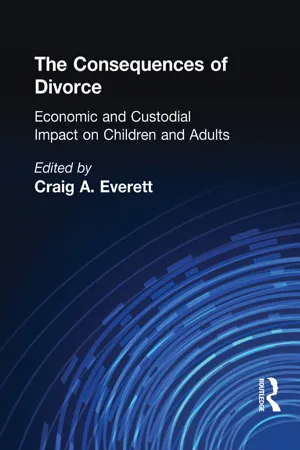
The Consequences of Divorce
Economic and Custodial Impact on Children and Adults
- 356 pages
- English
- ePUB (mobile friendly)
- Available on iOS & Android
eBook - ePub
About this book
Information
ECONOMIC AND LEGAL FACTORS
Introduction
As the literature in the divorce and remarriage field evolved over the past decade there was an extensive focus on emotional and social adjustment outcomes for both children and adults following a divorce. These studies offered valuable insights, particularly for clinicians, with regard to the emotional impact of the divorce process on families and the identification of therapeutic needs. This foundation prompted other researchers and clinicians to begin to identify and track a variety of variables in the divorce process itself.
The deficit in these former studies addressing adjustment issues, particularly from a family systems point of view, was that they did not look seriously at the broader picture of legal, economic, and custodial variables. In other words, the consequences of divorce for families are the product of much broader influences that families themselves may have very little control over.
The intent of this special issue on the consequences of divorce is to take the next step to broaden the picture by addressing issues of economic and custodial variables that impact on a family’s adjustment to divorce. There are exciting articles here focusing on economic inequalities for men and women, the impact of legislative models and even the characteristics of attorneys and judges that influence child support awards. Other articles address custodial patterns, the children’s own views of custody and access, and intervention strategies. It is hoped that these contributions will prompt even further investigations that will begin to integrate our understanding of the broad systemic variables in the divorce and remarriage process.
Craig A. Everett, PhD
Editor
Editor
The Economics of Divorce: Findings from Seven States
Barbara R. Rowe, PhD, is on the Faculty of the College of Family Life, UMC 2949, Utah State University, Logan, UT 84322.
This is a revised version of a paper presented at the pre-conference workshop sponsored by the Family Economics-HomeManagement section of the American Home Economics Association, Cincinnati, OH, June 1989.
SUMMARY. This paper reviews the economic consequences of the current laws of marital dissolution. Findings from seven states reporting primary data are compared on three judicial trends: the basis for property awards in equal and equitable distribution states; the frequency, amount, and duration of alimony awards; and current rulings on child custody and amounts of child support awards. The major consequence of these legal rules is a deterioration in the economic well-being of women and children following divorce.
It has been 20 years since California first introduced legislation proposing that the grounds for divorce should be “predicated solely and exclusively upon the ground of irremediable breakdown” (Rheinstein, 1972, p. 384; Weitzman, 1981). In 1985, South Dakota became the fiftieth state to adopt some form of no-fault divorce (Freed and Walker, 1987).
Under traditional divorce law, the economic aspects of a divorce were closely linked to the determination of fault: being found guilty or innocent of a marital offense had important financial consequences. For example, alimony could only be awarded to an innocent spouse; the courts almost invariably awarded more than half of the property to the innocent or injured party; and custody could be denied a woman found guilty of adultery or cruelty on the grounds she was an unfit mother (Weitzman & Dixon, 1983).
During the years states were shifting from traditional, fault-based divorce laws to no-fault, more changed than just the grounds for divorce. Other legal reforms instituted in the 1970s gave the courts equitable power to distribute property upon divorce regardless of which spouse’s name was on the title, introduced a trend to award short-term rehabilitative alimony to dependent spouses, and added gender-neutral guidelines for child support and custody (Jacob, 1988).
In the seven states where primary data have been collected on the economic consequences of these legal changes (Alaska, California, Connecticut, Ohio, Oregon, Utah, and Vermont), researchers have found that divorced women and their children suffer a precipitous drop in income and standards of living after divorce with older homemakers and mothers with young children experiencing the greatest hardships, while men actually improve their level of economic well-being (Baker, 1987; McGraw, Sterin & Davis, 1982; McLindon, 1987; Rowe & Lown, 1989; Rowe & Morrow, 1988; Weitzman, 1981; Wishik, 1986).
How did laws designed to create more fairness and equity in the legal process of divorce result in such disastrous, gender-based economic inequities? The reasons are both complex and interwoven.
PROPERTY
In a review of property distribution statutes in 1986, Freed and Walker reported that seven states mandate an equal or 50-50 sharing of assets upon divorce. Although a husband and wife may agree to divide their property unequally, in contested cases the court must divide their assets equally. In all other states, except Mississippi where only jointly-held property is distributed at divorce, equitable distribution laws allow the courts to distribute property according to the court’s view of what is fair and just, taking into account the contributions of both parties (Foster & Freed, 1974). However, in 22 equitable distribution states, only marital property is subject to division (Golden, 1983). Separate property, defined as all property owned by a spouse before the marriage, any property obtained after the marriage by way of gift or inheritance, and other assets which can be traced back to separate property, is retained by the spouse claiming ownership (Cheadle, 1981; Greene, 1979).
In California, one of five states where statute mandates an equal division of property, Weitzman (1981) found that the most devastating consequence of divorce reform has been an increase in the forced sale of the family home upon divorce. For most middle-income families, the family home is the major asset and sale of the home becomes necessary to accomplish an equal division of property. Almost never are there enough marital assets of sufficient value to give the family home to the wife, who is usually the custodial parent,1 and award other assets of equal value to the husband. With half the equity from their former home, most custodial mothers are unable to purchase a home of comparable value and are instead forced to relocate to a smaller home or apartment, often in a less affluent neighborhood. Other researchers have documented a continuing pattern of residential moves by mothers and children after divorce (Bane & Weiss, 1980; Wallerstein & Kelly, 1980).
In states with equitable distribution laws, the family home is more likely to follow the children. In Alaska, 74 percent of custodial parents are awarded the family home; in Connecticut, 71 percent of custodial parents; 61.4 percent in Vermont; and 52.0 percent in Oregon. Although women are usually the custodial parent and thus more likely to retain the family home after divorce, men with custody of children are the most likely to get the family home: 100 percent in Vermont and 93 percent in Alaska (Baker, 1987; McLindon, 1987; Rowe & Morrow, 1988; Wishik, 1986).
With regard to pensions, the worker typically retains ownership of its full value, without an offsetting award of other property to the spouse. In states where interview data are available, few respondents had any idea how to value a pension fund, or they believed the pension was indivisible. In view of the fact that pensions may represent a large portion of the accrued capital in a marriage, such naivete about the present value of existing rights to future pension benefits probably means that men, who more often have pensions,2 are leaving marriages with an asset which has been undervalued or disregarded entirely (Baker, 1987; Rowe & Morrow, 1988; Wishik, 1986).
In overall property division, women in equitable distribution states are more likely to receive a majority of the net assets (in Oregon, 52.6 percent; in Alaska, 43 percent) than California women (where 26 percent of the wives received a majority of the community property). However, Cohen and Hillman (1985) report that, under New York’s equitable distribution law, 49 out of 54 women receive less than a 50 percent overall share of marital property.
It is important to point out here that the legal changes that occurred in California and in the eight other states which began the 1970s with community property rules differed from changes that occurred in the 42 states who derived their property statute...
Table of contents
- Cover
- Half Title
- Title Page
- Copyright Page
- Table of Contents
- About the Editor
- Economic and Legal Factors
- Custodial Patterns and Influences
- Index
Trusted by 375,005 students
Access to over 1.5 million titles for a fair monthly price.
Study more efficiently using our study tools.
Frequently asked questions
Yes, you can cancel anytime from the Subscription tab in your account settings on the Perlego website. Your subscription will stay active until the end of your current billing period. Learn how to cancel your subscription
No, books cannot be downloaded as external files, such as PDFs, for use outside of Perlego. However, you can download books within the Perlego app for offline reading on mobile or tablet. Learn how to download books offline
Perlego offers two plans: Essential and Complete
- Essential is ideal for learners and professionals who enjoy exploring a wide range of subjects. Access the Essential Library with 800,000+ trusted titles and best-sellers across business, personal growth, and the humanities. Includes unlimited reading time and Standard Read Aloud voice.
- Complete: Perfect for advanced learners and researchers needing full, unrestricted access. Unlock 1.5M+ books across hundreds of subjects, including academic and specialized titles. The Complete Plan also includes advanced features like Premium Read Aloud and Research Assistant.
We are an online textbook subscription service, where you can get access to an entire online library for less than the price of a single book per month. With over 1.5 million books across 990+ topics, we’ve got you covered! Learn about our mission
Look out for the read-aloud symbol on your next book to see if you can listen to it. The read-aloud tool reads text aloud for you, highlighting the text as it is being read. You can pause it, speed it up and slow it down. Learn more about Read Aloud
Yes! You can use the Perlego app on both iOS and Android devices to read anytime, anywhere — even offline. Perfect for commutes or when you’re on the go.
Please note we cannot support devices running on iOS 13 and Android 7 or earlier. Learn more about using the app
Please note we cannot support devices running on iOS 13 and Android 7 or earlier. Learn more about using the app
Yes, you can access The Consequences of Divorce by Craig A. Everett in PDF and/or ePUB format, as well as other popular books in Politics & International Relations & Health Care Delivery. We have over 1.5 million books available in our catalogue for you to explore.