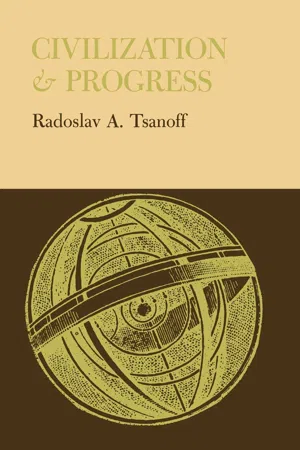
Historical and systematic in its treatment, this work reviews the idea of progress in Western thought as it relates to civilization, in a more comprehensive survey than is to be found in previous writings on the subject. In the author's view, the history of civilization reveals an increasing range of human capacity, both for good and for evil, depending upon men's choice between contending values.
From this standpoint, the work proceeds to the exploration of such fields of social activity as the evolution of the family, the emancipation of women, economic conditions and technology, intellectual and aesthetic values, moral and religious experience.
Civilization and Progress is marked by balanced and judicious treatment, very broad learning, and a lucid and forceful style. The author asks us to consider the alternatives we face and to reflect on the choices which men have made in the past, which confront us in the present world crisis, and on which our destiny hangs in the future. Seminal in scholarship and creativity, this work will interest those concerned with the Western intellectual tradition and with the condition of mankind.
- 384 pages
- English
- ePUB (mobile friendly)
- Available on iOS & Android
eBook - ePub
Civilization and Progress
About this book
Information
Topic
PhilosophySubtopic
World HistoryPART ONE
A Historical Review of the Idea of Social Progress
CHAPTER ONE
Alternatives and Approaches to the Idea of Progress in Classical Antiquity
THE BELIEF IN PROGRESS was not a vital idea for classical minds. The Greeks did not view history as a process of progressive achievement, realization, and expansion of values. Even their greatest historian, Thucydides (c. 460-400), did not contemplate the events of his time in the context of an advancing march out of the past. On his first page he tells us that his inquiries into remote antiquity and into more recent times failed to reveal to him anything “on a great scale, either in war or in other matters.” No classical poet sings: “I, the heir of all the ages.”
If we follow the example of the chronicler who was content with the bare statement that there are no snakes in Iceland, we shall find that our discussion of the idea of progress in the Christian-medieval period will be just as brief. But then we shall be failing to recognize the distinctive qualities of classical and the medieval Christian ideas of history—radically different views, both unlike our modern outlook. The examination of these differences and contending views should enable us to grasp better the motivation and the range of our modern doctrine of progress.
Before tracing some of the ancient classical approaches to the idea of progress we should examine two Greek views which also persisted, though not steadily, in Roman thought: the view of a series of world ages marked by an increasing degeneration, and the view of the cosmic process as cyclical, a treadmill of eternal recurrence. The first of these beliefs pervaded Greek mythology and characterized the world outlook of some poets and philosophers. The second was a theory of cosmological speculation, with significant implications.
It should be stated clearly at the outset that neither of these ideas commanded general acceptance. Thucydides writes in his account of the rude early beginnings of the Greek tribes, unsettled in habitation and in customs, many of them pirates and lawless nomads. While he unrolls before us the tragic events of the Peloponnesian war, Thucydides is not marked by any nostalgia for bygone primitive glories. Even in its disasters the Athens of his day could not lose the first memories which he engraved in his version of Pericles’ funeral oration. And he appealed to the undoubted judgment of the posterity: “I have written my work . . . as a possession for all time.”1
The issue between the doctrines of historical degeneration and eternal recurrence was not always drawn sharply. Both were held by many minds in ambiguous indecision. And alongside of them there were also some approaches to the belief in progress.
The view of history as periodic degeneration has been called the doctrine of cultural primitivism.2 Traditionally it was the belief in a bygone Golden Age. Hesiod in the eighth century gave us an early version of it in his Works and Days. The deathless Olympian gods made first of all “a golden race of mortal men who . . . lived like gods without sorrow of heart, remote and free from toil and grief.”3 The portrayal of their blessed light of existence is in sharp contrast to the series of lower and lower types of humanity which darkened the succeeding ages. Physically and mentally the men of the Silver Age were inferior to their predecessors. And down the scale of baser metals, the Bronze Age and the Iron Age marked the spreading degeneration of human nature.
The golden men lived in justice and ease and joy. Peaceful were their lives and their death was as a gentle sleep. The silver men were slow-witted and insolent, without piety, so that they angered the gods who did away with them. The brazen men were a race of terrible warriors, violent and hard of heart. They crushed and destroyed each other and without any abiding achievement sank into the chill muck of Hades. Hesiod complained: Ours is the age of the men of iron; in toil and grief we grind out our days; wrangling and trickery sully our homelife and our dealings with each other. Neither justice nor reverence are to be found among us, but “envy, foul-mouthed, delighting in evil.”4
The poet bewailed his lot, that he had been born in the Age of Iron. He interrupted his account of man’s deterioration by singing of the great Age of Heroes, between the Brazen and the Iron eras. Some of them were warlike, like the men of bronze and perished in dread battles, but others, nobler and more righteous, still live without grief or want in the Islands of the Blessed. Was Hesiod’s heroic episode in the dismal tale of human degeneration a hint of possible future hope of restoration, or was it a note of added dismay? Zeus the farseeing might just as well have allowed us to be born in the heroic mould.
The Golden Age doctrine persisted in the thought of both philosophers and poets, but it was slanted differently in various cosmic outlooks. Plato (427-347) seems to have regarded the myth of the Golden Age, along with some of his own myths, as an imaginative version of a deep truth. The truth would appear to be that individual human well-being and perfection come through divine guidance; but if, or rather when, God’s hand is withdrawn, men left to themselves go astray and the whole world reverts toward confusion and evil. This view of the world course, which we may call pendular, has kinships with the doctrine of eternal recurrence. It is also involved in Plato’s approach to the abysmal problem of evil. That evil can in any way be attributed to God, Plato rejected emphatically as an impious error. God is the author of good, and of good only. But there is in the constitution of the world a corrupt material strain, and in the very nature of things “there must always remain something which is antagonistic to good.” He declared further: “God desired that all things should be good and nothing bad, so far as this was attainable”;5 but left to our own devices we men let our lower impulses prevail. In this Platonic perspective of theodicy the legend of the Golden Age expressed deep significance.
During the Augustan period in Rome the myth of the Golden Age was given an optimistic turn in the prospect of its possible return, as in Virgil’s Fourth Eclogue: a kind of millennial hope, but hardly ongoing progress. This chant of divine restoration of mankind to a high estate was interpreted by Christian theologians in messianic, providential terms. A closer echo of Hesiod’s myth in Roman poetry is found in Ovid’s Metamorphoses. Ovid glorified especially the primeval perfection of mankind. “Golden was that first age, which, with no one to compel, without a law, of its own will, kept faith and did the right.”6 He also sang in Latin verse the old story of the several ages, but proceeding from the silver and the brazen directly to his age of hard iron, in which “modesty and truth and faith fled the earth, and in their place came tricks and plots and snares, violence and cursed love of gain.”7
The poetic version of the return of the Golden Age was not only a vision of eventual restoration but also a mediation between the doctrine of cultural degeneration and the cyclic cosmology of eternal recurrence. This second doctrine finds many expressions throughout the entire course of Greek thought, from Heraclitus to Plotinus. The world process goes through the entire scale of possible conditions or events and then returns to retrace its course to the least detail, aeon after aeon.
The basic idea of eternal recurrence was not exclusively or originally Greek. Its various versions may be studied in Babylonian, Brahmanic, Buddhist, and Chinese cosmogonies. It stimulated the Oriental zeal for vastness and infinitude, of which Buddhism provided the most elaborate expressions. The Buddhist kalpas, or aeons of world-destruction and world-restoration, were regarded as incalculable cosmic eras: how incalculable, Buddhist speculation taxed its resources to conceive. The monsoon rains of the Bay of Bengal discharge in some four months thirty or forty feet of flood. The Buddhist imagined such a downpour, but of three years’ duration: the total sum of raindrops would still come short of the number of years in an asankhyeya kalpa. And these cosmic aeons return cyclically, marked by the alternative destruction and restoration of the world. Our folktales begin with the familiar “once upon a time”; but a Buddhist legend is more expansive: “Ten quadrillion times a hundred quadrillions of kalpas ago, there lived a righteous king.”8 A dim recollection, and hardly a hope, yet Buddhist piety sought to sustain its serene prospect. Even if in this kalpa no lotus flower may appear on the primordial deep (and so no Buddha will come to teach men deliverance from misery), yet in some incredibly distant future, salvation and enlightenment will again return to wretched mankind. Even this brief passing mention of Oriental speculation may enable us to keep in mind the worldwide spread of the idea of eternal recurrence, as we consider it more directly in some of its Greek versions.
In Pre-Socratic philosophy the world course of eternal recurrence was conceived in pendular and in cyclical terms. Heraclitus viewed nature as a process of endless change of contending activities, as the opposition of upbuilding and downgrading. All things arising from cosmic fire are eventually consumed by fire, worlds without end. Empedocles envisioned a similar counteraction of love and strife, or attraction and repulsion, throughout the course of existence. He seems to have entertained also a cyclical cosmogony and was a believer in the transmigration of souls. These two beliefs found strong support in the Pythagorean school. Pythagorean influence may be traced in Plato’s advocacy of these doctrines, very definite in the case of transmigration, only occasional in the case of eternal recurrence. Aristotle also conceived of the course of existence in terms of circular motion, for it alone is continuous and in accord with his view of the universe as eternal.9 But while one can cite from Aristotle passages from which a cyclical doctrine might be surmised, he can hardly be listed with the definite advocates of eternal recurrence.
In Post-Aristotelian philosophy eternal recurrence was entertained by the Epicurean poet Lucretius (c.94-c.55), found its active expression among the earlier Stoics, and was viewed by Plotinus in a mystical perspective. Lucretius saw in nature a mechanical scrambling and unscrambling of material particles: his world was one of atoms-in-motion-in-space. Thus everything is an impermanent combination or cluster of atoms, and since the number of different combinations, no matter how vast, is yet exhaustible in eternity, there is bound to be recurrence and return not only in general terms but in detail. To a truly cosmic survey, “all things are always the same, eadem sunt omnia semper.”10
The Stoic sages were more explicit and detailed. Reviving the Heraclitean belief in a Cosmic Fire, which they exalted as Directive Reason or as Deity, they conceived of nature as a tension between refining and coarsening processes of material existence. When at long last a world aeon has gone through its whole round of possible conditions and events, it is all consumed in a cosmic conflagration, to start another world cycle recapitulating its predecessors to the least detail. A new Socrates, like so vastly many before him immemorially, again has his trials with his shrewish wife Xanthippe and his trial at court and his final cup of hemlock poison. These doctrines of cosmic conflagration and eternal recurrence were held by the early Stoics, but they were abandoned by Panaetius who introduced Stoicism into Rome, and the Roman Stoics took a linear view of the world process, only occasionally entertaining a cyclical cosmogony.
The doctrines of recurrence and rebirth were revived in the closing period of ancient thought by the Neopythagoreans and Neoplatonists. The greatest thinker of that age, Plotinus (205-270), introduced these ideas into his mystical cosmology of divine emanation. Plotinus believed that the spiritual essence of man’s soul was not extinguished along with his bodily disintegration. His assurance of personal immortality, like Plato’s, was combined with a view of the rebirth and transmigration of souls. In a larger cosmic setting, Plotinus regarded the repeated emanation of the Soul principle as an instance of the cyclical recapitulation of the vast cosmic process of Deity emanating in the three zones of existence—Nous or Rational Spirit, Soul, and Matter. The doctrine of Rational Divine Providence, which the Stoics fused subtly and strangely with their materialistic cosmology, was expressed by Plotinus in unmistakably spiritual terms. The ultimate reality for him was God, emanating radiant perfection throughout the universe at different levels of being.
The legend of the Golden Age and the mythology of world degeneration yielded a dismal view which excluded any real historical advance. The doctrine of eternal recurrence in its various forms viewed the world process either as the cyclical recapitulation of the forms of material existence or as the periodic reenactment of the drama of divine Providence. These ideas may be regarded as dominant in ancient thought.
The view of an upward trend to betterment in the world emerged with the rationalists, but it is interesting to note that cultural advance was recognized and the term progress itself was used by the Epicurean materialist Lucretius. Essential to all understanding of Epicureanism is its materialistic cosmology. Like Democritus and Epicurus, Lucretius recognized only atomic particles of matter moving in space, and he explained the nature of everything in terms of the cluster of atoms of which it was compounded, and their motions, contacts, and collisions. No divine guidance was recognized here, no spiritual principles, no dominant purposes and values. All is in a flux; the mechanics of nature is ever changing the composition of things, disintegrating and recombining the masses of atoms throughout existence. Besides this mechanical reassembling of particles, there is always the unaccountable power of each atom to swerve at any moment in any direction. In this world without plan, eternal duration would by the sheer calculation of chances yield eventual recurrence. But how could it afford, let alone assure, genuine and reliable progress?
The thought of Lucretius at this point is versatile rather than consistent. The universal atomic whirl and pulsation are not altogether random and chaotic; as he sees them, under certain conditions certain combinations persist or are transformed in a definite direction. Driven by need or lured by use and advantage, men devised tools, perfected plans and methods which sustained them in what they possessed and opened to them still larger prospects of achievement and even mastery of nature. So gradually in every field of activity, in farming and seafarin...
Table of contents
- Cover
- Half title
- Title
- Copyright
- Contents
- Acknowledgments
- Introduction
- Part One: A Historical Review of the Idea of Social Progress
- Part Two: Social Confidence and the Despair of Progress: Alternative Judgments of Civilization
- Epilogue
- Index
Trusted by 375,005 students
Access to over 1.5 million titles for a fair monthly price.
Study more efficiently using our study tools.
Frequently asked questions
Yes, you can cancel anytime from the Subscription tab in your account settings on the Perlego website. Your subscription will stay active until the end of your current billing period. Learn how to cancel your subscription
No, books cannot be downloaded as external files, such as PDFs, for use outside of Perlego. However, you can download books within the Perlego app for offline reading on mobile or tablet. Learn how to download books offline
Perlego offers two plans: Essential and Complete
- Essential is ideal for learners and professionals who enjoy exploring a wide range of subjects. Access the Essential Library with 800,000+ trusted titles and best-sellers across business, personal growth, and the humanities. Includes unlimited reading time and Standard Read Aloud voice.
- Complete: Perfect for advanced learners and researchers needing full, unrestricted access. Unlock 1.5M+ books across hundreds of subjects, including academic and specialized titles. The Complete Plan also includes advanced features like Premium Read Aloud and Research Assistant.
We are an online textbook subscription service, where you can get access to an entire online library for less than the price of a single book per month. With over 1.5 million books across 990+ topics, we’ve got you covered! Learn about our mission
Look out for the read-aloud symbol on your next book to see if you can listen to it. The read-aloud tool reads text aloud for you, highlighting the text as it is being read. You can pause it, speed it up and slow it down. Learn more about Read Aloud
Yes! You can use the Perlego app on both iOS and Android devices to read anytime, anywhere — even offline. Perfect for commutes or when you’re on the go.
Please note we cannot support devices running on iOS 13 and Android 7 or earlier. Learn more about using the app
Please note we cannot support devices running on iOS 13 and Android 7 or earlier. Learn more about using the app
Yes, you can access Civilization and Progress by Radoslav A. Tsanoff in PDF and/or ePUB format, as well as other popular books in Philosophy & World History. We have over 1.5 million books available in our catalogue for you to explore.