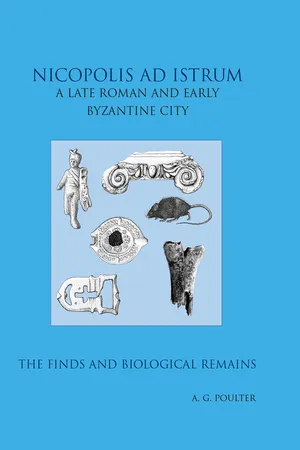
This, the third and final monograph, completes the description of the excavations carried out by the British team, part of the Anglo-Bulgarian archaeological programme on the site of Nicopolis ad Istrum in northern Bulgaria, one of the best-preserved ancient cities of the Roman Empire. The site provided a unique opportunity to compare the changing layout and economy of an urban centre from the Roman to the late Roman and the early Byzantine periods (c. AD 100-600). The excavations, geophysics, coins and wall-plaster were published in volume 1. Volume 2 describes the evidence for economic changes between the Roman and early Byzantine periods and contains full reports on the pottery and the glass. This volume includes full descriptions of all small-finds (ceramic copper-alloy and iron objects, glass, lamps, sculpture, architecture and flints) each object provided with a description of its archaeological context and the date of deposition. The second half of the volume identifies the environmental and economic differences between the three main periods in the history of the site. Reports include quantified assemblages of zooarchaeological finds (large and, small mammals), fish, birds, archaeobotanical remains, mollusca and human skeletons as well as the results of metallurgical analysis: copper-alloy, iron and 'natural' steel. Not only is this range and quantity of finds in these reports unparalleled in the Balkans, they represent a valuable resource for the material culture of the Roman and late Roman periods coming, as they do, from a part of the Roman Empire which has produced very few comparable assemblages. Of no less importance are the quantified bioarchaeological data which offers a unique insight into the charging morphology and economy of a Roman, late Roman and early Byzantine city.
eBook - ePub
Nicopolis ad Istrum III
A late Roman and early Byzantine City: the Finds and the biological Remains
- 330 pages
- English
- ePUB (mobile friendly)
- Available on iOS & Android
eBook - ePub
Nicopolis ad Istrum III
A late Roman and early Byzantine City: the Finds and the biological Remains
About this book
Trusted by 375,005 students
Access to over 1.5 million titles for a fair monthly price.
Study more efficiently using our study tools.
Information
Subtopic
ArchaeologyIndex
Social Sciences1
INTRODUCTION
by
The Aims of the Excavations at Nicopolis
The primary objective of the joint Anglo-Bulgarian research programme (1985–92) was to examine the character of a well-preserved Roman city in Bulgaria: to identify how it changed and developed from its origin as a Trajanic foundation (established c AD 109) through the Roman, late Roman and early Byzantine periods down to its final destruction and abandonment in the late 6th century AD (Fig 1.1 and 1.2). Whereas the Bulgarians continued excavations within the Roman city, the British team investigated the smaller fortified enclosure of 5.6 ha, immediately to the south, which had been identified as the site of Nicopolis in Late Antiquity (Poulter 1983, 90–97), built after the original Roman city had been abandoned (Fig 1.3). It was anticipated that a combined programme of geophysical research and area excavation would offer a unique opportunity to explore the physical layout of the city in the late Roman period. Few sites exist for such an extensive study of late Roman urbanism, either because the remains have been extensively robbed or else because the Late Roman city overlies its Roman predecessor, making it difficult to disentangle the general character of the site in just the late Roman period. Nicopolis, with its two separate sites, one Roman and the other late Roman, appeared not to have been significantly affected by later occupation. Research therefore offered every prospect of uncovering the character of this particular city which would serve as a case study to be compared with other, generally less well understood cities of Late Antiquity. The traditional view for the Balkans, and for the Eastern Empire as a whole, has been that there was no fundamental change in the organization and character of ancient cities down to the 6th century and that it was only after a last period of prosperity ‘in the Age of Justinian’ that the basis of urbanism was fatally weakened and finally extinguished, first by the Slav and Avar invasions in the northern Balkans and then, in the Near East, by the arrival of the Arabs in the 7th century. It has been the results from Nicopolis and the reinterpretation of the evidence emerging for other cities within the early Byzantine Empire that this view has been modified to reveal a much more complex picture with striking regional variations but also a more general and radical decline in the traditional nature of classical urbanism from the onset of the late Roman period (Liebeshuetz 2001). Even before the excavations at Nicopolis begun, there were indications, in the Balkans at least, that the cities had abandoned their classical form at a much earlier date. The only cities which appeared to still offer some of the amenities and private investment characteristic of urban life in the Roman period were centres of imperial administration where these signs of modest recovery were probably a response to imperial investment for the benefit of the new provincial administration, rather than representing a local revival of civic prosperity (Poulter 1992).
Although the physical development of the city was of importance and might provide clues as to functional continuity or change, the excavations were planned from the outset to include a large scale programme of archaeobiological analysis, aimed at providing evidence for the economy of the city, especially its role in the exploitation of its rich agricultural hinterland. Also, because there exist few sites in the Balkans which have produced a full and reliably dated sequence of occupation, a second objective was to reconstruct a largely site-based ceramic chronology, using coins, imported fine-ware and amphorae, but not relying upon other published corpora from the region. Although this potentially produces a more robust sequence, as well as more reliable dating for finds and biological evidence, it is an approach which is not without its own drawbacks, as will be described below (pp. 4–5). Circumstances also conspired to significantly widen the scope of the enquiry. The original agreement presupposed that our Bulgarian colleagues would be working on the Roman site and that the British excavations would be confined to the late Roman to early Byzantine periods. However, within the British sector, well-preserved Roman and late Roman levels were encountered and this allowed the British programme to be expanded to include a study of the Roman city from its foundation down to its eventual destruction in the late 6th century. At the other extreme, because it was discovered that the site had been reoccupied, if sparsely, in the ninth to tenth centuries, and extensively in the eighteenth to early nineteenth, the research was further extended to include both the early medieval and post-medieval periods.

Fig 1.2 The Lower Danube in the Roman period

Fig 1.3 The site of the British excavations
The Publication of the Excavations
The results of the first three years of excavation were published as an interim report in the Antiquaries Journal (Poulter 1988). Field-work was completed in 1992 and research commenced on the analysis of the results of the excavations, the finds and archaeobiological evidence. The task was made easier because the recording, analysis and drawing of the finds to publication standard had continued during each field season and was largely completed by the final year in Bulgaria. All specialist reports were available in first draft before the excavations, geophysics, inscriptions, coins and wall-plaster were published in the first monograph (Poulter 1995). Preparations then continued for the second volume which contained the pottery report by Falkner and the analysis of the glass finds by Shepherd (Poulter 1999). Since then, the original finds and archaeobiological reports have been revised and, in some cases, radically rewritten for publication in this volume although the general conclusions, summarized in the excavation report, remain essentially the same as those presented here.
Producing three separate volumes over a decade is not an ideal method of publishing a major excavation. The Society for the Promotion of Roman Studies published the first volume on the excavations (with substantial financial assistance from the excavation fund) but declined to continue its support. I and my team are therefore much indebted to the Society of Antiquaries of London for taking on the task of publishing the second monograph and now overseeing the publication of the final volume. In part, this explains the long delay in completing the task. It also accounts for the fact that there is a difference in format between the three books. Nevertheless, we hope that this does not unduly detract from the value of the material which is now all finally available in print.
Dating
It was recognized at the start of the excavation that, because there was no agreement as to the exact dating of ceramics and finds from the region, it was safer to construct and to rely upon a site-based chronology. The method and its more obvious disadvantages have been described (Poulter 1999, 6–7). The most significant of the problems are those presented by residuality which, as on all urban sites, proved to be high. In the case of the pottery, it was clear that in post-medieval contexts, as much as 95% of the ceramic assemblage was residual. Only for the very earliest period in the history of the site, was residuality of negligible significance. Recent work at Dichin has confirmed that residuality at Nicopolis has artificially extended the life of the local fine wares which, though they occur in early Byzantine contexts in the city, we can now demonstrate ceased production before the end of the 4th century. Clearly, in the case of small-finds, the terminal context date provides only a terminus ante quem for the use and manufacture of the object. Even so, the nature of the context should indicate whether there is a high or low probability that the find is residual. For example, a pit-fill may include objects of earlier date than the digging of the pit but finds from a destruction deposit, as in the case of the destruction of the Roman city c 450, are likely to have been in use at that time.
Despite these caveats, the provision of dating for all the small-finds is here considered of importance for researchers in the region as well as those interested in the dating of finds which occur broadly across the Roman Empire. In a few cases the date of the contexts can be relatively precise (as above, c 450). More often, a date range can be provided, based upon the associated finds from that context and its stratigraphic position within the sequence (eg, 300–350). All the dates listed are taken directly from final matrices, drawn up by the director for each area of the site and checked against associated material, notably coins and the final ceramic chronology.
The quantitative Assessment of the Data by Period
The essential breakdown of the history of the site falls into five distinct periods; Roman c 110–296, late Roman c 296–450, early Byzantine c 450–600, Slav c 800–1000, post-medieval c 1750–1850. For the most part, this chronology provides the framework into which the sequence can be most appropriately described. However, the reader should also be aware of the nature of the excavations and how this can affect–and may possibly distort–the validity of the results described below. The most obvious is the accuracy of the site dating: a problem deserving particular explanation and is discussed below. The other, less obvious, but equally important qualification concerns the relative representation of data in each of the periods. True, the quantities of bones, seeds and finds constitute major corpora but they are not evenly distributed. The Roman period was only examined in restricted areas in the centre of the site and along the northern defences. However, the late Roman period was by far the best represented period with deep, well-stratified deposits from all excavation areas except for area E. Although the early Byzantine period was well-understood in terms of buildings, there were relatively few areas which produced good occupation surfaces, partly because many of the structures were unlikely to have acquired domestic debris (the churches in areas F and K) and partly because the deposits were close to the surface and often contaminated or disturbed (area M). An additional complication is the failure of the excavations to identify major areas of intensive domestic occupation in this period–although, this probably accurately reflects the nature of the site at that time. For the Slav period, pottery indicated occupation close to area K, but only one building was found and excavated (area F). The evidence from the post-medieval period was abundant. Inevitably, this bias in the availability of data by period must be taken into account when judging the significance of the results. For example, Boev argues that the most extensive range of birds belongs to the late Roman period. This is true. What is less certain is whether this is significant in terms of the importance of, say, domestic fowl in the 4th century AD or whether it simply reflects the obvious fact that he had more material available for study from this period than from any other. The problem is of direct relevance to any attempts to accept, at face value, the conclusions based on the quantification of data, a difficulty that is rarely stated explicitly though it applies as much to Nicopolis as it does to any major excavation (Poulter 1999, 28–9).
The Excavations (Fig 1.4)
Excavations took place in fourteen areas (A, B, C, D, E, F, H, K, L, M, N, P, R, S).
High banks of spoil followed the line of the tower walls and curtain but only the occasional irregular hole indicated spasmodic robbing across the interior of the site. Consequently, it was anticipated that a resistivity survey over the full extent of the interior would guide the choice of areas for excavation. Because the early Byzantine level survived just below the modern ground surface, the survey proved remarkably successful and did locate structures and provided a clear distribution of buildings across the site, the majority of which were of early Byzantine date: earlier Roman and late Roman structures, even when surviving as upstanding walls, were so deeply buried that their existence was masked by the early Byzantine occupation level. Only in the case of the paved Roman road coming out from the south gate, did a prominent early feature appear clearly in the geophysical survey (Strange in Poulter 1995, 259–267). Despite the fact that internal floors remained mostly intact, the robbing of mortared structures in the post-medieval period had been so extensive that the walls of major buildings, such as the two basilicas (areas F and K), had been reduced to their lower foundations. However, earlier structures, built of stone with earth bonding, survived remarkably well. None must have been visible on the surface, even where the walls survived almost to the modern turf line (especially D and K). The post-medieval settlement was extensive and five of the excavation areas produced buildings of this date but the structures were flimsy and consequently rarely appeared in the geophysical survey.
Although, in the central area, all excavation areas were selected to investigate positive anomalies visible in the resistivity survey, the mounds of spoil, immediately inside the line of the defences, masked all buried features. Here, the selection of sites was dictated by upstanding visible remains or by the negative plan of structures which had been robbed, notably the sites of towers and the east gate. All were, from the outset, area excavations except for H, K, L, M and N. These cuttings examined the stratigraphy at key points across the site. All were recorded in plan and section but were not subsequently extended, apart from K and M which were enlarged into full area excavations. None of the cuttings were carried down below the early Byzantine occupation level so neither the extent nor the character of earlier occupation is known for these sites.
Area A was an area excavation, located where it was anticipated that the south gate of the Roman city would be found, at the end of the cardo running along the east side of the agora and which terminated at its northern end with a well-preserved town gate. This presumption proved to be mistaken: the south gate was found further west (area C). Instead, finds included an early Roman house, destroyed by fire in the late 2nd century, the berm of the city defences immediately south of the wall (here robbed to its lowest foundations) and the Roman defensive ditch, replaced in the early 5th century by a larger ditch and an outwork or proteichisma on the edge of the berm which had been destroyed by fire, then collapsed into the ditch when the city was destroyed c 450. After the subsequent backfilling of the ditch (largely with spoil and destruction debris from the latest levels within the abandoned city), the only evidence for occupation in the area during the 6th century was a hearth and one side of a building preserved in the east section and extending further east.

Fig 1.4 The early Byzantine city and the excavation areas
Area B was positioned to intersect both the strong north/south positive anomaly which turned out to be the paved surface of a Ro...
Table of contents
- Title Page
- Copyright Page
- Table of Contents
- ACKNOWLEDGEMENTS
- PREFACE
- THE STRUCTURE AND PRESENTATION OF THE REPORT
- 1 - INTRODUCTION
- 2 - THE METALWORK
- 3 - WORKED BONE
- 4 - BEADS AND GLASS, JET AND SHALE JEWELRY
- 5 - INTAGLIOS
- 6 - CERAMIC OBJECTS
- 7 - THE LAMPS
- 8 - SCULPTURE AND ARCHITECTURAL DECORATION
- 9 - THE WORKED PREHISTORIC LITHIC MATERIAL AND ITS POSSIBLE RE-USE
- 10 - THE LARGE MAMMAL AND REPTILE BONES
- 11 - THE SMALL MAMMALS
- 12 - THE FISH REMAINS
- 13 - THE BIRD BONES
- 14 - THE HUMAN SKELETAL REMAINS
- 15 - THE BOTANICAL REMAINS
- 16 - THE MOLLUSCA
- 17 - THE METALLURGICAL DEBRIS
- INDEX
- ABBREVIATIONS
- BIBLIOGRAPHY
Frequently asked questions
Yes, you can cancel anytime from the Subscription tab in your account settings on the Perlego website. Your subscription will stay active until the end of your current billing period. Learn how to cancel your subscription
No, books cannot be downloaded as external files, such as PDFs, for use outside of Perlego. However, you can download books within the Perlego app for offline reading on mobile or tablet. Learn how to download books offline
Perlego offers two plans: Essential and Complete
- Essential is ideal for learners and professionals who enjoy exploring a wide range of subjects. Access the Essential Library with 800,000+ trusted titles and best-sellers across business, personal growth, and the humanities. Includes unlimited reading time and Standard Read Aloud voice.
- Complete: Perfect for advanced learners and researchers needing full, unrestricted access. Unlock 1.5M+ books across hundreds of subjects, including academic and specialized titles. The Complete Plan also includes advanced features like Premium Read Aloud and Research Assistant.
We are an online textbook subscription service, where you can get access to an entire online library for less than the price of a single book per month. With over 1.5 million books across 990+ topics, we’ve got you covered! Learn about our mission
Look out for the read-aloud symbol on your next book to see if you can listen to it. The read-aloud tool reads text aloud for you, highlighting the text as it is being read. You can pause it, speed it up and slow it down. Learn more about Read Aloud
Yes! You can use the Perlego app on both iOS and Android devices to read anytime, anywhere — even offline. Perfect for commutes or when you’re on the go.
Please note we cannot support devices running on iOS 13 and Android 7 or earlier. Learn more about using the app
Please note we cannot support devices running on iOS 13 and Android 7 or earlier. Learn more about using the app
Yes, you can access Nicopolis ad Istrum III by Andrew Poulter in PDF and/or ePUB format, as well as other popular books in Social Sciences & Archaeology. We have over 1.5 million books available in our catalogue for you to explore.