- 320 pages
- English
- ePUB (mobile friendly)
- Available on iOS & Android
eBook - ePub
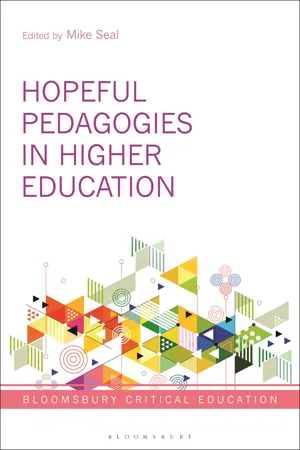
Hopeful Pedagogies in Higher Education
About this book
Many accounts of critical pedagogy, particularly accounts of trying to enact it within higher education (HE), express a deep cynicism about whether it is possible to counter the ever creeping hegemony of neo-liberalism, neo- conservatism and new managerialism within Universities. Hopeful Pedagogies in Higher Education acknowledges some of these criticisms, but attempts to rescue critical pedagogy, locating some of its associated pessimism as misreading of Freire and offering hopeful avenues for new theory and practice. These misreadings are also located in the present, in the assumption that unless change comes within the lifetime of the project, it has somehow failed. Instead, this book argues that a positive utopianism is possible. Present actions need to be celebrated, and cultivated as symbols of hope, possibility and generativity for the future - which the concept of hope implies. The contributors make the case for celebrating the pedagogies of HE that operate in liminal spaces – situated in the spaces between the present and the future (between the world as it is and the world as it could be) and also in the cracks that are beginning to show in the dominant discourses.
Information
Part I
Key Ideas and the Conceptual and Policy Terrain
Chapter One
Key Concepts in Critical Pedagogy
How We Teach
Mike Seal, Response from Alan Smith
Introduction
Many students in higher education will have gone through at least twelve years of indoctrination into what education is and, even if their experiences have often been negative, it is nonetheless the model they have internalized and expect when they go into a classroom. To counter this, the first thing I give to students on the courses I teach is a document called ‘How we teach’, which tries to pull apart and reconstruct any expectations of education. I will refer to it several times in this chapter as it tries to put the idea of critical pedagogy in ‘lay’ terms. The opening lines of the document are as follows:
You might have thought university would consist of a teacher, who ‘knows’ the ‘subject’, at the front of a classroom giving a ‘lecture’ i.e. giving you information which you are to write down. At some point you will be required to regurgitate this information back in the form or an essay or exam to show that you understood. You then promptly forget this information to make room for the next bit of knowledge you are meant to ‘learn’. For us this is not education, this is temporary rote learning of uncontested information. In this day and age, you can quickly access what we could give you in terms of information via the internet in seconds – so what is the point of that? For us education is something else, it is helping you become critical thinkers to discover, or uncover, knowledge and assess its worth.
This implies that we also need to challenge associated structures of education, such as exams, assignments and ‘learning outcomes’, and I think we should. Fundamental for educators is to give students, and people in general, the tools to undo, rethink and challenge their received wisdoms about what constitutes knowledge and education. This goes against a tradition of teacher-dominated education where the learner and teachers operate what Freire (1972) calls a ‘banking’ approach whereby the student receives a fixed curriculum that they accept unquestioningly. I think the undoing and reforming of educational expectations needs to be an active process. Ira Shor, a critical pedagogue, says we are trying to cultivate in learners:
Habits of thought, reading, writing, and speaking which go beneath surface meaning, first impressions, dominant myths, official pronouncements, traditional cliches, received wisdom, and mere opinions, to understand the deep meaning, root causes, social context, ideology, and personal consequences of any action, event, object, process, organization, experience, text, subject matter, policy, mass media, or discourse. (Shor, 2012, p. 129)
This is the starting point for the tradition of critical pedagogy. This chapter will explore the key concepts of critical pedagogy and assess whether the approach has potential resonance with educationalists looking for ‘another way’, who wish to make education vital and relevant again. It will look at critical pedagogy’s background and its views on the nature of knowledge and learning. It will examine some key principles of its educational approach and some of its characteristics and techniques.
Background on Critical Pedagogy
Critical pedagogy has existed as an approach to education for over forty years. The ideas behind critical pedagogy were first described by Paulo Freire (1972) and have since been developed by authors such as Henry Giroux, Ira Shor, Michael Apple, Joe L. Kincheloe, Shirley R. Steinberg and Peter Maclaren. It is a broad school that combines critical theory, a neo-Marxist approach and educational theory. It grew out a concern among educationalists with how education was being used as a method to reinscribe power relations in society.
Critical pedagogy seeks to illuminate the oppressed about their situation in which the state and the education system create a ‘common sense’ that reinscribes dominant elites’ social positions as ‘natural and inevitable’. It seeks to interrogate received wisdoms and ‘go beneath surface meaning, first impressions, dominant myths, official pronouncements, traditional clichés, received wisdom, and mere opinions’ (Shor, 2012, p. 125). As well as Marxism, critical pedagogy draws on other influences including humanism, existentialism and post-colonialism (Seal, 2014; Davies, 2012). Giroux (2020) describes it as an
educational movement, guided by passion and principle, to help students develop consciousness of freedom, recognize authoritarian tendencies, and connect knowledge to power and the ability to take constructive action. (Giroux, 2020, p. 1)
Knowledge and Education: What Are They and Who Creates Them?
What is Education?
In understanding critical pedagogy, it is important to outline and undo our preconceptions about what education is and what it is not, what knowledge is and is not and to de-neutralize education and acknowledge its inherently political nature. Critical pedagogy seeks to challenge traditional concepts of both knowledge and education. A common association with knowledge, and particularly theory, is that it is something created or discovered by ‘objective’, ‘neutral’ ‘experts’, often under scientific conditions. Knowledge and theory are therefore abstracted from most people’s everyday lived experience. Education is then traditionally seen as the process whereby this ‘knowledge’, often via a teacher who ‘knows’ it, is given to students who do not.
The process of students absorbing this knowledge is called ‘learning’. When a student applies this ‘learning’ to their experiences, it should make sense of them. However, if it does not apply, they have either not understood the knowledge properly, or applied it properly, or their experiences are ‘not representative’. Critical pedagogy challenges these views on knowledge and education on many levels
What is Knowledge?
Aristotle makes a claim for three types of knowledge. The first is ‘episteme’, which is scientific knowledge that largely does not change (although this idea is itself heavily contested). Second is ‘techne’, which is the technical knowledge and skills a person needs to put this science to use. His third type of knowledge is ‘phronesis’. ‘Phronesis’ says we need to ask why we are applying this knowledge – what our aim for doing this is and what moral values we are operating to when we do. The person is making a judgement about what knowledge we apply in particular situations. We should not try and find universal truths that apply to people, as the variables are so great and in flux.
Aristotle saw this as particularly important when taking about people and society rather than about objects. However, phronesis has fallen from favour as a concept, because it necessitates judgement, and also recognizes that social situations and phenomena are contextual and there are rarely fixed truths.
Everyone has a view on society and what is valuable, therefore this knowledge is not neutral and we should all be a part of creating it. Much of what is presented by ruling elites and educational systems as episteme, i.e. as facts that are objective, neutral and natural, are, in actuality, ‘phronesis’, knowledge that is a result of, and underpinned by, a particular moral view, a choice, and, as such, could be different. Much in society, including the idea of education itself, is not neutral, but stems from a particular ideology. Indeed, attempts to say education should be neutral, again re-enforces a view of society that favours existing power structures and hinders change.
Who Gets to Create Knowledge: Praxis
A part of not being neutral, and having values and morals behind the application of knowledge, is that knowledge, for critical pedagogues, needs to relate to the lived experiences of people, and where necessary, seek to change it for the better. One word for this is praxis and critical pedagogy has consistently described itself as a praxis (Batsleer, 2012; Smith, 1994; Ord, 2000). Praxis is often interpreted as the synthesis of theory and action. However, it is more complex, subtle and radical than this. Critical pedagogy has a dynamic, dialectical view of how knowledge is created (Aristotle, 1976). It sees knowledge as an evolving thing (Carr and Kemmis, 1989):
knowledge is not static, it is dynamic. It is created through dialogue. In a very real sense I cannot tell you what is right, for there is rarely a ‘right’. Common sense is rarely common, as in everyone agrees, or makes sense in that it is logical. Facts that were ‘known’ 100 years ago, are now discredited. Those in power might tell you that it is ‘common sense’ that things stay as they are. Knowledge is power and rarely neutral. (‘How we teach’)
Principles of Critical Pedagogy: Democracy, Consciousness-raising and Developing Critical Thinkers
Democracy and Equality in Learning Environments
Critical pedagogues also view knowledge as something we create through dialogue with each other. Cho (2010) describes knowledge as ‘democratic, context-dependent, and appreciative of the value of learners’ cultural heritage’ (Cho, 2010, p. 315). The creation of this evolving knowledge is an active democratic process that entails interrogation of the world by all parties. However, this means not simply acknowledging the diversity and multiculturalism in the room, accepting people’s views of their cultures as monolithic. Critical pedagogy may well entail challenging and changing cultural norms (Freire, 1972, p. 12), as being oppressed does not make us less subject to dominant hegemonies. However, learners have their own theories and ideas about the world, and this needs to be our starting place (Bolton, 2010). We try and capture the spirit of this in ‘How we teach’, declaring:
We try, in what we teach and how we teach, to create these dialogical spaces. We want to create a debate about a topic which will inspire you to go and find out more about it. We will try and make these spaces democratic – that you can challenge us, and each other, and even change what we are learning.
This can be difficult for some educators as it means, as Foley notes (2007), that they need to challenge the structure they operate within including their own teaching approaches and, fundamentally, the ‘power which is given to them through their titles’ (Foley, 2007). As we say in ‘How we teach’, we need to be explicitly humble and challenging of our own privilege. ‘Sometimes you will know more than we do, and we should acknowledge this and let you educate us.’
To be a critical educator can mean challenging the power the ‘teacher’ has in the educational spaces they inhabit. Years of experience of education in its narrow school form means that the ‘teacher’ gets a certain level of deference. They are assumed to be ‘in charge’, of both the educational experience and the classroom itself, and learners are passive receivers of information. As Joldersma (1999) notes, there is a certain familiar complacency in this for learners; they can sit back and receive, not taking responsibility for their learning, or the learning environment. Some learners passively resist, as they may have done at school, taking small chances to undermine the authority of the teacher. However, this can be in a non-constructive way that can in turn be infantilized by the teacher. Resistance can also happen when encountering new ideas, as well as ways of conveying them, As Kopelson notes:
Resistance is often, at the least, understandably protective: As anyone who can remember her or his own first uneasy encounters with particularly challenging new theories or theorists can attest, resistance serves to shield us from uncomfortable shifts or all-out upheavals in perception and understanding-shifts in perception which, if honored, force us to inhabit the world in fundamentally new and different ways. (Kopelson, 2003, p. 120)
For the learning to be real, this ‘play’ of accepted roles again needs to be challenged.
To be democratic means that we all have responsibility for these spaces. We have heard students say that it is the tutor’s ‘job’ to ‘control’ the class. Where is the democracy in that? – there are 30 of you and only one of us. Also, if we control the class though our perceived power, either of our personality or status, haven’t we all fallen into the same old traps again?
Teachers have to admit their vulnerabilities in an educational environment, that they are not all-knowing and their ‘power’ is an illusion which students can, and should, challenge. I have had colleagues who have found this difficult. However, at the same time, critical pedagogues challenge constructions of democracy in education as consumerism. In this view, students pay for a product that they consume, often embodied in comments about ‘what do I pay my fees for?’. Under this construction, education needs to be delivered in a way that they like and say things that they like – this is not critical pedagogy, which can be very challenging. As we say in ‘How we teach’:
while we are trying to provide stimulus, we are not entertainers. It is not our job to perfectly match your ‘learning style’ – how many learning styles are in one room? It is all too easy to fall back into being a consumer of knowledge, ‘give me what I want in the way I say I want it’. Remember we are creating knowledge together, and at times there will be clashes, conflict and worst of all apathy and boredom – it is the responsibility of all of us to work these things through.
Developing Critical Thinkers
The most importan...
Table of contents
- Cover
- Half-Title
- Series
- Title
- Contents
- List of Figures
- Notes on Contributors
- Series Editor’s Foreword
- Acknowledgements
- Introduction: Are Hopeful Pedagogies Possible in Higher Education?
- Part I Key Ideas and the Conceptual and Policy Terrain
- Part II Hopeful Pedagogies in Higher Education
- Part II B Hopeful Pedagogies within Structures
- Part II C Becoming the Hopeful Pedagogue
- Part II D Hopeful Pedagogies in the Spaces In-between
- Part II E Hopeful Pedagogies beyond the Institution
- References
- Index
- copyright
Trusted by 375,005 students
Access to over 1.5 million titles for a fair monthly price.
Study more efficiently using our study tools.
Frequently asked questions
Yes, you can cancel anytime from the Subscription tab in your account settings on the Perlego website. Your subscription will stay active until the end of your current billing period. Learn how to cancel your subscription
No, books cannot be downloaded as external files, such as PDFs, for use outside of Perlego. However, you can download books within the Perlego app for offline reading on mobile or tablet. Learn how to download books offline
Perlego offers two plans: Essential and Complete
- Essential is ideal for learners and professionals who enjoy exploring a wide range of subjects. Access the Essential Library with 800,000+ trusted titles and best-sellers across business, personal growth, and the humanities. Includes unlimited reading time and Standard Read Aloud voice.
- Complete: Perfect for advanced learners and researchers needing full, unrestricted access. Unlock 1.5M+ books across hundreds of subjects, including academic and specialized titles. The Complete Plan also includes advanced features like Premium Read Aloud and Research Assistant.
We are an online textbook subscription service, where you can get access to an entire online library for less than the price of a single book per month. With over 1.5 million books across 990+ topics, we’ve got you covered! Learn about our mission
Look out for the read-aloud symbol on your next book to see if you can listen to it. The read-aloud tool reads text aloud for you, highlighting the text as it is being read. You can pause it, speed it up and slow it down. Learn more about Read Aloud
Yes! You can use the Perlego app on both iOS and Android devices to read anytime, anywhere — even offline. Perfect for commutes or when you’re on the go.
Please note we cannot support devices running on iOS 13 and Android 7 or earlier. Learn more about using the app
Please note we cannot support devices running on iOS 13 and Android 7 or earlier. Learn more about using the app
Yes, you can access Hopeful Pedagogies in Higher Education by Mike Seal in PDF and/or ePUB format, as well as other popular books in Education & Education Theory & Practice. We have over 1.5 million books available in our catalogue for you to explore.